ResearchWednesday, February 25, 2026

AI Trade Finance Intelligence: Unlocking $2.5 Trillion in Working Capital for SME Exporters

The global trade finance gap has reached $2.5 trillion, with 45% of SME trade finance applications rejected. While banks require property collateral and 45-day processing times, AI agents can underwrite export invoices in hours by analyzing buyer creditworthiness, compliance risks, and optimal deal structures across a network of alternative lenders.

1.

Executive Summary

International trade finance represents a $9 trillion market that remains stubbornly offline, paper-heavy, and inaccessible to the businesses that need it most. The Asian Development Bank estimates a $2.5 trillion global trade finance gap—rejected applications from creditworthy SMEs who lack collateral, banking relationships, or patience for 45-day approval cycles.

This is a systems problem, not a credit problem. The data to approve these deals exists: buyer payment history, shipping records, trade compliance databases, and invoice authenticity signals. But it's scattered across silos, requiring manual aggregation that banks can't economically perform for a $50,000 export invoice.

AI changes the unit economics entirely. An intelligent trade finance platform can:

  • Extract and validate trade documents in minutes (not weeks)
  • Score buyer creditworthiness using alternative data
  • Run compliance checks (sanctions, AML, dual-use goods) automatically
  • Match deals to the optimal lender from a network of banks, NBFCs, and fintech funds
  • Structure terms that balance exporter needs with lender risk appetite
The opportunity: become the "Stripe for cross-border trade finance"—an AI-powered layer that connects SME exporters to working capital in 48 hours instead of 45 days.


2.

Problem Statement

Who Experiences This Pain?

Primary: SME exporters ($500K - $50M annual revenue) in manufacturing, textiles, agriculture, and commodities. They have confirmed orders from international buyers but lack the working capital to fulfill them. Secondary: Alternative lenders (NBFCs, fintech funds, export credit agencies) who want trade finance exposure but can't source and underwrite deals economically.

The Pain Points

StakeholderProblemCurrent Workaround
SME ExporterBank requires property collateral for a $100K LCDecline orders or borrow from informal lenders at 24-36% APR
SME Exporter45-day approval cycle for invoice financingMiss shipping deadlines, damage buyer relationships
SME ExporterNo visibility into why applications are rejectedKeep trying the same banks, wasting months
Alternative LenderCan't find deal flow from creditworthy SMEsRely on expensive sales teams or broker networks
Alternative LenderManual underwriting costs $500-2000 per dealOnly viable for deals >$500K, leaving SME segment unserved

ZEROTH PRINCIPLES Analysis

The fundamental axiom everyone accepts: "Trade finance requires collateral because exporters are risky."

What if this axiom is wrong?

The risk isn't the exporter—it's the information asymmetry. Banks can't efficiently verify:

  • Is this invoice real? (Document fraud)
  • Will the buyer pay? (Buyer credit risk)
  • Is this trade legal? (Compliance risk)
  • Is the goods description accurate? (Operational risk)
With AI, these verification costs collapse. The exporter isn't riskier than a collateralized borrower—they're just more expensive to underwrite with traditional methods.


3.

Current Solutions

CompanyWhat They DoWhy They're Not Solving It
Drip CapitalInvoice factoring for Indian exportersSingle-lender model limits capacity; still requires 5-7 day approvals
CredlixSupply chain finance in IndiaFocused on anchor-led programs; SMEs without big buyers excluded
Contour NetworkBlockchain LC digitizationBank consortium model; doesn't help SMEs get approved faster
KomgoTrade finance digitization for commoditiesEnterprise focus; minimum deal size $5M+
Flexport CapitalFreight financingOnly serves Flexport logistics customers
MarcoCross-border payments + creditLatin America focus; limited trade finance products

INCENTIVE MAPPING: Why Incumbents Won't Solve This

Banks profit from complexity:
  • Documentary credits (LCs) generate $8-15B in annual fee revenue globally
  • Manual processes justify relationship manager headcount
  • Collateral requirements create cross-sell opportunities (deposit accounts, insurance)
Trade finance fintechs are stuck in local maxima:
  • Single-lender models can't scale beyond balance sheet
  • Anchor programs require enterprise sales cycles
  • Blockchain solutions add complexity without solving underwriting
The systemic incentive keeps the status quo: banks profit from friction, and fintechs haven't built the AI infrastructure to remove it.
4.

Market Opportunity

Market Size

MetricValueSource
Global trade finance market$9 trillionICC Banking Commission
Trade finance gap (rejected applications)$2.5 trillionADB Trade Finance Survey 2024
SME share of trade finance gap68%IFC MSME Finance Gap Report
India export credit outstanding$45 billionRBI, FY2025
India trade finance gap (SME)$120 billionWorld Bank estimates

Growth Drivers

Why Now?
  • AI document processing hit production quality (2024-2025): GPT-4V, Claude, and Gemini can reliably extract structured data from trade documents (invoices, packing lists, bills of lading) with >95% accuracy.
  • Alternative data sources matured: GST data (India), business credit bureaus, shipping container tracking, and bank statement analyzers provide creditworthiness signals without traditional collateral.
  • Regulatory tailwinds: RBI's Trade Receivables Discounting System (TReDS), India's ONDC for B2B trade, and MLETR (Model Law on Electronic Transferable Records) create regulatory pathways for digital trade finance.
  • Lender diversification: NBFCs, fintech debt funds, and export credit agencies are actively seeking trade finance exposure but lack origination channels.

  • 5.

    Gaps in the Market

    ANOMALY HUNTING: What's Strange About This Market?

    Anomaly 1: The $2.5T gap exists despite "solved" technologies

    Invoice factoring, supply chain finance, and export credit have existed for decades. Why hasn't technology closed the gap?

    Insight: The problem isn't financing products—it's distribution and underwriting. SMEs can't find lenders, and lenders can't underwrite SMEs economically. Anomaly 2: Alternative lenders are capital-rich but deal-poor

    Debt funds and NBFCs have raised billions for trade finance but struggle to deploy it. Meanwhile, SMEs are desperate for capital.

    Insight: The missing piece is an intelligent matching layer—AI that can source deals, pre-underwrite them, and route to the optimal lender. Anomaly 3: Document fraud rates are ~5% but rejection rates are ~45%

    Banks reject far more applications than the actual fraud rate justifies.

    Insight: Banks use rejection as a risk management shortcut because investigation is expensive. AI makes investigation cheap, enabling approval of the 40% who are creditworthy but fail current filters.

    The Five Gaps

  • Document Intelligence Gap: No platform extracts, validates, and structures trade documents end-to-end with AI
  • Buyer Credit Gap: SMEs have no way to assess international buyer creditworthiness before extending terms
  • Lender Matching Gap: No marketplace efficiently connects SME deals to optimal lenders
  • Compliance Automation Gap: Sanctions, AML, and dual-use goods checks are manual and duplicated
  • Pricing Transparency Gap: SMEs don't know what rates they should expect, enabling lender exploitation

  • 6.

    AI Disruption Angle

    How AI Agents Transform the Workflow

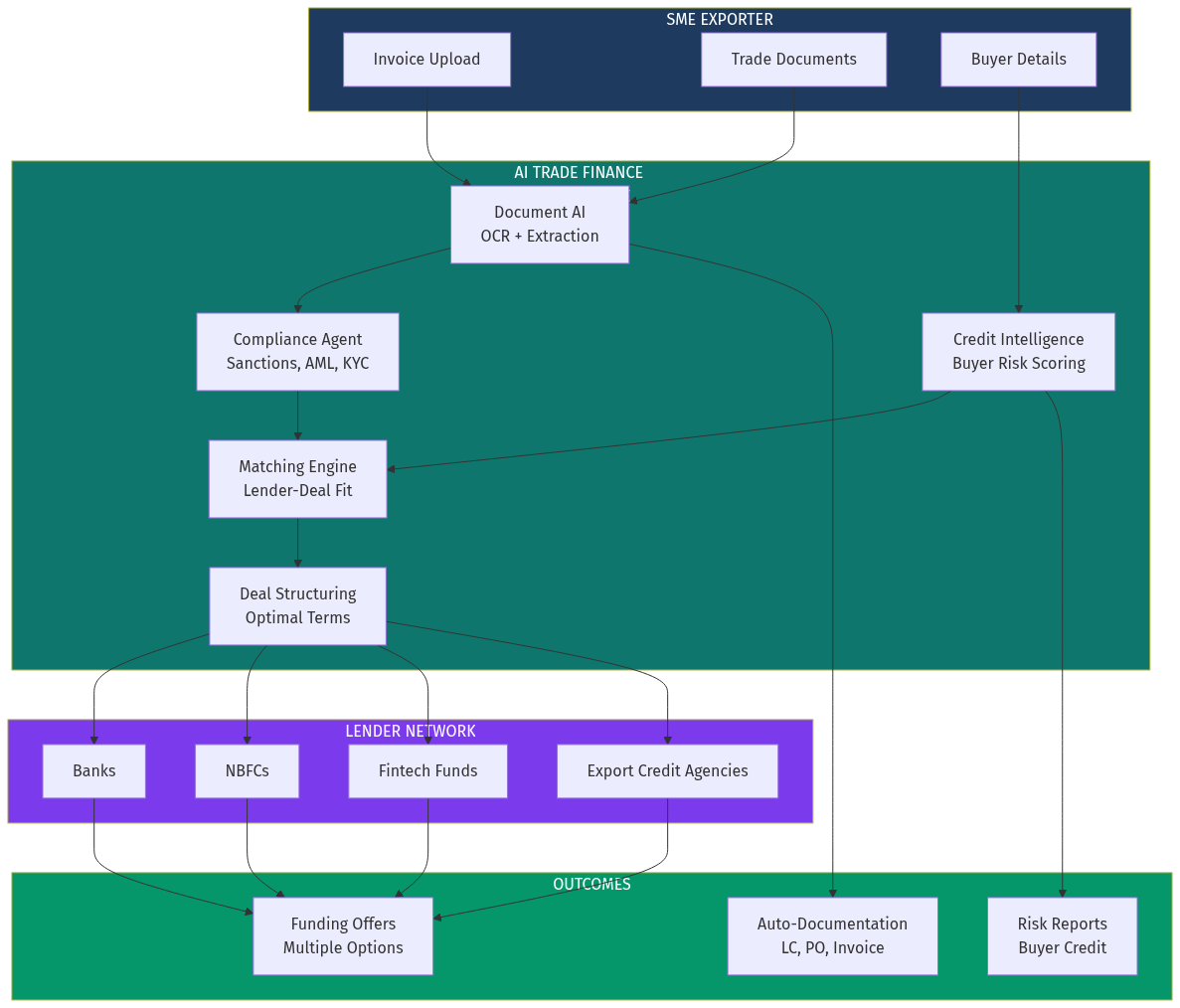
    Architecture Diagram
    Architecture Diagram
    Agent 1: Document AI
    • Ingests invoices, purchase orders, bills of lading, packing lists
    • Extracts structured data (amounts, dates, parties, goods descriptions)
    • Cross-validates documents for consistency
    • Flags anomalies suggesting fraud (duplicate invoices, altered amounts)
    Agent 2: Buyer Credit Intelligence
    • Aggregates buyer data: payment history, credit bureau, news sentiment
    • Scores creditworthiness on 1-100 scale
    • Predicts probability of payment delay
    • Recommends credit limits by buyer
    Agent 3: Compliance Automation
    • Checks parties against OFAC, EU, UN sanctions lists
    • Screens goods descriptions for dual-use/export control items
    • Validates beneficial ownership structures
    • Generates compliance certificates for lenders
    Agent 4: Lender Matching Engine
    • Maintains profiles of 200+ lenders (banks, NBFCs, funds)
    • Matches deal characteristics to lender appetites
    • Predicts approval probability by lender
    • Routes applications to maximize approval odds
    Agent 5: Deal Structuring
    • Calculates optimal advance rates, tenors, pricing
    • Generates term sheets for exporter review
    • Handles negotiation within approved parameters
    • Automates documentation (facility agreements, UCC filings)

    DISTANT DOMAIN IMPORT: What Field Solved This?

    Insurance underwriting faced a similar transformation. Manual underwriting of property, auto, and life insurance was slow and expensive. AI now enables:
    • Instant quotes from document uploads (Lemonade, Hippo)
    • Automated risk scoring from alternative data (telematics, satellite imagery)
    • Dynamic pricing based on real-time risk signals
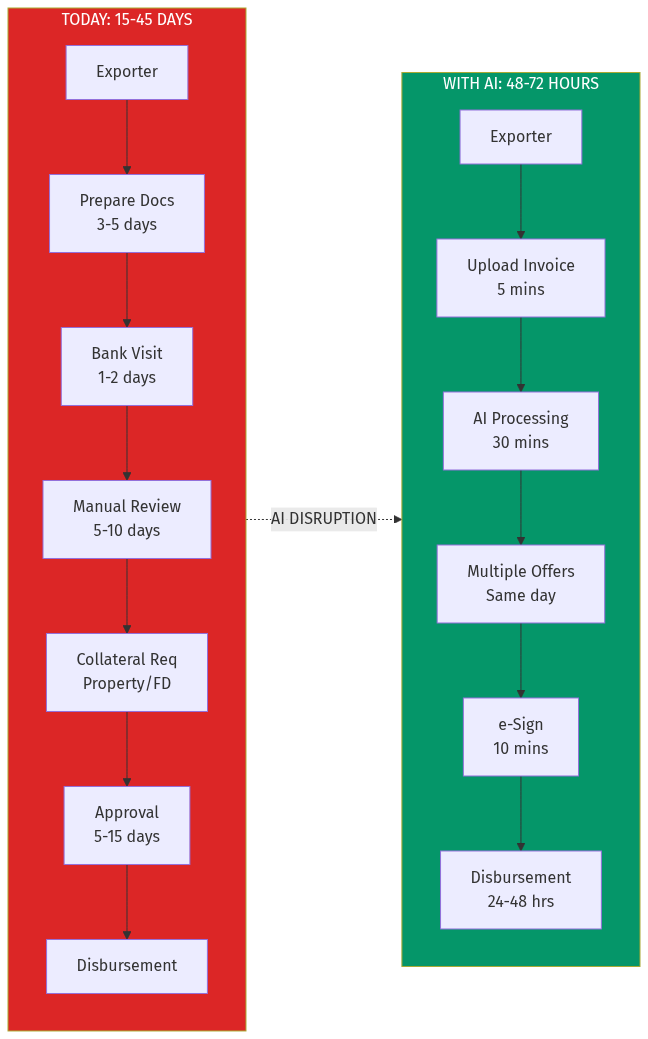
    Trade finance underwriting can follow the same pattern: from 45-day manual review to 48-hour AI decisioning.
    7.

    Product Concept

    Core Platform: TradeFinance.ai

    Workflow Comparison
    Workflow Comparison
    For SME Exporters:
  • Upload & Verify (5 minutes)
  • - Upload invoice, PO, shipping documents via WhatsApp or web - AI extracts and validates within 30 minutes - Instant feedback on missing/inconsistent information
  • Get Buyer Intelligence (Instant)
  • - See buyer credit score, payment history, recommended credit limit - Receive alerts on buyer payment delays or credit deterioration - Access buyer intelligence even before extending credit terms
  • Receive Funding Offers (Same day)
  • - Multiple offers from pre-qualified lenders - Clear comparison: advance rate, fees, tenor, collateral requirements - One-click acceptance and e-signature
  • Track & Manage (Ongoing)
  • - Real-time dashboard of all financed invoices - Automated collections follow-up - Buyer payment prediction and early warning For Lenders:
  • Deal Flow Dashboard
  • - Pre-underwritten deals matched to appetite - Full document packages with AI verification - One-click approval/rejection with feedback
  • Portfolio Intelligence
  • - Concentration monitoring (buyer, geography, sector) - Early warning on portfolio risks - Automated compliance reporting
  • API Integration
  • - Connect existing loan management systems - White-label for banks to offer to their SME customers
    8.

    Development Plan

    PhaseTimelineDeliverables
    MVP12 weeksDocument AI (invoice, PO extraction), buyer credit scoring, manual lender matching, WhatsApp interface
    V1+8 weeksCompliance automation, automated lender matching (10 lenders), web dashboard
    V2+8 weeksMulti-currency support, LC digitization, lender API integrations (50 lenders)
    V3+12 weeksBuyer intelligence product (standalone), embedded finance APIs, international expansion

    Technical Architecture

    ┌─────────────────────────────────────────────────────────────┐
    │                      PRESENTATION LAYER                      │
    │  WhatsApp Bot │ Web Dashboard │ Mobile App │ Lender Portal  │
    └─────────────────────────────────────────────────────────────┘
                                  │
    ┌─────────────────────────────────────────────────────────────┐
    │                        AI AGENT LAYER                        │
    │  Document AI │ Credit Agent │ Compliance │ Matching │ Deals │
    └─────────────────────────────────────────────────────────────┘
                                  │
    ┌─────────────────────────────────────────────────────────────┐
    │                       DATA LAYER                             │
    │  Trade Docs │ Buyer Database │ Lender Profiles │ Compliance │
    └─────────────────────────────────────────────────────────────┘
                                  │
    ┌─────────────────────────────────────────────────────────────┐
    │                    INTEGRATION LAYER                         │
    │  GST │ Bank Statements │ Shipping │ Credit Bureaus │ OFAC   │
    └─────────────────────────────────────────────────────────────┘

    9.

    Go-To-Market Strategy

    Phase 1: India SME Exporters (Months 1-12)

    Target Segment: Manufacturing exporters in textiles, auto components, and engineering goods with $1-20M annual exports. Channel Strategy:
  • Export Promotion Councils (FIEO, EEPC, Apparel Export Promotion Council)
  • - Partner for member outreach - Offer free buyer credit reports as lead magnet
  • GST Data Partnership
  • - Integrate with GST filing platforms - Identify active exporters from filings - Pre-qualify based on export history
  • Freight Forwarder Network
  • - Partner with top 50 freight forwarders - Embed financing offer in shipping workflow - Revenue share on financed shipments
  • WhatsApp-First Acquisition
  • - Viral referral mechanics - "Check your buyer's credit" free tool - Zero-friction onboarding

    Phase 2: Lender Network Build (Parallel)

  • NBFC Partnerships (Month 1-3)
  • - Onboard 5-10 NBFCs focused on trade finance - API integration for automated decisioning - Volume commitments with take-or-pay
  • Bank Pilots (Month 6-12)
  • - Position as "deal sourcing as a service" - White-label for bank's SME portal - Risk-sharing models to prove credit quality
  • Export Credit Agencies (Month 9-18)
  • - ECGC (India), Euler Hermes, Coface - Provide portfolio-level data for policy pricing - Enable seamless insurance integration

    Phase 3: Geographic Expansion (Year 2+)

    • Southeast Asia: Vietnam, Bangladesh, Indonesia (manufacturing exporters)
    • Latin America: Mexico, Colombia, Brazil (agricultural exporters)
    • Africa: Kenya, Nigeria, South Africa (commodity exporters)

    10.

    Revenue Model

    Revenue StreamDescriptionUnit Economics
    Transaction Fee% of financed amount (paid by lender)0.5-1.5% of disbursement
    Subscription (Exporter)Buyer credit intelligence, portfolio tools$50-500/month based on volume
    Subscription (Lender)Deal flow access, underwriting tools$2,000-20,000/month based on AUM
    Data LicensingBuyer credit database, trade intelligenceEnterprise contracts
    Embedded InsuranceCredit insurance commission10-15% of premium

    Revenue Projections

    YearFinanced VolumePlatform RevenueNet Revenue Margin
    Y1$50M$750K-50% (investment phase)
    Y2$300M$4.5M10%
    Y3$1B$15M30%
    Y4$3B$45M40%
    ---
    11.

    Data Moat Potential

    Proprietary Data Assets

  • Buyer Payment Database
  • - Every funded invoice = data point on buyer payment behavior - Network effect: more transactions → better buyer credit scores → lower defaults → more lender participation → more transactions
  • Document Anomaly Patterns
  • - AI learns fraud signatures from rejected applications - Cross-exporter pattern detection (same buyer, conflicting info) - This knowledge doesn't exist in any centralized form today
  • Lender Appetite Graph
  • - Real-time understanding of which lenders approve what deals - Enables routing optimization that improves over time - Lenders can't replicate without the multi-lender view
  • Trade Flow Intelligence
  • - Aggregated view of trade corridors, seasonality, pricing - Valuable to exporters, lenders, and trade bodies - Secondary monetization through data products

    SECOND-ORDER THINKING: If This Succeeds, What Happens Next?

    Positive second-order effects:
    • SME export capacity increases → job creation in manufacturing hubs
    • Faster working capital → shorter order-to-delivery cycles
    • Buyer credit transparency → healthier export relationships
    Potential challenges:
    • Banks may view as disintermediation threat and compete directly
    • Lender concentration risk if few lenders dominate the network
    • Regulatory scrutiny on "shadow banking" characterization
    Mitigation:
    • Position as enabler for banks, not competitor
    • Maintain lender diversity as core platform metric
    • Proactive regulatory engagement and compliance

    12.

    Why This Fits AIM Ecosystem

    Strategic Alignment

  • B2B Marketplace DNA: Trade finance is the ultimate B2B transaction layer—without financing, trade doesn't happen
  • AI-Native Opportunity: Document AI, credit scoring, and matching engines are core AI capabilities aligned with AIM's technology stack
  • India-First, Global-Second: India's $45B export credit market is underserved; success here proves model for global expansion
  • Network Effects Match AIM Philosophy: More exporters → better buyer data → more lender participation → more exporters
  • Potential AIM Integrations

    • niyukti.in (Recruitment): Finance staffing costs for export-oriented manufacturers
    • instabox.in (Logistics): Embedded financing for freight costs
    • thefoundry.in (Industrial): Working capital for machinery procurement against export orders
    • masale.in (Ingredients): Commodity trade finance for spice exporters

    Domain Opportunity: tradefinance.in

    A premium, exact-match domain that signals authority in the space. Current holder should be approached for acquisition.


    ## Pre-Mortem: Why This Might Fail

    FALSIFICATION EXERCISE

    Assume five well-funded startups tried this and failed. Why?

  • Credit losses exceeded projections
  • - Risk: AI models overfit to training data, fail on new buyer populations - Mitigation: Conservative advance rates (70-80%), mandatory credit insurance for new buyers, continuous model retraining
  • Lender concentration killed economics
  • - Risk: One or two lenders dominate, extract all margin - Mitigation: Enforce lender diversity quotas, vertical integration option (warehouse facility)
  • Regulatory shutdown
  • - Risk: RBI classifies as unregulated lender, requires NBFC license - Mitigation: Pure marketplace model, no balance sheet lending, clear regulatory legal opinions
  • Document fraud evolved faster than AI
  • - Risk: Fraudsters adapt techniques to bypass detection - Mitigation: Human review for high-value/high-risk, consortium approach to fraud intelligence sharing
  • Banks copied and won
  • - Risk: HDFC/ICICI launch similar product with distribution advantage - Mitigation: Multi-bank positioning, speed-to-market, proprietary data moats banks can't replicate

    STEELMANNING: Best Argument Against This Opportunity

    "Trade finance exists in equilibrium. Banks profit from complexity, SMEs accept it because they have no alternative, and regulators don't prioritize reform. Any disruptor faces three incumbents simultaneously: banks who control lender relationships, large corporates who prefer anchor programs, and regulators who instinctively protect banking intermediation. The $2.5T gap isn't a market failure—it's a feature that maintains banking profitability." Counter-argument: This equilibrium held because alternatives didn't exist. AI changes the cost structure so dramatically that a new equilibrium becomes possible—one where alternative lenders (NBFCs, funds, ECAs) can serve the SME segment profitably through an intelligent intermediary.

    ## Verdict

    Opportunity Score: 8.5/10
    CriterionScoreNotes
    Market Size9/10$2.5T gap, $9T overall market
    Pain Intensity9/10Working capital is existential for exporters
    AI Leverage9/10Document AI, credit scoring, matching engines
    Competitive Moat7/10Data moat strong but requires scale to build
    Execution Risk6/10Regulatory, credit risk, lender concentration
    AIM Fit9/10Perfect alignment with B2B marketplace thesis

    Final Assessment

    This is a high-conviction opportunity for the following reasons:

  • The problem is acute and quantified: $2.5 trillion gap is not theoretical—it's rejected applications from real SMEs
  • AI fundamentally changes unit economics: What costs $500-2000 to underwrite manually can be done for $5-20 with AI
  • The timing is right: Document AI, alternative data, and regulatory frameworks have all matured simultaneously
  • Network effects create defensibility: Buyer payment data and lender matching intelligence compound over time
  • Recommended next step: Validate with 10 SME exporter interviews and 3 NBFC conversations to confirm willingness to transact on the platform.

    ## Sources