ResearchWednesday, February 25, 2026

AI Technology Expense Intelligence: The $47B Opportunity to Unify Telecom, SaaS & Cloud Cost Management

Every enterprise is bleeding money through fragmented technology expense management. The average company overspends 30% on telecom, underestimates SaaS applications by 3x, and has zero visibility across vendors. AI can finally unify this chaos into a single intelligence layer—and the first platform to do it owns a category.

1.

Executive Summary

Technology expense management is a $47 billion problem hiding in plain sight. Enterprises manage telecom, SaaS subscriptions, and cloud costs through 3-4 separate platforms that don't talk to each other. Finance teams manually reconcile thousands of invoices. IT has no visibility into shadow SaaS. Procurement can't negotiate effectively without usage data.

The opportunity: Build an AI-native platform that ingests ALL technology expenses (telecom, SaaS, cloud, hardware), automatically parses contracts, detects anomalies, and generates actionable optimization recommendations. Unlike legacy TEM (Telecom Expense Management) platforms built for the 2010s, this would be the first truly unified technology expense intelligence platform.

Why now: The convergence of three trends—LLMs capable of parsing complex contracts, API-first SaaS vendors exposing usage data, and CFO pressure on software ROI—creates a window for a new category leader.
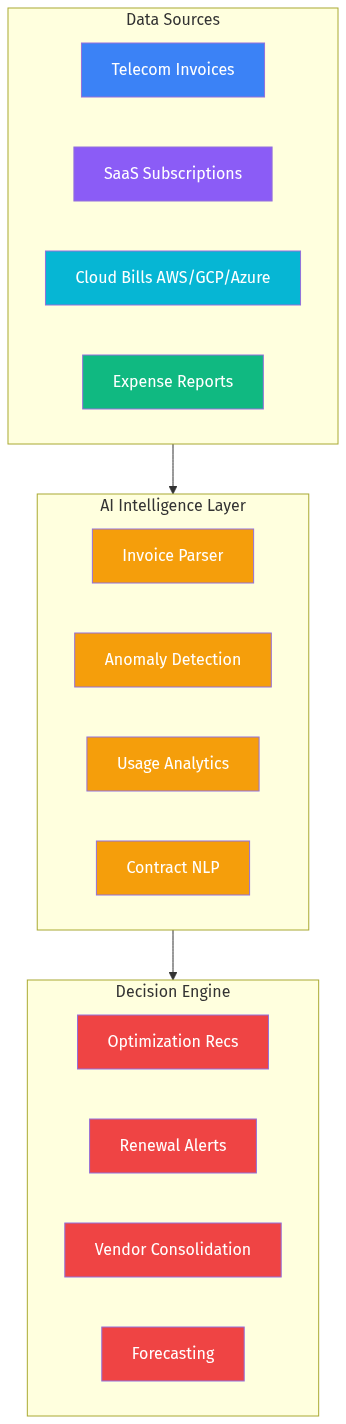
Platform Architecture

2.

Problem Statement

Who experiences this pain?

CFOs and Finance Teams:
  • Reconcile 500+ vendor invoices monthly with no automated matching
  • Can't forecast technology spend accurately (30-40% variance is common)
  • No visibility into which departments are overspending
IT and Procurement:
  • Average enterprise has 600+ SaaS applications; IT only knows about 200
  • Shadow IT purchases bypass approval workflows
  • Renewal dates surprise procurement—no leverage for negotiation
Operations:
  • Telecom bills are 50-200 pages of incomprehensible line items
  • Cloud bills from AWS/GCP/Azure require specialized tools to understand
  • No single source of truth across all technology vendors

The Pain by Numbers

MetricReality
Average SaaS apps per enterprise600+
IT's visibility~35% of actual apps
Overspend on telecom15-30%
Wasted SaaS licenses25-35%
Time to process one telecom invoice4-8 hours
Renewal dates tracked in spreadsheets70% of companies
Zeroth Principles Question: Why do we accept that technology expenses require 4 separate management systems (TEM, SaaS management, FinOps, AP automation) when it's all just vendor spend data?

The axiom we've accepted: "Telecom is different from SaaS is different from cloud." But from a data structure perspective, they're all: vendor + service + contract + invoice + usage. The separation exists because vendors built point solutions, not because the problem actually requires it.


3.

Current Solutions

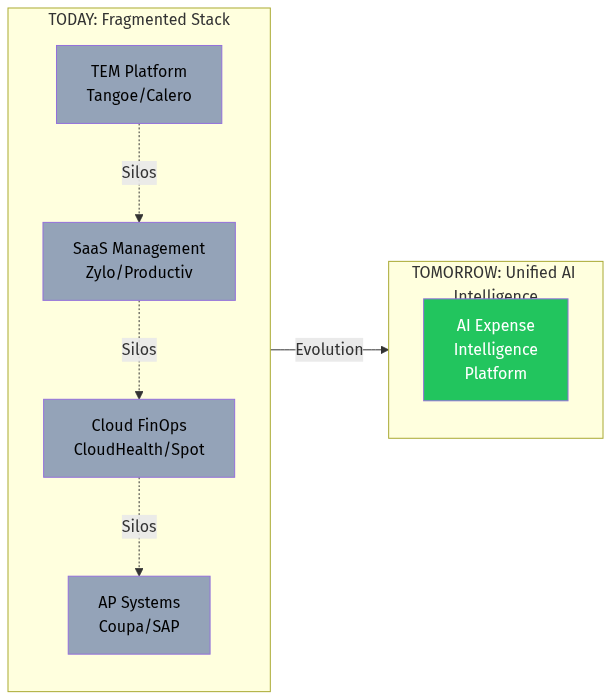
The market is fragmented across four categories that don't integrate:

CompanyWhat They DoWhy They're Not Solving It
TangoeTelecom Expense ManagementLegacy platform, weak on SaaS, no AI-native features
ZyloSaaS Management PlatformOnly handles SaaS, requires financial system integration
ProductivSaaS IntelligenceStrong analytics, but narrow scope—no telecom/cloud
CloudHealth (VMware)Cloud Cost ManagementAWS/GCP/Azure only—misses telecom entirely
CaleroUnified TEM + SaaSClosest competitor, but still legacy architecture
FlexeraIT Asset ManagementBroad but shallow—not expense-focused

Incentive Mapping: Why Incumbents Won't Solve This

Who profits from the status quo?
  • Consulting firms make $200-500/hour on telecom audits and contract negotiations. A self-service AI tool threatens this revenue.
  • Legacy TEM vendors charge per-invoice processing fees. Faster automation means less revenue per customer.
  • Point solution vendors (Zylo, CloudHealth) prefer customers buying their specialized tool + others rather than one unified platform.
  • Telecom carriers benefit from confusing bills—complexity hides overcharges.
  • Feedback loops maintaining current behavior:
    • Enterprise procurement cycles favor "best of breed" over unified platforms
    • TEM contracts are 3-5 years—slow churn
    • IT vs. Finance vs. Procurement silos each have their own budgets and tools

    4.

    Market Opportunity

    Market Size

    SegmentTAMGrowth
    Telecom Expense Management$5.2B12% CAGR
    SaaS Management Platforms$3.8B28% CAGR
    Cloud Cost Management$7.1B24% CAGR
    Accounts Payable Automation$3.2B15% CAGR
    Combined Technology Expense Intelligence$19.3B18% CAGR
    Add adjacent markets (contract lifecycle management, vendor risk management) and the TAM expands to $47B by 2028.

    Why Now?

  • LLM Contract Parsing: GPT-4/Claude can now read complex telecom contracts and extract key terms, pricing, and obligations with 95%+ accuracy. This was impossible 3 years ago.
  • API-First SaaS: Modern SaaS vendors expose usage APIs. Connecting to 100+ vendors is now tractable.
  • CFO Pressure: Post-2023, every CFO is scrutinizing software spend. "Prove ROI" is the mandate.
  • Cloud Complexity: Multi-cloud is now standard. No single human can optimize AWS + GCP + Azure spend.
  • Remote Work: Decentralized purchasing means more shadow IT than ever. Visibility is critical.

  • 5.

    Gaps in the Market

    Anomaly Hunting: What's Strange Here?

  • No unified data model: Every platform has its own taxonomy. There's no standard for "technology expense" that spans telecom, SaaS, and cloud.
  • Manual contract extraction: Even "AI-powered" platforms require humans to upload and tag contracts. True automation doesn't exist.
  • Reactive, not predictive: Platforms show what you spent. None predict what you'll spend or recommend proactive optimizations.
  • No vendor benchmarking: Companies have no idea if they're paying more than peers for the same SaaS/telecom services.
  • Disconnected from procurement: Cost intelligence doesn't feed into RFP processes or negotiations.
  • Missing: Usage-to-value correlation: Platforms track usage (licenses, minutes, GB) but not business outcomes. A license used daily isn't necessarily valuable.
  • Market Evolution
    Market Evolution

    6.

    AI Disruption Angle

    How AI Transforms This Workflow

    Today's Process (Manual):
  • Download 50-200 page telecom invoice PDF
  • Finance manually enters line items into spreadsheet
  • Compare against contract (good luck finding it)
  • Flag anomalies for IT review
  • IT investigates, creates ticket for carrier
  • Wait 30-90 days for dispute resolution
  • Repeat monthly for 500+ vendors
  • Tomorrow's Process (AI-Native):
  • Invoice arrives via email/API
  • AI parses all line items, matches to contract database
  • Anomalies auto-flagged with root cause analysis
  • Optimization recommendations generated
  • One-click dispute generation with carrier
  • Predictive alerts before overages occur
  • Automatic renegotiation triggers at renewal
  • Distant Domain Import: What Field Solved This?

    Financial trading: Bloomberg Terminal aggregates data from hundreds of exchanges into a unified interface. Technology expense intelligence should be the "Bloomberg for vendor spend." Healthcare claims processing: AI systems parse complex medical bills, match to coverage, and auto-adjudicate. Same pattern applies to technology invoices. Supply chain visibility: Platforms like Flexport unified fragmented logistics data. Technology expenses need the same consolidation.
    7.

    Product Concept

    Core Platform: TechExpense.ai

    Data Ingestion Layer:
    • Email forwarding for invoice capture (any format)
    • API connectors to 200+ SaaS vendors (Salesforce, Slack, Zoom, etc.)
    • Direct integration with AWS/GCP/Azure cost APIs
    • Bank/AP feed for credit card SaaS purchases
    • Contract upload with AI extraction
    Intelligence Layer:
    • LLM-powered invoice parsing (any format, any language)
    • Contract term extraction and obligation tracking
    • Usage anomaly detection (statistical + ML)
    • Vendor benchmarking against anonymized peer data
    • Predictive spend forecasting
    Action Layer:
    • Optimization recommendations with $ impact
    • Auto-generated dispute letters
    • Renewal calendar with negotiation playbooks
    • Vendor consolidation recommendations
    • Budget alerts and approval workflows

    Key Features

    FeatureDescriptionAI Role
    Universal Invoice ParserReads any PDF/email invoiceGPT-4 vision + fine-tuned extraction
    Contract IntelligenceExtracts terms, alerts on obligationsLLM + document understanding
    Anomaly DetectionFlags unusual charges in real-timeStatistical models + usage patterns
    Benchmark PricingShows how your rates compareAnonymized peer network
    Renewal CopilotGenerates negotiation strategiesContract analysis + market rates
    Shadow IT DiscoveryFinds unknown SaaS via bank feedsTransaction classification
    ---
    8.

    Development Plan

    PhaseTimelineDeliverables
    MVP12 weeksInvoice parsing, SaaS discovery via bank feeds, basic anomaly detection
    V1+8 weeksContract management, 50 SaaS integrations, renewal calendar
    V2+12 weeksCloud cost integration, benchmarking, predictive forecasting
    V3+12 weeksAI negotiation copilot, vendor consolidation engine

    Technical Architecture

    ┌─────────────────────────────────────────────────────┐
    │                   Data Ingestion                     │
    │  [Email Parser] [API Connectors] [Bank Feeds]       │
    └─────────────────────────────────────────────────────┘
                             │
                             ▼
    ┌─────────────────────────────────────────────────────┐
    │               Unified Data Lake                      │
    │  [Normalized vendor/contract/invoice/usage schema]  │
    └─────────────────────────────────────────────────────┘
                             │
                             ▼
    ┌─────────────────────────────────────────────────────┐
    │                 AI Intelligence                      │
    │  [LLM Parsing] [Anomaly ML] [Benchmark Engine]      │
    └─────────────────────────────────────────────────────┘
                             │
                             ▼
    ┌─────────────────────────────────────────────────────┐
    │                  Action Engine                       │
    │  [Recommendations] [Alerts] [Automations]           │
    └─────────────────────────────────────────────────────┘

    9.

    Go-To-Market Strategy

    Phase 1: Land with SaaS Discovery (Free Tool)

    Strategy: Give away shadow IT discovery for free. Connect bank feed, show all SaaS purchases. Instant value, zero effort. Why it works: CFOs are obsessed with SaaS visibility. Free tool builds trust, captures data, enables upsell.

    Phase 2: Expand to Telecom Audit

    Target: Mid-market companies (500-5000 employees) with $2-10M annual telecom spend. Hook: "We'll audit your telecom bills for free. Keep 50% of what we find." Conversion: Audit customers convert to subscription for ongoing management.

    Phase 3: Enterprise Platform Sale

    Target: F500 with $50M+ technology spend. Motion: Replace fragmented TEM/SaaS/Cloud tools with unified platform. Pricing: 0.5-1% of managed spend (industry standard).

    Distribution Channels

  • Content/SEO: "How much are you overspending on [vendor]?" calculators
  • Partnerships: Integrate with AP systems (Bill.com, Coupa) as expense intelligence layer
  • Channel: IT consultants who do technology audits
  • PLG: Free SaaS discovery tool → paid platform

  • 10.

    Revenue Model

    Revenue StreamModelEstimated Annual Value
    Platform subscription% of managed spend0.5-1% ($50K-500K/customer)
    Audit servicesSuccess fee50% of savings found
    Negotiation assistanceFlat fee per negotiation$5K-25K
    Benchmark dataPremium tier$10K-50K/year
    API accessUsage-based$0.10 per invoice parsed
    Unit Economics:
    • Average contract value: $120K ARR
    • Gross margin: 75-80%
    • Payback period: 12-18 months
    • NDR: 120%+ (expand as more spend managed)

    11.

    Data Moat Potential

    What Proprietary Data Accumulates?

  • Vendor Pricing Database: Every contract processed adds to benchmark pricing intelligence. After 1000 customers, you know what every company pays for Salesforce/AWS/AT&T.
  • Invoice Patterns: Anomaly detection improves with every invoice processed. Rare error types become detectable.
  • Negotiation Outcomes: Which tactics work with which vendors? Data from thousands of negotiations creates playbooks.
  • Usage Patterns: What does healthy vs. unhealthy SaaS utilization look like? Benchmarks inform optimization.
  • Vendor Risk Signals: Aggregate data reveals which vendors are raising prices, degrading service, or going bankrupt.
  • Network Effects

    • More customers → better benchmarks → more value → more customers
    • More invoices → better parsing models → higher accuracy → more trust
    • More negotiations → better playbooks → better outcomes → more customers

    12.

    Why This Fits AIM Ecosystem

    AIM.in Mission: Help businesses DECIDE, not just DISCOVER.

    Technology expense intelligence is pure decision support:

    • "Should I renew this contract?" → AI recommendation with data
    • "Which vendor should I consolidate to?" → Benchmarked analysis
    • "Am I overpaying?" → Peer comparison
    Integration Points:

    AIM VerticalConnection
    thefoundry.inIndustrial companies need telecom/cloud management
    forx.inSoftware discovery feeds into expense intelligence
    niyukti.inHR tech spend is major SaaS category
    Domain Opportunity: TechExpense.in, SpendIQ.in, VendorIQ.in

    ## Risk Analysis: Pre-Mortem

    Falsification: Why Would This Fail?

    Assume 5 well-funded startups failed here. Why?
  • Integration hell: Connecting to 500+ vendors is harder than it looks. APIs break, formats change, vendors resist.
  • Enterprise sales cycles: 12-18 month sales cycles kill startups before they achieve scale.
  • Data quality: Garbage in, garbage out. If invoice parsing isn't 99%+ accurate, trust erodes.
  • Incumbent response: Tangoe/Calero have existing relationships and could add AI features.
  • Budget fragmentation: IT owns TEM, Finance owns AP, Procurement owns contracts. No single buyer.
  • Steelmanning: Best Case AGAINST This Opportunity

    Why incumbents might win:
    • Tangoe has 15+ years of carrier relationships and invoice formats
    • Switching costs are high (3-5 year contracts, data migration pain)
    • CFOs prefer "safe" enterprise vendors over startups for financial data
    • Calero is already trying to unify TEM + SaaS—they have a head start
    • The "platform" approach might be too ambitious; point solutions win in enterprise
    Counter-argument: Incumbents are built on services revenue and manual processes. AI-native means 10x efficiency—they can't match economics without cannibalizing their business.

    ## Second-Order Effects

    If this succeeds, what happens next?
  • Vendor pricing transparency: Benchmark data forces vendors to compete on price. SaaS inflation slows.
  • Procurement automation: If AI handles expense intelligence, next step is AI-driven procurement and vendor selection.
  • Real-time budgeting: Technology spend becomes predictable. Finance can do rolling forecasts instead of annual budgets.
  • Vendor consolidation: Clear visibility accelerates the "fewer, deeper" vendor strategy trend.
  • New vendor risk category: Platforms like this become critical infrastructure—single points of failure for expense visibility.

  • ## Verdict

    Opportunity Score: 8.5/10
    CriterionScoreNotes
    Market Size9/10$47B TAM with strong growth
    Timing9/10AI capabilities + CFO pressure = perfect window
    Competition7/10Fragmented, but incumbents exist
    Moat Potential8/10Strong data network effects
    GTM Clarity8/10Free audit → paid platform is proven
    Execution Risk7/10Integration complexity is real
    AIM Fit9/10Core to B2B decision intelligence
    Recommendation: HIGH PRIORITY. This is a category-defining opportunity. The fragmentation is real, the pain is acute, and AI finally makes unified intelligence possible. First mover with strong execution owns this market for a decade. Suggested domains: TechExpense.in, SpendIQ.in, VendorIQ.in, ExpenseAI.in

    ## Sources