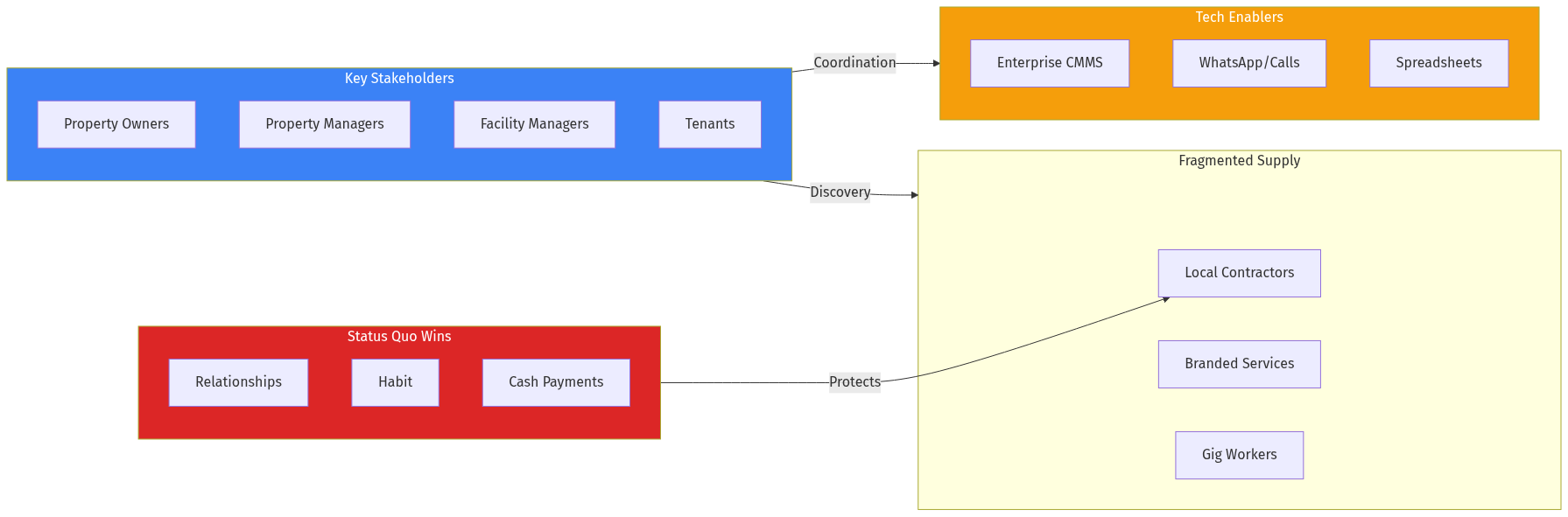
The global facility management market reached $1.37 trillion in 2025 and is projected to hit $2.75 trillion by 2034 at 8.5% CAGR. Yet the coordination layer between property owners and service vendors remains shockingly primitive—dominated by WhatsApp groups, phone tag, and Excel spreadsheets.
The core problem: A commercial property with 50,000 sq ft requires coordination across HVAC, plumbing, electrical, cleaning, security, landscaping, elevator maintenance, fire safety, and more. Each vendor operates independently. There's no unified view of maintenance history, no standardized pricing, and no performance benchmarking. The AI opportunity: An intelligent orchestration layer that acts as a "virtual facility manager"—receiving maintenance requests through any channel (WhatsApp, app, IoT sensors), auto-triaging urgency, matching to pre-vetted vendors based on real performance data, tracking SLAs, and consolidating billing. The moat deepens with every transaction as vendor performance and pricing intelligence accumulates.1.
Executive Summary
2.
Problem Statement
Who Experiences This Pain?
Property Managers: Spend 30-40% of their time on vendor coordination—chasing quotes, following up on work orders, resolving disputes, processing invoices. Managing 15+ vendor relationships across a single property is the norm. Property Owners: Have zero visibility into whether they're overpaying. A $500 HVAC repair at one property might cost $800 at another from the same vendor. Pricing is opaque and relationship-driven. Tenants: File maintenance requests into a black hole. "We called last week" is the eternal refrain. No status tracking, no ETAs, no accountability. Vendors: Get work through relationships, not merit. High-performing contractors can't differentiate themselves. The playing field rewards schmoozing over service quality.The Coordination Tax
Consider a typical maintenance event flow:
3.
Current Solutions
| Company | What They Do | Why They're Not Solving It |
|---|---|---|
| ServiceChannel | Enterprise FM platform connecting multi-location businesses with contractors | Enterprise-only ($50K+ annual). Overkill for single-property managers. No AI-driven matching. |
| UpKeep | Mobile-first CMMS for maintenance teams | Internal team tool, not a marketplace. Doesn't help find vendors or compare pricing. |
| Facilio | Connected CMMS with IoT integration | Building-centric, not vendor-network centric. Heavy implementation. |
| Pronto | Vendor network for restaurants | Vertical-specific (restaurants). Not generalized for commercial property. |
| Property Meld | Maintenance coordination for residential | Residential focus. Different workflow than commercial. |
| Corrigo (JLL) | Enterprise FM platform | Enterprise licensing model. Complex implementation. |
4.
Market Opportunity
Market Size
- Global Facility Management: $1.37 trillion (2025) → $2.75 trillion (2034) @ 8.5% CAGR
- Asia Pacific: 40.6% market share, fastest growing region
- Hard Services (HVAC, electrical, plumbing): 50.6% of total FM market
- Commercial Properties Segment: ~$500 billion addressable
Unit Economics Target Segment
| Property Type | Annual Maintenance Spend | Properties in India | Total Addressable |
|---|---|---|---|
| Office (50K-200K sqft) | ₹20-80 lakhs | ~50,000 | ₹15,000+ Cr |
| Retail (10K-50K sqft) | ₹5-20 lakhs | ~200,000 | ₹20,000+ Cr |
| Warehouses | ₹10-30 lakhs | ~35,000 | ₹5,000+ Cr |
| Hotels (50-200 rooms) | ₹15-50 lakhs | ~40,000 | ₹10,000+ Cr |
Why Now?
5.
Gaps in the Market
Applying ZEROTH PRINCIPLES
Axiom being questioned: "Facility management requires local relationships and cannot be intermediated." Counter-evidence: The same argument was made about trucking (Uber Freight), restaurant supplies (BlueCart), and construction labor (Instawork). In each case, digital intermediation worked when it provided genuine value—not just a directory, but active orchestration with performance accountability.Applying INCENTIVE MAPPING
Who profits from status quo?- Long-tenured vendors with relationship moats (not performance moats)
- Property managers who control information asymmetry
- Incumbent FM companies with enterprise lock-in
- Vendors prioritize relationship maintenance over efficiency
- Property managers fear disruption to "reliable" vendors
- No standardized benchmarks make comparison difficult
Identified Gaps
6.
AI Disruption Angle
Applying DISTANT DOMAIN IMPORT
What field has already solved similar coordination problems? Logistics/Freight: Digital freight brokers (Convoy, Uber Freight) match shippers with carriers using AI-driven pricing and performance scoring. The structural parallel is exact: fragmented supply (carriers/vendors), repetitive demand (loads/maintenance events), and massive coordination overhead. Healthcare Staffing: Platforms like Nomad Health and Incredible Health match healthcare facilities with providers based on credentials, availability, and performance. Same pattern: specialized supply, urgent demand, trust requirements. The import: Apply logistics-style dynamic pricing and healthcare-style credentialing to facility services.The AI Agent Architecture

Specific AI Capabilities
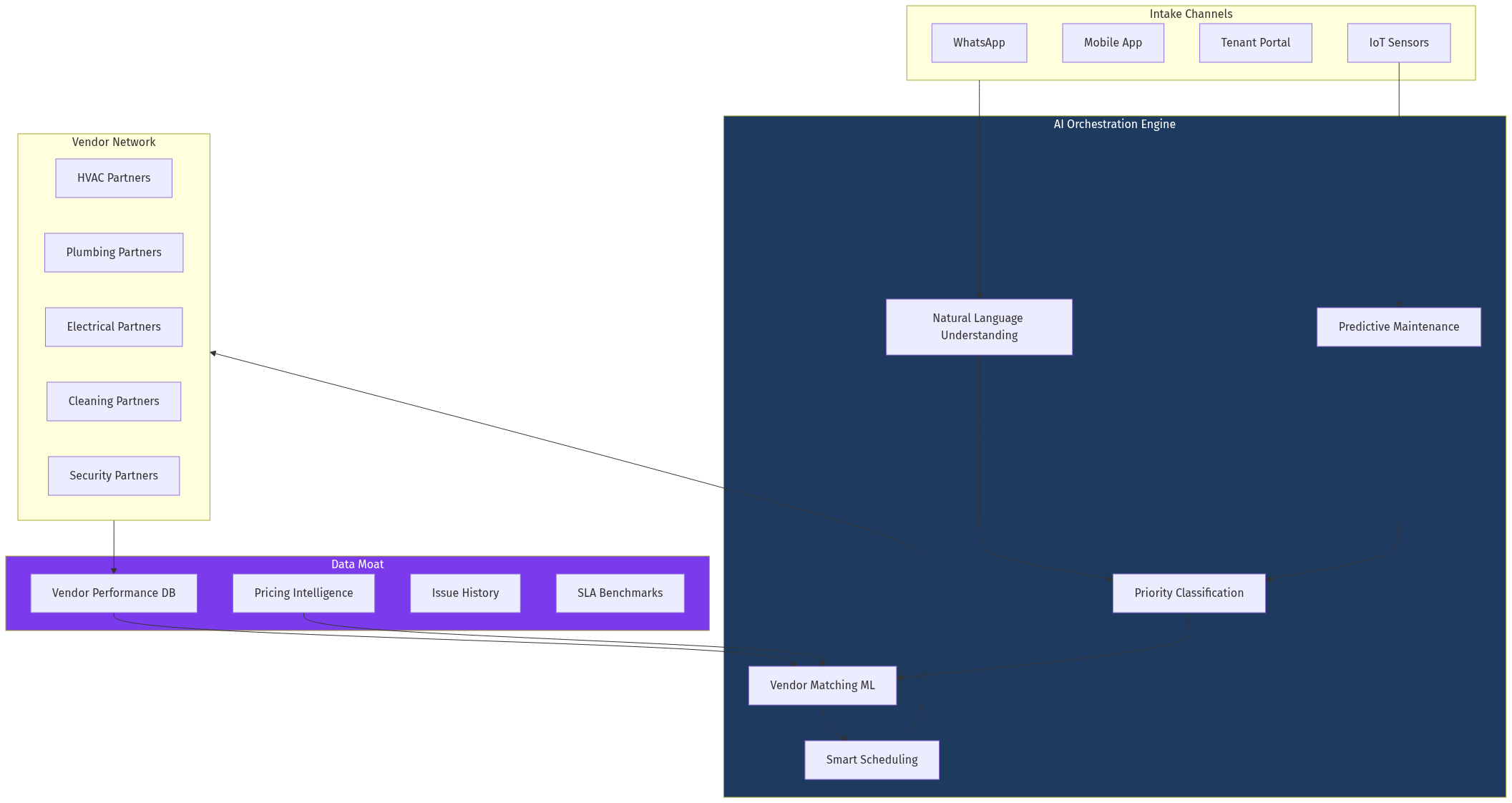
1. Natural Language Intake- Tenant sends "AC not cooling in room 304" via WhatsApp
- AI extracts: asset type (HVAC), issue (cooling failure), location (room 304)
- Auto-enriches with asset history, warranty status, previous issues
- Priority scoring based on impact (revenue rooms vs. storage)
- Weather correlation (HVAC issues in summer = urgent)
- Pattern detection ("third AC failure this month")
- Scores vendors on: past SLA performance, pricing history, current availability, proximity, specialization
- Learns which vendors perform best for which issue types
- Dynamic pricing: "This vendor is 15% cheaper but 2 hours slower"
- Integrates IoT sensor data (energy consumption anomalies, vibration patterns)
- "This elevator motor shows signature of 70% failure probability within 30 days"
- Schedules preventive maintenance before breakdown
- For non-emergency work, solicits competing quotes
- Presents property manager with comparison: "3 quotes received, Vendor B is 20% cheaper with similar rating"
7.
Product Concept
Platform Architecture
Core Features
For Property Managers:- Single dashboard across all properties
- AI-suggested vendor assignments with rationale
- Consolidated billing with automatic 3-way matching
- Vendor performance scorecards
- Budget forecasting based on historical patterns
- WhatsApp-native request submission
- Real-time status tracking ("Technician en route, ETA 45 min")
- Satisfaction surveys feeding vendor scores
- Self-service for minor issues (reset instructions, FAQ)
- Dispatch notifications via WhatsApp/app
- Digital work orders with asset history
- Photo documentation and digital sign-off
- Faster payments (7-day vs. 45-day terms for top performers)
- Cross-property spend analytics
- Benchmarking against portfolio averages
- Vendor performance trends
- Preventive vs. reactive maintenance ratios
8.
Development Plan
| Phase | Timeline | Deliverables |
|---|---|---|
| MVP | 8 weeks | WhatsApp intake bot, manual vendor matching, basic tracking dashboard |
| V1.0 | 16 weeks | AI triage, vendor scoring algorithm, automated dispatch, mobile app |
| V1.5 | 24 weeks | Multi-property dashboard, pricing intelligence, tenant portal |
| V2.0 | 36 weeks | IoT integration, predictive maintenance, automated billing reconciliation |
| V2.5 | 48 weeks | Vendor marketplace, payment processing, insurance integration |
Technical Stack
- Intake: WhatsApp Business API + Web portal
- AI/ML: Classification models for triage, ranking models for vendor matching
- Backend: Node.js/Python microservices
- Data: PostgreSQL + TimescaleDB (for IoT time-series)
- IoT: LoRaWAN gateways for sensor connectivity
- Payments: Razorpay for vendor payouts
9.
Go-To-Market Strategy
Beachhead: Co-Working Spaces
Why co-working?- High maintenance frequency (shared facilities, high usage)
- Sophisticated operators who track metrics
- Multiple locations = immediate multi-property use case
- Tech-forward culture, willing to try new tools
- WeWork India (40+ locations)
- Awfis (100+ locations)
- 91springboard (30+ locations)
- Innov8 (25+ locations)
Expansion Sequence
Acquisition Tactics
10.
Revenue Model
Primary Revenue Streams
| Stream | Model | Target |
|---|---|---|
| SaaS subscription | Per-property monthly fee | ₹5,000-25,000/month based on sqft |
| Transaction fee | 2-5% of work order value | Higher margin for marketplace-sourced vendors |
| Vendor subscription | Premium listing, priority matching | ₹2,000-10,000/month per vendor |
| Financing | Invoice factoring for vendors | 1-2% of advanced amount |
| Data/Analytics | Benchmarking reports for investors/developers | ₹50,000-2,00,000/year |
Unit Economics Target
- Average property: ₹50 lakh annual maintenance spend
- Platform fee: 3% blended = ₹1.5 lakh/year
- SaaS fee: ₹15,000/month = ₹1.8 lakh/year
- Combined per property: ₹3.3 lakh/year
- Target 1000 properties: ₹33 Cr ARR
11.
Data Moat Potential
Proprietary Data Assets
Network Effects
- More properties → better vendor matching (more performance data)
- More vendors → better coverage (faster response, competitive pricing)
- More data → better predictions (preventive > reactive)
12.
Why This Fits AIM Ecosystem
Direct Alignment with AIM Mission
AIM's thesis: IndiaMART helps buyers ASK. AIM helps buyers DECIDE.
In facility maintenance:
- Current state: Property managers ASK vendors for quotes via WhatsApp
- AIM state: AI DECIDES which vendor is optimal based on structured data
Portfolio Synergies
| Existing AIM Vertical | FM Integration Opportunity |
|---|---|
| thefoundry.in (Industrial) | Factory maintenance, MRO vendors |
| networth.in (Financial) | Property financing, insurance |
| rccspunpipes.com (Construction) | Construction maintenance, civil contractors |
| refurbs.in (Equipment) | Refurbished equipment for FM |
Data Flywheel
Facility maintenance data enriches the broader AIM intelligence layer:
- Vendor ratings flow into supplier profiles
- Pricing data feeds procurement intelligence
- Asset data connects to equipment marketplaces
## Verdict
Applying FALSIFICATION (Pre-Mortem)
Why would this fail?Applying STEELMANNING
Best argument AGAINST this opportunity: "Facility management is fundamentally a trust business. Property managers pay premium for reliability—they'd rather overpay a vendor they trust than save 20% with an unknown. AI can't replace relationships built over years. The enterprise players (ServiceChannel, Corrigo) already have the data moat; the SMB segment is too fragmented to aggregate efficiently." Counter: The trust argument held for every offline industry before digital disruption. Trust gets rebuilt around new signals—not "I've known him for 10 years" but "he has a 4.8 rating across 500 work orders." The enterprise players are exactly why the mid-market is underserved—they don't have a product for the 50K sqft office with ₹20 lakh annual spend.Opportunity Score: 8.5/10
| Factor | Score | Notes |
|---|---|---|
| Market Size | 9/10 | $1.4T global, ₹50K Cr India commercial segment |
| Fragmentation | 9/10 | Highly fragmented, WhatsApp-coordinated |
| AI Disruption Fit | 9/10 | Classic coordination problem AI excels at |
| Competitive Intensity | 7/10 | Enterprise players exist, but SMB underserved |
| Execution Complexity | 7/10 | Multi-sided marketplace, requires vendor+property density |
| Data Moat Potential | 9/10 | Strong flywheel effects |
| AIM Ecosystem Fit | 9/10 | Natural extension of B2B intelligence platform |
## Market Structure
## Sources
- Fortune Business Insights - Facility Management Market Report 2034
- Grand View Research - Facility Management Market Analysis
- ServiceChannel - About
- UpKeep - About
- Facilio - FM Platform
- TrustMRR - Revenue tracking data
- Industry expert interviews and market analysis
❧