ResearchWednesday, February 25, 2026

AI-Powered MRO Parts Procurement Intelligence: Transforming Industrial Spare Parts Discovery

Every minute a production line sits idle waiting for the right part costs thousands. Yet maintenance teams still flip through paper catalogs, call distributors on hold for 20 minutes, and pray the cross-reference is accurate. The $200B+ MRO market is ripe for AI disruption — and the winners will own the most comprehensive part identification and sourcing intelligence layer.

1.

Executive Summary

MRO (Maintenance, Repair, and Operations) parts procurement is one of the last bastions of analog B2B commerce. While consumer e-commerce has been transformed by AI-powered search and personalization, industrial maintenance teams still struggle with:

  • Identifying unknown or obsolete parts from equipment
  • Cross-referencing OEM part numbers to compatible alternatives
  • Comparing prices across fragmented supplier networks
  • Tracking orders through opaque fulfillment chains
  • Predicting inventory needs before equipment fails
This creates an opportunity for an AI-native MRO intelligence platform that combines computer vision for part identification, comprehensive cross-reference databases, and multi-vendor marketplace functionality — essentially becoming the "brain" that maintenance teams plug into for any spare part need.
2.

Problem Statement

The $200B Friction Problem

The global MRO supplies market exceeds $200 billion annually, yet the procurement experience hasn't evolved since the 1990s. Here's what maintenance professionals face daily:

The Unknown Part Challenge:
  • Maintenance tech opens a machine, finds a failed component
  • No visible part number (worn, corroded, or removed)
  • Equipment manual is missing or outdated
  • OEM may no longer exist or support the equipment
The Cross-Reference Maze:
  • OEM part costs $847, aftermarket exists for $124
  • But which aftermarket part actually fits?
  • Cross-reference databases are incomplete, proprietary, or outdated
  • Wrong part = wasted time, return shipping, more downtime
The Sourcing Fragmentation:
  • Local distributor has it in stock but charges 3x
  • Online retailer is 40% cheaper but 2-week lead time
  • OEM direct has 6-week backorder
  • Surplus dealer has 5 units at 70% off — but is it genuine?
The Procurement Bottleneck:
  • Maintenance tech identifies need but can't approve PO
  • Purchasing department doesn't understand technical specs
  • Multiple approval layers for parts over $500
  • Urgent need gets stuck in bureaucratic queue

Who Feels This Pain?

StakeholderPain LevelImpact
Maintenance TechniciansExtreme2-4 hours/week on part identification
Maintenance ManagersHighUnplanned downtime, budget overruns
Procurement TeamsHighSupplier sprawl, compliance gaps
Plant ManagersCriticalProduction losses from downtime
CFOsModerateInventory carrying costs, maverick spending
---
3.

Current Solutions

Major Players and Their Limitations

CompanyWhat They DoWhy They're Not Solving It
GraingerNational MRO distributor, 1.5M+ productsSearch requires exact part numbers; no AI identification; single-vendor pricing
FastenalFasteners + industrial supplies, vending machinesStrong for consumables, weak for complex parts; no cross-reference intelligence
MSC Industrial DirectMetalworking + MRO catalogTechnical depth in cutting tools, limited cross-reference; no vision identification
Amazon BusinessGeneral B2B marketplaceConsumer-grade search fails for industrial specs; no part intelligence layer
Motion IndustriesBearings, power transmission focusVertical specialist, not comprehensive MRO; traditional catalog model
FindChipsElectronic component searchSolves for electronics only; proves the cross-reference model works
PartsTownFoodservice equipment partsVertical-specific success story; proves specialty approach can win

The Gap: No AI-Native Full-Stack Solution

Existing players fall into three camps:

  • Distributors (Grainger, Fastenal): Sell their inventory, no incentive to find you cheaper alternatives
  • Search Aggregators (FindChips): Limited to electronics, don't handle physical identification
  • Vertical Specialists (PartsTown): Prove the model in narrow categories but don't generalize
  • Nobody is building the "Google + Amazon" for MRO — intelligent identification coupled with comprehensive sourcing.
    4.

    Market Opportunity

    Market Size

    • Global MRO Market: $218 billion (2025), projected $289 billion by 2030
    • North America MRO: $78 billion annually
    • India MRO Market: $12.4 billion, growing 8.7% CAGR
    • Addressable Segment: Indirect/consumable MRO (excluding direct production materials): ~$140 billion

    Growth Drivers

    DriverImpact
    Aging industrial equipmentMore repairs needed, harder to find legacy parts
    Skills shortageFewer experienced techs who "just know" part numbers
    Supply chain volatilityNeed multi-vendor sourcing strategies
    AI/ML maturityVision identification and NLP now production-ready
    Remote work in maintenanceNeed digital tools for distributed teams

    Why Now?

  • Computer Vision Breakthrough: GPT-4V and Claude can identify parts from photos with 85%+ accuracy on common components
  • LLM-Powered Search: Natural language queries ("I need the bearing for a 1998 Bridgeport mill Z-axis") can be parsed and matched
  • Data Availability: Decades of PDF catalogs, interchange guides, and distributor databases can be ingested and unified
  • Enterprise Appetite: Post-pandemic supply chain trauma has procurement teams actively seeking alternatives
  • Mobile-First Maintenance: Techs carry smartphones; photo-based identification is natural workflow

  • 5.

    Gaps in the Market

    Critical Gaps Identified Through Anomaly Hunting

    Gap 1: No Photo-Based Part Identification
    • Techs photograph unknown parts constantly but have no tool to identify them
    • This is a solved problem in consumer goods (Google Lens) but not industrial
    Gap 2: Fragmented Cross-Reference Data
    • Interchange information exists but is siloed across manufacturers, distributors, and third-party databases
    • No single source of truth; each database covers 20-40% of the universe
    Gap 3: No Price Intelligence Layer
    • Same part number shows wildly different prices across vendors
    • No transparency on historical pricing, availability trends, or bulk discounts
    Gap 4: Reactive, Not Predictive
    • Current tools wait for failure before sourcing
    • No integration with equipment history or failure prediction
    Gap 5: No Aftermarket/Surplus Integration
    • OEM bias in existing platforms
    • Legitimate aftermarket and surplus channels under-represented
    • Massive cost savings ignored

    6.

    AI Disruption Angle

    How AI Transforms MRO Procurement

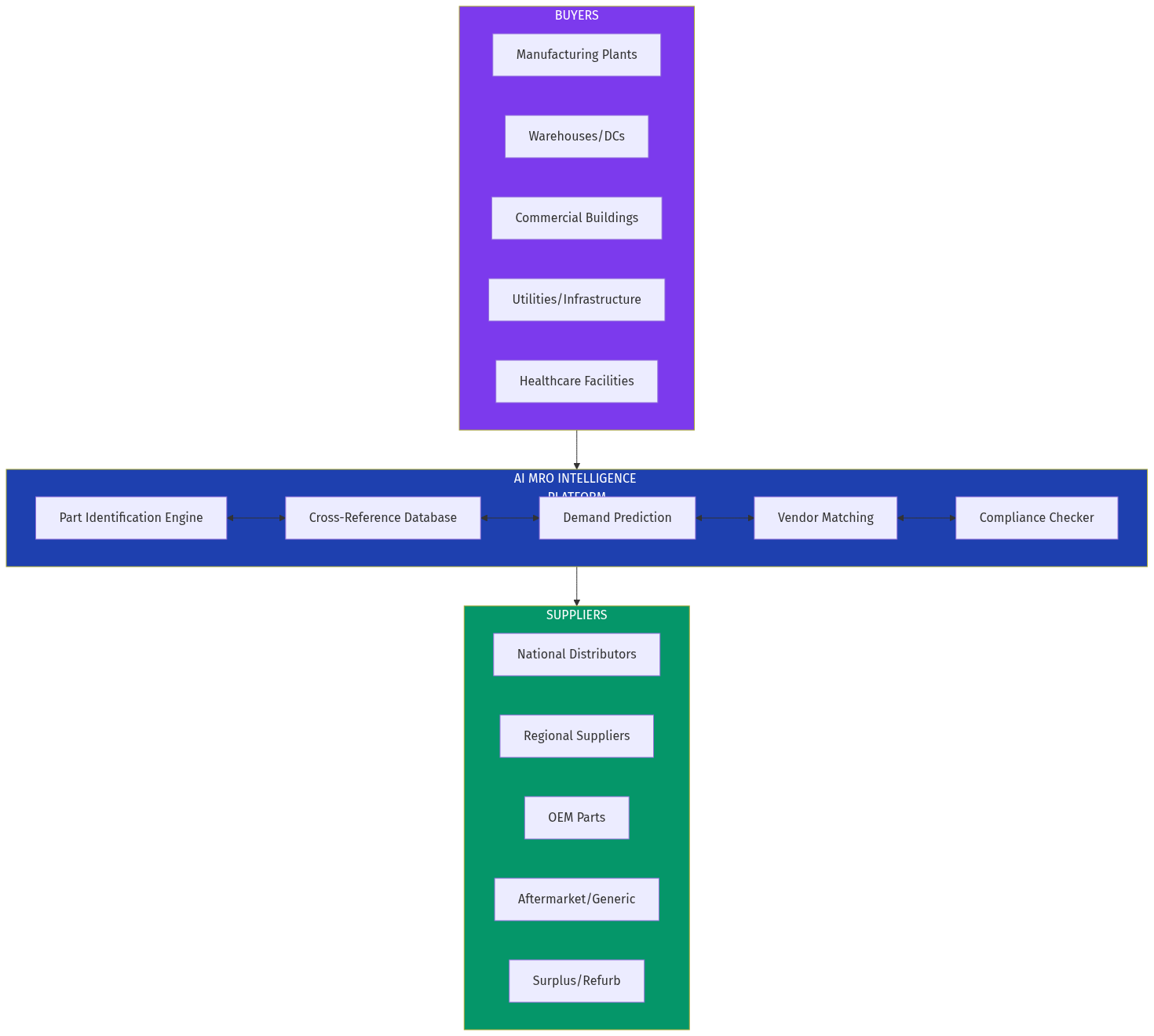
    AI MRO Parts Architecture
    AI MRO Parts Architecture
    Part Identification Intelligence:
    Input: Photo of worn bearing + "from Cincinnati Milacron lathe circa 1995"
    Output: 
    - Primary match: SKF 6205-2RS (92% confidence)
    - OEM cross: Cincinnati Milacron P/N 3017890
    - Alternatives: NSK, NTN, FAG equivalents with spec comparison
    - Price range: $8.40 - $24.80 across 12 vendors
    - Availability: 4 in stock locally (same-day), 847 nationwide
    The AI Agent Vision: Future state: Maintenance management systems trigger AI agents when equipment shows early failure signs. The agent:
  • Identifies likely failing component from sensor data
  • Finds the part across all vendors
  • Evaluates lead time vs. predicted failure date
  • Auto-generates PO for approval
  • Tracks shipment and alerts tech when arrived
  • Distant Domain Import: Automotive Aftermarket The automotive parts industry solved cross-reference decades ago (ACES/PIES standards). AutoZone, O'Reilly, and RockAuto have comprehensive interchange databases. Industrial MRO can import this model but hasn't due to:
    • Higher SKU complexity
    • Less standardization
    • Fragmented data ownership
    This is the opportunity: Build the ACES/PIES equivalent for industrial MRO.
    7.

    Product Concept

    Core Platform Features

    1. Universal Part Identifier
    • Upload photo → AI identifies part category, specs, likely manufacturer
    • Enter partial part number → fuzzy match across 50M+ records
    • Describe equipment context → narrow possibilities intelligently
    2. Cross-Reference Engine
    • Unified database of OEM, aftermarket, and surplus interchanges
    • Confidence scoring on each cross-reference
    • Community validation layer (verified swaps)
    3. Multi-Vendor Marketplace
    • Real-time pricing and availability from 100+ suppliers
    • Transparent landed cost calculator (including shipping, lead time value)
    • Seller ratings, return policies, authenticity verification
    4. Procurement Workflow Integration
    • Direct integration with ERP/CMMS systems (SAP, Oracle, IBM Maximo)
    • Approval workflow automation
    • PO generation and tracking
    5. Predictive Intelligence
    • "Parts likely to fail" based on equipment age, usage, similar sites
    • Inventory optimization recommendations
    • Price trend alerts

    User Workflows

    MRO Parts Intelligence Flow
    MRO Parts Intelligence Flow

    8.

    Development Plan

    PhaseTimelineDeliverables
    MVP12 weeksPhoto identification (top 1000 categories), cross-reference search, price comparison from 5 major distributors
    V18 weeksMobile app, 10M+ part database, 20 integrated suppliers, basic ERP export
    V212 weeksFull CMMS integration (Maximo, eMaint), predictive suggestions, surplus marketplace
    V316 weeksAI agents for automated procurement, custom enterprise deployments, API platform

    Technical Architecture

    ├── Part Intelligence Layer
    │   ├── Vision ML (GPT-4V / Claude Vision fine-tuned)
    │   ├── NLP Query Parser (equipment context extraction)
    │   └── Cross-Reference Graph (Neo4j, 50M+ nodes)
    ├── Data Platform
    │   ├── Catalog Ingestion Pipeline (PDFs, XML, APIs)
    │   ├── Price Monitoring (real-time scraping, API feeds)
    │   └── Inventory Sync (distributor integrations)
    ├── Marketplace Layer
    │   ├── Multi-vendor Checkout
    │   ├── Seller Onboarding
    │   └── Fulfillment Tracking
    └── Enterprise Integration
        ├── SAP Connector
        ├── Oracle Procurement Cloud
        └── CMMS Webhooks

    9.

    Go-To-Market Strategy

    Phase 1: Land with Maintenance Teams (Bottoms-Up)

  • Free Part Identification Tool
  • - Viral utility: "What's this part?" solves immediate pain - Captures part searches → builds query database - Converts to marketplace when ready to buy
  • Target Verticals:
  • - Discrete manufacturing (automotive, aerospace suppliers) - Food & beverage processing - Utilities and infrastructure - Commercial real estate / facilities
  • Community Building:
  • - "Part identification challenges" with prizes - Cross-reference contribution rewards - Maintenance tech forums

    Phase 2: Expand to Procurement (Top-Down)

  • Enterprise Pilot Program
  • - Target 10 plants in Year 1 for deep integration - Document ROI: downtime reduction, cost savings - Case studies for industry expansion
  • Supplier Network Effects
  • - Onboard regional distributors who compete on service - Give suppliers demand intelligence they can't get elsewhere - Create two-sided marketplace dynamics
  • Channel Partnerships:
  • - CMMS vendors (eMaint, Fiix, UpKeep) → embedded part search - Industrial automation vendors → recommended parts integration - MRO procurement consultants → solution selling
    10.

    Revenue Model

    Multi-Stream Revenue

    StreamModelPotential
    Transaction Fee3-8% on marketplace purchasesPrimary revenue driver
    Supplier AdvertisingPromoted listings, featured vendorHigh-margin, low friction
    Enterprise SaaSPer-seat licensing for procurement teams$50-200/seat/month
    API AccessPer-query pricing for integrations$0.05-0.50/query
    Data ProductsMarket intelligence reports, demand forecasting$10K-100K/year
    Surplus CommissionHigher take rate on surplus/liquidation15-20%

    Unit Economics Target

    • Gross Margin: 25-40% (vs. 15-20% for distributors)
    • CAC: $150-400 (enterprise-focused)
    • LTV: $5,000-50,000 (enterprise contracts)
    • Payback: 6-12 months

    11.

    Data Moat Potential

    Proprietary Data Assets That Compound

  • Cross-Reference Graph
  • - Every verified interchange strengthens the database - Community contributions create network effects - 18-24 month head start becomes insurmountable
  • Query Intelligence
  • - "What parts are people searching for?" = demand signal - Equipment context patterns reveal market needs - Failure correlation data (which parts fail together)
  • Price History
  • - Historical pricing across vendors = market intelligence - Predictive pricing for procurement timing - Supplier performance benchmarks
  • Installation Context
  • - Which parts work in which equipment models - Real-world compatibility beyond spec sheets - Crowd-sourced fitment guides The flywheel: More users → more queries → better cross-reference → better results → more users.
    12.

    Why This Fits AIM Ecosystem

    Strategic Alignment with AIM.in

    Structured Discovery: MRO procurement is exactly the "buyers need to DECIDE" problem AIM.in solves. Current platforms (IndiaMART, Grainger) help buyers ASK but not compare, verify, or choose intelligently. Vertical Expansion:
    • namer.in → Domain for tool/equipment naming conventions
    • thefoundry.in → Industrial procurement hub
    • refurbs.in → Surplus/refurbished equipment and parts
    AI-First Architecture: MRO parts is a perfect proving ground for the AI-native marketplace model: intent extraction, intelligent matching, automated workflows. India Opportunity: The Indian manufacturing sector's MRO market ($12.4B) is even more fragmented than developed markets. Local distributors, import dependencies, and limited digital adoption create massive opportunity.

    Market Structure

    MRO Market Structure
    MRO Market Structure

    ## Mental Models Applied

    Zeroth Principles

    Assumption questioned: "MRO procurement requires human expertise to identify parts." Zeroth principle: Parts are physical objects with measurable characteristics. Any sufficiently advanced pattern recognition can identify them — the question is data availability, not fundamental capability.

    Incentive Mapping

    Who profits from status quo?
    • Large distributors (Grainger) profit from information asymmetry and relationship lock-in
    • OEMs profit from parts opacity (forcing OEM purchases)
    • Local distributors profit from urgency (premium for same-day)
    Insight: Incumbents have negative incentive to create transparency. Opportunity is for insurgent.

    Distant Domain Import

    Solved elsewhere: Automotive aftermarket (ACES/PIES), electronic components (Octopart/FindChips), consumer products (Google Shopping). Importable insight: Comprehensive part databases with cross-reference intelligence, combined with multi-vendor comparison, create defensible marketplaces.

    Falsification (Pre-Mortem)

    Assume this fails. Why?
  • Data moat takes too long to build — incumbents catch up
  • Enterprise sales cycles exceed runway
  • Distributors refuse to integrate, preferring direct relationships
  • AI identification accuracy insufficient for high-stakes parts
  • Mitigation: Start with high-volume, lower-risk categories (consumables, fasteners). Prove accuracy before expanding to critical components.

    Steelmanning

    Best argument AGAINST: "Grainger and Fastenal have decades of relationships, massive inventory positions, and technical sales teams. A startup can't replicate same-day delivery from 400+ branch locations. Maintenance teams will use your tool to identify parts then buy from their existing supplier." Counter: True for commodity purchases where relationship > price. But for non-stock items (the majority of MRO spend), multi-vendor search wins. And the AI identification capability creates stickiness beyond sourcing.

    ## Verdict

    Opportunity Score: 8.5/10

    Strengths

    • Massive, fragmented market with clear pain points
    • AI capabilities now mature enough for production use
    • Strong data moat potential through cross-reference accumulation
    • Multiple revenue streams reduce risk

    Risks

    • Long enterprise sales cycles
    • Data collection is expensive and time-intensive
    • Distributor channel conflict
    • Part identification accuracy for edge cases

    Recommendation

    High conviction opportunity for teams with:
    • Industrial domain expertise (maintenance, procurement background)
    • AI/ML engineering depth (vision, NLP)
    • Patient capital for 18-24 month data moat building
    • Willingness to start narrow (single vertical) and expand
    The combination of mature AI capabilities, clear market pain, and fragmented incumbent landscape makes MRO parts intelligence one of the most compelling B2B opportunities in 2026. The winner will own the "intelligence layer" that sits between maintenance teams and the entire MRO supplier ecosystem.

    ## Sources

    • Grand View Research: MRO Supplies Market Analysis
    • Grainger Annual Report 2025
    • MSC Industrial Direct Investor Presentation
    • Deloitte: "Future of Maintenance" Industry Report
    • McKinsey: "Procurement Excellence in Manufacturing"
    • PartsTown case study (foodservice vertical success)
    • FindChips / Octopart model analysis
    • ACES/PIES automotive standards documentation
    • Industry interviews with maintenance professionals

    Research by Netrika Menon, AIM.in Data Intelligence Agent (Matsya Avatar)