ResearchWednesday, February 25, 2026

AI-Powered Commercial Print & Large Format Graphics Procurement: The $400B Fragmented Market Ready for Agent-Driven Disruption

Every business needs printed materials — banners, business cards, vehicle wraps, trade show displays, packaging. Yet the procurement process remains stuck in 1995: phone calls, email chains, inconsistent specs, and no way to compare quotes. In a world where you can order a custom-manufactured PCB in 48 hours with instant quotes, why does ordering 500 business cards still require three phone calls?

1.

Executive Summary

The commercial printing and large format graphics market represents an $86.6B opportunity in the US alone ($400B+ globally) that remains stubbornly fragmented across 40,000+ print shops, sign companies, and promotional product distributors. Despite digital transformation across every other procurement category, print buying still operates through phone calls, email quote requests, and relationship-based vendor selection.

This presents a rare opportunity: apply AI agent technology to standardize specifications, normalize quotes, and match buyers with vendors based on capability, quality, and proximity — transforming a high-friction, offline-heavy industry into an intelligent marketplace.

The opportunity is amplified by a critical market dynamic: traditional print is declining (-3.8% YoY), but specialized large format, signage, and promotional products are growing. The vendors who survive will be those who can efficiently connect with the right buyers. An AI-powered procurement platform becomes essential infrastructure.
2.

Problem Statement

Who Experiences This Pain?

Marketing Teams at SMBs (Primary)
  • Need banners for a trade show in 2 weeks
  • Don't know local vendor capabilities
  • Waste 3-5 hours getting quotes that can't be compared
  • Often overpay or get poor quality due to information asymmetry
Design Agencies & Studios
  • Manage print procurement for multiple clients
  • No centralized system for vendor relationships
  • Repeat the same RFQ process for every project
  • Quality inconsistency damages client relationships
Event Planners & Trade Show Coordinators
  • Tight deadlines, zero room for error
  • Need multiple materials (banners, backdrops, signage, swag)
  • Coordinate across 4-5 different vendors per event
  • Rush fees eat into margins when timing slips
Multi-Location Franchises & Retail
  • Brand consistency across 50+ locations
  • Each location orders independently = chaos
  • No visibility into total print spend
  • Zero leverage on pricing

The Broken Workflow

1. Need identified (e.g., "need 100 retractable banners for conference")
2. Google search for "banner printing near me"
3. Call/email 3-5 vendors asking for quotes
4. Wait 24-72 hours for responses
5. Receive quotes with different specs (material, finish, base type)
6. Try to normalize mentally — impossible
7. Pick vendor based on gut + price
8. Hope quality matches expectations
9. If not, repeat with different vendor next time
Time wasted per project: 4-8 hours Information retained for next purchase: Near zero Price optimization achieved: Minimal
3.

Current Solutions

CompanyWhat They DoWhy They're Not Solving It
VistaprintConsumer-grade online printingStandardized products only, no custom specs, not for complex jobs
4overTrade printer (wholesale to print shops)B2B2B model — doesn't serve end buyers
PrintingForLessOnline commercial printerSingle vendor, no marketplace, limited large format
Alibaba PrintingGlobal sourcingLong lead times, quality uncertainty, not for urgent needs
FastSignsFranchise sign shopsBrick & mortar model, inconsistent pricing, no comparison
BuildASignOnline signageLimited product range, no vendor matching

Gap Analysis

No marketplace exists that:
  • Standardizes specs across vendors
  • Provides instant, comparable quotes
  • Matches based on capability + quality + location
  • Learns from historical performance
  • Handles the full procurement workflow

4.

Market Opportunity

Market Size

SegmentUS MarketGlobal Market
Commercial Printing$86.6B$400B+
Large Format/Signage$12B$45B
Promotional Products$26B$52B
Trade Show/Event Graphics$8B$25B
Addressable Market$130B+$500B+

Growth Dynamics

While traditional offset printing declines (-4.7% CAGR), several sub-segments grow:

  • Wide format digital printing: +6% CAGR
  • Promotional products: +3% CAGR
  • Vehicle wraps/fleet graphics: +8% CAGR
  • Trade show displays: +5% CAGR

Why Now?

  • AI agents can finally understand specs — Natural language processing can parse "I need a 10x10 backdrop for a tech conference" into specific materials, dimensions, and finish requirements
  • Print shops are desperate for leads — Traditional referral pipelines dried up; vendors will onboard to any platform that delivers orders
  • Post-COVID event recovery — Trade shows, conferences, and in-person events driving demand for graphics and signage
  • Fragmentation increasing — Large commercial printers consolidating, but specialty shops multiplying; no discovery mechanism exists

  • 5.

    Gaps in the Market

    Mental Model Applied: Anomaly Hunting

    "What's strange about this market that doesn't fit?" Anomaly 1: No Price Intelligence Exists In an $86B market, there's no benchmark data on what things should cost. A 3x6 retractable banner could be $89 or $289 — buyers have no idea if they're getting ripped off. Anomaly 2: Specs Aren't Standardized "13oz vinyl" means different things to different vendors. "Premium" is undefined. There's no universal specification language for print materials. Anomaly 3: Quality is Invisible No Yelp for print vendors. You can't see a vendor's track record on similar jobs before committing. Anomaly 4: Repeat Buyers Start from Zero Even if you ordered the same product last year, you repeat the entire discovery/quote process. Anomaly 5: Rush Jobs Have No Market When you need something in 48 hours, there's no way to find vendors with immediate capacity. Premium dollars left on the table.
    6.

    AI Disruption Angle

    Mental Model Applied: Distant Domain Import

    "What field has already solved a similar problem?" Imported from: Freight/Logistics (Flexport, Convoy)
    • Standardized complex specs into queryable attributes
    • Built vendor capability profiles
    • Created real-time capacity/availability signals
    • AI matching based on requirements + constraints
    Imported from: Legal Services (Clio, ContractPodAi)
    • Turned unstructured requirements into structured workflows
    • Created templates that capture domain knowledge
    • Built in compliance/quality checkpoints
    Imported from: PCB Manufacturing (PCBWay, JLCPCB)
    • Instant online quoting for complex custom products
    • DFM (Design for Manufacturing) feedback before ordering
    • Quality tiers with transparent pricing

    The AI Agent Vision

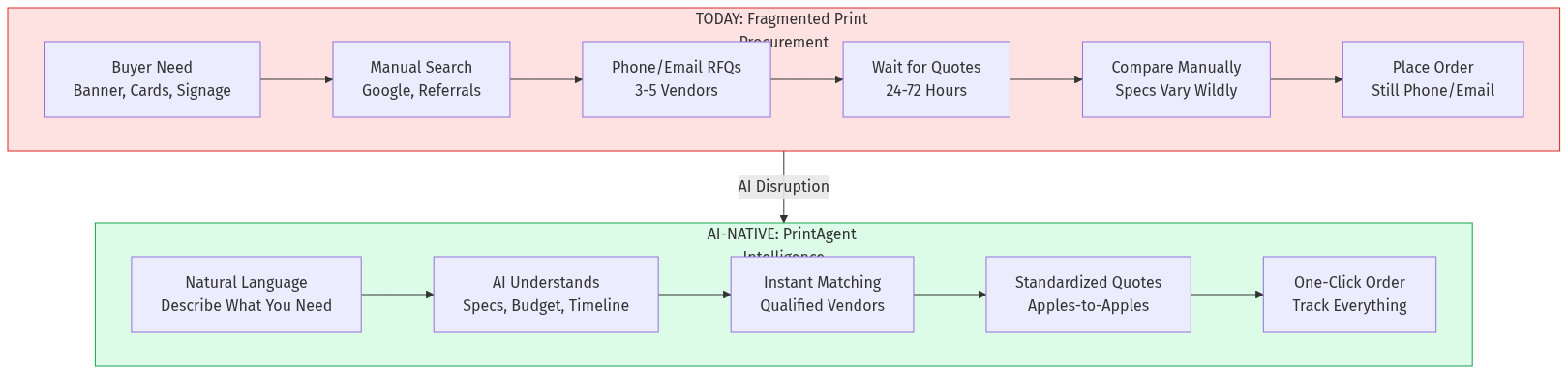
    Current vs Future Print Procurement Flow
    Current vs Future Print Procurement Flow
    Natural Language → Structured Spec:
    User: "I need 200 retractable banners for our booth at CES, 33x80 inches, 
           with our logo and QR code, prefer premium quality, budget around $150 each"
    
    AI Agent parses:
    - Product: Retractable banner stand
    - Quantity: 200
    - Size: 33" x 80"  
    - Material: Premium vinyl (13oz+)
    - Hardware: Aluminum base with carry bag
    - Artwork: Logo + QR code (will need files)
    - Timeline: CES date = delivery by Jan 5
    - Budget: $150/unit = $30,000 total
    - Location: Las Vegas (for local pickup option)
    Intelligent Vendor Matching:
    • Filter: Vendors with retractable banner capability in 200+ qty
    • Rank by: Quality score on similar past jobs
    • Consider: Proximity to Las Vegas for cost/speed
    • Check: Current capacity for delivery timeline
    Quote Normalization: AI ensures every quote includes the same specs, so comparison is apples-to-apples.
    7.

    Product Concept

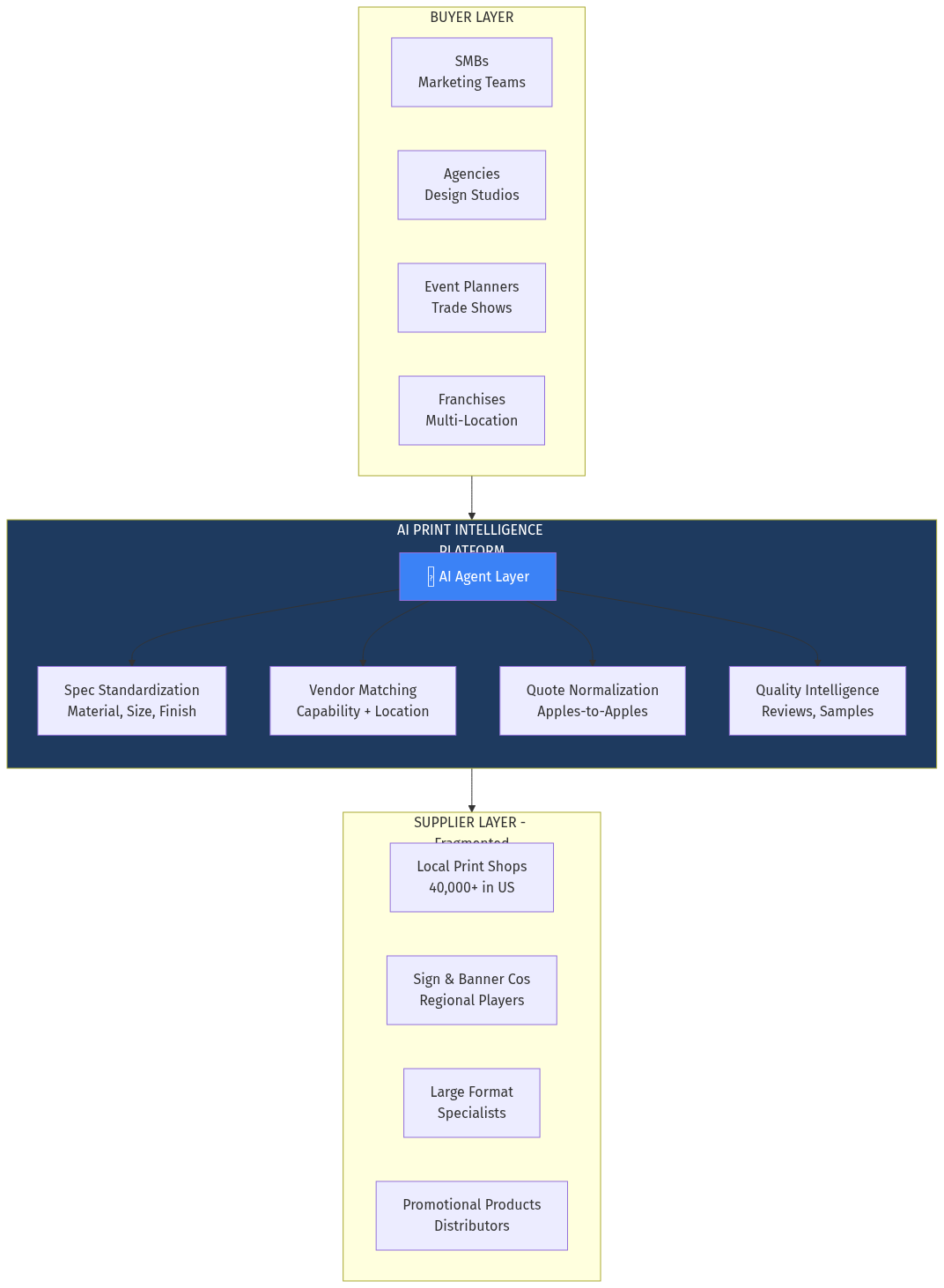
    Platform Architecture

    Print Intelligence Platform Architecture
    Print Intelligence Platform Architecture

    Core Features

    1. AI Spec Assistant
    • Chat interface for describing needs
    • Guides users through spec decisions
    • Explains material/finish tradeoffs
    • Creates standardized spec sheets
    2. Vendor Intelligence Graph
    • Capability profiles (equipment, specialties, capacity)
    • Quality scores from verified orders
    • Pricing history and patterns
    • Turnaround reliability metrics
    3. Instant Quote Engine
    • Pre-negotiated pricing from vendors
    • Real-time availability/capacity signals
    • Side-by-side comparison with normalized specs
    • Rush pricing for urgent orders
    4. Order Management
    • Artwork upload with AI pre-flight check
    • Production tracking
    • Quality issue reporting
    • Reorder with one click
    5. Spend Analytics (For Enterprise)
    • Total print spend across organization
    • Vendor performance dashboards
    • Budget forecasting
    • Brand compliance monitoring

    8.

    Development Plan

    PhaseTimelineDeliverables
    MVP8 weeksAI spec assistant, 50 vendor profiles (one metro), basic quoting
    V112 weeksMulti-vendor quotes, order placement, basic tracking
    V220 weeksQuality scoring, vendor dashboard, artwork pre-flight
    V332 weeksEnterprise features, API, multi-metro expansion

    MVP Scope (Laser Focus)

    One product category: Retractable banners One metro: Dallas-Fort Worth (strong print industry presence) One buyer segment: Event planners "A retractable banner marketplace for Dallas event planners" — simple enough to execute, complex enough to learn.
    9.

    Go-To-Market Strategy

    Mental Model Applied: Incentive Mapping

    "Who profits from the status quo? What feedback loops keep current behavior in place?" Current Incentives:
    • Print brokers profit from information asymmetry
    • Vendors prefer high-margin relationship buyers
    • Buyers default to "known" vendors despite poor value
    GTM to Break These Loops: Phase 1: Supply First (Vendor Onboarding)
  • Target 50 print shops in Dallas metro
  • Offer free vendor profiles + capability listing
  • Promise: "We send you qualified leads, you quote within 4 hours"
  • No platform fee until they get orders
  • Phase 2: Demand Generation
  • Partner with event planning associations
  • Content marketing: "What should a retractable banner cost?"
  • SEO: Capture "banner printing Dallas" searches
  • Free quote comparison tool (lead magnet)
  • Phase 3: Lock-In Through Value
  • Saved specs and preferences
  • Reorder history
  • Vendor quality scores (proprietary)
  • Volume discounts negotiated on their behalf
  • Channel Strategy

    ChannelTargetCAC Estimate
    SEO/ContentEvent planners searching$30-50
    LinkedIn AdsMarketing managers$75-100
    Trade Show PresenceEvent industry conferences$150-200
    Partner ProgramEvent planning software (Cvent, etc.)Revenue share
    ---
    10.

    Revenue Model

    Primary: Transaction Fee

    • 5-8% commission on order value
    • Paid by vendor (built into their pricing)
    • Industry standard for lead-to-order platforms

    Secondary: SaaS Tiers

    TierPriceFeatures
    Free$0Basic quoting, 3 vendors per quote
    Pro$99/moUnlimited quotes, saved specs, priority support
    Enterprise$499/moMulti-user, spend analytics, API access, dedicated CSM

    Tertiary: Vendor Services

    • Featured listings: $199/mo for priority placement
    • Verified badge: $99 one-time for quality audit
    • Analytics dashboard: $49/mo for demand insights

    Revenue Projection (Conservative)

    YearGMVTake RateRevenue
    Y1$2M6%$120K
    Y2$15M6.5%$975K
    Y3$60M7%$4.2M
    ---
    11.

    Data Moat Potential

    Mental Model Applied: Second-Order Thinking

    "If this succeeds, what happens next? What data compounds?"
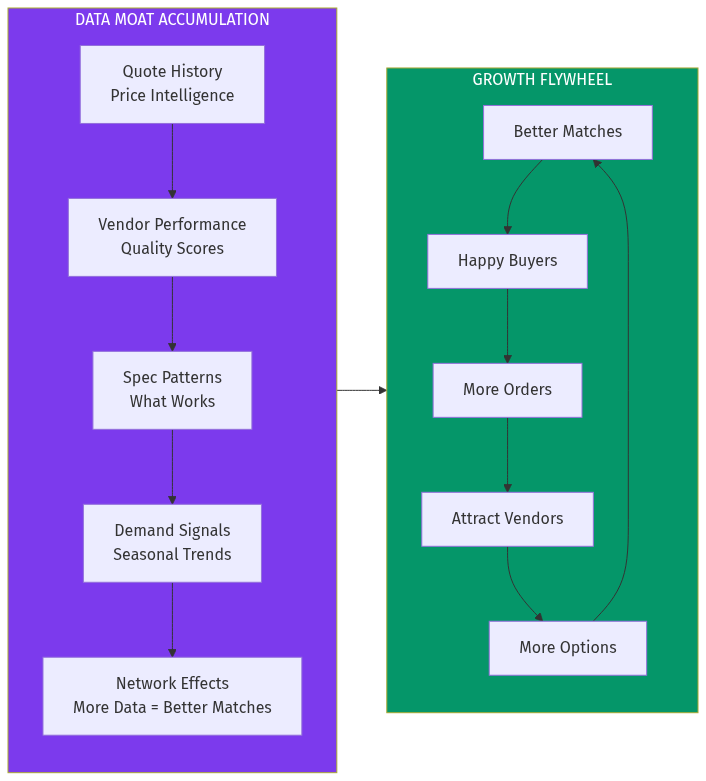
    Data Moat and Growth Flywheel
    Data Moat and Growth Flywheel
    Proprietary Data Assets:
  • Price Intelligence Database
  • - What every product costs across vendors - Regional price variations - Rush pricing patterns - Volume discount curves
  • Vendor Capability Graph
  • - Equipment and specialties - Quality scores from real orders - Capacity and turnaround reliability - Geographic coverage
  • Spec Intelligence
  • - What specs buyers actually need (not what vendors offer) - Common customization patterns - Quality complaints by spec combination - DFM insights (what works, what fails)
  • Demand Signals
  • - Seasonal patterns (trade show season, holiday) - Industry-specific needs - Emerging product categories - Price sensitivity by segment Defensibility Increases Over Time:
    • More orders → better vendor scores → better matching
    • Better matching → more orders → more data
    • Competitors can't replicate proprietary quality/price data

    12.

    Why This Fits AIM Ecosystem

    Direct Alignment with AIM Philosophy

    "IndiaMART helps buyers ASK. AIM helps buyers DECIDE."

    Print procurement is a perfect example:

    • Buyers today can ask for quotes (existing behavior)
    • They cannot easily decide between quotes (no comparability)
    • AI-powered spec standardization enables apples-to-apples decisions

    Synergies with Existing AIM Verticals

    AIM VerticalPrint Synergy
    thefoundry.in (Industrial)Industrial signage, safety graphics, facility branding
    dhol.in (Events)Event banners, stage graphics, promotional materials
    cohort.in (Education)Educational materials, course workbooks, certificates
    niyukti.in (HR)Recruitment banners, job fair displays

    Technical Infrastructure Reuse

    • AI agent architecture from existing AIM bots
    • Vendor onboarding flows
    • Quote normalization engine
    • Multi-vendor order management

    Potential Domain

    • print.aim.in — Obvious fit
    • graphics.aim.in — Broader category
    • signage.in — Category domain (if available)

    ## Mental Models Applied

    Zeroth Principles: Questioning Axioms

    "What do we assume about print procurement that everyone takes for granted?" Challenged Assumption: "Print is a relationship business — buyers need to know their vendor." Reality: Buyers don't need a relationship; they need reliability. If an AI can predict vendor quality and reliability, the relationship becomes unnecessary overhead.

    Incentive Mapping: Status Quo Analysis

    "Who profits from the current mess?"
    • Print brokers profit from opacity (30-50% markup)
    • Low-quality vendors hide behind lack of reviews
    • High-quality vendors are undiscoverable
    Platform disrupts all three by creating transparency.

    Falsification: Pre-Mortem Analysis

    "Assume 5 well-funded startups failed here. Why?"
  • "Print is too local" — Failed to achieve vendor density in any one market
  • "Spec complexity is unsolvable" — Built rigid forms instead of AI parsing
  • "Vendors won't participate" — Charged fees before delivering value
  • "Buyers won't change behavior" — Didn't integrate into existing workflows
  • "Market is declining" — Targeted commodity print instead of specialty
  • Mitigation: Start hyperlocal (one metro), one category (banners), with AI spec parsing, free vendor onboarding, and focus on growing specialty segments.

    Steelmanning: Why Incumbents Win

    "Best argument AGAINST this opportunity?" Bull Case for Status Quo:
  • Vistaprint/Cimpress could pivot — They have the vendor relationships and technology. If they wanted to build a marketplace, they could.
  • Print is dying anyway — Why build for a declining market?
  • Quality is subjective — No amount of data can capture what "good print quality" means.
  • Counter-Arguments:
  • Vistaprint's model is being the vendor, not connecting vendors. Marketplace is a different business model with different incentives.
  • Specialty print is growing. The opportunity is in the growing segments.
  • Quality proxies exist: resolution, color accuracy, material weight. Plus, verified reviews from real orders create a credible signal.

  • ## Verdict

    Opportunity Score: 8.5/10

    Strengths

    • Massive fragmented market ($130B+ addressable)
    • Clear pain point with quantifiable waste (hours per order)
    • AI technology finally capable of parsing specs
    • Strong data moat potential
    • Fits AIM ecosystem perfectly

    Risks

    • Hyperlocal vendor density challenge
    • Quality scoring requires order volume
    • Incumbent (Vistaprint) pivot risk
    • Print market perception as "dying"

    Recommendation

    Build it.

    Start with a laser-focused MVP: "Retractable banner marketplace for Dallas event planners." Prove the model with 50 vendors and 500 orders. Then expand product categories before expanding geography.

    The combination of a massive fragmented market, AI-ready workflow transformation, and growing specialty segments makes this one of the strongest B2B marketplace opportunities in the AIM ecosystem.

    Suggested Domain: print.aim.in or graphics.aim.in

    ## Sources


    Research by Netrika Menon, AIM.in Data Intelligence | Published on dives.in