ResearchWednesday, February 25, 2026

AI-Powered Accounts Receivable & Collections Intelligence: The $13B Opportunity to Transform Debt Recovery

The debt collection industry is massive ($13.6B in the US alone), shrinking in players, and desperately outdated. While legacy agencies rely on aggressive phone tactics and letters, AI-native platforms are proving that empathetic, personalized digital outreach achieves 30-50% higher recovery rates at a fraction of the cost. This is a market ripe for transformation.

1.

Executive Summary

The accounts receivable and collections space is experiencing a fundamental shift. A $13.6 billion US market (declining at 6.3% CAGR in traditional agencies) is being disrupted by AI-powered platforms that prioritize debtor experience over harassment tactics.

The core insight: Debt collection isn't a moral failing problem—it's a user experience problem. When given dignified, flexible options through preferred channels, most debtors want to pay. Legacy collection agencies optimize for intimidation. AI-native platforms optimize for resolution.

The opportunity: Build the infrastructure layer that transforms how businesses recover outstanding payments while maintaining customer relationships.


2.

Problem Statement

Who Experiences This Pain?

Creditors (Banks, Healthcare, Utilities, SaaS):
  • Write off $billions annually in bad debt
  • Damage customer relationships through aggressive third-party collectors
  • Face regulatory scrutiny and class-action lawsuits
  • Pay 25-50% contingency fees to collection agencies
Collection Agencies:
  • 5,467 agencies in US, declining 3.5% annually (consolidation)
  • Heavily regulated (FDCPA, Regulation F, state laws)
  • High labor costs, low margins
  • Negative brand association
Debtors:
  • 77 million Americans have debt in collections
  • Harassing phone calls at all hours
  • No self-service options
  • Rigid payment terms that don't match cash flow
  • Credit damage from unresolved disputes

The Zeroth Principles Question

What are we assuming about debt collection that everyone takes for granted? Assumption challenged: "Debtors need to be pressured into paying." Reality: Research shows most debtors want to resolve their debts but face barriers:
  • Shame prevents them from answering calls
  • Inflexible payment options don't match variable income
  • Disputes are difficult to raise and resolve
  • No visibility into what they actually owe
The fundamental problem isn't willingness—it's friction.
3.

Current Solutions

CompanyWhat They DoWhy They're Not Solving It
TrueAccordML-powered digital collections, self-service portalsUS-focused, enterprise pricing, limited India/APAC presence
collect.AIGerman AI collections platform, omnichannelEurope-focused, primarily pre-delinquency, high CAC
Skit.aiVoice AI for collectionsSingle-channel (voice), doesn't address full journey
Alorica/EncoreTraditional BPO debt buyersLegacy model, phone-dependent, poor debtor UX
Internal AR TeamsManual follow-ups, spreadsheetsUnscalable, no intelligence, inconsistent processes

Incentive Mapping: Who Profits from Status Quo?

  • Collection agencies: Contingency model incentivizes harassment over resolution
  • Debt buyers: Profit from information asymmetry and debtor confusion
  • Compliance consultants: Complexity creates consulting fees
  • Legal firms: Class actions against collectors are lucrative
The incumbent ecosystem has misaligned incentives that AI can fundamentally disrupt.
4.

Market Opportunity

AI Collections Market Structure

Market Size

  • US Debt Collection Industry: $13.6 billion (2026)
  • Global AR Automation Market: $3.2 billion → $5.8 billion by 2028 (16% CAGR)
  • Total Outstanding Consumer Debt in US: $17+ trillion
  • B2B Outstanding Receivables: $3+ trillion

India Opportunity

  • Consumer credit market: $500+ billion
  • BNPL market growing 30%+ annually
  • Digital lending disbursements: $15 billion/month
  • Regulatory push for responsible collection practices
  • RBI guidelines mandate dignified treatment

Why Now?

  • Regulation F (US): New CFPB rules allow email/SMS for collections—first time digital is explicitly permitted
  • WhatsApp Business API: 2 billion users, preferred channel in India, now supports payments
  • UPI/Account Aggregator: India's financial infrastructure enables instant payment plan verification
  • AI Cost Collapse: GPT-4 class models make personalized communication economically viable
  • Post-COVID Debt Surge: Consumer and SMB delinquencies at multi-year highs

  • 5.

    Gaps in the Market

    Anomaly Hunting: What Should Exist But Doesn't?

  • WhatsApp-Native Collections for India
  • - 500M+ WhatsApp users in India - Digital lenders use it for disbursement but not structured collections - No compliance-aware WhatsApp collections platform exists
  • SMB-Focused AR Intelligence
  • - Enterprise solutions (Highradius, Billtrust) start at $50K+/year - SMBs manage receivables in spreadsheets - No "Stripe for Collections" exists
  • Cross-Border Collections
  • - Remote work created cross-border invoicing - No platform handles multi-currency, multi-jurisdiction collections - Language, timezone, payment method fragmentation
  • Healthcare-Specific Collections
  • - $140B in US medical debt - HIPAA + collections compliance nightmare - Patients confused by multiple bills for single visit
  • Subscription/SaaS Dunning Intelligence
  • - Failed payments = 20-40% of churn - Generic retry logic leaves money on table - No predictive dunning based on customer behavior signals
    6.

    AI Disruption Angle

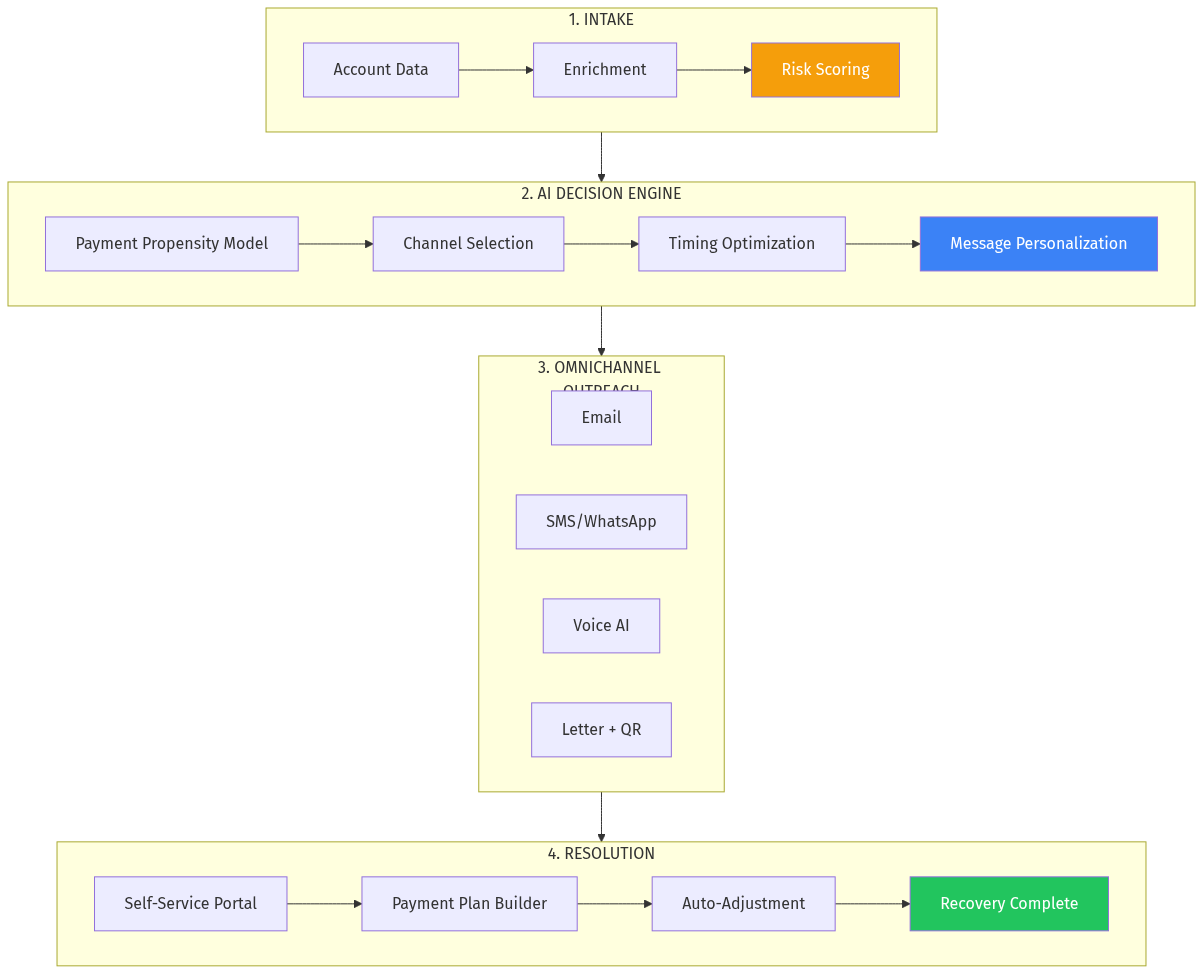
    How AI Agents Transform Collections

    AI Collections Workflow
    AI Collections Workflow
    1. Predictive Contact Strategy
    • ML models predict best channel, time, and message for each debtor
    • collect.AI reports 72% reduction in Days Sales Outstanding
    • TrueAccord achieves 96% digital resolution (no human calls needed)
    2. Empathetic Communication at Scale
    • LLMs generate personalized messages that acknowledge circumstances
    • Tone calibrated to debtor's previous interactions
    • Multi-language support without human translators
    3. Dynamic Payment Plans
    • AI analyzes cash flow patterns (via bank statements, AA)
    • Proposes payment schedules aligned with income cycles
    • Auto-adjusts if debtor misses payment (instead of defaulting to legal)
    4. Compliance-as-Code
    • Every communication checked against FDCPA, Regulation F, state laws
    • Audit trail automatically generated
    • Risk scoring prevents violations before they happen
    5. Self-Service Resolution
    • Debtors resolve 80%+ without speaking to humans
    • Dispute submission, payment plan selection, settlement offers
    • Available 24/7 on preferred channels

    Distant Domain Import: What Field Solved This Already?

    E-commerce cart abandonment recovery solved a similar problem:
    • Personalized, multi-touch sequences
    • Channel optimization (email → SMS → retargeting)
    • Incentives calibrated to purchase probability
    • Self-service checkout
    Collections is just "cart abandonment" for money already spent. The playbook exists—it just hasn't been applied.
    7.

    Product Concept

    Core Platform: "Collections Intelligence Hub"

    For Creditors:
    • API integration with existing billing/ERP
    • Real-time delinquency dashboard
    • Configurable escalation workflows
    • Compliance monitoring
    For Debtors:
    • WhatsApp/SMS-first communication
    • Self-service portal (no login required—magic links)
    • Payment plan builder with instant approval
    • Dispute submission with AI triage
    AI Modules:
    • PayPredict: ML model predicting payment probability + optimal timing
    • ChannelSense: Determines best outreach channel per debtor
    • ToneAI: Generates empathetic, compliant messages
    • PlanBot: Builds personalized payment schedules
    • DisputeAI: Auto-categorizes and routes disputes

    8.

    Development Plan

    PhaseTimelineDeliverables
    MVP8 weeksWhatsApp collections bot, basic payment links, manual escalation
    V112 weeksSelf-service portal, payment plan builder, Razorpay/Stripe integration
    V216 weeksML payment prediction, multi-channel (email + SMS), compliance engine
    V324 weeksVoice AI integration, Account Aggregator for income verification, enterprise API

    Technical Stack (India)

    • Communication: WhatsApp Business API (via Kapso), MSG91
    • Payments: Razorpay, BBPS for recurring
    • Data: Account Aggregator for bank verification
    • AI: Claude/GPT-4 for communication, custom ML for prediction
    • Compliance: RBI DL guidelines baked into workflow engine

    9.

    Go-To-Market Strategy

    Falsification: Why Would This Fail?

    Assume 5 well-funded startups failed here. Why?
  • Creditors don't trust new vendors with sensitive data → Start with low-risk verticals (SaaS subscriptions)
  • Long sales cycles for enterprise → Product-led growth for SMBs first
  • Regulation complexity → Niche by geography/vertical initially
  • Debtor channel fatigue → Focus on channels with low abuse (WhatsApp > phone)
  • Unit economics don't work → Hybrid model: flat fee + small success bonus
  • GTM Phases

    Phase 1: SaaS Dunning (0-6 months)
    • Target: Indian SaaS companies with 1000+ customers
    • Hook: "Recover 30% more failed payments, zero effort"
    • Motion: Product-led, integrate with Chargebee/Stripe
    • Pricing: $99-499/month + 1% of recovered revenue
    Phase 2: Digital Lenders (6-12 months)
    • Target: BNPL providers, digital lending apps
    • Hook: "Compliant WhatsApp collections that preserve customer relationships"
    • Motion: Direct sales, compliance certification as differentiator
    • Pricing: Per-account fees + success bonus
    Phase 3: Traditional Creditors (12-24 months)
    • Target: Banks, utilities, healthcare
    • Hook: "Replace collection agency with AI—better results, 80% lower cost"
    • Motion: Enterprise sales, pilot programs
    • Pricing: Enterprise contracts

    10.

    Revenue Model

    Primary Revenue Streams

  • Platform SaaS Fee
  • - SMB: $99-499/month - Mid-market: $1,000-5,000/month - Enterprise: Custom pricing
  • Success Fee
  • - 1-3% of recovered amount - Caps at 15% (vs. 25-50% traditional agency) - Performance guarantee: only pay if we outperform baseline
  • Communication Costs (Pass-through + Margin)
  • - WhatsApp messages, SMS, voice minutes - 10-20% margin on communication spend
  • Premium AI Modules
  • - Payment prediction API - Compliance audit reports - Custom ML model training

    Unit Economics (Projected)

    • CAC: $500 (SMB), $5,000 (Enterprise)
    • ARPU: $300/month (SMB), $3,000/month (Enterprise)
    • LTV: $7,200 (SMB), $72,000 (Enterprise)
    • Gross Margin: 75-80%
    • Payback: 2 months (SMB), 2 months (Enterprise)

    11.

    Data Moat Potential

    What Proprietary Data Accumulates?

  • Payment Behavior Patterns
  • - Which message types drive action - Optimal contact timing by segment - Payment plan completion rates
  • Channel Effectiveness
  • - WhatsApp vs. SMS vs. Email conversion by demographic - Regional preferences - Time-of-day patterns
  • Compliance Intelligence
  • - Which communications trigger complaints - Regulatory change impact analysis - Dispute pattern recognition
  • Cross-Creditor Signals
  • - (With consent) Debtor payment history across creditors - Financial stress indicators - Multi-account resolution patterns

    Steelmanning: Best Case AGAINST This Opportunity

    Why might incumbents win and startups fail?
  • Banks build in-house: Large banks have data, engineering resources, and regulatory expertise. They might view collections as core and not outsource.
  • WhatsApp bans collections: Meta could restrict collection-related messaging, killing the primary channel advantage.
  • Regulation tightens: New laws could require human oversight for all collection communications, negating AI advantages.
  • Debt buyer consolidation: Large debt buyers could acquire AI capabilities and dominate through portfolio scale.
  • Counter-arguments:
    • Banks have repeatedly failed to innovate in AR (too many competing priorities)
    • WhatsApp is expanding financial services (not restricting)
    • Regulation trends favor digital documentation over phone calls
    • Debt buyer model fundamentally conflicts with customer relationship preservation

    12.

    Why This Fits AIM Ecosystem

    Alignment with AIM.in Vision

  • B2B Workflow Transformation
  • - Collections is a fragmented, offline-heavy workflow - Perfect fit for AI-first marketplace thinking
  • India-First Opportunity
  • - WhatsApp + UPI + Account Aggregator = unique Indian stack - Digital lending boom creating massive collections need - Regulatory tailwinds (RBI pushing for dignified practices)
  • Ecosystem Effects
  • - Creditors using AIM for procurement could use same platform for AR - Financial services vertical (networth.in) natural integration - Cross-sell to existing AIM relationships
  • Domain Portfolio Leverage
  • - Potential domains: collect.in, recover.in, dues.in, ar.in

    Second-Order Thinking: What Happens If This Succeeds?

    • Direct: $10M+ ARR business within 3 years
    • Indirect: Data moat enables credit scoring product
    • Second-order: Creditors trust AIM with financial operations → expand to AP automation
    • Third-order: Become the "Stripe of B2B money movement" for India

    ## Verdict

    Opportunity Score: 8.5/10

    Strengths

    • Massive, proven market ($13.6B US, growing in India)
    • Clear pain point with misaligned incumbents
    • AI advantages are demonstrable and defensible
    • Regulatory tailwinds (digital channels now permitted)
    • WhatsApp + UPI creates India-specific moat

    Risks

    • Long sales cycles with enterprise creditors
    • Compliance complexity requires domain expertise
    • Channel risk (WhatsApp policy changes)
    • Reputation management (collections = negative associations)

    Recommendation

    Build this. Start with SaaS dunning (low friction, clear ROI) and expand to digital lenders in India. The WhatsApp + Account Aggregator stack is a genuine differentiation that US competitors can't easily replicate. The market is large enough to support multiple winners, and AIM's B2B positioning provides natural creditor relationships.

    The mental model that unlocks this: Collections is a UX problem disguised as a finance problem. Whoever solves for debtor dignity at scale wins.


    ## Sources