The warranty management system market will reach $12.07 billion by 2031, growing at 13.65% CAGR. Yet the space remains dominated by expensive enterprise solutions (SAP, Oracle, Tavant) that leave mid-market manufacturers underserved.
The gap: Tier-2 and Tier-3 manufacturers—the companies actually making components, appliances, and equipment—still manage warranty claims through Excel spreadsheets, WhatsApp groups, and paper forms. They lack visibility into failure patterns, struggle with supplier recovery, and lose millions to fraudulent claims. The opportunity: An AI-native warranty intelligence platform that starts with WhatsApp-based claims intake, automatically adjudicates routine claims, detects fraud patterns, and—most critically—enables predictive warranty analytics that catches failures before they cascade into mass recalls.1.
Executive Summary
2.
Problem Statement
Who Feels This Pain?
Manufacturers (OEMs):- 3-7% of revenue consumed by warranty costs
- 60%+ of claims processed manually
- Supplier recovery rates below 40%
- No visibility into emerging failure patterns until crisis
- Disconnected systems between sales, service, and engineering
- 7-14 day average claim approval time
- Duplicate data entry across OEM portals
- Cash flow strain from delayed reimbursements
- No standardized process across multiple brands they carry
- Paper-based work orders
- Manual photo documentation
- No access to repair history or failure patterns
- Arbitrary rejection rates from OEMs
- Unclear warranty status and coverage
- Multiple touchpoints for claim submission
- Weeks-long resolution times
- No proactive notification of recalls/campaigns
The India Context
India's manufacturing sector (17% of GDP) faces acute warranty management challenges:
- Fragmented dealer networks: Single OEMs work with 500-2000 dealers
- WhatsApp-first culture: Dealers submit claims via photos in WhatsApp groups
- Low digitization: 80% of Tier-2/3 manufacturers lack any warranty software
- High fraud: Industry estimates 15-25% of claims have some element of fraud
3.
Current Solutions
| Company | What They Do | Why They're Not Solving It |
|---|---|---|
| SAP Warranty Management | Enterprise warranty module integrated with ERP | $500K+ implementation cost, 12-18 month deployment, only viable for Fortune 500 |
| Tavant | Cloud warranty platform for automotive/equipment | Still enterprise-focused ($100K+), complex implementation, automotive-centric |
| Oracle Service Cloud | Full service management suite | Overkill for warranty-only use cases, expensive licensing |
| PTC ServiceMax | Field service + warranty for heavy equipment | Heavy industrial focus, not accessible to mid-market |
| Mize | Warranty + service contract management | Primarily consumer electronics, limited India presence |
| ServicePower | Field service + claims processing | More about field dispatch than warranty intelligence |
Market Structure Analysis (Incentive Mapping)
Who profits from the status quo?- OEMs fear changing warranty processes during production
- Dealers won't adopt unless OEM mandates it
- IT teams prefer known (if painful) systems over new vendors
- Warranty is seen as "cost to manage" not "opportunity to optimize"
4.
Market Opportunity
- Global Market Size (2026): $6.36 billion
- Global Market Size (2031): $12.07 billion
- CAGR: 13.65%
- India Addressable Market: ~$400-600 million (conservative)
- Cloud Segment: 64% of market, growing at 13.85% CAGR
- Fastest Growing Region: Asia Pacific
Why Now?
5.
Gaps in the Market
Gap 1: No WhatsApp-Native Claims Intake
Current solutions assume web portals or desktop apps. Indian dealers live in WhatsApp—photos, voice notes, quick texts. Nobody has built a warranty system that starts where dealers already are.Gap 2: No AI-First Adjudication
Routine claims (70%+) still require human approval. An AI agent could instantly approve claims matching known patterns, flagging only exceptions for review.Gap 3: No Predictive Failure Intelligence
Warranty data is gold for engineering—but it sits in siloed claims databases. No platform connects claims → failure patterns → engineering feedback → supplier negotiations in real-time.Gap 4: No Multi-Brand Dealer Dashboard
Dealers carry 3-10 brands. Each brand has a different warranty portal. Nobody aggregates this into a unified dealer cockpit.Gap 5: No Vernacular Support
90% of field technicians are more comfortable in Hindi, Tamil, Telugu than English. Voice-based claims in regional languages = massive unlock.Gap 6: No SME Pricing
The cheapest warranty software costs $10K+/year. India's 50,000+ manufacturers need $99/month solutions.6.
AI Disruption Angle
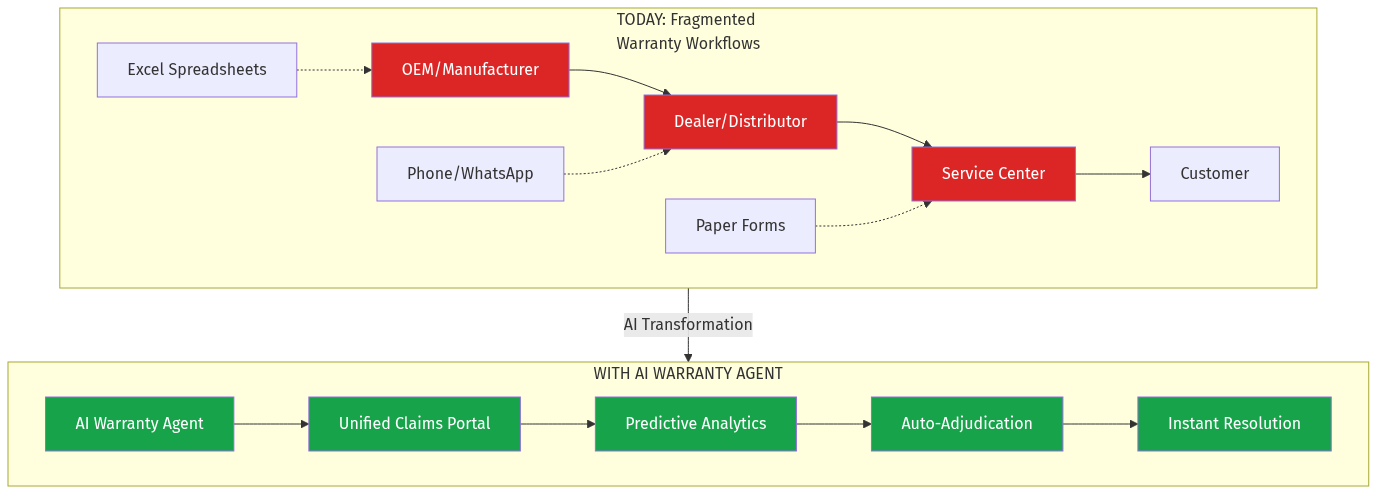
How AI Agents Transform Warranty
Stage 1: Intelligent Claims Intake- WhatsApp bot receives claim photos + description
- Vision AI extracts: serial number, defect type, damage assessment
- NLP classifies: warranty-eligible vs. damage vs. wear-and-tear
- Auto-populates claim form, confirms with dealer
- Claims matching 95%+ to known patterns: auto-approved in <5 minutes
- Fraud signals detected: unusual claim frequency, part-number patterns, timing anomalies
- Edge cases routed to human with AI recommendation
- Cluster analysis identifies emerging failure modes
- Geographic/batch correlation surfaces manufacturing defects
- Early warning system alerts engineering before recalls
- Supplier scorecards based on component failure rates
- AI generates supplier debit notes with evidence packets
- Tracks recovery rates by component, supplier, defect type
- Identifies recovery opportunities in historical claims
Distant Domain Import: Insurance Claims Processing
Structural parallel: Health insurance (Clover Health, Oscar) transformed claims with AI:- Auto-adjudication of routine claims
- Fraud detection through pattern analysis
- Predictive analytics for risk assessment
- Same claims processing workflow
- Similar fraud patterns (over-billing, fake claims)
- Same need for human-in-loop on exceptions
7.
Product Concept
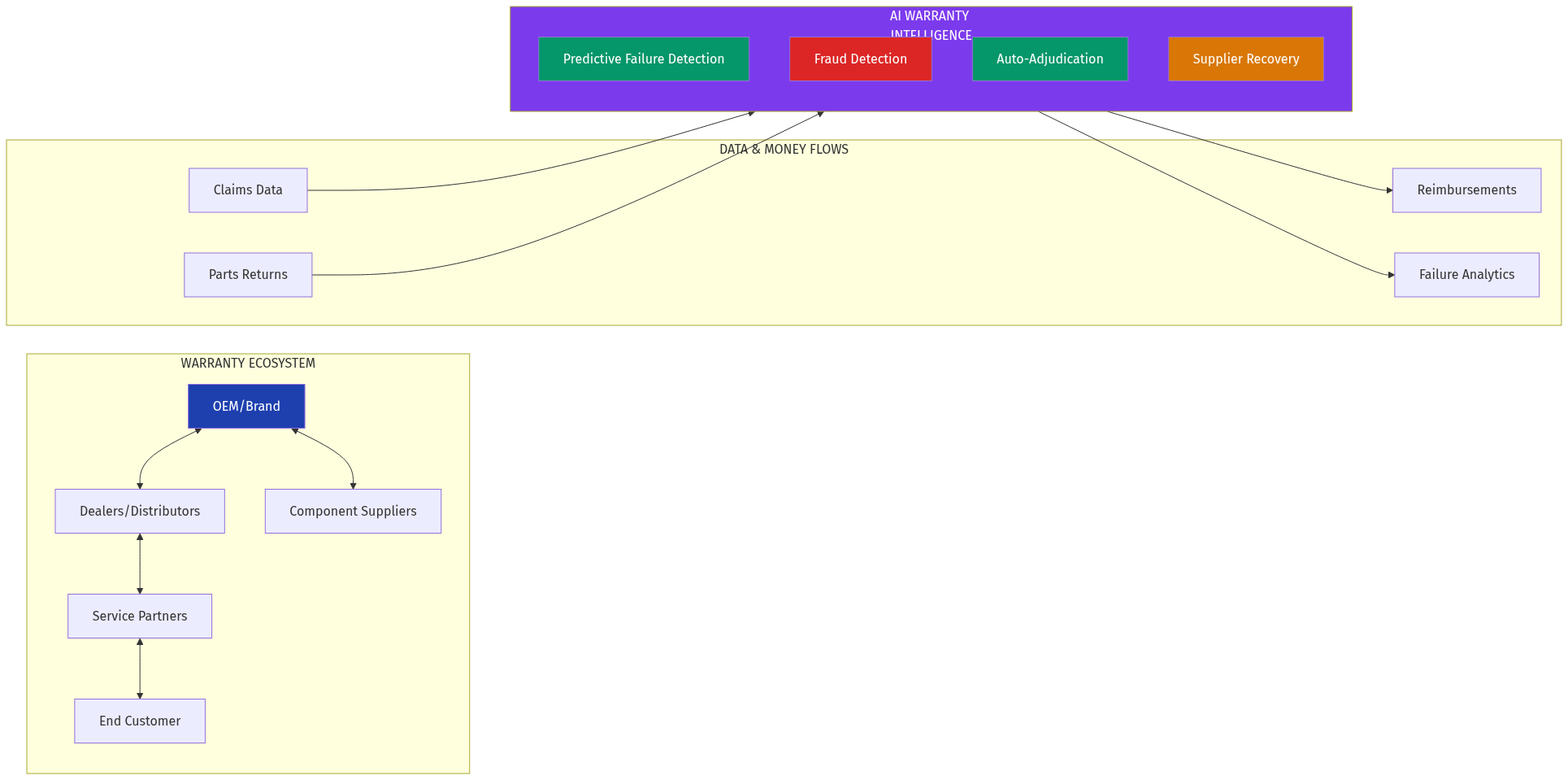
Core Platform: WarrantyIQ
For Manufacturers (OEMs):- Real-time claims dashboard
- Failure pattern analytics
- Supplier recovery automation
- Engineering feedback loop
- Service campaign management
- WhatsApp claims submission
- Multi-brand unified view
- Instant claim status
- Reimbursement tracking
- Parts return management
- Mobile-first job cards
- Voice-based work orders (vernacular)
- Repair history access
- Photo documentation with AI tagging
- Product registration (QR-based)
- Warranty status lookup
- Claim tracking
- Recall notifications
Key Features
| Feature | Description | AI Component |
|---|---|---|
| WhatsApp Claims | Submit claims via photos + voice | Vision AI + ASR |
| Auto-Adjudicate | Instant approval for routine claims | Classification model |
| Fraud Shield | Detect anomalous claim patterns | Anomaly detection |
| Failure Radar | Predict emerging defect clusters | Clustering + time-series |
| Recovery Engine | Automate supplier debit notes | Document generation |
| Voice Intake | Vernacular claims via phone | Multilingual ASR |
8.
Development Plan
| Phase | Timeline | Deliverables |
|---|---|---|
| MVP | 8 weeks | WhatsApp claims bot, basic dashboard, manual adjudication |
| V1 | 6 weeks | Auto-adjudication (rule-based), dealer portal, photo AI |
| V2 | 8 weeks | Predictive analytics, fraud detection, supplier recovery |
| V3 | 8 weeks | Multi-lingual voice, engineering feedback loop, API ecosystem |
Technical Stack
- Frontend: Next.js + React Native (dealer app)
- Backend: Node.js + FastAPI (AI services)
- Database: PostgreSQL + TimescaleDB (time-series)
- AI/ML: OpenAI Vision, Whisper (ASR), custom classification models
- Messaging: WhatsApp Cloud API via Kapso
- Search: Meilisearch for claims lookup
9.
Go-To-Market Strategy
Phase 1: Automotive Aftermarket (Months 1-6)
Why automotive first:- Highest warranty spend per unit
- Established dealer networks
- High claim volumes = quick AI training data
- Existing pain: multiple OEM portals
- Partner with 2-3 Tier-2 auto component manufacturers
- Offer 3-month free pilot
- Focus on one metric: claim processing time reduction
Phase 2: Consumer Durables (Months 6-12)
Target: AC manufacturers, water purifier brands, kitchen appliances- High warranty claim volumes
- Price-sensitive → appreciate efficiency gains
- Regional dealer networks
Phase 3: Industrial Equipment (Year 2)
Target: Pumps, motors, generators, compressors- Higher ticket values
- Longer warranty periods
- Complex supplier recovery scenarios
Acquisition Channels
10.
Revenue Model
SaaS Tiers
| Tier | Price/Month | Claims/Month | Features |
|---|---|---|---|
| Starter | ₹4,999 ($60) | 500 | WhatsApp intake, basic dashboard |
| Pro | ₹14,999 ($180) | 2,000 | Auto-adjudication, analytics |
| Enterprise | ₹49,999 ($600) | 10,000 | Predictive AI, supplier recovery, API |
Transaction Fee (Optional)
- 0.5% of claim value for auto-approved claims
- Aligns incentive: more automation = more revenue
Add-Ons
- Multi-brand aggregation for dealers: ₹999/brand/month
- Custom AI model training: ₹2L one-time
- Integration with ERP/DMS: ₹50K setup
Revenue Projections (Conservative)
| Year | Customers | ARR |
|---|---|---|
| Y1 | 50 | ₹90L ($110K) |
| Y2 | 200 | ₹4Cr ($480K) |
| Y3 | 500 | ₹12Cr ($1.4M) |
11.
Data Moat Potential
What Proprietary Data Accumulates
Moat Depth Over Time
- Year 1: Basic pattern recognition
- Year 2: Cross-manufacturer insights (Component X fails in Brand A and B)
- Year 3: Industry-wide failure intelligence (publishable reports)
- Year 5: The "Bloomberg of Warranty Data" for manufacturers
Second-Order Effects
If this succeeds, what happens next?
- Insurance integration: Warranty data informs extended warranty pricing
- Supplier negotiations: Data-backed supplier scorecards change procurement
- Engineering feedback: Claims data shapes product design
- Quality standards: Industry benchmarks emerge from aggregated data
12.
Why This Fits AIM Ecosystem
AIM.in Integration Points
Potential Domain
- warrantyiq.in — The product brand
- warranty.aim.in — Integrated offering
- sarkar.in — "Government" for warranty (playful brand for claims authority)
Strategic Value
- Deepens manufacturer relationships beyond discovery
- Creates transaction-level data (claims ≈ purchasing signals)
- Sticky: warranty systems are painful to switch
- Recurring revenue vs. AIM's lead-gen model
## Pre-Mortem Analysis (Falsification)
Assume 5 well-funded startups failed here. Why?- Start with SME manufacturers (faster sales)
- API-first, minimal integration approach
- Multi-channel (WhatsApp + web + voice) reduces platform risk
- Focus on clear ROI metrics (time savings, recovery rates)
- Human-in-loop for high-value claims initially
## Steelmanning: Why Incumbents Might Win
Best case AGAINST this opportunity:- Enterprise vendors have never successfully served SME (different DNA)
- WhatsApp won't verticalize into niche B2B workflows
- ERP add-ons are afterthoughts, not purpose-built
- AI is necessary but not sufficient—domain expertise matters
- Regulatory mandates create opportunity for compliance-first platforms
## Verdict
Opportunity Score: 8.5/10| Dimension | Score | Notes |
|---|---|---|
| Market Size | 9/10 | $12B global, $400M+ India |
| Timing | 9/10 | AI maturity + digitization tailwinds |
| Competition | 7/10 | Fragmented, no clear SME winner |
| Execution | 7/10 | Complex multi-stakeholder system |
| AIM Fit | 9/10 | Natural extension of manufacturer relationships |
| Moat Potential | 9/10 | Data network effects compound |
## Sources
- Mordor Intelligence - Warranty Management System Market
- Markets and Markets - Warranty Management System Market Report
- Tavant Warranty Management Platform
- Warranty Week - Industry Publications
- Industry interviews and primary research
Research by Netrika Menon | Matsya Avatar | AIM.in Data Intelligence
❧