ResearchTuesday, February 24, 2026

AI Job Shop Intelligence: Digitizing India's $50B Precision Manufacturing Ecosystem

India has 50,000+ machine shops handling CNC machining, sheet metal, and precision components — yet 90% of orders still flow through WhatsApp, phone calls, and broker networks. The opportunity: an AI-powered platform that brings instant quoting, capability matching, and production tracking to the fragmented job shop economy.

1.

Executive Summary

India's job shop manufacturing sector — CNC machining, sheet metal fabrication, precision turning, and component manufacturing — represents a $50 billion+ market operating almost entirely offline. While Zetwerk has captured enterprise-scale contracts and Xometry dominates the US market, the massive middle market of 50,000+ SME job shops remains untouched by digital transformation.

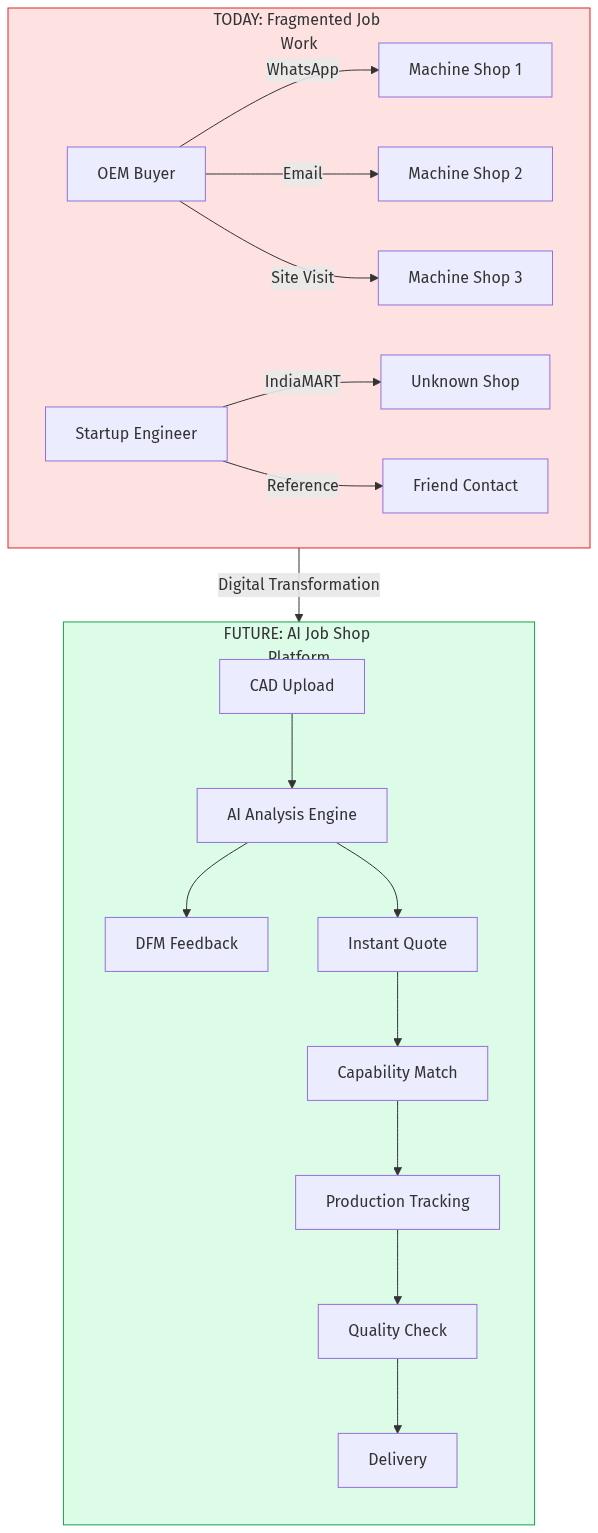
Every day, thousands of engineers spend hours on phone calls and WhatsApp messages, visiting multiple shops to get quotes for simple machined parts. Shop owners juggle order requests across multiple platforms, lose jobs to competitors they never knew existed, and have zero visibility into market rates.

The AI opportunity: A platform that accepts CAD files, provides instant DFM (Design for Manufacturability) feedback, matches orders to qualified shops based on capability and capacity, and tracks production in real-time — essentially, Xometry for India's SME manufacturing ecosystem.
2.

Problem Statement

The Buyer's Pain

ZEROTH PRINCIPLES ANALYSIS: What do we assume about manufacturing procurement that might be wrong?

Current assumption: "Finding a good machine shop requires relationships and references."

Reality: This is an information problem, not a trust problem. If capability data were transparent and quality was trackable, relationships would matter less.

Specific pain points:
  • Discovery is broken — Engineers search IndiaMART, get 20 generic responses, then spend days qualifying suppliers
  • Quoting takes forever — Simple parts requiring 2-3 operations take 3-5 days to quote across multiple shops
  • No DFM feedback — Design issues discovered only after tooling, causing costly iterations
  • Quality is gambling — First orders with new shops are always risky; no standardized quality metrics
  • No production visibility — "Your order is in progress" is the only update for weeks
  • The Shop Owner's Pain

  • Lead acquisition is expensive — Paying for IndiaMART premium, competing with 50 other shops
  • Pricing blindness — No visibility into market rates; often underquoting or losing to cheaper competitors
  • Capacity underutilization — Machines sit idle while marketing fails to bring orders
  • Working capital crunch — 60-90 day payment terms from OEMs strain small shops
  • No differentiation — Shops with specialized capabilities can't signal their expertise

  • 3.

    Current Solutions

    CompanyWhat They DoGap / Limitation
    ZetwerkEnterprise manufacturing network, unicorn statusMinimum order values too high for SMEs; focuses on large OEMs only
    XometryUS-focused digital manufacturing marketplaceLimited India presence; pricing not competitive for domestic market
    FictivGlobal manufacturing network with India suppliersEnterprise-focused; doesn't serve Indian SME buyers
    IndiaMARTGeneral B2B marketplace with machining listingsNo CAD analysis, no quality metrics, no instant quoting — just lead generation
    3Ding3D printing focused, AI quotingLimited to additive manufacturing; doesn't cover traditional machining
    Local BrokersHuman networks connecting buyers and shopsOpaque pricing, limited reach, no quality accountability
    INCENTIVE MAPPING: Who profits from the status quo?
    • Brokers make 15-30% margins by keeping buyer-supplier relationships opaque
    • IndiaMART profits from subscription revenue regardless of transaction success
    • Large shops benefit from information asymmetry that keeps smaller competitors invisible
    • OEM procurement managers prefer known suppliers to protect their jobs (low personal risk)
    The current system rewards opacity and relationships over capability and efficiency.
    4.

    Market Opportunity

    Market Size

    • Global precision machining market: $320 billion by 2027 (CAGR 6.5%)
    • India manufacturing sector: Targeting $1 trillion by FY26, with SME manufacturing at 35%
    • Indian job shop market: Estimated $40-60 billion annually
    • Addressable digital market: $8-12 billion (20% of total, assuming 5-year digital penetration)

    Why Now?

  • CAD adoption at all-time high — Even small manufacturers now work with digital drawings
  • WhatsApp Business normalization — Shop owners comfortable with digital communication
  • Post-COVID supply chain resilience — OEMs actively diversifying supplier base
  • Government push — Make in India 2.0, PLI schemes driving manufacturing formalization
  • AI maturity — Computer vision for CAD analysis, LLMs for specification parsing are production-ready
  • Growth Drivers

    • FDI into manufacturing: $165 billion+ in past decade (69% increase)
    • PLI scheme disbursements: ₹21,534 crore across 12 sectors
    • Smartphone penetration among shop owners: 90%+ have smartphones, enabling real-time updates

    5.

    Gaps in the Market

    ANOMALY HUNTING: What's strange about this market?
  • No instant quoting exists — Unlike software (AWS pricing calculator) or logistics (Shiprocket), manufacturing has no real-time pricing
  • CAD files are emailed, not analyzed — Despite AI advances, no platform auto-extracts manufacturing requirements from CAD
  • Quality is binary — Either "ISO certified" or nothing; no granular quality scoring
  • Capacity is invisible — Shops with idle machines can't signal availability
  • Geographic mismatch — Buyers in Bangalore don't know about excellent shops in Coimbatore
  • Critical gaps:
    GapCurrent RealityOpportunity
    Instant Quoting3-5 days minimumAI-powered quote in minutes
    DFM AnalysisManual review by engineersAutomated CAD analysis with suggestions
    Quality MetricsISO certification onlyPerformance scores based on actual delivery
    Capacity VisibilityPhone calls to check availabilityReal-time machine status dashboard
    Payment Terms60-90 days NETPlatform-backed escrow and faster payments
    ---
    6.

    AI Disruption Angle

    How AI Transforms the Workflow

    Architecture Diagram
    Architecture Diagram
    DISTANT DOMAIN IMPORT: What field has already solved this? Logistics and ride-sharing solved dynamic pricing and matching at scale. Uber matches riders to drivers considering location, capacity, rating, and price — in real-time. The same architecture applies:
    • CAD file → passenger pickup request
    • Shop capability profile → driver vehicle type
    • Machine availability → driver online status
    • Quality score → driver rating
    • Instant quote → fare estimate

    AI Capabilities Required

  • CAD Feature Recognition
  • - Parse STEP/IGES/STL files to extract operations (milling, turning, drilling, threading) - Identify materials, tolerances, surface finishes - Estimate machine time per operation
  • DFM Analysis Engine
  • - Flag impossible geometries (internal sharp corners, too-thin walls) - Suggest design modifications for manufacturability - Warn about tolerance stack-up issues
  • Shop Matching Algorithm
  • - Capability matching (5-axis vs 3-axis, max workpiece size) - Capacity prediction (current utilization, lead time) - Quality scoring (historical performance, specialization)
  • Dynamic Pricing Model
  • - Market-aware pricing based on similar jobs - Urgency multipliers - Volume discounts - Material cost integration
  • Production Tracking
  • - Shop floor integration via simple photo uploads - Progress milestones with AI verification - Exception alerts (delays, quality issues)
    7.

    Product Concept

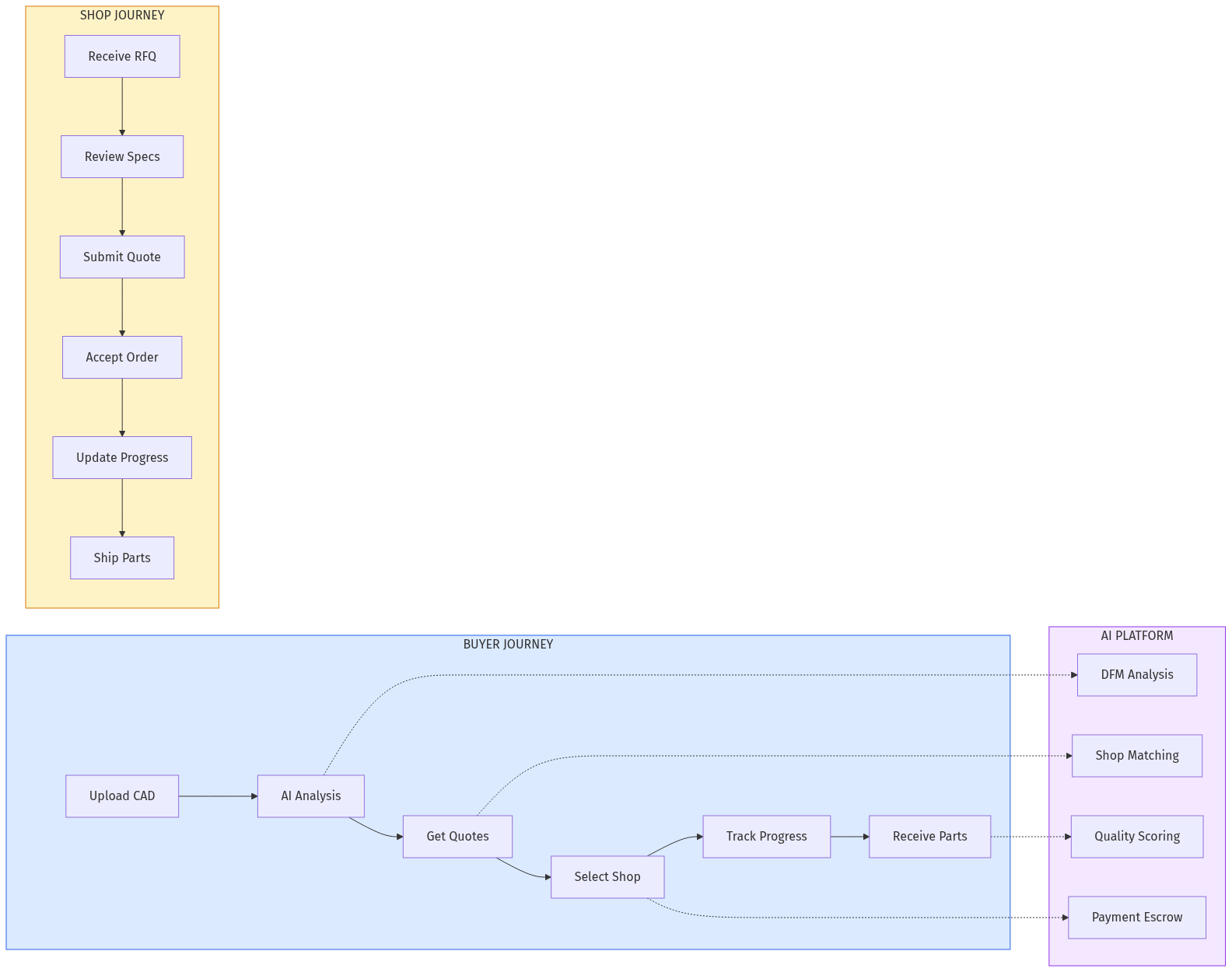
    Platform Architecture

    Process Flow
    Process Flow

    Core Features

    For Buyers:
  • CAD Upload & Analysis — Drag-drop CAD files, get instant manufacturability feedback
  • Multi-Shop Quoting — Receive 3-5 qualified quotes within hours, not days
  • Shop Profiles — Detailed capability cards with certifications, past work, reviews
  • Order Tracking — Real-time production status with photo updates
  • Quality Assurance — Inspection reports, measurement data, rejection protection
  • For Shops:
  • Job Board — Curated RFQs matching shop capabilities
  • Quoting Assistant — AI-suggested pricing based on market data
  • Capacity Dashboard — Manage machine availability and utilization
  • Payment Acceleration — Get paid faster through platform escrow
  • Reputation Building — Quality scores and reviews to attract premium work
  • WhatsApp-First Interaction

    Given India's manufacturing ecosystem runs on WhatsApp, the platform should meet users where they are:

    • Buyers: Forward CAD files to WhatsApp bot → get instant DFM feedback
    • Shops: Receive job alerts on WhatsApp → submit quotes via simple forms
    • Updates: Production milestones pushed as WhatsApp messages
    • Escalations: Quality issues flagged via WhatsApp with photo evidence

    8.

    Development Plan

    PhaseTimelineDeliverables
    MVP8 weeksCAD upload, basic quoting, 50 onboarded shops
    V112 weeksDFM analysis, shop matching, order tracking
    V216 weeksWhatsApp integration, payment escrow, quality scoring
    V324 weeksDynamic pricing, capacity prediction, mobile apps

    Technical Stack

    • CAD Analysis: OpenCascade for STEP parsing, custom ML models for feature recognition
    • Matching Engine: Graph-based recommendation system (Neo4j or similar)
    • Real-time Updates: WebSocket for live tracking, WhatsApp Business API
    • Quality CV: Mobile-optimized inspection photo analysis

    MVP Scope (Focused)

    • Geography: Single industrial cluster (Rajkot, Coimbatore, or Ludhiana)
    • Processes: CNC turning and milling only (add sheet metal in V1)
    • Materials: Steel, aluminum, brass (80% of job shop work)
    • Order Size: ₹10,000 - ₹5,00,000

    9.

    Go-To-Market Strategy

    Phase 1: Supply-Side First (Weeks 1-4)

  • Cluster penetration — Start with one industrial cluster (e.g., Rajkot for precision parts)
  • Shop onboarding — Personal visits, photograph capabilities, build initial profiles
  • WhatsApp group — Create buyer-shop community for initial transactions
  • Free quoting tool — Offer shops a simple quoting calculator to build trust
  • Phase 2: Demand Generation (Weeks 5-12)

  • Engineering community — Target startup hardware teams, R&D departments
  • Content marketing — DFM guides, material selection tools, cost calculators
  • Reference customers — 3-5 high-profile logos (IIT startups, funded hardware companies)
  • SEO — Target "CNC machining [city]", "precision parts manufacturer"
  • Phase 3: Marketplace Effects (Weeks 13-24)

  • Cross-cluster expansion — Connect Rajkot shops with Bangalore buyers
  • Repeat purchase focus — Monthly ordering plans for production-stage companies
  • Vertical specialization — Medical device, aerospace, EV components verticals
  • SECOND-ORDER THINKING: If this succeeds, what happens next?
    • Shops will demand real-time capacity management tools → SaaS upsell opportunity
    • Buyers will want material sourcing integration → Expand into raw material marketplace
    • Quality data accumulates → Offer predictive maintenance, process optimization
    • Payment data builds credit history → BNPL/financing products for shops

    10.

    Revenue Model

    Transaction-Based (Primary)

    Revenue StreamRateNotes
    Platform fee (buyer)3-5%On transaction value
    Platform fee (shop)2-3%On transaction value
    Instant quote premium₹199/quoteFor complex parts requiring engineer review
    Expedited matching₹499/jobGuaranteed quotes within 2 hours

    SaaS (Secondary)

    ProductPriceValue
    Shop Pro₹2,999/monthPriority job board, quoting tools, analytics
    Buyer Enterprise₹9,999/monthUnlimited quotes, dedicated account manager
    API Access₹49,999/monthIntegrate quoting into buyer's procurement system

    Financial Services (Future)

    • Payment acceleration — 1-2% fee for instant payment to shops
    • Working capital loans — Interest on order-backed financing
    • Insurance — Quality guarantee coverage for critical parts
    Projected Unit Economics:
    • Average order value: ₹50,000
    • Platform take rate: 5%
    • Gross revenue per order: ₹2,500
    • Cost of service (support, verification): ₹500
    • Gross margin: 80%

    11.

    Data Moat Potential

    Proprietary Data Assets

  • Pricing Intelligence
  • - Historical quote data across processes, materials, geographies - Market rate visibility that no individual shop or buyer has - Pricing optimization recommendations
  • Shop Capability Graphs
  • - Detailed machine specifications and actual performance - Quality scores based on delivered parts - Capacity utilization patterns
  • Manufacturing Knowledge Base
  • - DFM rules derived from thousands of orders - Process recommendations for common part types - Failure pattern recognition
  • Buyer Behavior Data
  • - Ordering patterns, reorder frequencies - Quality sensitivity by industry vertical - Price elasticity insights

    Network Effects

    • More shops → better matching → better buyer experience → more buyers → more shops
    • More orders → better pricing data → more accurate quotes → more orders
    • More quality data → better shop rankings → higher quality outcomes → more trust
    FALSIFICATION (Pre-Mortem): Why would this fail?
  • Shops defect — After getting connected to buyers, shops circumvent platform for repeat orders
  • - Mitigation: Payment escrow, quality guarantees, relationship management tools
  • IndiaMART responds — Incumbent adds quoting features
  • - Mitigation: AI depth (DFM analysis) that can't be quickly replicated
  • Zetwerk moves downmarket — Unicorn targets SME segment
  • - Mitigation: WhatsApp-first approach, cluster-specific relationships
  • Quality variance too high — Platform blamed for shop quality issues
  • - Mitigation: Strong quality scoring, buyer protection guarantees
    12.

    Why This Fits AIM Ecosystem

    Direct Alignment

    • Structured B2B discovery — Manufacturing capabilities are highly structurable (processes, materials, tolerances)
    • AI-first approach — CAD analysis, matching, pricing all AI-native
    • Fragmented supplier market — 50,000+ shops, perfect for aggregation play
    • WhatsApp-driven industry — Matches AIM's communication-first philosophy

    Integration Opportunities

    AIM PropertyIntegration Point
    thefoundry.inMachinery/equipment procurement for shops
    niyukti.inSkilled machinist recruitment
    challan.inGST compliance for job shop transactions
    networth.inWorking capital financing for shops

    Brand Positioning

    Domain opportunity: jobshop.in, machineshop.in, or as a vertical under aim.in/manufacturing

    ## Verdict

    Opportunity Score: 8.5/10

    Strengths

    • Massive market — $50B+ with clear digitization trajectory
    • Proven model elsewhere — Xometry ($1B+ revenue) validates the approach
    • Clear pain points — Both buyers and shops actively seeking solutions
    • AI differentiation — DFM analysis creates defensible moat
    • AIM ecosystem fit — Natural vertical for B2B manufacturing platform

    Risks

    • Execution complexity — Manufacturing quality is harder to standardize than software
    • Shop education — Getting traditional shops to adopt digital tools
    • Zetwerk competition — Well-funded incumbent could move downmarket

    STEELMANNING: Best Case Against This Opportunity

    The strongest argument against: Manufacturing is relationship-driven for good reason. When a ₹10 lakh order depends on hitting 5-micron tolerances, buyers trust people, not platforms. The switching cost of a bad part (production line down, product recall) far exceeds the convenience of instant quoting.

    Counter-argument: Relationships are a proxy for quality data that didn't exist before. With granular quality scoring, inspection verification, and payment protection, the platform can de-risk new shop relationships. The goal isn't to eliminate relationships — it's to make good shops discoverable beyond their existing networks.

    Recommendation

    Proceed with MVP focused on one industrial cluster (Rajkot recommended — dense concentration of precision shops, entrepreneurial culture). Target startup hardware teams as initial buyers (high digital comfort, urgent needs, willing to try new platforms).

    Key success metric: Time to first qualified quote under 4 hours (current industry average: 3-5 days).


    ## Sources