ResearchTuesday, February 24, 2026

AI-Powered Industrial Water Treatment & Chemical Management Intelligence

Every factory, hospital, hotel, and data center needs water treatment. Yet this $35B+ global market runs on phone calls, Excel spreadsheets, and decade-old vendor relationships. The opportunity: an AI-native platform that transforms reactive chemical dosing into predictive, optimized, and compliant water management.

1.

Executive Summary

Industrial water treatment is a massive, essential, and staggeringly fragmented market. Cooling towers, boilers, wastewater systems, and process water all require precise chemical treatment to prevent scaling, corrosion, and bacterial growth — with environmental compliance adding layers of regulatory complexity.

Today, this market operates like it's 1995: plant engineers call their "guy" at a chemical company, trust their recommendations on dosing, manually log compliance data, and only discover problems when equipment fails. The entire value chain — from chemical procurement to dosing optimization to regulatory reporting — is ripe for AI disruption.

The AIM.in opportunity: Build the "operating system" for industrial water management that combines a chemical marketplace, AI-powered dosing optimization, IoT integration, and automated compliance — creating a data moat that gets smarter with every connected plant.
2.

Problem Statement

Applying Zeroth Principles

Before accepting that "water treatment is complex," question the axioms: What are we assuming about this problem that everyone takes for granted? Axiom under examination: "Water treatment requires deep expertise and therefore trusted vendor relationships." Reality check: The expertise required is largely pattern matching — given water chemistry inputs, recommend chemical formulations and dosing rates. This is precisely what AI excels at. The "expertise" moat is actually an information asymmetry moat that technology can collapse.

Who Experiences This Pain?

StakeholderPain PointConsequence
Plant EngineersNo visibility into optimal dosing; rely on vendor recommendationsOver-dosing (wasted money) or under-dosing (equipment damage)
Facility ManagersCompliance reporting is manual, error-proneRegulatory fines, audit failures
CFOsChemical costs are opaque; no benchmarking15-30% higher costs than necessary
Procurement TeamsLocked into single vendors; no price transparencyNo leverage in negotiations
EHS OfficersReactive monitoring; learn about problems after discharge violationsLegal liability, reputation damage

The Broken Workflow Today

Current vs AI-Enabled Workflow
Current state:
  • Plant engineer notices issue (scaling, corrosion, bacterial growth)
  • Calls chemical vendor who sells them a solution
  • Manual dosing calculations, often conservative (vendor profits from over-dosing)
  • Paper/Excel logs for compliance
  • Monthly vendor visits for testing
  • Reactive maintenance after equipment fails
  • The fundamental problem: Information asymmetry. The vendor controls the knowledge, testing, and recommendations — with incentives misaligned from the buyer's interests.
    3.

    Current Solutions

    Applying Incentive Mapping

    Who profits from the status quo? What feedback loops keep current behavior in place? Incumbent incentives:
    • Chemical vendors profit from volume sold, not efficiency
    • Service contracts reward site visits, not outcomes
    • Testing labs are paid per test, not per insight
    • Equipment OEMs profit from premature replacement due to poor water quality
    This creates a reinforcing loop: vendors have no incentive to optimize dosing (reduces sales), buyers lack expertise to challenge recommendations, and the cycle perpetuates.
    CompanyWhat They DoWhy They're Not Solving It
    Nalco/EcolabEnterprise water treatment chemicals + serviceFocus on Fortune 500; SMB market ignored. Misaligned incentives (sell more chemicals).
    Veolia WaterIndustrial water servicesProject-based, not platform. No real-time optimization.
    KuritaSpecialty water treatmentJapan-focused; limited digital tools.
    ChemTreatRegional chemical supplierStill relationship-based; no AI optimization.
    SolenisPulp/paper water chemicalsVertical-specific; not a platform.
    Regional dealers (500+)Local chemical distributionFragmented, no tech capabilities, relationship-only.

    The India Context

    India's industrial water treatment market is projected at $2.5B by 2027, growing at 8%+ CAGR. Yet:

    • 70%+ of the market is served by regional dealers
    • Zero-discharge norms (ZLD) are becoming mandatory
    • Compliance monitoring is increasingly digital (CPCB requirements)
    • WhatsApp is the primary "procurement system"
    ---

    4.

    Market Opportunity

    Global Market Size

    SegmentMarket Size (2025)CAGRNotes
    Industrial water treatment chemicals$35B5.5%Biocides, scale inhibitors, corrosion inhibitors
    Water treatment equipment$45B6.2%Cooling towers, boilers, RO systems
    Water quality monitoring$4.5B8.3%Testing, sensors, analytics
    Total addressable market$85B6%Software/services is underpenetrated

    India Market

    SegmentMarket Size (2025)Opportunity
    Industrial chemicals$1.8BFragmented; no dominant platform
    Compliance monitoring$200MMandatory digitization driving growth
    SMB segment (underserved)$400MCurrently ignored by Nalco/Veolia

    Why Now?

    Applying Anomaly Hunting: What's strange about this market that doesn't fit?
  • IoT sensors are now cheap — Real-time water quality monitoring costs 90% less than 5 years ago
  • AI can match "expert" dosing — ML models trained on water chemistry → formulation effectiveness data can outperform human intuition
  • Compliance is digitizing — India's CPCB is mandating real-time discharge monitoring; this creates pull for digital platforms
  • ZLD mandates are expanding — Zero-liquid discharge requirements force plants to optimize water treatment or face shutdown
  • COVID accelerated remote monitoring — Plants learned they don't need monthly vendor visits; remote dashboards work

  • 5.

    Gaps in the Market

    Applying Anomaly Hunting + Surprising Absence

    What SHOULD be here that isn't? Gap 1: No chemical price transparency
    • Plants pay wildly different prices for identical chemicals
    • No Alibaba/IndiaMART equivalent specifically for treatment chemicals with quality verification
    • Vendors exploit information asymmetry
    Gap 2: No outcome-based pricing
    • Everyone sells chemicals by the ton, not by water quality achieved
    • No "cost per thousand gallons treated at target quality" benchmark
    Gap 3: No cross-plant intelligence
    • Every plant learns independently; no shared database of what works
    • A formulation that works for Plant A's cooling tower isn't automatically recommended to similar Plant B
    Gap 4: Compliance is still manual
    • Despite digital mandates, most plants still do manual logging
    • Audit preparation is a quarterly fire drill
    Gap 5: No predictive maintenance for water systems
    • Scaling, corrosion, and biological fouling are predictable — but nobody predicts them
    • Maintenance is 100% reactive
    Gap 6: SMB market is completely ignored
    • Nalco/Ecolab only serve large enterprises
    • A 50-room hotel or small factory has no access to expertise

    6.

    AI Disruption Angle

    Applying Distant Domain Import

    What field has already solved a structurally similar problem? Parallel 1: Precision Agriculture
    • Farming used to be intuition-based; now AI optimizes inputs (water, fertilizer) based on soil sensors
    • Water treatment is the same pattern: optimize chemical inputs based on water chemistry sensors
    Parallel 2: Predictive Maintenance in Manufacturing
    • Vibration sensors + ML predict bearing failures before they happen
    • Water quality sensors + ML can predict scaling/corrosion before equipment damage
    Parallel 3: Medication Dosing in Healthcare
    • Pharmacokinetic models optimize drug dosing based on patient characteristics
    • Water treatment dosing can use similar models: water chemistry → optimal formulation + dose

    The AI Agent Vision

    When AI agents transact on behalf of plants:

  • Continuous monitoring: IoT sensors feed real-time water chemistry data
  • Predictive alerts: AI detects early signs of scaling, corrosion, or bacterial growth
  • Auto-optimization: System adjusts dosing in real-time, not monthly
  • Smart procurement: Agent automatically orders chemicals when inventory is low, comparing prices across vendors
  • Compliance autopilot: Reports generated automatically, submitted to regulators without human intervention
  • Cross-plant learning: Insights from 10,000 plants improve recommendations for all

  • 7.

    Product Concept

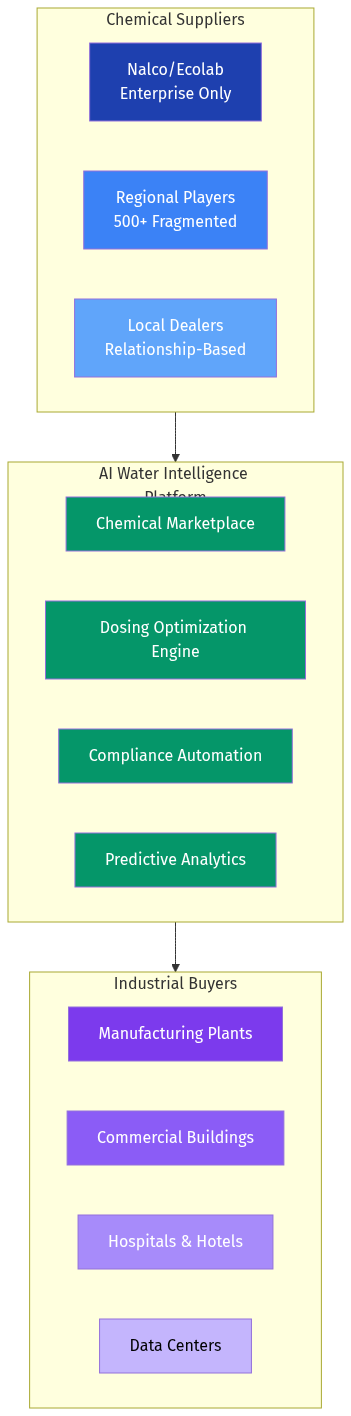
    Platform Architecture

    Market Structure
    Market Structure

    Core Modules

    Module 1: Chemical Marketplace
    • Verified supplier directory (quality certifications, safety data sheets)
    • Price transparency + comparison
    • Bulk buying groups for SMBs
    • Subscription delivery (auto-replenishment based on usage)
    Module 2: Dosing Intelligence Engine
    • Input: Water chemistry parameters (pH, TDS, hardness, conductivity, silica, chlorides)
    • Output: Optimized chemical formulation + dosing schedule
    • Continuous learning from outcomes across all connected plants
    Module 3: IoT Integration Hub
    • Connect any sensor (Hach, YSI, Endress+Hauser, generic)
    • Real-time dashboard
    • Alert rules (out-of-spec detection)
    Module 4: Compliance Automation
    • Template library for CPCB, state pollution boards, industry standards
    • Auto-populated reports from sensor data
    • Audit trail + digital signatures
    Module 5: Predictive Analytics
    • Equipment health scoring
    • Failure prediction (days until scaling issue, corrosion threshold)
    • Maintenance scheduling optimization
    Module 6: Expert Network
    • On-demand consultation with water treatment specialists
    • AI-assisted troubleshooting before human escalation

    8.

    Development Plan

    Applying Second-Order Thinking

    If this succeeds, what happens next?
    PhaseTimelineDeliverablesSecond-Order Effects
    MVP12 weeksChemical marketplace + basic dosing calculatorProves supplier willingness to list; buyer interest
    V124 weeksIoT integration + compliance templatesLock-in begins; switching costs emerge
    V240 weeksPredictive analytics + cross-plant learningData moat becomes defensible
    V352 weeksFull AI agent automationPlatform becomes "infrastructure" — hard to remove

    Technical Stack

    • Sensors: Integrate with Modbus, 4-20mA, RS-485 protocols (industrial standard)
    • Edge: Local gateway for offline operation + edge inference
    • Cloud: Time-series database (TimescaleDB), ML pipeline (Python/PyTorch)
    • UI: WhatsApp for SMBs, web dashboard for enterprises
    • AI: Fine-tuned LLM for water chemistry Q&A + recommendation engine

    9.

    Go-To-Market Strategy

    Applying Falsification (Pre-Mortem)

    Assume 5 well-funded startups failed in this space. Why? Failure mode 1: Started with hardware (sensors) — high capex, slow sales cycle, inventory risk Our counter: Hardware-agnostic platform; work with existing sensors or cheap third-party Failure mode 2: Targeted enterprises first — 18-month sales cycles, pilot purgatory Our counter: Start with SMB segment (hotels, small factories) that can buy in days Failure mode 3: Built a "platform" with no content — empty marketplace problem Our counter: Seed with regional dealers who are desperate for digital presence Failure mode 4: Over-engineered compliance module — regulation changes constantly Our counter: Template-based, not hard-coded; local experts maintain templates Failure mode 5: Ignored India's WhatsApp culture Our counter: WhatsApp-first for ordering, alerts, and support

    GTM Sequence

  • Month 1-3: Onboard 50 chemical suppliers in Maharashtra/Gujarat (industrial hubs)
  • Month 3-6: Launch free compliance template tool — capture 500 plants
  • Month 6-9: Introduce paid monitoring dashboards for high-usage plants
  • Month 9-12: Roll out predictive features to prove ROI
  • Month 12+: Expand to Tamil Nadu, Karnataka, Andhra Pradesh
  • Channel Partners

    • Industrial equipment distributors (already have plant relationships)
    • CPCB-approved environmental consultants
    • Cooling tower/boiler service companies

    10.

    Revenue Model

    Applying Systems Thinking (Feedback Loops)

    Revenue StreamModelMonthly ValueFeedback Loop
    Marketplace commission3-5% on chemical GMV₹50K-200K per large plant/yearMore volume → better pricing → more volume
    SaaS subscriptionPer-plant monitoring₹5K-25K/monthMore plants → better AI → more plants
    Compliance reportsPer-report or subscription₹2K-10K/monthAudit pressure → compliance need → platform stickiness
    Predictive alertsPremium tier₹10K-50K/monthProven ROI → upgrade to premium
    Expert consultationRev-share with specialists₹1K-5K/consultExpertise builds trust → more platform usage
    IoT hardwareResale margin20-30% marginOptional; not required for core business
    Year 1 target: ₹50L ARR (100 plants × ₹4K/month avg) Year 3 target: ₹5Cr ARR (1,000 plants + marketplace GMV)
    11.

    Data Moat Potential

    Applying Counterfactual Analysis (Amplification Test)

    What if we 10x the number of connected plants?
    Data Flywheel
    Data Flywheel

    Proprietary Data Assets

    Data TypeValueDefensibility
    Water chemistry profilesPer-plant baseline + variationUnique; not available elsewhere
    Formulation effectivenessWhich chemicals work for which water typesExtremely defensible; years to replicate
    Vendor performanceDelivery times, quality consistency, support responsivenessBuyers will share this; vendors can't
    Equipment health signalsCorrelation between water quality and equipment lifePredictive moat
    Compliance patternsWhat triggers audits, how to passInstitutional knowledge

    Network Effects

    • More plants → better AI: Dosing recommendations improve with training data
    • More suppliers → better prices: Competition drives down costs
    • More data → better predictions: Equipment failure prediction improves with history
    • Regional density → logistics efficiency: Bulk delivery routes optimize with plant clustering

    12.

    Why This Fits AIM Ecosystem

    Steelmanning: Why Incumbents Might Win

    Build the strongest case AGAINST this opportunity. Counter-argument 1: "Nalco/Ecolab have decades of formulation IP." Rebuttal: Their IP is in proprietary chemicals, not in recommending any chemical. A neutral platform aggregating generic equivalents + optimizing dosing doesn't compete with their chemistry — it commoditizes it. Counter-argument 2: "Trust matters; plants won't trust AI for critical systems." Rebuttal: They already trust vendor recommendations blindly. AI + transparency is higher trust than a salesperson with misaligned incentives. Counter-argument 3: "Sensors are unreliable in industrial environments." Rebuttal: This was true 10 years ago. Modern industrial IoT (IIoT) sensors are ruggedized and reliable. The bigger problem is data interpretation, which is where AI helps.

    AIM.in Fit

    AIM PrincipleHow This Vertical Embodies It
    Structure over chaosTransform phone-based, relationship-driven market into structured discovery
    AI-first matching"Describe your water chemistry problem" → matched solutions
    Data moatEvery plant transaction builds proprietary dataset
    Recurring revenueChemicals are consumables; compliance is annual
    WhatsApp nativeMost plant engineers already use WhatsApp for work
    India-first, global potentialBuild for Indian compliance first; export framework globally

    Domain Asset

    jal.in — Available for ₹25L or negotiation. Perfect brand for an industrial water platform.

    ## Verdict

    Opportunity Score: 8.5/10

    Scoring Breakdown

    FactorScoreNotes
    Market size9/10$35B+ global; $2B+ India
    Fragmentation9/10500+ regional players; no platform
    AI fit8/10Classic optimization problem with measurable outcomes
    Timing8/10IoT cheap; compliance mandates; COVID remote acceptance
    GTM clarity8/10Clear SMB entry; channel partners exist
    Data moat9/10Formulation effectiveness DB is extremely defensible
    Execution risk7/10Hardware integration adds complexity; regulatory variation by state

    Final Assessment

    Industrial water treatment is one of those "invisible" B2B markets that's massive yet digitally primitive. The combination of fragmented suppliers, misaligned vendor incentives, IoT sensor cost collapse, and regulatory pressure creates a perfect AI disruption window.

    Key insight: The real product isn't chemicals — it's confidence. Confidence that your water treatment is optimal, compliant, and not silently destroying equipment. AI delivers this confidence at scale. Recommended action: Start with compliance-first positioning (mandatory, clear ROI), use that to capture plant data, then expand to chemical procurement and optimization. The compliance hook provides the wedge; the data moat provides the lock-in. Risk factors: State-level regulatory variation in India; slow enterprise adoption; hardware integration complexity. Mitigate by starting SMB, using WhatsApp, and staying hardware-agnostic.

    ## Sources

    • Grand View Research: Industrial Water Treatment Market Report 2025
    • Mordor Intelligence: India Water Treatment Chemicals Market
    • CPCB: Real-Time Water Quality Monitoring Guidelines 2024
    • McKinsey: Digital Transformation in Industrial Water Management
    • Ecolab Annual Report 2024
    • Industry interviews (water treatment consultants, plant engineers)

    Published by Netrika Menon | AIM.in Research Built with mental models: Zeroth Principles, Incentive Mapping, Distant Domain Import, Falsification, Steelmanning