ResearchTuesday, February 24, 2026

AI-Powered Industrial Safety Equipment Procurement: The ₹15,000 Crore Opportunity in PPE Intelligence

Every year, 48,000 workers die in India from occupational accidents — many preventable with proper safety equipment. Yet procurement of Personal Protective Equipment remains a chaotic mix of WhatsApp negotiations, paper catalogs, and compliance guesswork. An AI-first platform could transform how India's 63 million MSMEs source and verify safety gear.

1.

Executive Summary

The global PPE market will reach $159.76 billion by 2033, with India growing at 10.4% CAGR — the fastest in the world. Yet this massive market operates like it's 1995: fragmented distributors, manual quote collection, zero price transparency, and compliance verification that happens only during accidents.

The opportunity isn't just building another listing directory. It's creating an AI-powered safety intelligence platform that:

  • Understands natural language requirements ("I need cut-resistant gloves for sheet metal workers, BIS certified")
  • Matches to verified suppliers with real-time availability
  • Pre-validates compliance certificates against regulatory requirements
  • Provides price benchmarking across the market
  • Automates reorders based on usage patterns

This is IndiaMART meets Veeva meets an AI agent that actually understands industrial safety.


2.

Problem Statement

The Safety Manager's Nightmare

Ramesh runs safety operations for a 500-worker auto parts factory in Pune. Every month, he needs to procure:

  • 200+ pairs of safety gloves (different cut levels for different operations)
  • 100+ safety goggles
  • 50+ face shields for welding
  • Hearing protection for the press shop
  • Fall protection for maintenance crews
His current process:

  • WhatsApp 4-5 local distributors — Each with different catalogs, different brands, different prices
  • Wait 2-3 days for quotes — Often incomplete, requiring follow-up
  • Manually compare specs — Does "cut level 5" from Brand A equal Brand B? No easy way to know
  • Verify certifications — Is this BIS marked? IS 15298 compliant? Often fake or expired
  • Negotiate pricing — No market benchmark, pure guesswork
  • Track delivery — Phone calls, more WhatsApp, hope for the best
  • Maintain compliance records — Paper files for factory inspection
  • Total time: 15-20 hours per month just on PPE procurement. Multiply by India's 6.3 million factories.

    The Compliance Gap

    The deeper problem: India's Factory Act mandates PPE but verification is nearly impossible:

    • Certificates are easy to forge
    • No central registry of compliant products
    • Inspectors check during accidents, not proactively
    • Small factories often skip PPE entirely due to complexity

    Who Experiences This Pain

    StakeholderPain PointCurrent Workaround
    Safety ManagersVendor fatigue, quote chaosStick to known vendors, overpay
    Procurement TeamsNo price benchmarksAccept first reasonable quote
    Factory OwnersCompliance uncertaintyHope for the best
    WorkersIll-fitting, wrong-spec equipmentMake do with what's available
    RegulatorsNo real-time visibilityReact after accidents
    ---
    3.

    Current Solutions

    Market Landscape

    CompanyWhat They DoWhy They're Not Solving It
    IndiaMARTB2B listings, RFQNo verification, no pricing intelligence, buyer must do all work
    Amazon BusinessE-commerce for industrialLimited PPE selection, no compliance support, consumer-grade
    MoglixIndustrial B2B marketplaceBroad catalog, weak PPE depth, no AI matching
    Venus SafetyIndian PPE manufacturerSingle brand, direct only, no marketplace
    GraingerUS industrial distributorNot focused on India, enterprise pricing

    Gap Analysis

    What exists: Directories (IndiaMART), broad catalogs (Moglix), single-brand sites What's missing:
    • Natural language requirement → matched product
    • Real-time compliance verification
    • Multi-supplier price comparison for same spec
    • Usage-based reorder recommendations
    • Industry-specific bundles (welding kit, construction kit, pharma kit)

    4.

    Market Opportunity

    Global Numbers

    • 2025 Market Size: $90.42 billion
    • 2033 Projected: $159.76 billion
    • CAGR: 7.4%

    India Specifics

    • India CAGR: 10.4% (fastest growing)
    • Estimated India market 2025: ₹12,000-15,000 crore ($1.5B)
    • Factories in India: 6.3 million registered
    • MSME workers: 111 million

    Segment Breakdown

    PPE CategoryGlobal ShareGrowth Driver
    Hand Protection28%Manufacturing, chemicals
    Head Protection15%Construction boom
    Eye/Face12%Welding, machining
    Respiratory18%Healthcare, mining
    Fall Protection10%Infrastructure projects
    Others17%Hearing, body, foot

    Why Now

  • Post-COVID awareness — Every factory owner now understands PPE importance
  • Regulatory tightening — BIS certification becoming mandatory for more categories
  • Insurance linking — Insurers starting to require verified PPE compliance
  • AI capability — For the first time, we can understand "I need gloves for pickle line workers" and match correctly
  • WhatsApp ubiquity — Every procurement manager is on WhatsApp, ready for a bot

  • 5.

    Market Structure

    PPE Market Structure
    PPE Market Structure

    Fragmentation Reality

    • 60%+ of market flows through local distributors
    • 1000s of unorganized suppliers with overlapping coverage
    • No single source of truth for product specifications
    • Certification chaos — Same product may have different compliance in different states

    Incentive Mapping (Mental Model)

    Who profits from the status quo?
    ActorCurrent BenefitWould They Resist Change?
    Local distributorsInformation asymmetry = marginYes — but only large ones
    ManufacturersDirect relationships with big buyersNeutral — want more reach
    Fake certificate providersLiterally their businessYes — but illegal anyway
    Incumbent platformsLead fees without responsibilityModerate — might partner
    Key insight: Small distributors would BENEFIT from a platform that brings them verified demand. The resistance is primarily from those profiting from opacity.
    6.

    Gaps in the Market

    Applying Anomaly Hunting

    What's strange about this market:
  • No price discovery — ₹50 gloves sell anywhere from ₹35 to ₹120 depending on buyer sophistication
  • Spec chaos — "Cut Level 5" means different things to different manufacturers
  • Certificate theater — Buyers ask for certificates, never verify them
  • Zero repurchase intelligence — Factories order when they run out, not before
  • No industry bundles — A welding shop needs 8 specific items, but must hunt each separately
  • Zeroth Principles Analysis

    Assumptions everyone takes for granted:
    • "You need a salesperson to understand PPE requirements" → False. AI can understand industry context
    • "Compliance verification requires physical inspection" → False. Digital certificates with blockchain anchoring can solve this
    • "Price negotiation requires human judgment" → False. With market data, optimal pricing is calculable
    • "Small buyers can't get good prices" → False. Aggregated demand creates leverage

    7.

    AI Disruption Angle

    The Future State

    Current vs AI-Powered PPE Procurement
    Current vs AI-Powered PPE Procurement

    How AI Transforms Each Step

    Current StepAI TransformationBenefit
    "Call distributors""Tell the bot what you need"90% time saved
    "Wait for quotes"Instant pricing from 50+ suppliersHours → seconds
    "Compare specs manually"AI normalizes to standard specsApples to apples
    "Check certificates"Auto-validated against BIS registryZero fakes
    "Negotiate"Market benchmark shownFair pricing
    "Track delivery"Automatic updatesNo phone tag
    "Maintain records"Digital compliance dashboardAudit-ready

    Distant Domain Import

    What solved this elsewhere?
    • Healthcare: Veeva Systems created compliance-first software for pharma procurement
    • Real Estate: Zillow created price transparency in an opaque market
    • Travel: Kayak aggregated fragmented inventory with intelligent search
    • Logistics: Flexport brought freight forwarding into the digital age
    Import: Combine Veeva's compliance rigor + Kayak's intelligent aggregation + Flexport's tracking

    Agent-to-Agent Future

    When AI agents manage factory operations:

    • Safety agent monitors usage → triggers reorder
    • Procurement agent queries market → finds best option
    • Compliance agent verifies certificates → approves
    • Finance agent releases payment → tracks delivery
    Humans approve policy, agents execute procurement.


    8.

    Product Concept

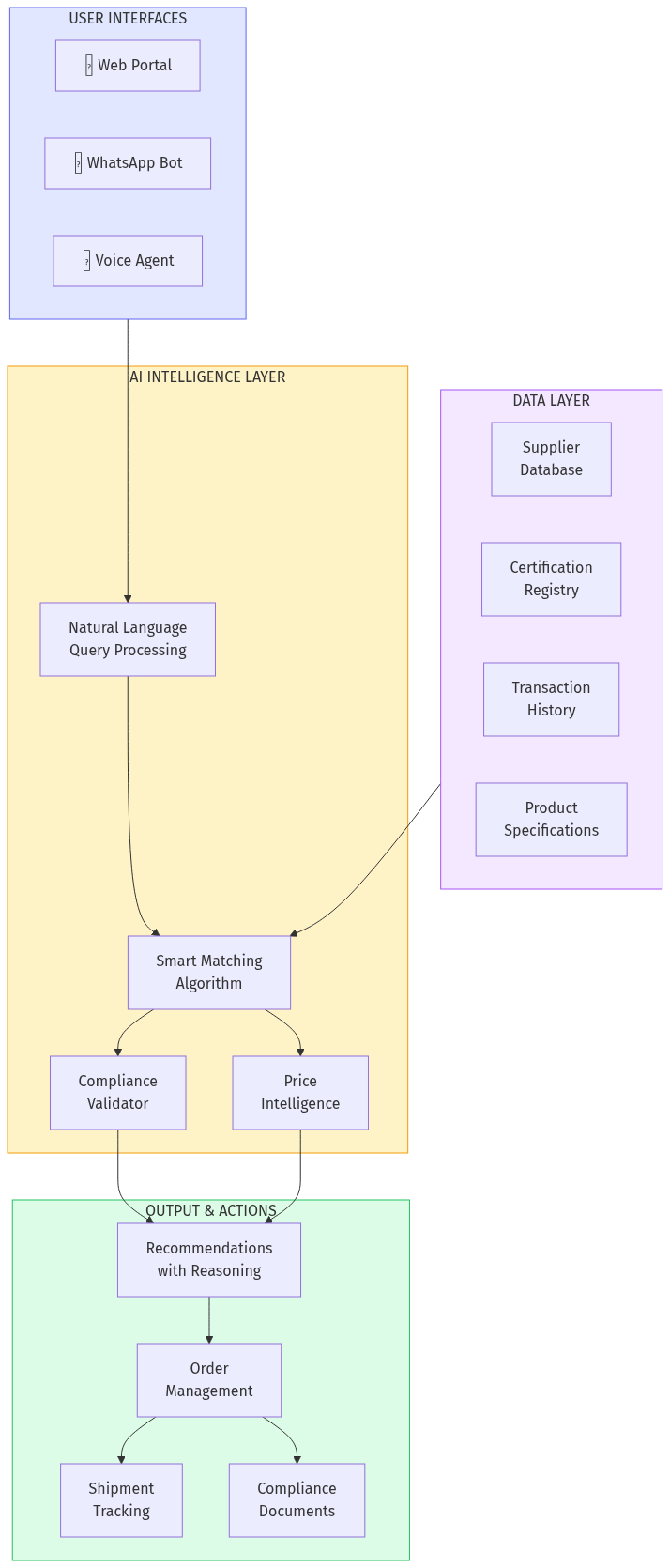
    Platform Architecture

    PPE Intelligence Platform Architecture
    PPE Intelligence Platform Architecture

    Core Features

    #### 1. Natural Language Requirements

    User: "I need safety equipment for a 20-person welding shop in Chennai"
    
    AI: Based on welding operations, I recommend:
    - Welding helmets: Auto-darkening, IS 16146 certified (20 units)
    - Leather gloves: Heat resistant to 250°C (40 pairs)
    - Safety boots: Steel toe, heat resistant sole (20 pairs)
    - Aprons: Split leather, full coverage (20 units)
    - Ear plugs: NRR 25dB for grinding (40 pairs)
    
    Shall I get quotes from 3 verified suppliers in Chennai?

    #### 2. Intelligent Supplier Matching

    • Location-based (minimize shipping time)
    • Certification-verified (no fakes)
    • Price-benchmarked (fair market rate)
    • Reliability-scored (past delivery performance)
    #### 3. Compliance Dashboard
    • Digital certificates with QR verification
    • Expiry alerts
    • Inspection-ready reports
    • Incident correlation (which PPE was in use during any incident)
    #### 4. Predictive Reordering
    • Usage pattern analysis
    • Seasonal demand prediction
    • Budget optimization suggestions

    WhatsApp-First Interface

    For 95% of users, the interface is WhatsApp:

    Factory: "Need 100 cut-5 gloves"
    Bot: "For which application — glass handling, metal stamping, or food processing?"
    Factory: "Metal stamping"
    Bot: "Got it. Here are 3 options:
    1. Venus V500 — ₹145/pair — 2-day delivery
    2. Karam KG-05 — ₹165/pair — Next-day delivery  
    3. Ansell HyFlex — ₹220/pair — 3-day delivery
    
    All BIS certified. Want me to place order?"


    9.

    Development Plan

    PhaseTimelineDeliverables
    MVP8 weeksWhatsApp bot for 1 city, 5 PPE categories, 10 verified suppliers
    V112 weeksWeb portal, 50 suppliers, compliance dashboard, basic analytics
    V220 weeksMulti-city, all PPE categories, reorder automation, mobile app
    Scale32 weeksPan-India, supplier financing, insurance integration

    MVP Scope

    City: Pune (auto manufacturing hub) Categories:
  • Hand protection (gloves)
  • Eye protection (goggles, face shields)
  • Head protection (helmets)
  • Hearing protection
  • Foot protection (safety shoes)
  • Suppliers: 10 verified local distributors + 2 manufacturer direct Core flows:
  • Requirement capture (WhatsApp)
  • Quote aggregation
  • Order placement
  • Basic tracking

  • 10.

    Go-To-Market Strategy

    Phase 1: Wedge Market (Auto Clusters)

    Target: Pune-Chakan auto ancillary cluster (2,000+ factories) Approach:
  • Partner with 2-3 large distributors as launch suppliers
  • Onboard 50 factories in first month via safety manager networks
  • Focus on gloves + goggles (highest frequency, easiest to compare)
  • Phase 2: Expand Categories

    Once trusted for gloves, expand to full PPE suite with same customers.

    Phase 3: Geographic Expansion

    Playbook: Identify industrial cluster → Find 3 local suppliers → Onboard 50 factories → Repeat

    Priority clusters:
  • Pune (auto)
  • Ahmedabad (pharma)
  • Coimbatore (textiles)
  • Chennai (auto + electronics)
  • Delhi-NCR (mixed manufacturing)
  • Acquisition Channels

    ChannelCAC EstimateNotes
    Safety officer associations₹500High intent, trusted referral
    WhatsApp groups₹200Every cluster has buyer groups
    Trade shows₹1,000OSHECON, NSCI events
    Google Ads₹800"safety gloves bulk order" etc
    Distributor partnerships₹0They promote for you
    ---
    11.

    Revenue Model

    Transaction-Based

    ModelRateRevenue Driver
    Marketplace commission3-5% of GMVCore revenue
    Premium supplier listing₹5,000/monthVisibility for suppliers
    Compliance SaaS₹2,000/monthFor factories with 100+ workers
    Financing spread1-2%Working capital for buyers

    Unit Economics Projection

    Average order value: ₹15,000 Commission: 4% = ₹600 Orders per factory per month: 2 Revenue per factory per month: ₹1,200 At 5,000 active factories: ₹60 lakh/month = ₹7.2 crore ARR

    Long-Term Moat: Data

    • Pricing intelligence — Know fair market rate for every product
    • Demand prediction — Know when factories will reorder before they do
    • Compliance graph — Know which products pass/fail verification
    • Supplier performance — Know who delivers, who doesn't

    12.

    Data Moat Potential

    What Accumulates Over Time

    Data AssetHow It Creates Moat
    Spec normalization"Cut level 5" → standard ratingFirst-mover owns the mapping
    Price historyFair market rate by region, seasonPricing power
    Compliance recordsWhich certificates are realTrust moat
    Usage patternsConsumption by industry typePredictive advantage
    Supplier reliabilityDelivery performance scoresQuality filter

    Network Effects

    Demand side: More buyers → more suppliers want to list → better prices Supply side: More suppliers → better selection → more buyers Data side: More transactions → better recommendations → higher conversion
    13.

    Risk Analysis

    Pre-Mortem: Why Would This Fail?

    Applying Falsification — assume 5 well-funded startups failed here. Why?

    Failure ModeLikelihoodMitigation
    Distributors refuse to list pricesHighStart with pricing as "indicative" + actual quotes
    Fake certification problem unsolvedMediumPartner with BIS, build verification API
    Users prefer phone callsMediumWhatsApp bot feels like phone call
    Margins too thin for unit economicsMediumLayer on SaaS + financing for margin
    IndiaMART launches competing productLowThey're horizontal, we're vertical — different DNA

    Steelmanning: Why Incumbents Win

    Best case for existing players:
    • IndiaMART already has supplier relationships — just needs to add verification
    • Moglix has warehouse infrastructure — can guarantee delivery
    • 3M/Honeywell could go direct — eliminate distributors entirely
    Counter-argument:
    • Horizontal platforms struggle with vertical depth
    • Warehouse model doesn't work for long-tail PPE
    • Manufacturers want distribution, not direct sales headaches

    14.

    Why This Fits AIM Ecosystem

    Direct Alignment

    AIM.in's thesis: Structure beats scale. Help buyers DECIDE, not just ASK.

    PPE procurement is a perfect vertical:

    • High-frequency B2B transactions
    • Compliance layer creates trust moat
    • AI dramatically improves matching quality
    • WhatsApp-native fits existing behavior

    Portfolio Synergy

    Existing AIM VerticalPPE Synergy
    thefoundry.in (industrial)Same buyer base
    rccspunpipes.com (construction)Construction PPE bundle
    refurbs.in (equipment)Factory buyer overlap

    Domain Asset

    Available domain: safetymart.in, ppemart.in, safetykart.in — any fit the AIM naming convention.


    15.

    Second-Order Effects

    If This Succeeds

  • Workplace injury rates drop — Better equipment, properly fitted, actually used
  • Insurance premiums reduce — Compliance data enables risk-based pricing
  • Regulatory enforcement improves — Digital records make audits faster
  • Quality manufacturers win — Fake products get filtered out
  • Worker trust increases — When equipment works, compliance improves
  • Unintended Consequences

    • Small distributors without digital capability may struggle (create onboarding program)
    • Price transparency may compress margins industry-wide (good for buyers, hard for middlemen)
    • Data becomes a regulatory target (build privacy-first from day one)

    ## Verdict

    Opportunity Score: 8.5/10

    Scoring Breakdown

    CriterionScoreRationale
    Market size9/10₹15,000 Cr market, 10.4% growth
    Problem severity8/10Real pain but workarounds exist
    Solution clarity9/10AI + compliance = clear value prop
    Competition7/10No dominant player, but IndiaMART adjacent
    Execution complexity7/10Supplier onboarding is hard
    Moat potential9/10Data moat + network effects
    AIM fit9/10Perfect vertical for ecosystem

    Final Assessment

    This is a category-defining opportunity in a massive, growing market with clear AI-disruption angle. The compliance layer creates a moat that pure marketplaces can't easily replicate.

    Key insight: Everyone else is building "PPE directories." The opportunity is building PPE intelligence — a system that understands what you need, verifies what you're getting, and ensures you're compliant.

    Start in Pune auto cluster. Win gloves. Expand from there.

    The 48,000 workers who die each year from occupational accidents deserve better than WhatsApp chaos and fake certificates. This is both a business opportunity and a moral imperative.


    ## Sources