ResearchTuesday, February 24, 2026

AI Industrial Equipment Rental Intelligence: The $200B Fleet Marketplace Waiting for Disruption

Every day, construction managers waste hours calling rental yards. Equipment sits idle while projects stall. The global equipment rental market exceeds $200B, yet discovery remains stuck in the fax machine era. AI agents can transform this chaos into a real-time matching engine that knows every excavator, crane, and generator across the supply network.

1.

Executive Summary

The industrial equipment rental market represents one of the largest untapped opportunities for AI-native marketplace disruption. Worth over $200B globally and growing at 5-7% CAGR, this sector remains stubbornly fragmented—dominated by phone calls, regional relationships, and zero price transparency.

The opportunity: Build an AI-powered equipment rental intelligence platform that aggregates supply from thousands of rental operators, matches demand in real-time, and automates the entire transaction lifecycle from quote to contract to IoT monitoring.

Why this matters now:
  • IoT adoption in heavy equipment has crossed 40%, enabling real-time availability
  • Construction activity is at record levels globally
  • Equipment costs are rising faster than wages, making rental economics increasingly attractive
  • AI agents can finally handle the complex matching logic (specifications, location, duration, insurance)
2.

Problem Statement

The Daily Pain

A project manager at a mid-sized construction firm needs a 30-ton excavator with a hydraulic breaker attachment for a 3-week demolition project starting next Monday. Here's their current workflow:

  • Call 5-8 local rental yards to check availability
  • Email specifications to each vendor
  • Wait 24-48 hours for quotes
  • Compare prices manually (often apples to oranges due to different terms)
  • Negotiate insurance and liability terms separately
  • Sign physical contracts and arrange delivery
  • Hope the equipment arrives on time and in working condition
  • This process takes 3-5 days. For urgent needs, it's often "take whatever's available at any price."

    Who Feels This Pain?

    StakeholderPain Point
    Construction Contractors15-20 hours/month on equipment sourcing
    Infrastructure Project ManagersNo visibility into regional availability
    Manufacturing PlantsCannot plan equipment needs predictively
    Event CompaniesLast-minute rental gouging
    Rental Operators30-40% fleet utilization on average

    The Zeroth Principle Question

    What are we assuming about equipment rental that everyone takes for granted?

    The industry assumes rental is inherently local. A contractor in Pune calls Pune vendors. But equipment is mobile. A crawler crane in Nagpur could serve Pune tomorrow. The "local rental" axiom is actually a discovery problem, not a logistics constraint.


    3.

    Current Solutions

    CompanyWhat They DoWhy They're Not Solving It
    United RentalsLargest rental company globally ($14B revenue)Vertical integration, not a marketplace. Own-fleet bias.
    BigRentzAggregator connecting renters with suppliersUS-only. Basic lead gen, no AI matching. Manual quotes.
    EquipmentShareFleet management + rental marketplaceFocused on fleet owners, not broad aggregation.
    Infra.MarketB2B construction materials marketplaceMaterials focus, minimal equipment rental.
    ZetwerkManufacturing marketplaceCustom fabrication, not rental equipment.

    India-Specific Landscape

    The Indian equipment rental market (~$4-5B) is even more fragmented:

    • ORIX Leasing — Financial services angle, limited inventory
    • Sanvik/JCB rental arms — OEM bias, own equipment only
    • Thousands of regional operators — Zero online presence
    No one has built the "Swiggy for equipment rental" in India.


    4.

    Market Opportunity

    Market Size

    SegmentGlobalIndiaGrowth
    Construction Equipment Rental$120B$2.5B6% CAGR
    Industrial Machinery Rental$45B$0.8B7% CAGR
    Aerial Work Platforms$20B$0.4B8% CAGR
    Material Handling Equipment$15B$0.3B5% CAGR
    Total Addressable Market$200B+$4B+6% CAGR

    Why Now?

  • IoT Penetration — 40%+ of new construction equipment ships with telematics. Real-time location and status are now possible.
  • Post-Pandemic Project Surge — Infrastructure spending is at all-time highs globally. India's $1.4T infrastructure pipeline demands equipment access.
  • Rental Preference Growth — Asset-light models are winning. Companies prefer OPEX (rental) over CAPEX (purchase) for non-core equipment.
  • AI Maturity — Language models can finally understand "I need a JCB with rock breaker for 2 weeks near Vizag" and match it to inventory.
  • Labor Arbitrage — Equipment operators increasingly come bundled with rentals. AI can match operator+equipment combinations.

  • 5.

    Gaps in the Market

    Gap 1: No Universal Equipment Catalog

    There's no standardized way to describe equipment across vendors. One calls it "20T Excavator," another "Tracked Excavator 20MT," another "JCB JS200." AI-native cataloging can normalize this chaos.

    Gap 2: Availability is a Black Box

    Even large rental operators don't have real-time availability dashboards. Equipment might be "available" but committed to a recurring customer. Or it's available but in maintenance. AI agents need to interpret availability signals, not just accept them.

    Gap 3: No Price Intelligence

    Rental rates vary 30-50% for identical equipment across vendors. No one aggregates pricing data to help buyers benchmark. This opacity benefits incumbents.

    Gap 4: Insurance & Liability Remains Manual

    Every rental requires separate insurance verification, damage waivers, and liability agreements. This paperwork adds 2-3 days to every transaction.

    Gap 5: No Predictive Demand Matching

    Construction projects are predictable months in advance. Equipment demand could be forecast from permit data, tender awards, and project schedules. No one does this.

    Anomaly: The Idle Fleet Problem

    40% of rental fleet sits idle at any given time. This isn't because there's no demand—it's because discovery is broken. Equipment owners don't know who needs their machines. This is a massive inefficiency AI can solve.
    6.

    AI Disruption Angle

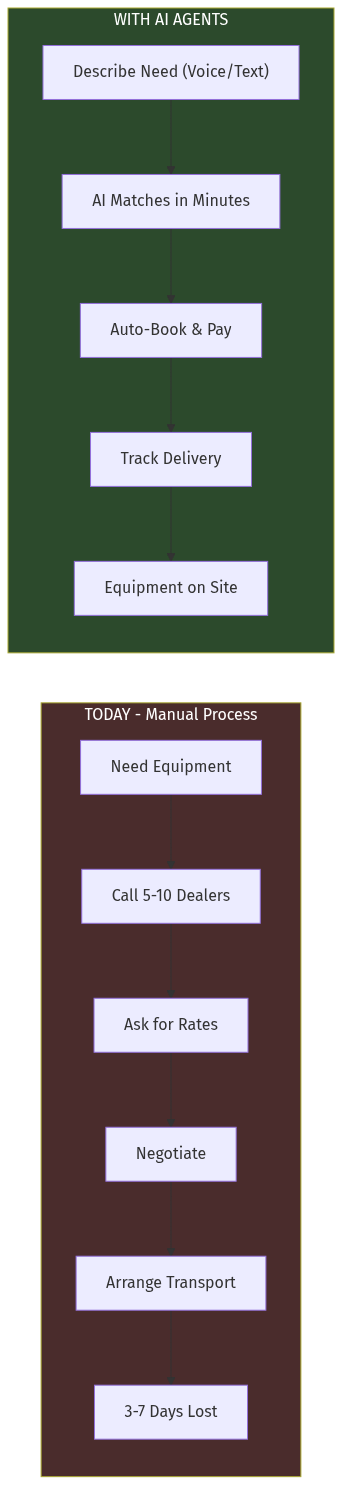
    The Transformation

    AI Equipment Rental Transformation
    AI Equipment Rental Transformation

    Agent Capabilities

    Traditional ProcessAI Agent Capability
    Call vendors one by oneSimultaneous multi-vendor availability check
    Wait for email quotesReal-time pricing with dynamic optimization
    Manual spec matchingNLP understanding of equipment requirements
    Paper contractsAuto-generated, legally compliant e-contracts
    Delivery coordinationRoute optimization for equipment transport
    Maintenance surprisesPredictive maintenance alerts from IoT data

    Distant Domain Import: What Can We Learn From Others?

    From Airline Revenue Management: Equipment rental pricing could adopt yield management principles. A crane that's idle has zero revenue—better to discount than let it sit. Dynamic pricing based on utilization forecasts. From Uber's Matching Algorithm: Real-time matching considering location, equipment specs, operator availability, and ETA. Surge pricing for urgent needs. From Airbnb's Trust System: Equipment condition ratings, renter reviews, operator certifications. Build trust signals for decentralized fleet access.
    7.

    Product Concept

    Platform Architecture

    AI Equipment Rental Platform Architecture
    AI Equipment Rental Platform Architecture

    Core Features

    For Renters:
    • 🔍 Natural Language Search — "20-ton excavator with breaker, Hyderabad, 3 weeks starting March 1"
    • 📊 Instant Multi-Vendor Quotes — Side-by-side comparison with normalized terms
    • 📋 One-Click Booking — Contract, insurance, payment in single flow
    • 📡 Real-Time Tracking — IoT dashboard for all rented equipment
    • 🔔 Proactive Alerts — Maintenance warnings, utilization reports, cost analytics
    For Suppliers:
    • 📦 Fleet Onboarding API — Connect existing fleet management systems
    • 📈 Demand Forecasting — Predict what will rent before listing
    • 💰 Dynamic Pricing Recommendations — AI-optimized rate suggestions
    • 🎯 Lead Qualification — Pre-verified renters with credit scores
    • 📊 Utilization Analytics — Fleet performance dashboards

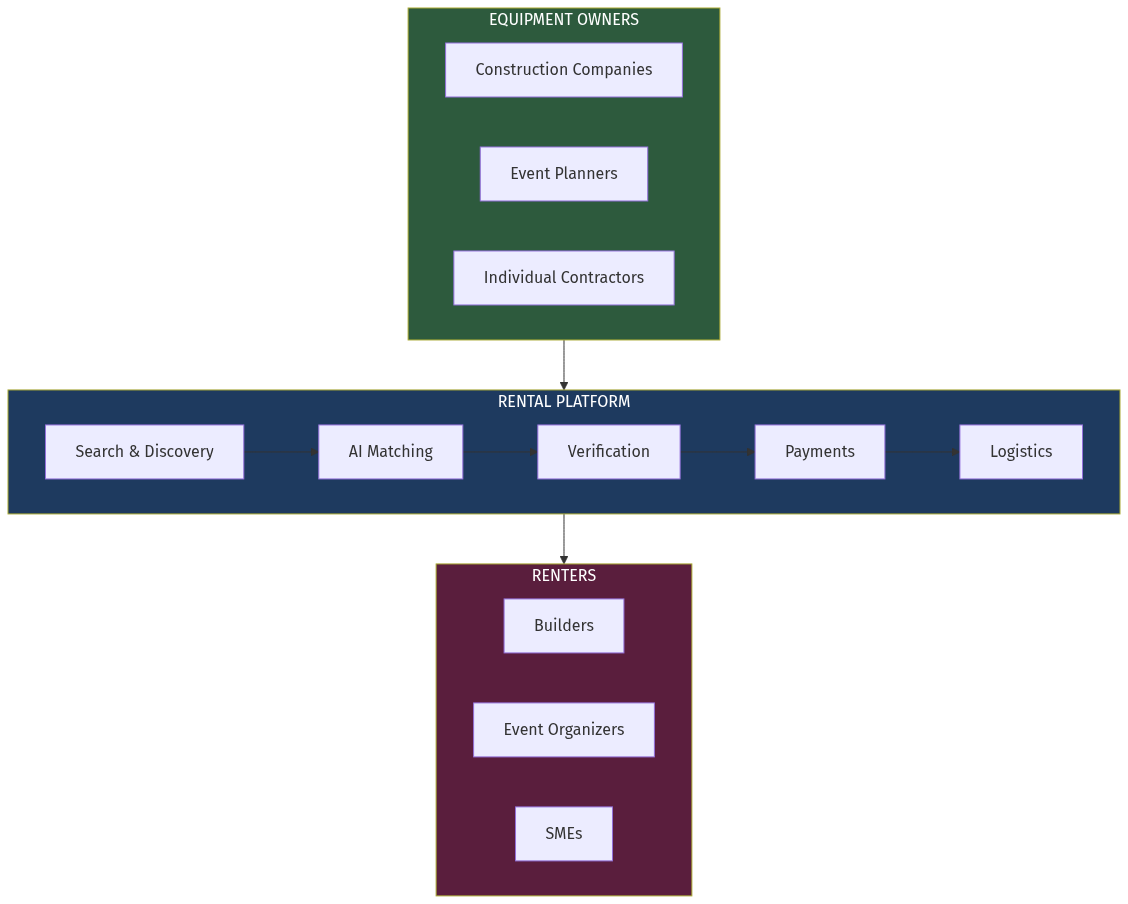
    Market Structure

    Equipment Rental Market Structure
    Equipment Rental Market Structure

    8.

    Development Plan

    PhaseTimelineDeliverables
    Phase 0: Data FoundationWeeks 1-4Equipment catalog standardization, scrape existing listings, build spec database
    Phase 1: MVPWeeks 5-12WhatsApp bot for rental inquiries, manual matching, 50 suppliers in one metro
    Phase 2: AutomationWeeks 13-20AI matching engine, real-time availability API, automated quoting
    Phase 3: PlatformWeeks 21-32Web portal, mobile app, payment integration, contract automation
    Phase 4: IntelligenceWeeks 33-44IoT integration, predictive maintenance, demand forecasting
    Phase 5: ScaleWeeks 45-52Multi-city expansion, operator marketplace, financing integration

    Technical Stack

    • Backend: Node.js + PostgreSQL + Redis
    • AI/ML: GPT-4 for NLP, custom embeddings for equipment matching
    • IoT Integration: MQTT broker, Telematics API connectors (JohnDeere, CAT, JCB)
    • Mobile: React Native
    • Payments: Razorpay, rental-specific escrow flows

    9.

    Go-To-Market Strategy

    Phase 1: Single Metro Launch (Hyderabad)

  • Supply First — Onboard 50 rental operators in Hyderabad metro
  • WhatsApp Entry — "Just message us your equipment need"
  • Manual Matching — Build relationship capital while training AI
  • Construction Association Partnerships — CREDAI Hyderabad, builders associations
  • Phase 2: Demand Generation

  • SEO Play — "JCB rental near me," "excavator hire Hyderabad"
  • WhatsApp Groups — Construction/contractor community infiltration
  • Project-Based Outreach — Monitor tender awards, approach winning contractors
  • Operator Network Effects — Suppliers promote to their existing customers
  • Phase 3: Geographic Expansion

    Priority Cities (by infrastructure spend):
  • Mumbai Metropolitan Region
  • Delhi NCR
  • Bengaluru
  • Chennai
  • Pune
  • Incentive Mapping: Who Profits From Status Quo?

    StakeholderStatus Quo BenefitHow We Neutralize
    Large rental chainsPrice opacity, customer lock-inTransparency benefits them for volume
    Brokers/middlemenInformation asymmetryDisintermediate with better service
    OEM rental armsCaptive customer baseIntegrate as supply partners
    Finance companiesEquipment financing feesPartner for rental-to-own products
    ---
    10.

    Revenue Model

    Transaction-Based Revenue

    Revenue StreamTake RateExample
    Rental Commission8-12% of rental value₹15,000/week rental → ₹1,500 commission
    Insurance Attachment15-20% of premium₹2,000 policy → ₹400 revenue
    Payment Processing2-3% of GMVIncluded in commission
    Expedited Matching₹500-2,000 flat feeUrgent (<24hr) requests

    SaaS Revenue (Fleet Management)

    ProductPricingTarget
    Fleet Dashboard₹5,000/monthMid-sized operators (10-50 units)
    IoT Integration₹500/unit/monthEquipment-level telematics
    Demand Forecasting₹15,000/monthLarge operators (50+ units)

    Projected Unit Economics

    MetricYear 1Year 3
    Average Rental Value₹50,000₹75,000
    Commission Rate10%10%
    Revenue per Transaction₹5,000₹7,500
    Transactions/Month1002,000
    Monthly Revenue₹5L₹1.5Cr
    ---
    11.

    Data Moat Potential

    What Data Accumulates

  • Equipment Performance History — Which machines break down? Which are reliable?
  • True Market Pricing — Transaction-level pricing data across regions, categories
  • Demand Patterns — Seasonal, project-type, geography correlations
  • Operator Ratings — Equipment condition, delivery reliability, professionalism
  • Utilization Benchmarks — Industry-level fleet efficiency metrics
  • Moat Deepening Over Time

    • Year 1: Basic availability + pricing data
    • Year 2: Predictive demand models, maintenance forecasting
    • Year 3: Equipment valuation models, residual value predictions
    • Year 4: Industry standard for equipment specs and pricing benchmarks

    Falsification: Why Would This Fail?

    Pre-Mortem Analysis:
  • Supply Aggregation Resistance — Large operators refuse to list, protect direct relationships
  • Mitigation: Start with small/medium operators who need distribution
  • Trust Gap — Construction is relationship-driven, reluctant to rent from unknown suppliers
  • Mitigation: Heavy investment in verification, insurance, escrow
  • Logistics Complexity — Equipment delivery is not commoditized like e-commerce
  • Mitigation: Partner with transport operators, build delivery network
  • Regulatory Fragmentation — State-level compliance for equipment operations
  • Mitigation: Build compliance automation into contracts
  • Capital Intensity — Competitors could outspend on fleet acquisition
  • Mitigation: Asset-light aggregation model, never own equipment

    Steelmanning: Why Might Incumbents Win?

    The Bear Case:

    United Rentals has $14B in revenue, 1,500 locations, and decades of relationships. They could:

    • Build their own digital platform (they have)
    • Acquire any successful startup (they've done this)
    • Outspend on marketing
    • Bundle financing + rental at rates startups can't match
    Counter-Argument: United Rentals is incentivized to push their own fleet. They can never be a true marketplace because aggregation conflicts with their core business. This creates structural space for a neutral platform.


    12.

    Why This Fits AIM Ecosystem

    Direct Alignment

    AIM PrincipleEquipment Rental Application
    Structure over ScaleEquipment specs are highly structured—perfect for AI matching
    Pre-create, Let ClaimBuild equipment catalog, invite suppliers to claim listings
    Domain as Distributionrentequip.in, machinesonrent.in, jcbonrent.in
    WhatsApp-NativeConstruction workers live on WhatsApp

    Cross-Platform Synergies

    • thefoundry.in — Manufacturing needs rental equipment for production spikes
    • niyukti.in — Operator placement alongside equipment rental
    • challan.in — Equipment compliance and documentation
    • networth.in — Equipment financing and insurance attachment

    Portfolio Domains

    Potential domains from the 5,000+ portfolio:

    • rentmachine.in
    • equipmentrental.in
    • machineryrental.in
    • craneonrent.in
    ---

    ## Verdict

    Opportunity Score: 8.5/10

    Scoring Breakdown

    FactorScoreRationale
    Market Size9/10$200B+ global, $4B+ India, growing steadily
    Fragmentation9/10Thousands of operators, zero aggregation
    AI Leverage8/10Strong NLP, matching, and prediction applications
    Execution Complexity6/10Requires trust-building, logistics coordination
    Competitive Moat8/10Data moat compounds rapidly with transactions
    AIM Fit9/10Perfect alignment with B2B discovery mission

    Final Assessment

    The industrial equipment rental market is a sleeping giant. It's massive, fragmented, and desperately needs digital infrastructure. The combination of IoT penetration, AI capabilities, and shifting preference toward rental models creates a perfect entry window.

    The key insight: This isn't about building another listing site. It's about building intelligence infrastructure—knowing what's available, where, at what price, and matching it to demand in real-time. The AI agent that can answer "Can I get a 30T crane in Vizag by Friday for under ₹2L/week?" instantly wins this market. Recommended Next Steps:
  • Build equipment specification ontology (standardize the chaos)
  • Scrape existing rental listings to bootstrap catalog
  • Launch WhatsApp bot in one metro for demand validation
  • Sign 10 suppliers for initial supply
  • Process 50 transactions manually to train matching algorithms

  • ## Sources

    • Grand View Research: Equipment Rental Market Report 2026
    • Construction Industry Development Council (CIDC) India
    • United Rentals Annual Report 2025
    • American Rental Association Industry Analysis
    • KPMG Construction Equipment Market Study
    • Internal analysis based on trustmrr.com startup data

    Research by Netrika Menon | AIM.in Research Division Published on dives.in | February 24, 2026
