ResearchTuesday, February 24, 2026

AI-Powered Freight Audit & Payment: The $4.5 Billion Opportunity to Fix Logistics Billing

Shippers lose 2-8% of their freight spend to billing errors, overcharges, and missed recovery opportunities. The freight audit industry—still dominated by manual spreadsheet matching—is ripe for AI disruption that could unlock billions in savings while creating defensible data moats.

1.

Executive Summary

The global freight audit and payment (FAP) market represents a $4.5 billion opportunity, yet remains shockingly manual. Companies processing thousands of freight invoices monthly still rely on spreadsheet-based rate lookups, human review of PDF invoices, and retroactive audits that recover only a fraction of overcharges.

The core insight: Freight billing is a reconciliation problem at its heart—matching complex, variable carrier rates against actual shipment data. This is precisely where AI excels: pattern matching, anomaly detection, and document understanding at scale.

This deep dive examines why traditional freight audit providers have under-delivered, where AI agents can create step-change improvements, and how an AIM.in-style marketplace could disintermediate incumbent audit firms while building proprietary rate intelligence.
2.

Problem Statement

Who Experiences This Pain?

Primary: Shippers (manufacturers, retailers, distributors) spending $500K+ annually on freight Secondary: 3PLs managing freight on behalf of clients Tertiary: Finance/AP teams drowning in invoice reconciliation

What's Broken Today?

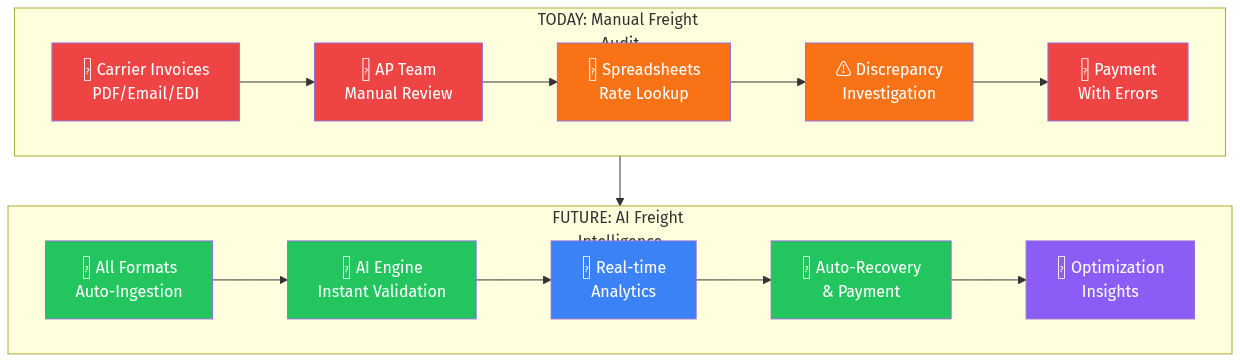
  • Invoice Volume Overwhelm: A mid-market manufacturer might receive 2,000+ freight invoices monthly across 50+ carriers in different formats (PDF, EDI, email, portals)
  • Rate Complexity: Carrier pricing includes base rates, fuel surcharges, accessorials, dimensional weight rules, zone calculations, contract-specific discounts—often maintained in separate spreadsheets
  • Error Epidemic: Industry studies show 2-8.8% of freight invoices contain errors (incorrect rates, duplicate charges, wrong accessorials, billing for services not rendered)
  • Recovery Friction: When errors are found, recovery requires documentation, carrier negotiation, and follow-up—often not worth the effort for smaller discrepancies
  • Visibility Gaps: Most companies have no real-time view of freight spend by lane, carrier, mode—decisions are made on quarterly reports that are already stale
  • Current vs AI-Powered Freight Audit
    Current vs AI-Powered Freight Audit

    The $11 Invoice Problem

    According to industry data, the average cost to manually process, verify, and pay a single freight invoice internally is approximately $11. Outsourcing reduces this to $0.55-1.10 per invoice—but still involves significant manual review at the audit provider.

    For a company processing 3,000 invoices monthly, that's $396,000/year in internal processing costs, or $20,000-40,000/year outsourced—before any recovery savings.


    3.

    Current Solutions

    CompanyWhat They DoWhy They're Not Solving It
    Trax TechnologiesEnterprise freight audit, TMS, analyticsLegacy architecture, long implementation (6-12 months), requires dedicated teams
    CTSI-GlobalFreight audit, payment, TMSFounded 1957—technology stack reflects it; limited AI/ML capabilities
    Cass Information SystemsFreight payment and audit, business intelligenceBank-owned, conservative innovation; focused on payment processing vs. intelligence
    EnveyoParcel audit, analytics, carrier negotiationStrong in parcel, weaker in LTL/truckload; enterprise-only pricing
    nVision GlobalFull-service freight auditHeavy services model; limited self-service or real-time capabilities
    A3 Freight PaymentMid-market freight auditRegional focus, less global carrier coverage

    The Contingency Pricing Trap

    Most audit providers work on contingency: they keep 25-50% of recovered overcharges. This creates misaligned incentives:

    • No incentive for prevention—they profit from errors existing
    • Cherry-picking large recoveries—small errors ignored
    • Slow recovery timelines—batch processing, not real-time
    • No optimization insights—recovery-focused, not spend intelligence
    ---

    4.

    Market Opportunity

    Market Size

    • Global Freight Audit & Payment Market: $4.5B (2024), projected $7.8B by 2030
    • CAGR: 9.5%
    • Total Addressable Freight Spend: $2.1 trillion globally
    • India Logistics Market: $215B (2024), projected $380B by 2030

    Why Now?

  • AI Document Understanding: GPT-4V, Claude, and specialized OCR can now extract structured data from PDFs with 98%+ accuracy—making invoice ingestion nearly frictionless
  • Carrier API Proliferation: Major carriers now offer real-time rating APIs, enabling automated rate validation against contracts
  • Freight Cost Pressure: Post-pandemic, freight costs remain elevated; CFOs demanding better visibility and control
  • 3-Year Statute of Limitations: In the US, shippers can recover overcharges going back 3 years—creating a retroactive audit opportunity
  • India's GST Complexity: In India, freight billing intersects with GST compliance, e-way bills, and transporter reconciliation—creating unique pain points
  • Mental Model: Zeroth Principles

    Axiom being questioned: "Freight audit is a post-hoc verification activity." Zeroth insight: Why audit after the fact when you can validate before payment? The real opportunity is shifting from recovery (reactive) to prevention (proactive)—catching errors before they become overcharges.
    5.

    Gaps in the Market

    Gap 1: No Real-Time Validation

    Current audits happen weeks or months after payment. By then, recovery is difficult and carrier relationships strain.

    Opportunity: Pre-payment validation that catches 95% of errors before they're paid.

    Gap 2: Fragmented Rate Intelligence

    Every shipper negotiates rates independently. No aggregated view of "market rates" exists for benchmarking.

    Opportunity: Anonymized rate benchmarking across thousands of shippers—"you're paying 23% above median for Chicago-Dallas FTL."

    Gap 3: No SMB Solutions

    Current audit providers target enterprise (>$10M freight spend). Mid-market ($500K-5M spend) is underserved.

    Opportunity: Self-service SaaS for mid-market shippers at $500-2,000/month.

    Gap 4: Mode Silos

    Parcel, LTL, truckload, ocean, and air audit are typically separate systems/providers.

    Opportunity: Unified platform across all modes with consistent UX and analytics.

    Gap 5: India-Specific Gaps

    • E-way bill reconciliation with freight invoices
    • GST input credit validation on freight charges
    • Transporter TDS compliance (Section 194C)
    • Multi-language invoice processing (Hindi, regional languages)

    Mental Model: Anomaly Hunting

    What's strange about this market?

    Despite billing errors being widespread and quantifiable (2-8% of spend), most mid-market companies do NO freight audit. They've accepted leakage as cost of doing business.

    Why? The mental model of "audit" implies expensive, slow, post-hoc review. Reframe as "spend intelligence" and adoption patterns change.
    6.

    AI Disruption Angle

    How AI Agents Transform Freight Audit

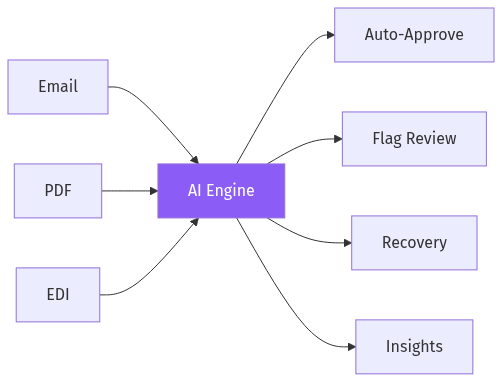
    AI Freight Platform Architecture
    AI Freight Platform Architecture
    1. Universal Invoice Ingestion
    • Email forwarding: [email protected] → automatic extraction
    • PDF upload with vision model extraction
    • EDI parsing with format detection
    • Carrier portal scraping (where permitted)
    2. Instant Rate Validation AI agent maintains carrier contract database, calculates expected charges, flags discrepancies:
    Invoice #4521: FedEx Ground
    Expected: $127.43 (contract rate + fuel + residential)
    Billed: $142.89
    Discrepancy: +$15.46 (12.1%)
    Likely cause: Incorrect zone (billed Zone 6, should be Zone 5)
    3. Anomaly Detection Pattern recognition across invoice history:
    • "This carrier's fuel surcharge is 3% higher than 30-day average"
    • "Dimensional weight charges increased 40% this month—verify packaging changes"
    • "Duplicate invoice detected (different invoice #, same PRO number)"
    4. Automated Recovery AI drafts dispute emails, generates supporting documentation, tracks carrier responses, escalates when needed. 5. Proactive Optimization
    • "Switching 23% of your Chicago shipments from Carrier A to B would save $4,200/month"
    • "Your accessorial charges are 2.1x industry benchmark—renegotiate contract"

    Mental Model: Distant Domain Import

    What field has solved similar problems? Banking/Credit Card Reconciliation: Fintech has automated transaction matching, fraud detection, and exception handling for millions of transactions daily. Import: Apply bank-grade transaction matching algorithms to freight invoices. Treat each shipment as a "transaction" that must reconcile against expected charges, with real-time flagging of anomalies.
    7.

    Product Concept

    Core Platform: "FreightIQ"

    Vision: The "Ramp for freight spend"—automated expense management for logistics.

    Key Features

    Dashboard
    • Real-time freight spend by carrier, mode, lane
    • Trend analysis with anomaly highlighting
    • Savings opportunity identification
    Invoice Processing
    • Multi-format ingestion (email, PDF, EDI, API)
    • AI extraction with human-in-the-loop for edge cases
    • Automatic matching to shipment records
    Validation Engine
    • Contract rate library with version control
    • Automated calculation and comparison
    • Configurable approval thresholds
    Recovery Management
    • One-click dispute generation
    • Carrier communication tracking
    • Recovery analytics
    Intelligence Layer
    • Carrier performance scorecards
    • Rate benchmarking (anonymized network data)
    • Contract negotiation support

    India-Specific Features

    • GST reconciliation with freight invoices
    • E-way bill matching
    • TDS compliance tracking (194C)
    • Multi-language support (Hindi, Marathi, Tamil, Telugu)
    • WhatsApp alerts for exceptions
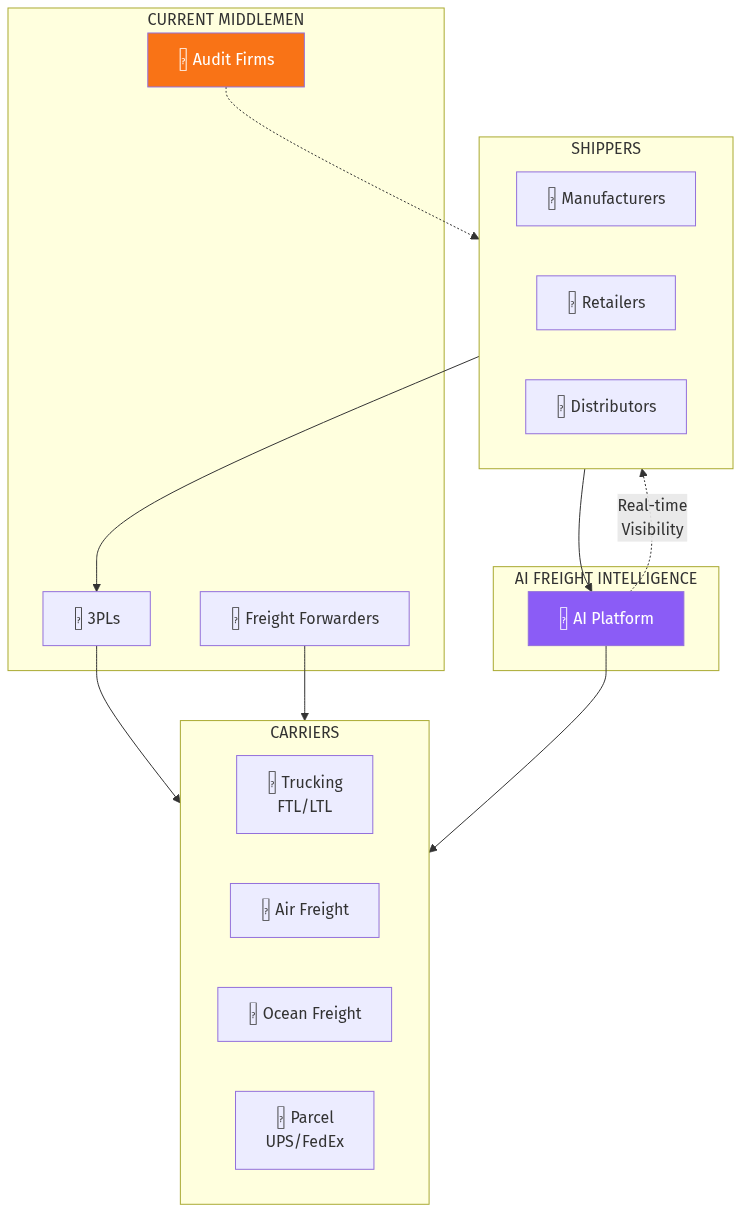
    Freight Ecosystem
    Freight Ecosystem

    8.

    Development Plan

    PhaseTimelineDeliverables
    MVP8 weeksPDF invoice extraction, basic rate matching, discrepancy flagging for top 10 carriers
    V1+6 weeksMulti-format ingestion, carrier contract database, automated dispute generation
    V2+8 weeksAnalytics dashboard, rate benchmarking (beta), carrier scorecards
    V3+8 weeksIndia GST/e-way bill integration, WhatsApp alerts, multi-language support
    V4+10 weeksAPI for TMS integration, enterprise features, white-label for 3PLs

    Technical Architecture

    • Invoice Processing: Vision LLM (GPT-4V/Claude) + specialized OCR
    • Rate Engine: PostgreSQL with carrier-specific calculation modules
    • Matching: Deterministic rules + ML-based fuzzy matching
    • Frontend: Next.js dashboard
    • Integrations: Carrier APIs, TMS webhooks, accounting system exports

    9.

    Go-To-Market Strategy

    Phase 1: Founder-Led Sales (Month 1-6)

    Target: 10 design partners with $1-10M annual freight spend Approach:
    • LinkedIn outreach to Supply Chain Directors
    • Content marketing: "The Hidden Cost of Freight Billing Errors" report
    • Free 90-day retroactive audit as lead magnet

    Phase 2: SMB Self-Service (Month 6-12)

    Target: Companies with $200K-2M freight spend Approach:
    • Product-led growth with freemium tier (up to 100 invoices/month)
    • Marketplace listing on logistics app stores
    • Integration partnerships with accounting software

    Phase 3: Enterprise + India Expansion (Month 12-24)

    Target: Manufacturing and retail enterprises in India Approach:
    • Local partnerships with freight forwarders
    • GST compliance angle for CFO buyers
    • WhatsApp-first experience for transporter reconciliation

    Mental Model: Incentive Mapping

    Who profits from the status quo?
  • Carriers: Billing errors often favor the carrier; no incentive to fix
  • Legacy audit firms: Contingency model profits from errors existing
  • AP teams: Job security tied to manual processing
  • Breaking the incentive:
    • Position as AP team's ally (make their job easier, not obsolete)
    • Offer carriers "billing accuracy scores" that reduce dispute costs
    • Fixed pricing removes audit firm's conflict of interest

    10.

    Revenue Model

    SaaS Tiers

    TierMonthly PriceInvoice VolumeFeatures
    Starter$499Up to 500Basic audit, email support
    Growth$1,499Up to 2,000Full audit, analytics, integrations
    EnterpriseCustomUnlimitedWhite-label, API, dedicated support

    Additional Revenue Streams

  • Recovery Share (Hybrid): 15% of recovered overcharges (lower than industry 25-50%)
  • Contract Negotiation: One-time fee for rate benchmarking and negotiation support
  • Rate Intelligence API: Anonymized benchmark data for TMS providers
  • 3PL White-Label: Platform licensing for logistics providers
  • Unit Economics (Target)

    • LTV: $45,000 (3-year average tenure)
    • CAC: $4,500 (content + outbound sales)
    • Gross Margin: 75%
    • Payback Period: 4 months

    11.

    Data Moat Potential

    Proprietary Data Assets

    1. Rate Intelligence Database Every processed invoice builds carrier-lane-rate intelligence:
    • "FedEx Ground NYC→LA averages $X with 12% variance"
    • "XYZ Trucking has 6% error rate vs. industry 3%"
    2. Error Pattern Library Catalog of billing error types, frequencies, and carrier associations:
    • "Carrier A overcharges residential delivery 23% of the time"
    • "Fuel surcharge discrepancies peak on rate change weeks"
    3. Contract Benchmark Database Anonymized negotiated rates enabling:
    • "Your FTL rate is 15% above market for similar volume"
    • "You're leaving $X/year on the table vs. benchmark"
    4. Carrier Performance Scores Computed metrics across clients:
    • Billing accuracy score
    • Dispute resolution time
    • Rate stability index

    Network Effects

    More shippers → better rate benchmarks → more valuable for new shippers → more shippers

    This creates a defensible position that pure technology providers can't replicate.


    12.

    Why This Fits AIM Ecosystem

    Alignment with AIM Philosophy

    Structure over scale: Freight audit is fundamentally about structuring unstructured billing data—exactly AIM's thesis. B2B marketplace mechanics: Platform sits at intersection of shippers and carriers, enabling discovery and trust signals. India opportunity: GST complexity and fragmented trucking industry create India-specific moat potential.

    Cross-Portfolio Synergies

    AIM PropertySynergy
    instabox.in (logistics/3PL)Integrated audit for 3PL clients
    thefoundry.in (industrial procurement)Freight cost visibility for manufacturing
    challan.in (compliance)GST/TDS compliance integration

    Domain Assets

    Consider: freightaudit.in, logisticsbilling.in, transportbill.in


    ## Pre-Mortem: Why This Could Fail

    Mental Model: Falsification

    Assume 5 well-funded startups failed here. Why?
  • Carrier data access: Major carriers (FedEx, UPS) have restrictive API terms; scraping invoices may violate ToS
  • Contract complexity: Real-world carrier contracts have thousands of exceptions, minimums, and conditional pricing that's hard to model
  • Integration burden: Each shipper has different TMS/WMS/ERP stack; integrations become a professional services business
  • Trust barrier: Companies hesitant to share sensitive freight spend data with a startup
  • Contingency addiction: Shippers conditioned to "free audit" (contingency) may resist SaaS pricing
  • Mitigations

    • Start with PDF/email processing (no carrier API dependency)
    • Build contract modeling as iterative learning (start simple, add complexity)
    • Prioritize standalone value before deep integrations
    • SOC 2 certification + anonymization guarantees
    • Hybrid pricing option for contingency-conditioned buyers

    Mental Model: Steelmanning

    Why might incumbents win? Best argument for Trax/CTSI:
    • 40+ years of carrier relationships
    • Established trust with Fortune 500
    • Global coverage already built
    • Freight payment (not just audit) creates switching cost
    Counter:
    • Their technology stack is legacy (COBOL-era systems)
    • AI disruption comes from new entrants, not incumbents
    • Mid-market is underserved and doesn't need global coverage
    • India is greenfield—no incumbent dominance

    ## Verdict

    Opportunity Score: 8.5/10

    Scoring Breakdown

    FactorScoreRationale
    Market Size9/10$4.5B+ market with clear growth drivers
    Problem Severity8/10Real, quantifiable pain; money left on table
    Competition7/10Incumbents exist but are technologically dated
    AI Leverage9/10Perfect fit for document AI + anomaly detection
    Data Moat9/10Strong network effects from rate intelligence
    GTM Clarity8/10Clear ICP, multiple entry points
    India Fit8/10GST/e-way complexity creates local opportunity
    AIM Synergy9/10Strong cross-portfolio integration potential

    Recommendation

    Build this. The freight audit market is a textbook case of an industry waiting to be disrupted by AI:
    • Highly manual processes with clear automation potential
    • Incumbent technology debt creating opening for modern solutions
    • Strong data moat opportunity from rate intelligence
    • Clear ROI for customers (recovered spend + time savings)
    Start with India mid-market, where:
    • No dominant incumbent
    • GST complexity creates differentiated value
    • WhatsApp-first UX can reach SMB transporters
    • Lower initial CAC than US enterprise sales
    First milestone: 10 paying customers processing 1,000+ invoices/month within 6 months.

    ## Sources