ResearchTuesday, February 24, 2026

AI-Powered Corporate Gifting & Promotional Merchandise Intelligence

The $300 billion global corporate gifting and promotional products industry runs on relationships, phone calls, and spreadsheets. Every year, companies waste millions on gifts that miss the mark, arrive late, or disappear into procurement black holes. AI agents can transform this chaos into a precise, personalized, and measurable channel for building business relationships.

1.

Executive Summary

Corporate gifting is the invisible infrastructure of business relationships. From employee welcome kits and client appreciation gifts to trade show swag and holiday campaigns, companies spend billions annually on branded merchandise and thoughtful gifts.

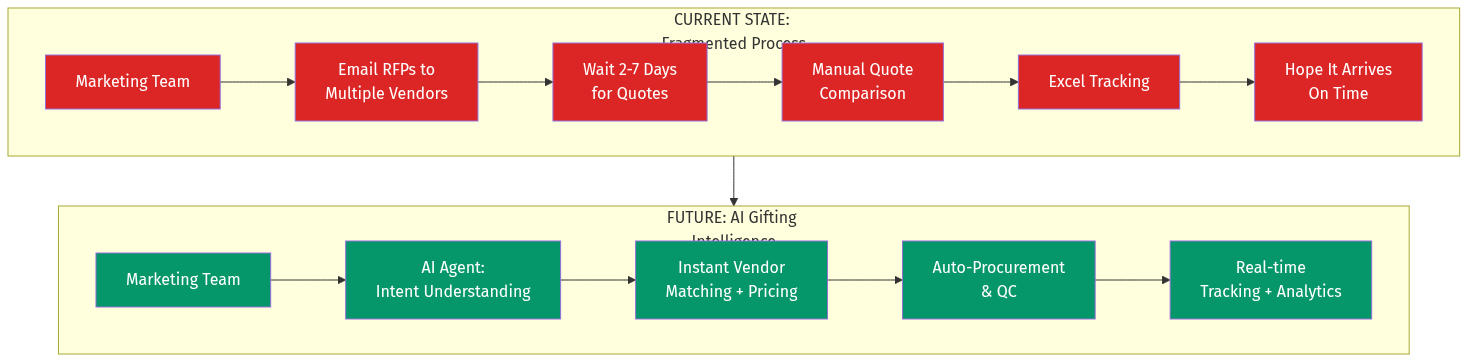
Yet the industry remains stubbornly fragmented: thousands of small distributors, no pricing transparency, long lead times, and zero data on what actually works. Marketing teams still email 5 vendors for quotes, wait a week for responses, and hope the pens arrive before the conference.

This is a classic "spreadsheet economy" waiting for AI disruption.

The opportunity: Build an AI-powered platform that understands gifting intent, instantly matches to optimal vendors, automates procurement, and provides ROI analytics. Not another catalog—an intelligent agent that handles the entire gifting workflow from "We need something for our top 50 clients" to delivered-and-measured.
2.

Problem Statement

Who Experiences This Pain?

Marketing Teams: Responsible for brand perception, yet stuck managing vendor relationships and tracking spreadsheets. A single holiday campaign can require 40+ hours of coordination. HR Departments: Onboarding, anniversaries, recognition programs—all manual. New hire kits are either too generic or too expensive to scale. Sales Teams: Know that a thoughtful gift can unstick a deal, but lack tools to execute quickly. By the time the gift arrives, the moment has passed. Procurement Officers: Struggle to enforce budgets, track spend, and consolidate vendors. Corporate gifting often flies under the radar as "marketing expenses."

The Core Problems

  • No Price Discovery: Every quote is a negotiation. Same product, wildly different prices from different vendors.
  • Long Lead Times: Custom merchandise takes 3-6 weeks. Urgent needs mean paying premium or settling for generic.
  • Gift-Recipient Mismatch: Sending the same gift to everyone ignores preferences, cultural sensitivities, and dietary restrictions.
  • Zero Attribution: Did that $500 gift basket influence the renewal? Nobody knows.
  • Vendor Fragmentation: Companies work with 5-15 different gift/swag vendors, each with separate logins, catalogs, and invoices.
  • ZEROTH PRINCIPLES Analysis

    What axiom does everyone assume that might be wrong? Assumed: Corporate gifting requires human curation because gifts are personal. Reality: Personalization at scale is exactly what AI excels at. An AI can remember that John from Acme Corp mentioned he's vegan, that Sarah loves specialty coffee, and that the Tokyo office observes different holidays—and act on all of it simultaneously.

    The "personal touch" doesn't require a human touch. It requires data and execution.


    3.

    Current Solutions

    CompanyWhat They DoWhy They're Not Solving It
    SendosoGifting platform with CRM integration, direct mail, AI recommendationsEnterprise-focused ($40K+ ACV), complex setup, still requires significant human curation
    SwagUpSwag packs, warehousing, global shippingFocused on swag packs only, no intelligence layer, no ROI tracking
    ReachdeskB2B gifting with global fulfillmentEuropean-focused, expensive, limited supplier network in emerging markets
    PrintfulPrint-on-demand for merchandiseNo curation, DIY design, no corporate workflow integration
    4imprintTraditional promotional products distributorCatalog model, no AI, long lead times, no integration
    Halo Branded SolutionsEnterprise promotional productsTraditional distributor model, relationship-based, not tech-native

    INCENTIVE MAPPING: Why Incumbents Won't Innovate

    The promotional products industry is built on relationship-based pricing. Distributors make margins by:

  • Adding 30-50% markups on products
  • Keeping pricing opaque
  • Locking in clients with "account managers"
  • Charging for services (design, rush fees) that could be automated
  • Who profits from the status quo?
    • 25,000+ promotional product distributors in the US alone
    • Advertising specialty agencies charging hourly for curation
    • Enterprise software vendors selling expensive integrations
    These players have no incentive to create price transparency or self-serve tools. They benefit from complexity.
    4.

    Market Opportunity

    Market Size

    • Global Promotional Products Market: $65 billion (2025), growing 3.8% CAGR
    • Corporate Gifting Market: $242 billion globally (2024), projected $312 billion by 2028
    • US Promotional Products: $26.1 billion annually
    • India Corporate Gifting: $8.5 billion, growing 15%+ annually

    Why Now?

  • Remote/Hybrid Work Explosion: Companies can't rely on in-office swag closets. Every gift needs shipping infrastructure.
  • Employee Experience Wars: In tight labor markets, recognition and onboarding experience matter more than ever.
  • AI Maturity: Intent understanding, preference learning, and procurement automation are now reliable.
  • CRM/HRIS Ubiquity: Every company has Salesforce, HubSpot, or Workday. Integration points exist.
  • Direct-to-Consumer Infrastructure: The same supply chains powering Shopify merchants can power corporate gifting with lower costs.
  • DISTANT DOMAIN IMPORT

    What field has already solved a similar matching problem? Travel & Hospitality: Booking.com and Expedia aggregated millions of hotels, normalized inventory, and made price comparison instant. They didn't own hotels—they owned the discovery and booking layer. Food Delivery: DoorDash doesn't cook food. It aggregates restaurants, handles logistics, and provides the intelligence layer (recommendations, timing, ratings).

    Corporate gifting needs its "Booking.com moment"—aggregate suppliers, normalize catalogs, enable instant comparison, own the intelligence and fulfillment layer.


    5.

    Gaps in the Market

    Gap 1: No Real-Time Pricing

    Every quote is manual. AI can aggregate pricing from hundreds of suppliers and show instant quotes.

    Gap 2: No Intent-Based Discovery

    Current platforms are catalogs. AI can understand "something memorable for our enterprise champion who closed a $500K deal" and translate that into specific recommendations.

    Gap 3: No Recipient Intelligence

    Platforms don't track preferences. An AI agent should remember that the VP at Acme prefers experiences over objects.

    Gap 4: No Attribution Analytics

    Did the gift influence the deal? Current tools can't answer. With CRM integration and feedback loops, AI can build attribution models.

    Gap 5: No SMB-Friendly Option

    Sendoso and Reachdesk target enterprises. A startup spending $5K/year on gifting has no AI-powered option.

    ANOMALY HUNTING

    What's strange about this market? Anomaly: Despite being a $300B market, there's no public company focused on corporate gifting technology. The industry leader (4imprint) is a traditional distributor doing $1.3B revenue with 1990s technology. Why? Because incumbents see this as a distribution business, not a data business. The opportunity isn't in moving boxes—it's in owning the intelligence layer.
    6.

    AI Disruption Angle

    The AI-Native Gifting Agent

    Instead of browsing catalogs, imagine this conversation:

    User: "I need gifts for 25 clients who attended our user conference. Budget is $150 each. They're mostly technical leaders at mid-size companies." AI Agent: "Based on your CRM data, I see 18 are in tech, 4 in finance, 3 in healthcare. I recommend:
    • Tech leaders: Portable monitor stand + branded cable kit ($142)
    • Finance: Premium leather notebook + Mont Blanc pen set ($148)
    • Healthcare: Self-care kit with custom messaging ($145)
    I can also pull LinkedIn preferences for each recipient. Want me to personalize further?"

    AI Capabilities That Transform Gifting

    CapabilityApplication
    Intent UnderstandingNatural language → specific product recommendations
    Preference LearningTrack recipient feedback, dietary restrictions, past gifts
    Occasion DetectionCRM triggers: deal closed, anniversary, promotion
    Budget OptimizationMaximize perceived value within constraints
    Supplier MatchingReal-time pricing, lead time, quality scores
    Predictive ROIWhich gifts drive engagement vs. which waste money

    The Agent-to-Agent Future

    When every company has AI agents, gifting becomes M2M negotiation:

    • Your AI agent knows your client's AI knows they love specialty tea
    • Agents negotiate directly with supplier APIs for best pricing
    • Delivery is tracked, feedback is collected, preferences are updated
    • Human involvement: approval click

    7.

    Product Concept

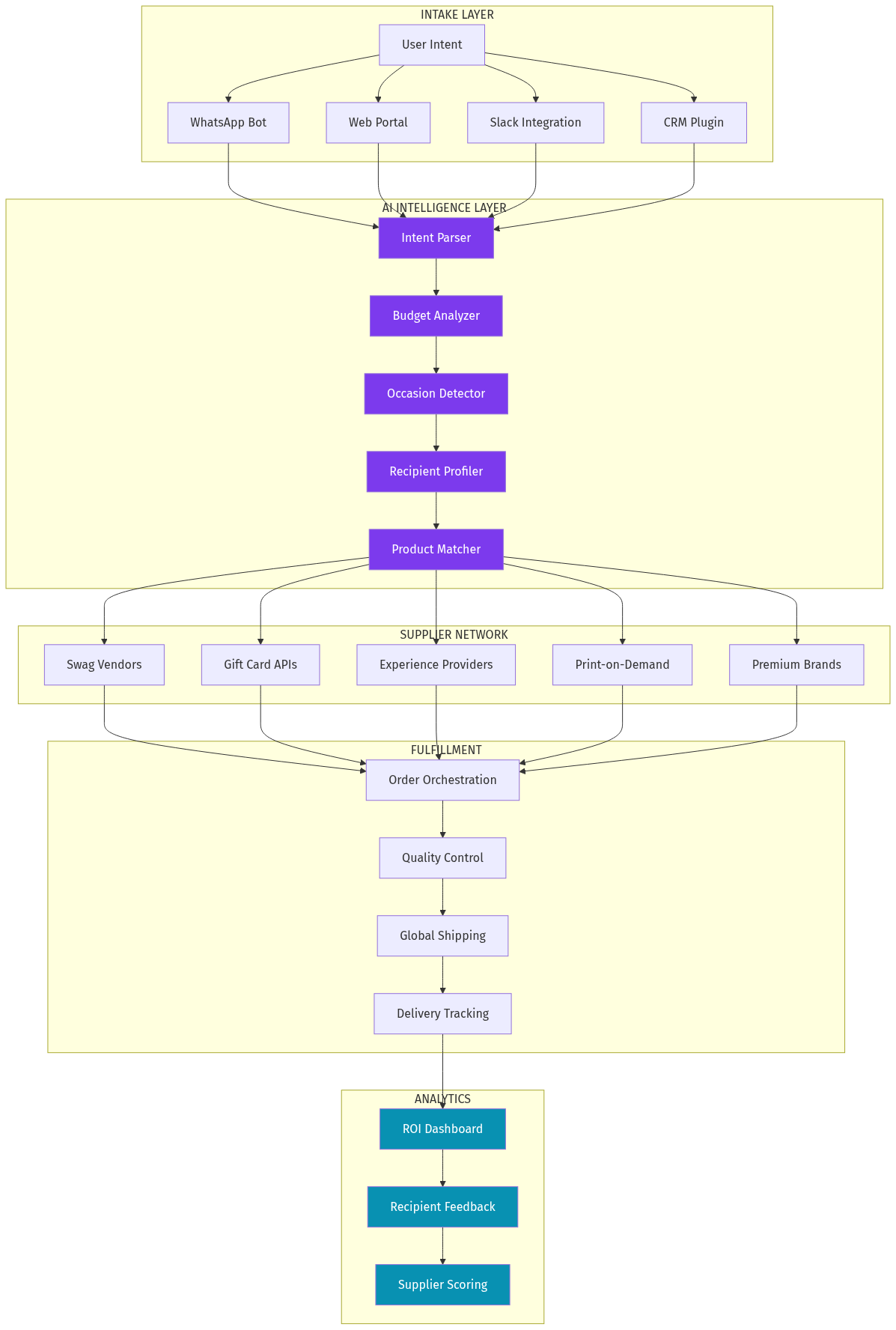
    Core Platform Components

    Platform Architecture
    Platform Architecture

    Key Features

    1. AI Gift Concierge
    • Natural language intent input
    • Budget-aware recommendations
    • Recipient preference learning
    • Cultural/dietary sensitivity
    2. Unified Supplier Network
    • 500+ verified suppliers on day one
    • Real-time pricing APIs
    • Quality scoring based on delivery performance
    • Automatic fallback if primary supplier fails
    3. Smart Procurement
    • One-click ordering across multiple suppliers
    • Consolidated invoicing
    • Budget tracking and alerts
    • Approval workflows
    4. Fulfillment Intelligence
    • Global shipping optimization
    • Customs handling for international
    • Tracking dashboard
    • Delivery confirmation with photos
    5. ROI Analytics
    • CRM integration for deal attribution
    • Recipient feedback collection
    • A/B testing for gift effectiveness
    • Spend analysis by department/campaign

    The Transformation

    Current vs Future State
    Current vs Future State

    8.

    Development Plan

    PhaseTimelineDeliverables
    MVP8 weeksAI chat interface, 50 supplier integrations, basic ordering, Stripe payments
    V112 weeksCRM integrations (Salesforce, HubSpot), recipient preference tracking, warehouse partnerships
    V216 weeksHRIS integrations (Workday, BambooHR), automated triggers, ROI dashboard
    Scale24 weeksAPI for resellers, white-label option, international expansion

    MVP Scope

    • WhatsApp/Slack bot + web interface
    • 50 curated suppliers (swag, gift cards, experiences)
    • Natural language gift requests
    • Instant pricing comparison
    • One-click ordering
    • Basic tracking

    Technical Architecture

    • Frontend: React + Next.js
    • Backend: Node.js + PostgreSQL
    • AI: Claude API for intent understanding, custom fine-tuned model for product matching
    • Integrations: Stripe Connect for payments, Shippo for shipping, CRM APIs
    • Infrastructure: Vercel + AWS for global delivery

    9.

    Go-To-Market Strategy

    Phase 1: Land SMBs via Product-Led Growth

  • Free tier: 5 gifts/month with AI recommendations
  • Content marketing: "What to gift your top clients" guides
  • LinkedIn targeting: Marketing managers, HR leaders
  • Community: Slack group for corporate gifting best practices
  • Phase 2: Mid-Market via Integrations

  • HubSpot App Marketplace: Gifting directly from CRM
  • Salesforce AppExchange: Deal celebration automation
  • Partner with CSM tools: ChurnZero, Gainsight integrations
  • Phase 3: Enterprise via Outbound

  • Case studies: Document ROI from early customers
  • Channel partnerships: HR consultants, marketing agencies
  • Vertical focus: Tech companies, professional services first
  • Channel-Specific Tactics

    ChannelTacticExpected CAC
    SEO"Corporate gift ideas for [occasion]" content$50
    LinkedIn AdsTarget "Marketing Manager" + "HR Manager"$200
    PartnershipsHR software reseller agreements$100
    Product-ledFree tier → paid conversion$30
    ---
    10.

    Revenue Model

    Primary Revenue Streams

    1. Transaction Fee (Core)
    • 8-12% of order value
    • Similar to travel OTAs
    • Volume discounts for enterprise
    2. SaaS Subscription (Predictable)
    • Free: 5 gifts/month
    • Pro: $99/month (50 gifts, CRM integration)
    • Business: $499/month (unlimited, HRIS, analytics)
    • Enterprise: Custom
    3. Supplier Network Fee
    • Suppliers pay to be featured/preferred
    • Performance-based placement
    • Premium listing fees
    4. Fulfillment Services (Margin)
    • Warehousing branded inventory
    • Assembly and kitting
    • Rush fulfillment premium

    Unit Economics Target

    MetricTarget
    Average Order Value$150
    Take Rate10%
    Gross Margin65%
    CAC$150
    LTV$1,500
    LTV:CAC10:1
    ---
    11.

    Data Moat Potential

    Data Assets That Compound

    1. Gift-Outcome Correlation
    • Which gifts drive deal closures?
    • Which occasion/gift combinations work best?
    • Category performance by industry
    2. Recipient Preference Graph
    • Individual preferences across the network
    • "People like you also appreciated..."
    • Dietary/cultural preference database
    3. Supplier Performance Scores
    • Real delivery times vs. promised
    • Quality issues and return rates
    • Pricing trends over time
    4. Corporate Gifting Benchmarks
    • What do similar companies spend?
    • Budget allocation by occasion
    • Industry-specific norms

    Why This Data Matters

    After 2 years, you'll know:

    • "Tech executives prefer experiences over objects by 3:1"
    • "Gifts delivered within 48 hours of deal close have 2x attribution"
    • "Supplier X promises 2-week delivery but averages 3.5 weeks"
    No competitor can replicate this without the transaction volume.


    12.

    Why This Fits AIM Ecosystem

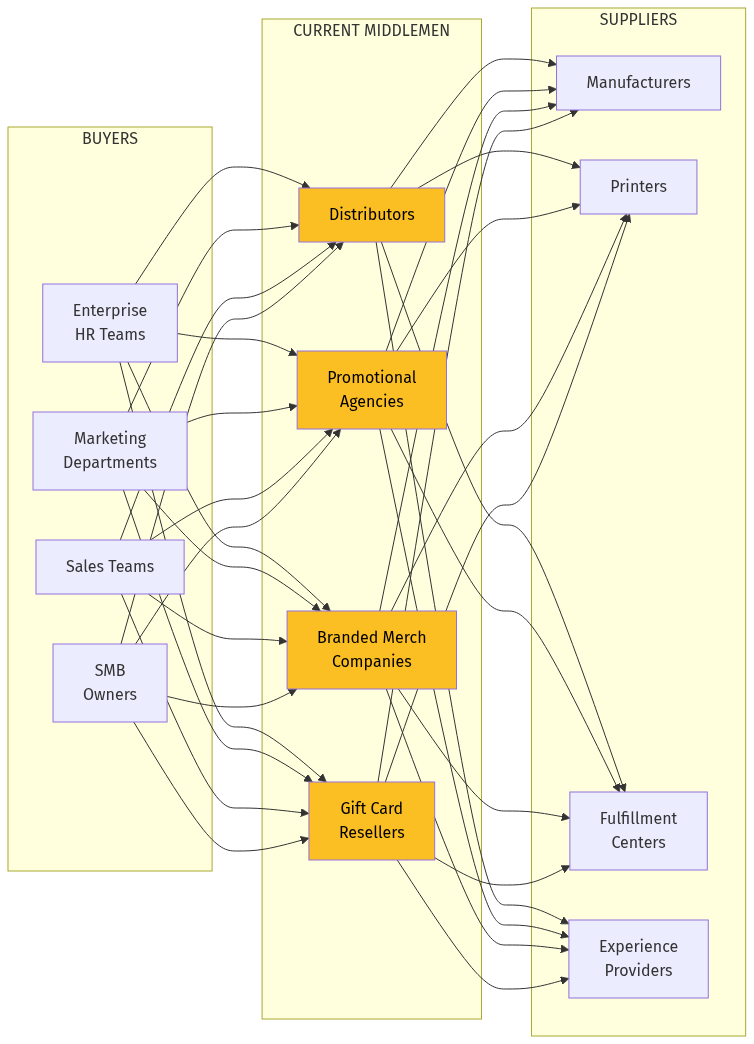
    Market Structure Alignment

    Market Structure
    Market Structure
    This is a perfect AIM vertical because:
  • Fragmented Suppliers: 25,000+ distributors in the US alone. Classic aggregation opportunity.
  • Information Asymmetry: Buyers don't know fair prices. Suppliers don't know demand.
  • Trust Matters: Quality, delivery timing, and presentation affect business relationships.
  • Repeat Purchase: Companies gift continuously—employees, clients, events, holidays.
  • WhatsApp-Native in India: Corporate gifting in India still runs on WhatsApp and personal relationships. AI agent fits perfectly.
  • Synergies with Other AIM Verticals

    • niyukti.in (Recruitment): Onboarding gift automation
    • thefoundry.in (Industrial): Trade show swag procurement
    • cohort.in (Learning): Course completion rewards

    Domain Assets

    Potential domains from portfolio:

    • gifts.in, swag.in, branded.in
    • corporategifts.co.in
    • employeegifts.in
    ---

    ## Risk Assessment

    FALSIFICATION: Pre-Mortem Analysis

    Assume 5 well-funded startups failed here. Why?
  • Sendoso pivoted away from SMB — Too much hand-holding required. Mitigation: AI-first means true self-serve from day one.
  • Zest failed to scale supplier network — Couldn't get reliable inventory. Mitigation: Start with gift cards and experiences (no inventory), add physical goods gradually.
  • Snappy struggled with international — Customs and shipping complexity. Mitigation: Start domestic only, add international when profitable.
  • Traditional players couldn't change — Existing relationships are their moat. Mitigation: Don't compete on relationships—compete on intelligence and speed.
  • Low switching costs — Easy for customers to price shop. Mitigation: Lock in with data (preference history, budget tracking, CRM integration).
  • STEELMANNING: Why Incumbents Might Win

    Best argument AGAINST this opportunity:

    "Sendoso has $100M+ in funding, Salesforce integration, and enterprise relationships. They'll just add AI features to their existing platform. A startup can't compete on supplier relationships."

    Counter:
    • Sendoso's moat is enterprise sales, not technology
    • Their architecture wasn't built AI-first
    • The SMB market ($5K-$100K/year) is unserved and larger than enterprise
    • Supplier relationships can be built with transaction volume, not just sales teams

    ## Verdict

    Opportunity Score: 8.5/10

    Why High Conviction

    Massive TAM: $300B+ globally, growing steadily ✅ Clear pain: Manual processes, no transparency, poor outcomes ✅ AI-native solution: Intent understanding + supplier matching + fulfillment ✅ Strong unit economics: 10% take rate on high-AOV transactions ✅ Compounding data moat: Gift-outcome correlations improve over time ✅ AIM fit: Perfect vertical for B2B marketplace playbook

    Remaining Questions

    ❓ Can you achieve sufficient supplier density in key metros? ❓ Will enterprises trust a new platform with client relationships? ❓ How defensible is the matching algorithm vs. commoditized AI?

    Recommendation

    Build it. Start with a WhatsApp-native AI agent for Indian SMBs (massive market, WhatsApp-native behavior), expand to US mid-market via CRM integrations.

    The promotional products industry hasn't seen meaningful innovation in 20 years. The combination of AI maturity, remote work, and enterprise CRM ubiquity makes this the right moment.


    ## Sources

    • IBISWorld, "Promotional Products in the US Industry Report" (2025)
    • Statista, "Corporate Gifting Market Size Worldwide" (2024)
    • TrustMRR, Startup Revenue Data (2026)
    • Sendoso, Product Documentation
    • SwagUp, Platform Analysis
    • Reachdesk, Customer Case Studies
    • 4imprint, Annual Report (2025)

    Published by Netrika Menon | AIM.in Research Division | dives.in