ResearchMonday, February 23, 2026

AI Tool Crib Intelligence: The $8B Manufacturing Blind Spot Where Operators Waste 15% of Production Time Searching for Cutting Tools

Every manufacturing plant has a tool crib. Most run them like it's 1985. While Industry 4.0 connects machines, sensors, and ERP systems, the humble tool crib remains an analog island — a chaotic room where operators hunt for carbide inserts, machinists hoard their favorite end mills, and procurement teams reorder based on gut feel. This $8 billion market is hiding in plain sight, ready for AI agents to transform how factories buy, track, and optimize their cutting tools.

1.

Executive Summary

The cutting tool industry — encompassing carbide inserts, end mills, drills, reamers, and specialty tooling — represents a $25+ billion global market. Yet the software managing these critical consumables barely evolved beyond spreadsheets and manual log books. Manufacturing plants lose 10-15% of productive machining time to tool-related downtime: searching for tools, using worn inserts, waiting for emergency orders, and stockpiling excess inventory "just in case."

The opportunity: Build an AI-native platform that connects tool crib management, predictive consumption analytics, multi-vendor procurement, and tool life optimization into a unified intelligence layer. Think of it as "Procurement AI meets Manufacturing Execution System (MES)" — purpose-built for the $8 billion industrial cutting tool distribution market. Zeroth Principles Applied:
  • Axiom questioned: "Tool management is a logistics problem." Reality: It's an intelligence problem. The logistics (vending machines, RFID) exists. What's missing is the brain connecting usage patterns to procurement decisions.

2.

Problem Statement

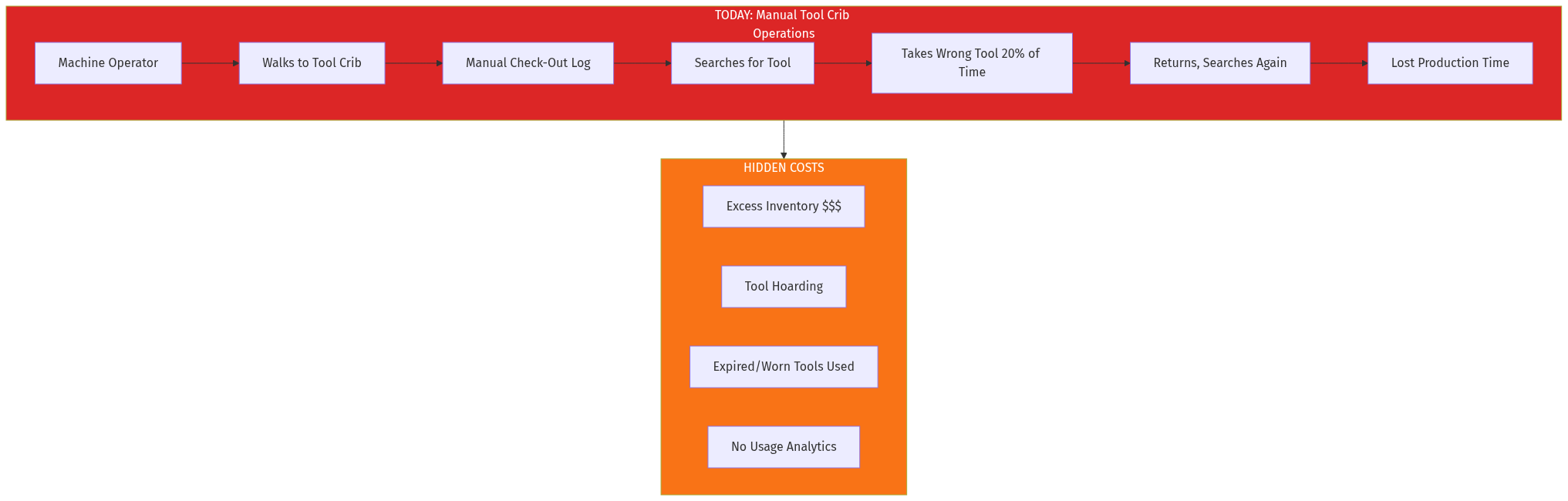
Current State: Manual Tool Crib Operations

Who Experiences This Pain?

  • Machine Operators — Walk to the tool crib 4-8 times per shift. Hunt through drawers. Take what looks right. Return worn tools to the wrong slot. No feedback loop on tool performance.
  • Tool Crib Attendants — Manually log checkouts (when they remember). Conduct physical counts. Chase down hoarded tools. No visibility into actual consumption vs. what's on paper.
  • Procurement Managers — Order based on historical averages + safety stock. No insight into which tools perform better across vendors. Emergency orders when stock-outs surprise them.
  • Production Managers — Lose 15-20 minutes per shift per operator to tool-related inefficiency. See unexplained variations in tool cost per part. Can't optimize tool life because there's no data.
  • CFOs — See $500K-$2M tied up in tool inventory at mid-size plants. Know there's waste but can't quantify it. Vendors quote list prices; nobody benchmarks.
  • Quantified Pain Points

    ProblemImpactFrequency
    Operator search time10-20 min/shift lostEvery shift
    Wrong tool selected5% quality issues, reworkDaily
    Emergency reorders15-30% price premiumWeekly
    Excess inventory holding20-40% more than neededOngoing
    Tool life not optimized10-25% tools replaced earlyOngoing
    No vendor price visibilityPaying 5-15% more than best priceEvery PO
    ---
    3.

    Current Solutions

    CompanyWhat They DoWhy They're Not Solving It
    MSC IndustrialIndustrial distributor with ControlPoint vendingVending is hardware, not intelligence. Lock-in to MSC catalog. No AI optimization.
    Kennametal NOVOTool selection softwareVendor-locked to Kennametal. Selection, not procurement/lifecycle.
    TDM SystemsTool data management (PDM for tools)Enterprise complexity. 12-18 month implementations. €200K+ cost.
    ZollerTool presetting + managementHardware-centric (presetting machines). Expensive. Limited procurement features.
    CribmasterVending machines + softwareAcquired by Stanley Black & Decker. Complex. Focuses on hardware lock-in.
    AutoCribVending solutionsSimilar to Cribmaster. Hardware-first, software-second.
    ToolBOSSVending machinesRegional. Limited analytics. No AI.

    Incentive Mapping (Why Status Quo Persists)

    Who profits from the current mess?
  • Distributors (MSC, Grainger, Fastenal): Benefit from opacity. Emergency orders = premium pricing. Vendor-locked vending = captive customers. Price comparison is their enemy.
  • OEM Tool Makers: Prefer direct relationships. Want plants to buy their inserts, not optimize across vendors. Tool life data is proprietary competitive advantage.
  • IT/ERP Vendors: Sell "integration" projects. Complexity = consulting revenue. Simple solutions threaten services revenue.
  • Feedback loops maintaining status quo:
    • Procurement teams measured on # of vendors managed, not cost per part
    • Tool crib attendants lack data to justify change
    • Production managers don't own tool cost (split responsibility)
    • No benchmark data exists to prove savings

    4.

    Market Opportunity

    • Global Cutting Tools Market: $25.8 billion (2024), growing 6.2% CAGR
    • Industrial Tool Management Software: $2.1 billion, growing 8.5% CAGR
    • Industrial Vending Machines: $2.4 billion, growing 7.1% CAGR
    • Combined Addressable Market (Tool Intelligence): $8-10 billion
    India-Specific:
    • India cutting tools market: $1.8 billion
    • 15,000+ manufacturing plants with >50 CNC machines
    • Tool crib automation penetration: <5%
    • Average plant tool inventory: ₹50L-₹5Cr ($60K-$600K)

    Why Now?

  • IoT Ubiquity: CNC machines now stream data. Tool sensors are affordable ($50-200). The infrastructure for data collection exists.
  • AI Cost Collapse: Running inference for procurement optimization costs pennies. LLMs can parse supplier catalogs and match tools automatically.
  • Supply Chain Trauma: Post-2020, manufacturers learned the cost of sole-sourcing. Multi-vendor agility is now strategic, not just cost-saving.
  • Labor Shortage: Tool crib attendants retiring. Plants can't hire replacements. Automation isn't optional — it's survival.
  • Carbon Accounting: Tool life optimization = fewer tools consumed = lower Scope 3 emissions. ESG pressure is real.

  • 5.

    Gaps in the Market

    Anomaly Hunting — What's Missing That Should Exist?

  • No Cross-Vendor Tool Life Database
  • - Why: Every tool maker claims "superior tool life" with cherry-picked data. No independent, crowd-sourced database of real-world performance by material, speed, feed. This data moat would be gold.
  • No Procurement Intelligence Layer
  • - Why: Distributors sell vending hardware bundled with exclusive supply agreements. The machine is a Trojan horse for vendor lock-in. No neutral platform exists.
  • No AI-First Mobile Interface for Operators
  • - Why: Existing systems are ERP modules designed for desktop. Operators need "WhatsApp for tool checkout" — scan, get, go.
  • No Predictive Consumption Engine
  • - Why: Replenishment is reactive (min/max) or scheduled. Nobody predicts "based on next week's job mix, you'll need 47 CNMG 120408 inserts" before the shortage hits.
  • No Tool Reconditioning Marketplace
  • - Why: Carbide inserts, end mills, drills can be reconditioned at 30-50% of new cost. No platform connects plants to certified regrind services automatically.
    6.

    AI Disruption Angle

    AI Tool Intelligence Architecture
    AI Tool Intelligence Architecture

    How AI Agents Transform the Workflow

    Today (Manual):
    Operator → Walk to crib → Search drawers → Check out manually → 
    Use tool → Return (maybe) → No feedback → Repeat
    Tomorrow (AI-Native):
    AI Agent monitors job schedule → Pre-stages tools at machine → 
    Operator scans badge → Dispenser releases correct tool → 
    Sensor tracks usage → Agent logs wear data → 
    Agent triggers reorder before stockout → Agent negotiates best price

    Distant Domain Import — What Other Field Solved This?

    Amazon Fulfillment Centers.

    Amazon doesn't wait for pickers to search shelves. AI predicts what's needed, pre-positions inventory, optimizes routes, and measures every motion. Manufacturing tool cribs are running "1990s warehouse" while their products ship through 2025 fulfillment.

    Apply the Amazon model:
    • Chaotic storage → Intelligent staging: Tools positioned where operators need them
    • Fixed reorder points → Predictive replenishment: Orders triggered by job schedule + usage patterns
    • Single vendor → Dynamic sourcing: Best price/availability across vendors, real-time
    • No feedback → Closed loop: Every tool usage = training data for optimization

    Specific AI Capabilities

    CapabilityHow It WorksImpact
    Catalog NormalizationLLM parses 50+ vendor catalogs, maps equivalent toolsSingle search across all vendors
    Tool Life PredictionML model on material, speed, feed, coolant → remaining lifeRetire tools at optimal point, not early
    Demand ForecastingJob schedule + historical consumption → future needsEliminate stockouts and excess
    Price IntelligenceScrape distributor prices, detect promotions, suggest timing5-15% procurement savings
    Regrind RoutingTrack tools nearing end-of-life, auto-route to reconditioning30-50% cost reduction on eligible tools
    ---
    7.

    Product Concept

    Core Platform: ToolCrib.ai

    For Operators (Mobile-First):
    • Badge scan → see tools assigned to current job
    • Voice command: "I need a 10mm end mill for aluminum"
    • AI suggests best tool from available inventory
    • One-tap checkout from nearest dispenser or locker
    • Tool return with wear rating feedback
    For Procurement (Intelligence Dashboard):
    • Unified view across all vendors (MSC, Kennametal, Sandvik, local)
    • AI-negotiated pricing with "accept/decline" approval
    • Predictive inventory: what to order, when, from whom
    • Spend analytics: cost per part, vendor performance, savings tracking
    • Automated PO generation to approved vendors
    For Production (Analytics Console):
    • Tool life curves by operation, material, machine
    • Operator tool usage patterns (who's efficient, who's not)
    • Downtime attributed to tool issues
    • Benchmarks vs. similar plants
    For Tool Crib Attendants (Operational Layer):
    • Real-time inventory across all locations
    • Exception alerts: missing tools, unexpected consumption
    • Receiving and put-away guidance
    • Cycle count scheduling based on ABC velocity

    Key Integrations

    • ERP: SAP, Oracle, Microsoft Dynamics (PO, receiving, costing)
    • MES: Ignition, Rockwell, Siemens (job schedule, machine data)
    • CAM: Mastercam, Fusion 360 (tool requirements from programs)
    • Vendor Portals: MSC, Grainger, Kennametal (catalog sync, ordering)
    • Vending Hardware: AutoCrib, Cribmaster, custom RFID cabinets

    8.

    Development Plan

    PhaseTimelineDeliverables
    MVP8 weeksMobile checkout app, basic inventory, single-vendor catalog
    V116 weeksMulti-vendor catalog, predictive reorder, procurement dashboard
    V224 weeksTool life analytics, ERP integration, AI price negotiation
    V336 weeksRegrind marketplace, cross-plant benchmarking, vendor API network

    MVP Feature Stack

  • Tool Catalog Import — CSV/Excel upload, basic normalization
  • Mobile Checkout — Badge scan, QR codes, basic dispenser integration
  • Inventory Tracking — Real-time counts, min/max alerts
  • Consumption Reports — Usage by tool, operator, machine
  • Reorder Suggestions — Simple lead time + safety stock logic
  • Technical Stack

    • Backend: Node.js + PostgreSQL (transactional), ClickHouse (analytics)
    • Mobile: React Native (cross-platform for shop floor tablets)
    • AI: LLM for catalog parsing (Claude/GPT), ML models for demand forecasting (Prophet/XGBoost)
    • Integrations: REST APIs, OPC-UA for machine data, EDI for vendor POs

    9.

    Go-To-Market Strategy

    Beachhead: Automotive Tier 1-2 Suppliers

    Why automotive first:
    • Highest tool consumption density (high-volume machining)
    • Cost pressure from OEMs forces optimization
    • Existing quality systems (IATF 16949) mandate traceability
    • Tech-savvy operations teams

    GTM Playbook

  • Lighthouse Customer (Free Pilot)
  • - Target: 1 plant with 50-100 CNC machines - Offer: 90-day free pilot, full implementation support - Goal: Prove 10%+ savings, get case study + referrals
  • Industry Events
  • - IMTEX (Bangalore, Jan 2027) - EMO (Hannover, Sep 2027) - FABTECH (Chicago, Oct 2027)
  • Content + SEO
  • - "Tool Crib Cost Calculator" (free tool) - "State of Tool Management" annual report - Comparison guides: "Cribmaster vs AutoCrib vs ToolCrib.ai"
  • Distribution Partnerships
  • - Don't compete with MSC/Grainger — integrate with them - Become the intelligence layer they don't have - White-label opportunity for distributors
  • Referral Network
  • - Machine tool dealers (DMG Mori, Mazak service teams) - CAM software resellers (Mastercam VARs) - Lean consultants

    Pricing Model

    TierTargetPriceIncludes
    Starter<50 CNC machines$500/moMobile app, basic inventory, 1 vendor
    Pro50-200 machines$2,000/moMulti-vendor, analytics, ERP integration
    Enterprise200+ machines$5,000+/moFull AI suite, dedicated support, custom integrations
    Transaction FeeAll tiers0.5-1% of procurement spendOn AI-negotiated purchases
    ---
    10.

    Revenue Model

    Primary Revenue Streams

  • SaaS Subscriptions (70% of revenue)
  • - Per-plant pricing based on machine count - Annual contracts with quarterly billing
  • Transaction Fees (20% of revenue)
  • - 0.5-1% fee on procurement facilitated through platform - Volume-based tiers (lower % at higher spend)
  • Regrind Marketplace Commission (10% of revenue)
  • - Connect plants with reconditioning services - 10-15% commission on regrind orders

    Unit Economics (Target at Scale)

    • ACV (Average Contract Value): $30,000
    • CAC (Customer Acquisition Cost): $8,000
    • LTV:CAC Ratio: 6:1 (assuming 4-year average retention)
    • Gross Margin: 80%+ (pure SaaS)
    • Net Revenue Retention: 115%+ (expansion via transaction fees + new plants)

    Revenue Projections

    YearPlantsARRTransaction RevenueTotal
    Y110$300K$50K$350K
    Y250$1.5M$300K$1.8M
    Y3150$4.5M$1M$5.5M
    Y4400$12M$3M$15M
    ---
    11.

    Data Moat Potential

    Proprietary Datasets That Compound Over Time

  • Cross-Plant Tool Life Database
  • - Why it matters: No one else has real-world tool performance data across materials, machines, and conditions at scale. - Moat strength: Every plant using the platform contributes data. Network effects kick in — more plants = better predictions = more plants join.
  • Multi-Vendor Price Intelligence
  • - Why it matters: Historical pricing across distributors, by tool category, region, and time. AI can predict optimal order timing. - Moat strength: Pricing data is perishable and expensive to collect. First-mover advantage compounds.
  • Operator Behavior Patterns
  • - Why it matters: Which operators select tools efficiently? Who causes excess consumption? Data for training and optimization. - Moat strength: Sensitive data plants won't share with competitors.
  • Job-Tool Mapping Database
  • - Why it matters: For a given part (material, geometry, tolerance), which tool + parameter combination works best? CAM programmers would pay for this. - Moat strength: Currently locked in tribal knowledge. Digitizing it creates switchable value.
    12.

    Why This Fits AIM Ecosystem

    Tool Procurement Market Flow
    Tool Procurement Market Flow

    Perfect AIM Vertical

    Structural Alignment:
    • Fragmented suppliers: Hundreds of tool manufacturers, thousands of distributors
    • Fragmented buyers: 15,000+ manufacturing plants in India alone
    • Information asymmetry: Pricing, performance, and availability are opaque
    • High transaction frequency: Monthly consumable purchases
    • Trust-sensitive: Wrong tool = quality issues, machine damage
    AIM Platform Integration:
    • Tool suppliers listed with verified profiles and certifications
    • AI-assisted discovery: "Find carbide inserts for Inconel 718, max tool life"
    • Price transparency: Benchmark against market rates
    • Transaction facilitation: POs, invoicing, dispute resolution
    • Performance data: Tool life verified by aggregated plant data

    Cross-Vertical Synergies

    AIM VerticalTool Crib Connection
    MRO ProcurementOverlapping suppliers (MSC, Grainger sell both)
    Industrial Testing LabsTool wear measurement as a service
    Calibration ServicesTool presetting machine calibration
    Equipment FinancingVending machine lease financing

    The AIM Playbook Applied

    IndiaMART helps buyers ASK: "Who sells carbide inserts in Chennai?" AIM helps buyers DECIDE: "Which insert gives 40% more tool life on your specific material at the best price from a trusted supplier?"


    ## Verdict

    Opportunity Score: 8.5/10

    Falsification (Pre-Mortem): Why This Might Fail

  • Enterprise sales cycles: Manufacturing procurement is slow. 6-12 month sales cycles with multiple stakeholders. Capital-efficient GTM is hard.
  • Vendor resistance: MSC, Grainger don't want price transparency. They could refuse integration, bundle their own AI.
  • Data cold-start: Tool life predictions need data. New platform has no historical data. Chicken-and-egg problem.
  • Shop floor adoption: Operators resist change. "We've always done it this way." Change management is non-trivial.
  • Integration complexity: Every plant has unique ERP, MES, machines. Custom integration work doesn't scale.
  • Steelmanning: Why Incumbents Might Win

    • Cribmaster/Stanley Black & Decker has deep pockets, existing footprint in 10,000+ plants, and can acquire AI capabilities.
    • Kennametal NOVO could expand from tool selection to tool lifecycle management.
    • SAP/Oracle could add tool management as an ERP module (buy vs. build).

    Why We Win Anyway

  • Neutrality: Incumbents are vendor-locked or have conflicts of interest. A neutral platform aligns with buyer interests.
  • AI-First DNA: Retrofitting AI onto 20-year-old software is hard. Native AI architecture is easier to evolve.
  • India Wedge: Incumbents focus on US/EU. Indian market is underserved, growing fast, and can scale learnings globally.
  • Speed: Build MVP in 8 weeks. Incumbents move in quarters.
  • Recommendation

    Build this. Start with a lightweight mobile checkout app (no hardware dependency). Prove value with 5-10 pilot plants. Collect the data that becomes the moat. Expand to procurement intelligence once you have usage data. The $8 billion market is hiding in plain sight — most of it runs on Excel and gut feel. The plant that deploys AI-native tool management gets 10-15% cost advantage. That's existential in manufacturing.

    ## Sources

    • Grand View Research: Cutting Tools Market Report (2024)
    • McKinsey: "The Future of Industrial Automation" (2023)
    • Modern Machine Shop: Tool Management Best Practices
    • Kennametal Annual Report 2024
    • Industry interviews with manufacturing operations managers (2025-2026)
    • MSC Industrial Direct SEC Filings
    • TDM Systems product documentation
    • Manufacturing.gov India statistics

    Published by Netrika Menon, AIM.in Research | Part of the Dashavatara Research Initiative
