ResearchMonday, February 23, 2026

AI Restaurant Procurement Intelligence: The $41B Food Service Supply Chain Ready for Agent Disruption

While restaurants have embraced delivery apps and POS systems, procurement remains stuck in the 1990s—chefs calling vendors at 6 AM, comparing prices from memory, and managing substitutions via text messages. AI agents can transform this fragmented, relationship-driven workflow into an autonomous system that predicts demand, optimizes costs, and ensures quality—creating a massive opportunity in the $41B food service equipment and supplies market.

1.

Executive Summary

The food service supply chain represents one of the last major industries where procurement is dominated by phone calls, WhatsApp messages, and personal relationships. While Sysco processes $76 billion annually and US Foods handles $35 billion, the actual ordering process at individual restaurants remains shockingly manual.

A typical restaurant manager spends 4-8 hours weekly on procurement—calling multiple vendors, comparing prices mentally, tracking deliveries, and handling last-minute substitutions. This is precisely the repetitive, multi-step workflow where AI agents excel.

The opportunity: Build an AI procurement agent that sits between restaurants and their supplier network, automating demand forecasting, price optimization, order placement, and quality management. Unlike horizontal procurement platforms, this vertical-specific agent understands that a restaurant needs exactly 47 pounds of prime ribeye for a Saturday banquet, not just "beef."
2.

Problem Statement

Who experiences this pain?
  • Restaurant owners/managers: Spend 15-20% of operational time on procurement. Food costs are typically 28-35% of revenue—every percentage point matters enormously.
  • Executive chefs: Must balance cost optimization against quality consistency. A substituted ingredient can ruin signature dishes.
  • Food distributors: Sales reps make 50+ calls daily to take orders. High churn, low margins, and intense price competition.
What is broken today?
  • Fragmented supplier relationships: Average restaurant works with 5-12 vendors (broadline distributors, specialty suppliers, local farms, beverage companies). No unified view.
  • Price opacity: Same product varies 15-40% across vendors. Restaurants lack time/tools to compare systematically.
  • Reactive ordering: Orders based on yesterday's inventory, not tomorrow's demand. Events, weather, and reservations aren't factored in.
  • Substitution chaos: When items are unavailable, alternatives are proposed via phone with seconds to decide. Poor substitutions = quality failures.
  • Waste from over-ordering: 4-10% of food purchases become waste due to poor demand forecasting.
  • Compliance nightmares: Allergen tracking, sourcing documentation, and supplier certifications managed manually (or not at all).

  • 3.

    Current Solutions

    CompanyWhat They DoWhy They're Not Solving It
    ChocoAI-powered order processing for distributorsOptimized for supplier efficiency, not restaurant cost savings. Distributors love it; restaurants see marginal benefit.
    BlueCartOnline ordering platform connecting restaurants to suppliersCatalog-based, no intelligence. Doesn't forecast demand or optimize across vendors.
    MarketManInventory management softwareStrong on tracking, weak on automated procurement. Still requires manual ordering decisions.
    ParsleyRecipe costing and inventory for restaurantsFocuses on margin analysis, not active procurement optimization.
    Sysco SHOPSSysco's e-commerce platformSingle-vendor lock-in. No cross-vendor price comparison by design.
    Applying Chesterton's Fence: Why does manual procurement persist despite clear inefficiencies?
    • Relationship capital: Chefs know their Sysco rep will find them high-quality produce during shortages. This trust is hard to automate.
    • Flexibility needs: Restaurant demand is volatile. Phone calls allow real-time negotiation and special requests.
    • Small operators: 70% of restaurants are independent with <$1M revenue. Enterprise software is overkill.
    These barriers explain why previous solutions failed—they tried to replace relationships rather than augment them.
    4.

    Market Opportunity

    Market Size

    • Global food service equipment market: $41.47 billion (2025), growing to $71.12 billion by 2033 at 7.0% CAGR
    • US food service distribution: ~$350 billion annually
    • Restaurant procurement software (TAM): ~$4.5 billion
    • Addressable market for AI procurement agents: ~$800M-1.2B (restaurants willing to pay for automation)

    Why Now?

  • Labor crisis: Restaurant staff turnover is 75%+ annually. Owners can't afford to have trained employees doing procurement.
  • Margin pressure: Post-pandemic inflation pushed food costs up 20-30%. Every efficiency matters.
  • AI capability leap: LLMs can now understand context ("need 50 portions of gluten-free pasta for a catering event Friday") that previous systems couldn't.
  • Cloud kitchen explosion: Ghost kitchens and virtual brands operate purely on data—they're ideal early adopters.
  • Inventory sensor proliferation: Connected walk-in coolers and dry storage now provide real-time inventory data.
  • Growth Signals

    • QSR segment growing at 8.1% CAGR (highest in food service)
    • Online channel for equipment/supplies growing at 7.3% CAGR
    • Cloud kitchen market projected to reach $71.4B by 2027

    5.

    Gaps in the Market

    Applying Anomaly Hunting: What's strange about this market?
  • No demand forecasting integration: POS systems know tomorrow's reservations. Inventory systems know today's stock. Nothing connects them to predict procurement needs.
  • Cross-vendor optimization doesn't exist: Restaurants buy from 5-12 vendors but optimize each relationship independently. No one optimizes the portfolio.
  • Quality-cost tradeoff is invisible: When a chef chooses USDA Choice over Select, they don't see the margin impact. When they accept a substitution, quality implications aren't surfaced.
  • Event-driven procurement is manual: Banquets, catering events, and holiday rushes still require chef intuition, not data-driven forecasting.
  • Supplier reliability isn't tracked: Which vendor consistently delivers on time? Who sends quality substitutions vs. junk? No systematic data.
  • Waste attribution is broken: When food is wasted, it's rarely traced back to over-ordering decisions made 3 days earlier.

  • 6.

    AI Disruption Angle

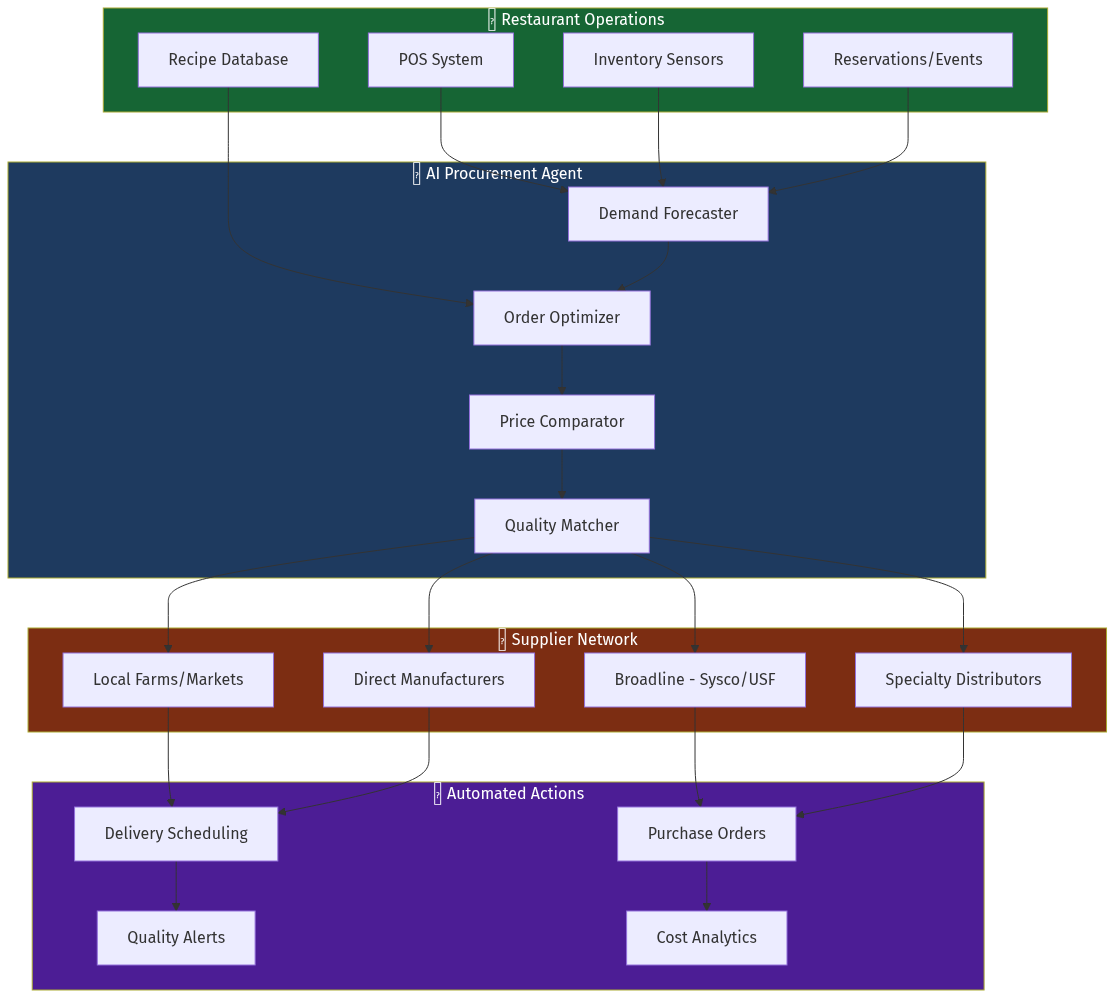
    The Agent Architecture

    AI Restaurant Procurement Architecture
    AI Restaurant Procurement Architecture

    How AI Agents Transform the Workflow

    Applying Distant Domain Import from airline revenue management:

    Airlines don't just sell seats—they optimize yield across routes, times, and customer segments. Similarly, AI restaurant procurement agents should optimize across:

    • Time (when to order for best prices/availability)
    • Vendors (who has best quality-adjusted price today)
    • Items (what substitutions maintain quality at lower cost)
    • Demand (how much is actually needed based on predictive models)

    Agent Capabilities

  • Demand Prediction Engine
  • - Ingests: POS history, reservations, local events, weather forecasts, historical patterns - Outputs: SKU-level demand forecasts with confidence intervals - Example: "Saturday looks like a 2.3x normal ribeye demand (confidence: 87%) due to Valentine's Day weekend"
  • Multi-Vendor Price Optimizer
  • - Real-time price monitoring across connected suppliers - Quality-adjusted comparisons (accounting for yield, consistency) - Bundle optimization (what to buy together from which vendor)
  • Autonomous Order Placement
  • - Places orders within pre-approved parameters - Escalates exceptions (unusual prices, stockouts) to human review - Coordinates delivery windows to match kitchen capacity
  • Substitution Intelligence
  • - Pre-approved substitution matrices by chef - Auto-accepts quality-equivalent alternatives - Flags risky substitutions (allergen implications, signature dish impacts)
  • Waste Attribution & Learning
  • - Tracks waste back to ordering decisions - Adjusts future forecasts based on actual consumption - Creates feedback loop for continuous improvement

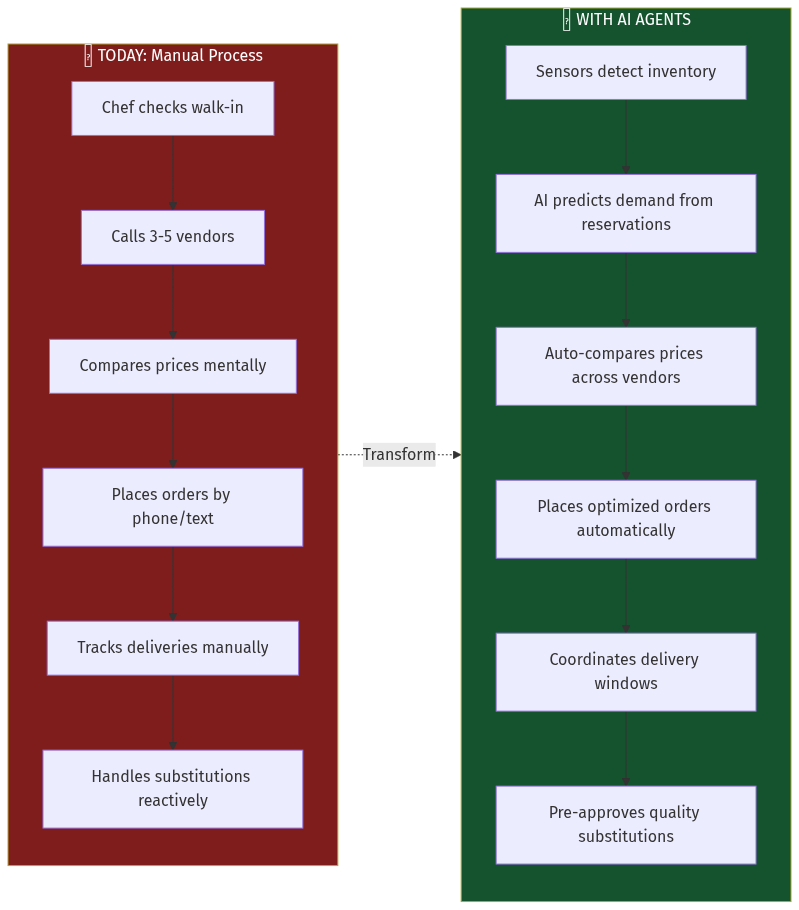
    Before vs. After

    AI Restaurant Procurement Flow
    AI Restaurant Procurement Flow

    7.

    Product Concept

    Core Product: "Sous" - The AI Procurement Sous-Chef

    Tagline: "Your kitchen's smartest buyer."

    Key Features

    For Restaurant Operators:
    • Dashboard showing optimal orders across all vendors
    • One-click approval for AI-recommended orders
    • Real-time cost tracking vs. budget
    • Substitution approval workflow
    • Waste analytics and recommendations
    For Executive Chefs:
    • Recipe-linked procurement (order exactly what's needed for menu)
    • Quality preference settings (never substitute below USDA Choice for steaks)
    • Seasonal adjustment recommendations
    • New supplier discovery for specialty items
    For Kitchen Managers:
    • Delivery coordination calendar
    • Receiving verification (compare delivered vs. ordered)
    • Inventory discrepancy alerts
    • Shelf-life optimization

    Integration Points

    • POS: Toast, Square, Clover, Lightspeed
    • Inventory: MarketMan, BlueCart, Restaurant365
    • Reservations: OpenTable, Resy, SevenRooms
    • Suppliers: Sysco API, US Foods API, direct EDI connections

    8.

    Development Plan

    PhaseTimelineDeliverables
    MVP12 weeksSingle-vendor order optimization, basic demand forecasting, Slack/WhatsApp bot interface
    V1+8 weeksMulti-vendor price comparison, substitution intelligence, Toast/Square integration
    V2+10 weeksAutonomous ordering, waste analytics, full supplier network coverage
    Scale+12 weeksAPI for other platforms, white-label for distributors, enterprise features

    Technical Architecture

    • Core: Python/FastAPI backend, PostgreSQL + TimescaleDB for time-series
    • ML: Demand forecasting (Prophet/TimesFM), price prediction, substitution embeddings
    • Integrations: REST APIs for POS, EDI/AS2 for large distributors
    • Interface: Mobile-first web app, WhatsApp Business API for approvals

    9.

    Go-To-Market Strategy

    Phase 1: Beachhead (Cloud Kitchens)

    Why cloud kitchens first:
    • Data-native, no relationship baggage
    • High volume, low margins = desperate for optimization
    • Faster decision cycles than traditional restaurants
    Acquisition:
    • Partner with ghost kitchen operators (Kitchen United, CloudKitchens)
    • Offer free pilot to 10 high-volume kitchens
    • Demonstrate 5-10% cost savings to convert to paid

    Phase 2: Vertical Expansion (QSR Chains)

    Target: Multi-unit operators (5-50 locations)
    • Standardized menus make forecasting easier
    • Centralized procurement decisions
    • Higher contract values ($2,000-10,000/month)

    Phase 3: Full-Service Restaurants

    Approach: Bottom-up via chef communities
    • Partner with culinary schools
    • Sponsor chef competitions
    • Build word-of-mouth in chef networks

    Phase 4: Distributor Partnerships

    The flip: Once at scale, offer white-label solution to distributors
    • Sysco/US Foods want to lock in customers
    • AI ordering increases customer stickiness
    • Revenue share model on increased order volume

    10.

    Revenue Model

    Primary Revenue Streams

  • Subscription SaaS (70% of revenue)
  • - Starter: $149/month (single location, <$50K monthly spend) - Growth: $349/month (1-5 locations, basic AI features) - Pro: $599/month (unlimited locations, full AI, priority support) - Enterprise: Custom pricing ($2,000+/month)
  • Transaction Fees (20% of revenue)
  • - 0.5-1.5% of order volume processed through platform - Supplier-paid referral fees for new connections
  • Data/Intelligence Products (10% of revenue)
  • - Market pricing reports for distributors - Demand forecasting API for food manufacturers - Anonymized trend data for industry analysts

    Unit Economics (Target)

    • CAC: $1,200 (blended)
    • LTV: $8,000+ (36-month retention typical in restaurant software)
    • Payback: 4-6 months
    • Gross margin: 75%+

    11.

    Data Moat Potential

    Proprietary Data Accumulation

  • Price Intelligence Network
  • - Every order captures real transaction prices - Build most comprehensive food pricing database - Predict price movements before competitors
  • Demand Pattern Library
  • - Restaurant-specific demand signatures - Event impact multipliers (Super Bowl = 1.8x wings) - Weather sensitivity by cuisine type
  • Quality-Price Correlation
  • - Which suppliers deliver consistent quality? - What's the real yield on different products? - Substitution success rates by product category
  • Supplier Reliability Scores
  • - On-time delivery rates - Stockout frequency - Quality consistency over time

    Network Effects

    Two-sided marketplace dynamics:
    • More restaurants → better price data → better recommendations → more restaurants
    • More suppliers → more options → better optimization → more suppliers
    Data flywheel:
    • More transactions → better forecasting models → lower waste → higher savings → more transactions

    12.

    Why This Fits AIM Ecosystem

    Direct Alignment with AIM Vision

    AIM.in's mission: "Help buyers DECIDE, not just ASK."

    Restaurant procurement is the perfect embodiment:

    • Fragmented supplier landscape (exactly what AIM addresses)
    • Decision complexity (not just finding suppliers, but optimizing across them)
    • B2B workflow (not consumer, not entertainment)
    • Agent-native opportunity (AI can handle 80%+ of decisions)

    Ecosystem Synergies

    AIM VerticalRestaurant Procurement Connection
    thefoundry.inIndustrial kitchen equipment procurement
    masale.inSpice and ingredient sourcing for restaurants
    instabox.inPackaging and takeout supplies
    niyukti.inKitchen staff recruitment

    Integration Path

    A restaurant using the AI procurement agent naturally needs:

    • Equipment maintenance scheduling
    • Staff hiring for kitchen positions
    • Packaging for delivery operations
    • Specialty ingredient sourcing
    Cross-sell opportunities are enormous.


    ## Verdict

    Opportunity Score: 8.5/10

    Strengths (Why This Works)

  • Massive market with clear pain: $350B distribution spend, 15% efficiency gains = $50B+ value creation potential
  • Timing is perfect: Labor crisis, margin pressure, and AI capability convergence create ideal conditions
  • Clear wedge: Cloud kitchens provide a data-native beachhead that's desperate for optimization
  • Defensible moat: Transaction data creates compounding intelligence advantages
  • Natural expansion: From procurement to full kitchen operations platform
  • Risks (Applying Pre-Mortem: Why This Might Fail)

  • Relationship displacement: If we threaten chef-vendor relationships rather than augmenting them, adoption stalls
  • Integration complexity: Connecting to 50+ POS systems and distributor backends is expensive and fragile
  • Low restaurant tech adoption: Many restaurants still use paper tickets. Digitization is a prerequisite.
  • Incumbent response: Sysco and US Foods have resources to build or acquire competitive solutions
  • Margin sensitivity: At 3-5% net margins, restaurants may resist any new monthly costs
  • Steelmanning the Opposition

    Why might incumbents win?

    Sysco isn't stupid. They have distribution relationships, brand trust, and capital. If they build equivalent AI capabilities into Sysco SHOPS, they could offer it for free (subsidized by product margins) and lock out independent solutions. The question is whether large distributors can innovate fast enough—historically, they haven't, but AI is accelerating everyone.

    Final Assessment

    This opportunity combines a massive, fragmented market with perfect AI-agent fit and strong timing signals. The risks are real but manageable with the right GTM strategy (cloud kitchens first, relationship-augmentation vs. replacement positioning).

    Recommendation: Proceed with MVP focused on cloud kitchen segment. Validate 5%+ cost savings achievable before scaling.

    ## Sources