ResearchMonday, February 23, 2026

AI Testing Lab Intelligence: The $3B Opportunity in India's Fragmented Quality Certification Market

India has 15,000+ testing laboratories but no intelligent marketplace to connect them with the manufacturers who desperately need their services. In a market where compliance is mandatory, discovery is still WhatsApp-driven, and trust is a coin flip. AI agents can transform this chaos into a structured, intelligent testing network.

1.

Executive Summary

India's Testing, Inspection, and Certification (TIC) market is valued at $3.2 billion and growing at 6.5% CAGR. Yet the market remains stubbornly fragmented: 15,000+ labs scattered across the country, clustered in metros while tier-2/3 manufacturers ship samples hundreds of kilometers away.

The opportunity: Build an AI-native testing lab marketplace that transforms how manufacturers discover, engage, and manage quality testing services. Think Practo for industrial compliance—but with AI agents handling the complexity of test requirements, lab matching, and compliance tracking.

Why now: Three forces converging:
  • Regulatory explosion: 150+ chemical products and 463 machinery lines now require mandatory testing
  • Export pressure: Global buyers demand certified compliance, pushing 63% of testing to outsourced partners
  • AI maturity: NLP can finally parse complex test requirements and match them to lab capabilities

  • 2.

    Problem Statement

    Who Feels the Pain?

    Manufacturers (especially SMEs):
    • Need testing for export compliance but don't know which labs handle their specific tests
    • Ship samples to distant metros because local labs lack capability
    • Wait 2-3 weeks for results that should take 3-4 days
    • Pay consultants just to navigate the lab discovery maze
    Quality Managers:
    • Manage 10-20 test types across multiple labs manually
    • Track certifications in spreadsheets that expire without warning
    • No visibility into lab capacity or turn-around times
    • Re-run tests because wrong lab was selected initially
    Testing Labs:
    • Capacity underutilized at 40-60% outside peak seasons
    • Compete on price against unaccredited labs offering faster, cheaper (but invalid) results
    • No digital presence—rely on broker relationships and word-of-mouth
    • Spend 30% of time on sample logistics and paperwork, not testing

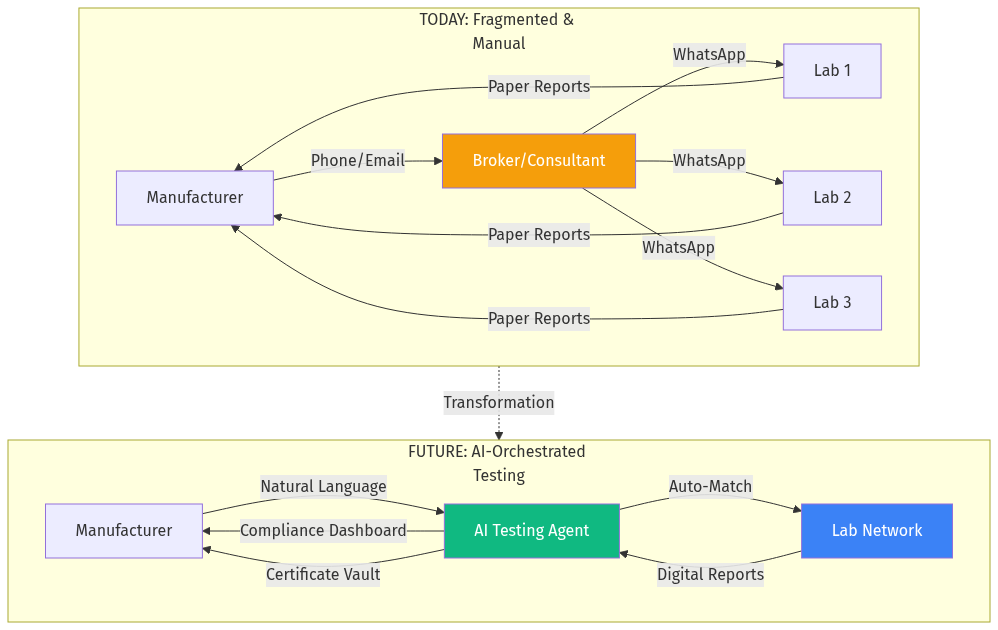
    The Current Workflow (A Disaster)

    Market Structure
    Market Structure
  • Manufacturer needs EMC testing for an electronic component
  • Asks procurement team, who asks their consultant
  • Consultant calls 3-4 labs they know, gets quotes over WhatsApp
  • Manufacturer selects based on price (no quality comparison possible)
  • Samples shipped by courier—often mishandled or delayed
  • Results come as PDF scans, manually entered into compliance systems
  • Certificate tracking happens in Excel; expirations missed regularly
  • Mental Model Applied: INCENTIVE MAPPING

    Who profits from this chaos?

    • Consultants/brokers earn fees by exploiting information asymmetry
    • Unaccredited labs thrive because buyers can't easily verify credentials
    • Legacy testing giants (SGS, Bureau Veritas) maintain premium pricing because alternatives are invisible
    The status quo rewards opacity. A transparent marketplace threatens these rent-seekers.


    3.

    Current Solutions

    CompanyWhat They DoWhy They're Not Solving It
    SGS, Bureau Veritas, TÜVFull-service TIC giantsExpensive, slow, enterprise-focused. SMEs can't afford their premiums.
    NABL DirectoryOfficial list of accredited labsStatic database, no matching, no pricing, no reviews. Useless for discovery.
    IndiaMARTLists labs as vendorsNo test-capability matching, no accreditation verification, pure lead-gen.
    Consultants/BrokersManual lab discoveryRelationship-dependent, non-transparent, adds cost and time.
    Lab Management SoftwareLIMS for lab operationsFocuses on lab-side operations, not buyer discovery or matching.
    Mental Model Applied: DISTANT DOMAIN IMPORT

    What field has solved similar fragmented-service matching?

    • Practo/Doctolib (Healthcare): Doctor discovery + booking + records. Testing labs could have "Lab Profiles" with capabilities, accreditations, turnaround times.
    • Uber Freight (Logistics): Real-time capacity visibility + instant pricing. Labs could show live slot availability.
    • Upwork (Professional Services): Verified skills + reviews + escrow. Labs could have verified test capabilities + customer ratings.
    None of these have been applied to industrial testing. The playbook exists; execution is missing.
    4.

    Market Opportunity

    Market Size

    • India TIC Market: $3.2 billion (2024), growing at 6.5% CAGR
    • Testing Services: 58.4% of TIC revenue = ~$1.87 billion
    • Outsourced Testing: 63.4% of testing = ~$1.19 billion TAM
    • SME Segment: ~40% of outsourced = $476 million serviceable market

    Growth Drivers

  • Regulatory Expansion: BIS certification now required for transformers, switchgear, solar modules
  • Export Compliance: Quality Council of India pushing for 10,000 new NABL accreditations by 2030
  • Make in India: Manufacturing expansion creates testing demand at 1.5x GDP growth rate
  • EV Transition: New test categories for batteries, charging equipment, motor controllers
  • Why Now?

    Mental Model Applied: ZEROTH PRINCIPLES

    What do we assume about testing labs that might be wrong?

    Assumption: "Lab discovery is a search problem." Challenge: It's actually a matching problem. Manufacturers don't search for labs—they need to express a complex requirement and be matched to capable labs. This requires NLP + domain knowledge, not keyword search. Assumption: "Labs compete on price." Challenge: They compete on capability + accreditation + turnaround. Price is third. A marketplace that surfaces these factors changes buying behavior. Assumption: "Testing is transactional." Challenge: Testing is recurring. Compliance certificates expire. A relationship management layer (like Practo's follow-up reminders) creates switching costs.
    5.

    Gaps in the Market

    Gap 1: No Intelligent Discovery

    There's no way to ask "I need tensile strength testing for ASTM A370 steel samples, 10 specimens, results needed in 5 days" and get matched labs with pricing.

    Gap 2: Accreditation Verification is Manual

    NABL publishes a directory, but cross-referencing lab accreditation scope against your specific test is manual labor. Many manufacturers unknowingly use unaccredited labs.

    Gap 3: No Capacity Visibility

    Labs operate at varying capacity. Manufacturers have no visibility into current queue depth, leading to surprise delays.

    Gap 4: Paper-Driven Results

    Test reports come as PDF scans. Integrating results into ERP/PLM systems requires manual data entry. No API-first reports.

    Gap 5: Certificate Lifecycle Management

    ISO, BIS, and export certificates expire. Most companies track this in spreadsheets. Missed renewals cause shipment delays.

    Gap 6: Tier-2/3 City Lab Discovery

    Labs cluster in metros. Manufacturers in Coimbatore, Rajkot, or Aurangabad either ship samples far or use local unaccredited labs. Mental Model Applied: ANOMALY HUNTING

    What's strange about this market?

    • Anomaly 1: India has 5,500+ NABL-accredited labs but no aggregated, searchable capability database. The accreditation body doesn't provide a useful interface.
    • Anomaly 2: Testing is mandatory for export, yet no startup has built a "compliance-as-a-service" layer. Regulatory moat is unoccupied.
    • Anomaly 3: Lab utilization is 40-60%, yet lead times are 2-3 weeks. Supply exists; coordination fails.

    6.

    AI Disruption Angle

    The AI Testing Agent

    Transformation Vision
    Transformation Vision
    Natural Language Test Requirement Parsing "I need to test our new stainless steel kitchen sink for ASTM A967, ISO 9227 salt spray, and REACH compliance. 15 samples, certificate needed for EU export."

    AI parses this into:

    • Test Standards: ASTM A967 (Passivation), ISO 9227 (Corrosion), REACH (Chemical)
    • Material: Stainless Steel
    • Quantity: 15 samples
    • Certification: EU Export (requires specific accredited labs)
    Intelligent Lab Matching

    Beyond keyword matching:

    • Cross-reference lab accreditation scope against required tests
    • Check real-time capacity (API integration with willing labs)
    • Consider logistics (sample pickup, temperature-controlled transport)
    • Factor in historical performance (turn-around accuracy, report quality)
    Dynamic Pricing + Slot Booking

    • Labs set base prices; AI adjusts for urgency and capacity
    • Instant quotes replace week-long RFQ cycles
    • Calendar integration for sample submission scheduling
    Compliance Autopilot
    • Track all active certificates per manufacturer
    • Alert 90/60/30 days before expiration
    • Auto-schedule re-testing with preferred labs
    • Generate compliance reports for audits

    Agent-to-Agent Future

    When buyer and supplier both have AI agents:

    • Manufacturer's procurement agent requests quote from platform
    • Platform agent negotiates with lab agents
    • Automatic scheduling, sample logistics, result delivery
    • Zero human involvement for routine testing
    ---

    7.

    Product Concept

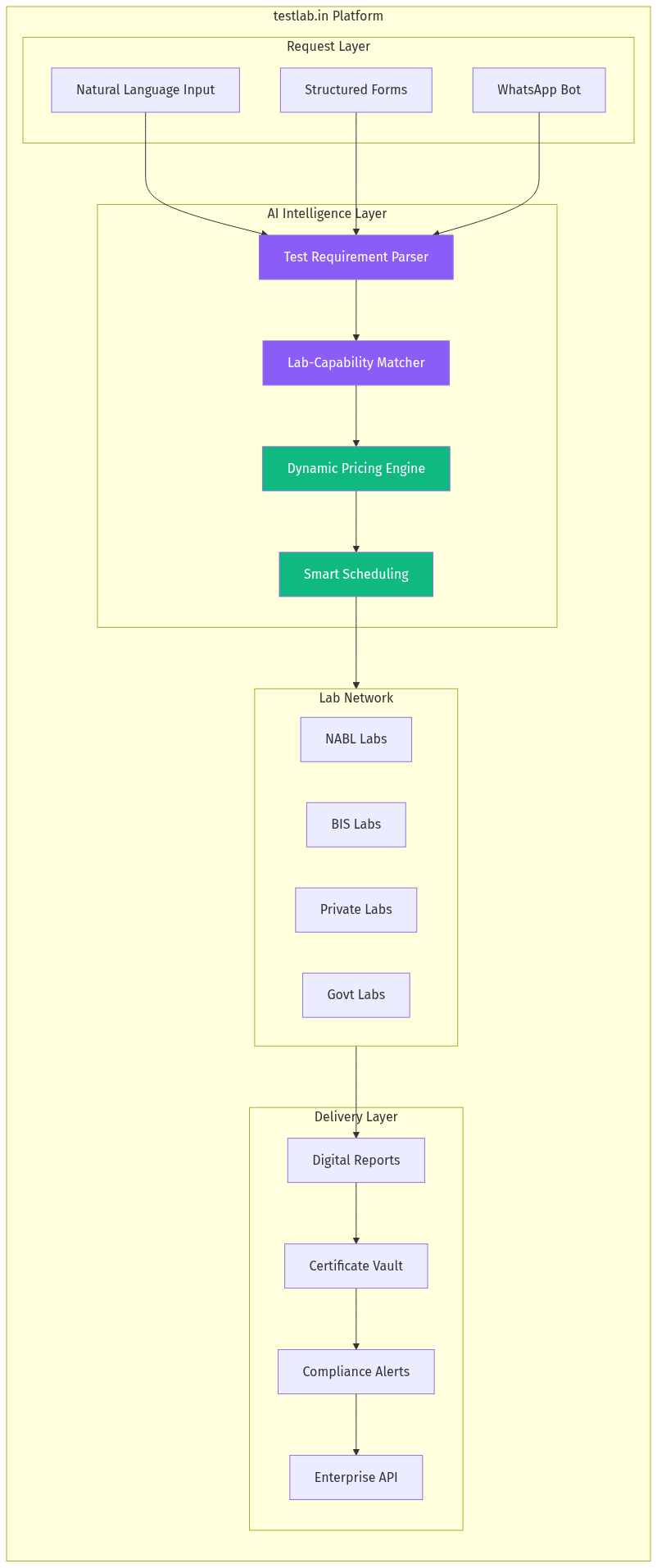
    Platform: testlab.in (or pariksha.in)

    Platform Architecture
    Platform Architecture
    For Manufacturers (Demand Side)
  • Smart Request Builder
  • - Natural language input: "test my product for..." - Guided forms for standard tests - Upload product specs, get recommended tests
  • Lab Comparison Dashboard
  • - Matched labs with accreditation verification - Pricing, turnaround, reviews visible - Real-time slot availability
  • Order Management
  • - Sample pickup scheduling (integrated logistics) - Real-time testing status tracking - Digital report delivery + API export
  • Compliance Center
  • - All certificates in one vault - Expiration alerts and auto-renewal - Audit-ready compliance reports For Labs (Supply Side)
  • Capability Profile Builder
  • - Map accreditation scope to test catalog - Set pricing rules, capacity limits - Integration with LIMS for auto-updates
  • Demand Dashboard
  • - Incoming requests matched to capabilities - Accept/decline with pricing confirmation - Capacity management tools
  • Digital Result Submission
  • - Structured report templates - Digital signature and certificate generation - Auto-distribution to buyer systems

    WhatsApp-First for SMEs

    Most SME quality managers live in WhatsApp. The platform must offer:

    • Request submission via WhatsApp bot
    • Status updates via WhatsApp
    • Report delivery via WhatsApp
    ---

    8.

    Development Plan

    PhaseTimelineDeliverables
    MVP8 weeksLab profile directory (100 labs), basic search, manual quote requests
    V112 weeksAI requirement parsing, automated matching, digital quotes
    V216 weeksOrder management, sample logistics integration, digital reports
    V320 weeksCompliance center, certificate vault, enterprise API
    ScaleOngoingLab network expansion, vertical-specific features

    MVP Focus

    Start with ONE vertical: Electronics Testing (EMC/EMI)

    • Well-defined test standards
    • Mandatory for BIS certification
    • High-value tests ($500-2000 per test)
    • Concentrated lab supply (20-30 capable labs)
    ---

    9.

    Go-To-Market Strategy

    Phase 1: Supply Side First (Weeks 1-8)

  • Onboard 50-100 NABL labs in electronics testing
  • - Direct outreach to lab directors - Free listing in exchange for capability mapping - Exclusive "verified" badge for early adopters
  • Build capability database
  • - Manually map each lab's accreditation scope - Create standardized test catalog - Cross-reference accreditation documents

    Phase 2: Demand Activation (Weeks 8-16)

  • Target electronic product manufacturers
  • - LinkedIn outreach to Quality Managers - Partnership with electronics industry associations - Content marketing: "Guide to BIS Certification"
  • WhatsApp number as MVP
  • - "Send your test requirements, get lab matches" - Manual matching initially, automated later - Build request volume before building UI

    Phase 3: Scale & Expand (Months 4-12)

  • Expand to adjacent verticals
  • - Mechanical testing (tensile, hardness, impact) - Chemical testing (composition, purity) - Environmental testing (RoHS, REACH)
  • Enterprise sales
  • - Compliance-as-a-service packages - API integration with ERP/PLM systems - Annual contracts with volume discounts Mental Model Applied: SECOND-ORDER THINKING

    If this succeeds, what happens next?

    • First-order: Labs get more customers, manufacturers find labs easier
    • Second-order: Data accumulates on test pricing, turnaround, quality—becomes valuable for market intelligence
    • Third-order: Platform can offer "testing-as-a-service" with guaranteed compliance, abstracting lab selection entirely
    • Fourth-order: Insurance companies use platform data to price product liability policies

    10.

    Revenue Model

    Transaction Fees

    • Take rate: 8-12% on test orders placed through platform
    • Average order value: ₹15,000-50,000
    • Target: 500 orders/month by Month 12 = ₹4-6L monthly revenue

    Subscription: Compliance Center

    • SME Plan: ₹2,000/month – 50 certificates, basic alerts
    • Enterprise Plan: ₹10,000/month – Unlimited, API access, audit reports
    • Target: 100 subscribers by Month 12 = ₹5-10L monthly revenue

    Premium Lab Listings

    • Featured listing: ₹5,000/month – Priority in search results
    • Verified badge: ₹2,000/month – Additional trust signals
    • Target: 50 premium labs = ₹2.5-3.5L monthly revenue

    Long-Term: Testing-as-a-Service

    • Annual compliance packages: "We handle all your testing for ₹X/year"
    • Margin from volume discounts negotiated with labs
    • Fully managed service for enterprises

    11.

    Data Moat Potential

    What Data Accumulates?

  • Test Pricing Database
  • - Real transaction prices by test type, lab, region - No such data exists publicly today
  • Lab Performance Scores
  • - Turn-around time accuracy - Report quality ratings - Dispute rates
  • Compliance Patterns
  • - Which products need which tests - Certification expiration trends - Industry-specific compliance calendars
  • Requirement-to-Test Mapping
  • - NLP models improve with usage - Proprietary understanding of how requirements translate to tests

    Moat Strength

    Mental Model Applied: FALSIFICATION (Pre-Mortem) "Assume 5 well-funded startups failed here. Why?"
  • Lab onboarding is slow. Labs are traditional businesses. Getting 1000+ labs is a 2-3 year effort. Patience required.
  • Chicken-and-egg: Manufacturers won't come without labs; labs won't join without demand. WhatsApp concierge solves this—be the marketplace before building the marketplace.
  • Low margins, high CAC. Testing is infrequent per customer. Need enterprise accounts with recurring needs, not one-off SME orders.
  • Big players could build this. SGS/Bureau Veritas have the lab relationships but no incentive—platform cannibalizes their margins.
  • Regulatory compliance is complex. Each industry has different requirements. Vertical focus beats horizontal spread.

  • 12.

    Why This Fits AIM Ecosystem

    Strategic Alignment

    AIM.in helps buyers DECIDE, not just ASK. Testing labs are a perfect fit:

    • High-stakes decisions (compliance = market access)
    • Complex evaluation criteria (accreditation, capability, turnaround)
    • Information asymmetry favors brokers today

    Synergies with Existing AIM Verticals

    AIM VerticalTesting Connection
    thefoundry.inRaw material testing for industrial suppliers
    masale.inFood safety testing for ingredient suppliers
    refurbs.inFunctionality testing for refurbished equipment
    rccspunpipes.inStructural testing for construction materials

    Domain Potential

    • pariksha.in (Hindi for "test/examination")
    • testlab.in
    • nabl.in (if acquirable)
    • ticmarketplace.in

    ## Verdict

    Opportunity Score: 8.5/10 Mental Model Applied: STEELMANNING Why might incumbents win and startups fail?

    The strongest counter-argument: SGS/Bureau Veritas could build this themselves.

    They have:

    • Existing lab relationships (as customers, not competitors)
    • Trust with enterprise buyers
    • Deep domain expertise
    • Capital for platform investment
    But they won't because:
    • Platform margins (8-12%) < their service margins (30-40%)
    • Cannibalization of consulting revenue
    • Organizational inertia in 100+ year old companies
    The window exists for a digitally-native player to build the infrastructure layer.

    Final Assessment

    This is a high-conviction, medium-velocity opportunity:

    • Market size is compelling ($476M SME segment alone)
    • Pain is real and recurring
    • AI maturity enables the core innovation (requirement parsing, intelligent matching)
    • Execution risk is moderate (lab onboarding is slow but achievable)
    • Data moat compounds over time
    Recommendation: Build as a standalone vertical under AIM.in umbrella. Start with electronics testing, expand horizontally once playbook is proven. WhatsApp-first for SMEs, enterprise dashboard for large manufacturers.


    ## Sources

    • Mordor Intelligence, "India Testing, Inspection, And Certification Market Size & Trends," 2024-2030
    • National Accreditation Board for Testing and Calibration Laboratories (NABL), "Accredited Laboratories Directory"
    • Quality Council of India, "NABL Annual Report 2023-24"
    • Bureau of Indian Standards, "BIS Certification Scheme Documentation"
    • Grand View Research, "Testing, Inspection, and Certification Market Analysis"
    • SAMEER, "Electromagnetic Compatibility Test Facilities," sameer.gov.in
    • Tata Elxsi, "Future Growth of the Medical Device Market in India"