ResearchMonday, February 23, 2026

AI Calibration Services Intelligence: The Hidden $12B Industrial Metrology Opportunity

Every manufacturing plant, pharma lab, and hospital relies on accurately calibrated instruments — yet the calibration services market operates on paper forms, phone calls, and filing cabinets. This $12B global market is one of the last bastions of manual, trust-based B2B operations crying out for AI-native transformation.

1.

Executive Summary

Industrial calibration — the process of verifying and adjusting measurement instruments against known standards — is the invisible foundation of quality manufacturing, pharmaceutical safety, and healthcare accuracy. Every pressure gauge, temperature sensor, weighing scale, and testing instrument requires periodic calibration to maintain regulatory compliance.

The global calibration services market exceeds $12 billion and grows at 6.5% CAGR, yet remains shockingly fragmented and manual. Companies still discover calibration vendors through word-of-mouth, manage due dates on spreadsheets, store certificates in filing cabinets, and scramble during regulatory audits.

The opportunity: An AI-powered calibration intelligence platform that digitizes asset registries, auto-matches with accredited labs, tracks compliance in real-time, and creates audit-ready certificate vaults. This vertical has everything: regulatory tailwinds, fragmented supply, repeat transactions, and zero AI incumbents.

2.

Problem Statement

The Calibration Chaos

Every manufacturing facility, research lab, hospital, and food processing plant operates hundreds to thousands of instruments requiring periodic calibration. The pain is universal:

Finding Qualified Vendors
  • NABL (National Accreditation Board for Testing and Calibration Laboratories) accreditation is mandatory in India, yet there's no centralized directory with capabilities, turnaround times, and pricing.
  • Quality managers rely on referrals and repeat the same vendor vetting process annually.
  • No visibility into which labs can calibrate specific instrument types (pressure, temperature, electrical, dimensional).
Managing Calibration Schedules
  • Companies track 500-5,000 instruments on Excel spreadsheets.
  • Missed calibration due dates → non-conformance reports → audit failures.
  • No predictive visibility into upcoming workloads or budget requirements.
Certificate Management Hell
  • Paper certificates stored in binders, scanned as PDFs in scattered folders.
  • During FDA/ISO audits, teams spend days locating certificates.
  • No traceability chain from instrument to certificate to accredited standard.
Cost Opacity
  • Every calibration requires manual quote requests via phone/email.
  • No market visibility into fair pricing by instrument type.
  • Pickup, calibration, and delivery timelines are opaque.

Applying Zeroth Principles

Before accepting that calibration management is inherently complex, question the axioms. Axiom challenged: "Calibration requires physical interaction with instruments, so the process must be offline." Truth revealed: While the physical calibration act requires hands-on work, 95% of the workflow surrounding it is information management — scheduling, vendor selection, certificate storage, compliance tracking. This information layer is ripe for complete digitization. Axiom challenged: "Trust in calibration comes from personal relationships with vendors." Truth revealed: Trust in calibration is actually anchored to accreditation, not relationships. An NABL-accredited lab with traceable standards is objectively trustworthy regardless of personal connections. AI can surface and verify this trust signal better than human networks.
3.

Current Solutions

The calibration management landscape is a graveyard of partial solutions:

CompanyWhat They DoWhy They're Not Solving It
Fluke CalibrationOEM calibration services for Fluke instrumentsProprietary — only serves own equipment ecosystem
Testo ServiceCalibration for Testo measurement toolsSame — locked to brand
Calibration Control (Qualityze)CMMS module for calibration trackingEnterprise-only, $50K+ implementations, no marketplace
BeamexCalibration management softwareExpensive desktop software, no vendor discovery
Local labs (1000s)Perform actual calibrationsZero digital presence, no standardized quoting
IndiaMARTLists some calibration vendorsNo accreditation verification, no compliance tracking

Applying Incentive Mapping

Who profits from the status quo? Current winners:
  • Large OEMs (Fluke, Testo, Mettler Toledo) lock customers into proprietary calibration services at 3-5x market rates.
  • Legacy CMMS vendors charge six-figure implementation fees for basic tracking.
  • Established local labs benefit from opacity — long-term customers don't comparison shop.
Status quo feedback loops:
  • Quality managers stick with known vendors → new entrants can't get visibility
  • Paper certificates create job security for compliance teams → resistance to digital
  • Audit anxiety makes companies over-engineer → bloated enterprise software wins
  • Breakout opportunity: A platform that makes accreditation transparent and comparison easy breaks the relationship-based moat of established labs.
    4.

    Market Opportunity

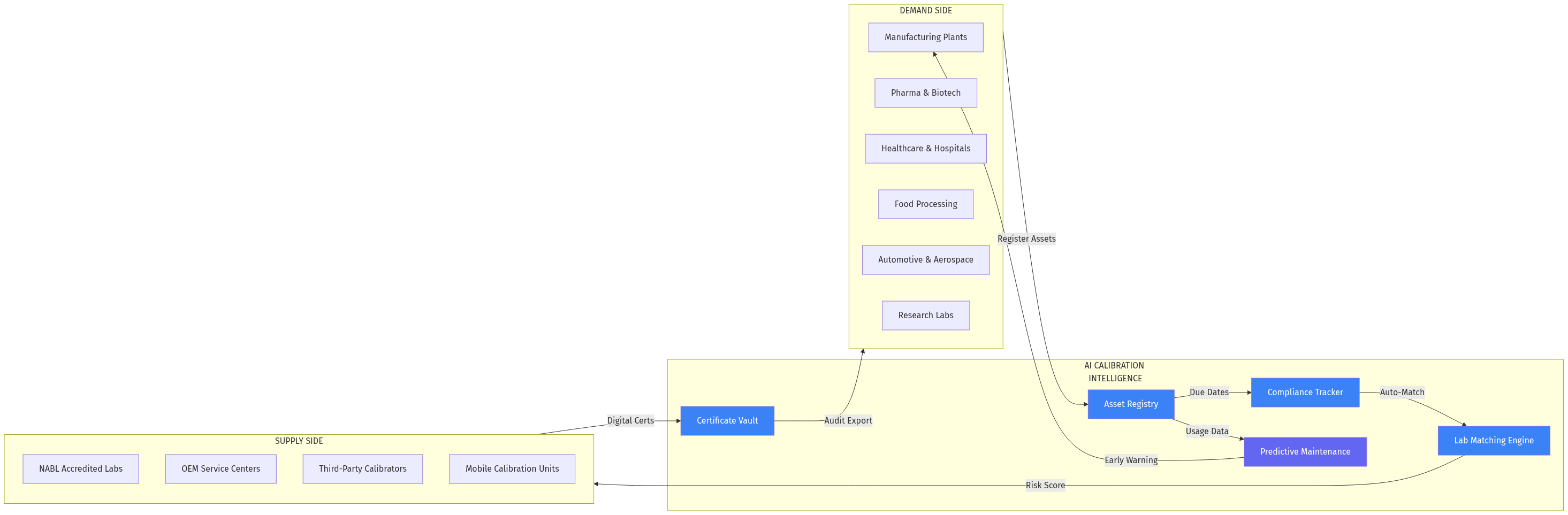
    Calibration Intelligence Ecosystem
    Calibration Intelligence Ecosystem

    Market Size

    • Global calibration services market: $12.4 billion (2025)
    • India calibration services market: $450 million (2025), growing 8.2% CAGR
    • Asia-Pacific: Fastest-growing region at 7.8% CAGR

    Market Segments

    SegmentSizeGrowth Driver
    Manufacturing45%Make in India, PLI schemes
    Pharma & Biotech22%WHO prequalification push
    Food Processing12%FSSAI compliance enforcement
    Healthcare10%NABH accreditation requirements
    Automotive/Aerospace8%IATF 16949, AS9100 mandates
    Research Labs3%NIH/DST funding requirements

    Why Now?

  • Regulatory tightening: FDA, WHO, NABL audits becoming more stringent and digital-first.
  • Industry 4.0 adoption: Smart factories need digital calibration records integrated with SCADA/MES.
  • NABL growth: 6,000+ accredited labs in India (up from 1,200 in 2015) — fragmentation increasing.
  • AI readiness: OCR can now read legacy calibration certificates; LLMs can parse instrument specifications.
  • Applying Market Timing Evaluation

    What's appearing now that wasn't possible before?
    • AI-powered document extraction: Converting 20 years of PDF certificates into structured data
    • Accreditation API access: NABL now publishes machine-readable lab directories
    • IoT calibration: Connected sensors can report calibration drift, enabling predictive maintenance
    • Blockchain timestamps: Immutable proof of calibration dates for regulatory defense

    5.

    Gaps in the Market

    Gap Analysis Using Anomaly Hunting

    What's surprising about this market that doesn't fit the standard "SaaS eats everything" narrative? Anomaly 1: No marketplace exists Despite 6,000+ calibration labs in India and millions of instruments requiring service, there's no Uber-for-calibration or even a robust directory. IndiaMART lists vendors but provides no accreditation verification, pricing, or capability matching. Anomaly 2: OEMs haven't verticalized Fluke, Testo, Keysight — all could build cross-brand calibration platforms but haven't. Why? Proprietary lock-in is more profitable than ecosystem plays. This creates the classic disruption opening. Anomaly 3: Compliance software ignores the marketplace Calibration tracking software (Beamex, MasterControl) manages internal processes but doesn't connect to external service providers. The most painful part — finding and booking calibration services — remains unsolved. Anomaly 4: Mobile calibration is underserved On-site calibration (for large equipment that can't be shipped) is 40% of the market but nearly invisible online. These mobile units have zero discoverability.

    Key Gaps

  • Accreditation-first vendor discovery with real-time scope verification
  • Asset registry with intelligent due-date management and budget forecasting
  • Marketplace with instant quotes — not contact forms
  • Digital certificate vault with blockchain anchoring
  • Predictive calibration based on usage patterns and drift detection
  • Audit export in FDA 21 CFR Part 11 compliant formats

  • 6.

    AI Disruption Angle

    Current vs AI-Powered Workflow
    Current vs AI-Powered Workflow

    Distant Domain Import

    What other fields have solved structurally similar problems? Insurance claims processing → Calibration certificate validation Both involve: document intake, data extraction, verification against standards, fraud detection, and audit trails. Insurtech companies like Lemonade use AI to process claims in minutes. Apply the same to certificate validation. Hotel booking engines → Calibration scheduling Both involve: inventory management (lab capacity), availability calendars, real-time pricing, and service matching. Calibration can borrow the OTA model — aggregate supply, show availability, enable instant booking. Fintech KYC → Lab accreditation verification Both require: validating credentials against authoritative databases, continuous monitoring for status changes, and trust scoring. Labs lose NABL accreditation or have scope changes — AI can monitor this in real-time.

    AI Capabilities to Deploy

    CapabilityApplication
    OCR + NLPExtract structured data from legacy paper certificates
    Matching algorithmsConnect instrument types to qualified labs by scope
    Predictive analyticsForecast calibration needs from usage patterns
    Anomaly detectionFlag certificates with suspicious data or timelines
    Conversational AIWhatsApp bot for quality managers to check status, request quotes
    Document intelligenceAuto-generate audit reports from certificate vault

    The Agent-Native Future

    When AI agents transact on behalf of companies:

    • Agents scan asset registries → identify due calibrations
    • Agents query the marketplace → get quotes from 5+ qualified labs
    • Agents negotiate pricing based on historical data
    • Agents schedule pickup logistics
    • Agents receive, verify, and file digital certificates
    • Agents generate monthly compliance reports
    Human involvement: Strategic decisions, exception handling, and final audit sign-off.


    7.

    Product Concept

    CalibrateIQ — AI-Powered Calibration Intelligence Platform

    Core Modules: 1. Asset Registry
    • Upload instrument list via Excel or integrate with existing CMMS
    • AI auto-classifies by calibration type (pressure, temperature, electrical, dimensional)
    • Track serial numbers, locations, criticality levels
    • Automatic due-date calculations with 30/60/90-day alerts
    2. Lab Marketplace
    • 6,000+ NABL-accredited labs with real-time scope verification
    • Filter by: location, instrument type, turnaround time, pricing
    • Instant quotes (no contact forms) — labs pre-configure pricing
    • Ratings and reviews from verified calibration customers
    3. Compliance Tracker
    • Dashboard showing compliance status across all instruments
    • Non-conformance alerts when due dates pass
    • Budget forecasting based on upcoming calibrations
    • Regulatory calendar (NABL validity, ISO audit dates)
    4. Certificate Vault
    • Digital certificate storage with OCR extraction
    • Blockchain timestamping for audit defense
    • One-click export for FDA, ISO, NABH audits
    • Traceability chain: instrument → certificate → standard → NABL
    5. Predictive Intelligence
    • Usage-based calibration recommendations
    • Drift detection for critical instruments (IoT integration)
    • Vendor performance analytics (turnaround, accuracy, pricing trends)
    6. WhatsApp Assistant
    • "Check calibration status for PG-001"
    • "Get quotes for pressure gauge calibration in Mumbai"
    • "When is the next batch due?"

    8.

    Development Plan

    PhaseTimelineDeliverables
    MVP8 weeksAsset registry + NABL lab directory + basic matching
    V1+6 weeksQuote requests, certificate upload, compliance alerts
    V2+8 weeksMarketplace with instant booking, digital certificates, blockchain
    V3+10 weeksPredictive analytics, WhatsApp bot, IoT integration

    Tech Stack

    • Frontend: Next.js + React Native (mobile for field audits)
    • Backend: Node.js + PostgreSQL + Redis
    • AI/ML: OpenAI for document intelligence, custom models for matching
    • Blockchain: Ethereum L2 (Polygon) for certificate anchoring
    • Integrations: SAP, Oracle, Tally for CMMS sync

    9.

    Go-To-Market Strategy

    Phase 1: Supply Aggregation (Month 1-3)

  • Scrape NABL directory for all accredited labs
  • Build structured database with capabilities, locations, contact info
  • Outreach to top 100 labs — offer free listing with premium placement option
  • Verify accreditation scopes programmatically
  • Phase 2: Demand Seeding (Month 3-6)

  • Target pharma and food processing — highest regulatory pressure
  • Free asset registry tool for quality managers (lead gen)
  • Content marketing: "How to prepare for NABL/ISO audits"
  • Partner with quality certification consultants
  • Phase 3: Transaction Enablement (Month 6-9)

  • Launch quote request flow
  • Enable direct booking with participating labs
  • Introduce SLA guarantees and escrow payments
  • Phase 4: Platform Flywheel (Month 9-12)

  • Demand attracts supply → supply enables selection → selection drives demand
  • Launch mobile app for field audits
  • Enterprise tier with API access and CMMS integrations

  • 10.

    Revenue Model

    StreamDescriptionPricing
    Transaction feeCommission on bookings through platform8-12%
    Premium listingsFeatured placement for labs₹5,000/month
    SaaS subscriptionAsset registry + compliance tracker₹15,000-50,000/month
    Enterprise APIIntegration with CMMS/ERP systemsCustom
    Audit reportsCompliance documentation packages₹2,000/report
    Predictive insightsAdvanced analytics tier₹25,000/month
    Revenue potential at scale:
    • 10,000 companies managing 500 instruments each
    • Average 2 calibrations/instrument/year
    • Average ticket size: ₹2,000
    • Platform GMV: ₹2,000 × 2 × 500 × 10,000 = ₹2,000 crore ($240M)
    • At 10% take rate: ₹200 crore ($24M) revenue

    11.

    Data Moat Potential

    Applying Pre-Mortem Analysis

    Assume 5 well-funded startups failed in calibration tech. Why?
  • Supply aggregation too slow — Labs have no incentive to onboard without demand
  • Enterprise sales cycles — Quality managers need 6-12 months to switch vendors
  • No switching cost — Easy to leave without accumulated data
  • Regulatory risk — Any compliance software faces liability concerns
  • Low margins — Transaction fees compete with relationship-based pricing
  • Building Defensibility

    Data moat 1: Calibration history database
    • Every calibration logged → drift patterns, vendor performance, pricing trends
    • This becomes the industry reference for "what should calibration cost" and "how often should this instrument be calibrated"
    Data moat 2: Instrument-to-capability graph
    • Every successful match teaches the system which labs can calibrate which instruments
    • New labs can be auto-scored based on similar accreditations
    Data moat 3: Compliance intelligence
    • Aggregated audit outcomes across customers → best practices database
    • "Companies using this lab have 23% fewer non-conformances"
    Data moat 4: Predictive models
    • Usage patterns → calibration frequency optimization
    • Environmental data → drift prediction
    • Vendor capacity → availability forecasting

    12.

    Why This Fits AIM Ecosystem

    Steelmanning: Why Incumbents Might Win

    Build the strongest case AGAINST this opportunity:
  • OEMs could vertically integrate — Fluke announces multi-brand calibration service
  • NABL launches its own platform — Government-backed marketplace undercuts private
  • Existing CMMS adds marketplace — Beamex acquires lab network
  • Quality managers resist change — "We've always used XYZ Lab"
  • Labs prefer opacity — Refuse to list standardized pricing
  • Counter-arguments:
    • OEMs haven't moved in 30 years; incentives favor lock-in
    • NABL is an accreditation body, not a tech company
    • CMMS vendors are enterprise-focused, not marketplace builders
    • Regulatory pressure outweighs relationship inertia
    • Labs that don't participate lose visibility to those that do

    AIM Ecosystem Integration

    CalibrateIQ fits naturally as a vertical under AIM.in:

    • Discovery: AI-powered vendor matching (core AIM pattern)
    • Compliance: Structured data for regulatory requirements
    • Transactions: Marketplace with trust signals
    • Data: Proprietary intelligence on industrial services
    Cross-sell opportunities:
    • Equipment financing (via networth.in) for new instruments
    • Industrial procurement (via thefoundry.in) for equipment vendors
    • Recruitment (via niyukti.in) for quality engineers

    ## Verdict

    Opportunity Score: 8.5/10

    Bayesian Confidence Breakdown

    FactorPriorEvidencePosterior
    Market size7/10$450M India, 8% growth8/10
    Fragmentation8/106,000+ labs, no aggregator9/10
    Regulatory tailwind7/10NABL/ISO tightening8/10
    AI applicability6/10Document intelligence mature8/10
    Defensibility5/10Data moat takes time to build6/10
    GTM clarity7/10Clear pharma/food entry8/10
    Competition8/10No AI-native player9/10

    Final Assessment

    Industrial calibration services represent a rare "hidden in plain sight" opportunity. The market is large ($450M+ in India), growing (8% CAGR), fragmented (6,000+ labs), and completely undigitized. No AI-native incumbent exists. Regulatory pressure provides natural demand tailwind.

    Key risks: Supply aggregation requires significant BD effort; enterprise sales cycles are long; the market may be "boring" for VC storytelling. Recommendation: Build as a patient vertical SaaS with marketplace ambitions. Start with the asset registry (zero supply-side dependency) and layer marketplace capabilities as lab participation grows. The compliance tracking use case alone justifies ₹15-50K/month SaaS pricing for pharma/food companies. The CalibrateIQ thesis: In 5 years, no quality manager should need to make a phone call to schedule calibration. AI should handle vendor selection, quote comparison, scheduling, and certificate filing — leaving humans for strategic decisions and final sign-offs.

    ## Sources

    • NABL Annual Report 2024-25 (nabl-india.org)
    • "Global Calibration Services Market" — MarketsandMarkets, 2025
    • "Industrial Metrology Market Trends" — Grand View Research, 2025
    • IndiaMART Calibration Services listings (indiamart.com)
    • Fluke Calibration Services pricing documentation
    • Beamex CMX Software documentation
    • FDA 21 CFR Part 11 Electronic Records guidance
    • ISO 17025:2017 General requirements for competence of testing and calibration laboratories