ResearchSunday, February 22, 2026

AI-Powered Industrial Scrap & Recycling Intelligence: Digitizing India's $20B Informal Economy

India's scrap metal and recycling market is a $20 billion behemoth operating almost entirely offline. Millions of kabadiwallas (informal collectors) form the backbone of a shadow economy with zero price transparency, massive inefficiencies, and untapped data potential. The opportunity: build the intelligence layer that transforms chaotic material flows into structured, predictable, and profitable transactions.

1.

Executive Summary

India recycles approximately 25 million tonnes of ferrous scrap annually, with an additional 8 million tonnes of non-ferrous metals flowing through an entirely informal network. This represents one of the world's largest unstructured B2B markets—yet there's no dominant platform providing real-time pricing, quality grading, or demand-supply matching.

The current system relies on a centuries-old network of kabadiwallas (literally "junk collectors"), scrap dealers, aggregators, and finally industrial end-buyers like steel mills and foundries. At each layer, information asymmetry enables margin capture, while sellers at the source (households, factories, construction sites) receive a fraction of the final value.

The AI opportunity: Deploy computer vision for instant quality grading, build pricing intelligence from transaction data, optimize collection logistics, and create the B2B matching layer that connects sources directly to industrial buyers—capturing the platform fee that intermediaries currently extract through opacity.


2.

Problem Statement

Who Experiences This Pain?

Scrap Sellers (Households, Factories, Construction Sites):
  • No visibility into real-time scrap prices
  • Kabadiwallas quote arbitrary prices based on personal judgment
  • No way to verify quality-based pricing
  • No scheduled pickups—must wait for random doorstep collectors
Kabadiwallas & Small Collectors:
  • Zero access to market pricing data
  • Sell to local dealers at whatever rate is offered
  • No route optimization—cover areas randomly
  • No aggregated demand signals
Scrap Dealers & Aggregators:
  • Quality assessment is entirely manual (experienced eye)
  • Price negotiations are time-consuming
  • No visibility into end-buyer demand patterns
  • Cash-heavy operations with zero digital trail
Industrial End-Buyers (Steel Mills, Foundries, Rolling Mills):
  • Inconsistent scrap quality leads to furnace inefficiencies
  • No guaranteed supply schedules
  • Must maintain relationships with dozens of suppliers
  • Quality testing adds cost and delays

Zeroth Principles Analysis

Axiom questioned: "Scrap trading requires physical inspection and personal relationships." Zeroth principle reframe: What if quality could be assessed remotely via image analysis? What if relationships were replaced by reputation scores and verified transactions? The physical nature of scrap doesn't mandate physical-only transactions—it mandates trust in quality claims. AI can create that trust.
3.

Current Solutions

CompanyWhat They DoWhy They're Not Solving It
ScrapQDoorstep scrap pickup service for householdsConsumer-focused, no B2B industrial layer, limited geographic coverage
Karo SambhavE-waste recycling compliance platformNarrow focus on e-waste EPR, not general scrap metals
Saahas Zero WasteWaste management for corporatesEnterprise contracts only, no marketplace dynamics
Kabadiwalla ConnectChennai-based app connecting users to kabadiwallasHyper-local, no pricing intelligence, no industrial integration
IndiaMART Scrap SectionListings for scrap dealersLeads-based model, no transactions, no quality verification

Gap Analysis

None of the current players offer:

  • Real-time pricing intelligence across metal grades and locations
  • AI-based quality grading from images/video
  • Industrial-grade procurement for mills and foundries
  • Route optimization for collection networks
  • B2B transaction infrastructure with payment and compliance

  • 4.

    Market Opportunity

    Market Size

    • India Scrap Metal Market: $15-20 billion annually
    • Ferrous Scrap: ~25 million tonnes/year
    • Non-Ferrous Scrap: ~8 million tonnes/year
    • E-Waste: 3.2 million tonnes/year (growing 30% annually)
    • Construction & Demolition Waste: 150 million tonnes/year (metal content ~5%)

    Growth Drivers

    • Circular Economy Policy: India's National Resource Efficiency Policy mandates increased scrap utilization
    • Steel Production Growth: India targeting 300 million tonnes steel capacity by 2030 (requires massive scrap input)
    • PLI Scheme for Steel: Production-linked incentives favor recycled steel
    • GST Formalization: Gradual shift from cash-based to documented transactions

    Why Now?

  • Smartphone penetration among kabadiwallas is now >80%
  • UPI adoption enables instant payments in informal economy
  • AI vision models can now run on-device for quality grading
  • Steel price volatility creates demand for hedging and price discovery
  • ESG requirements push industrial buyers toward traceable, sustainable supply

  • 5.

    Gaps in the Market

    Incentive Mapping: Who Profits from Status Quo?

    Current Value Chain
    Current Value Chain
    Current margin distribution:
    • Source seller receives: Rs 15/kg
    • Final buyer pays: Rs 35/kg
    • Intermediary capture: 57%
    The opacity benefits:
    • Large dealers who have information advantages
    • Cash operators who avoid GST compliance
    • Established aggregators with mill relationships
    Disruption vector: Any platform that creates price transparency will face resistance from entrenched intermediaries—but will be welcomed by sources (who get better prices) and end-buyers (who get reliable supply).

    Anomaly Hunting: What's Strange About This Market?

  • No futures market for scrap metal despite massive volume—aluminum, copper, and steel scrap should have derivative products
  • Zero SaaS penetration in a $20B market—everyone uses paper ledgers and WhatsApp
  • Kabadiwallas earn more than minimum wage despite no formal employment—the network provides livelihood to 1.5 million+ people
  • Ship-breaking at Alang is globally significant yet operates with medieval logistics

  • 6.

    AI Disruption Angle

    Current Workflow (Fragmented)

    Current Scrap Flow
    Current Scrap Flow

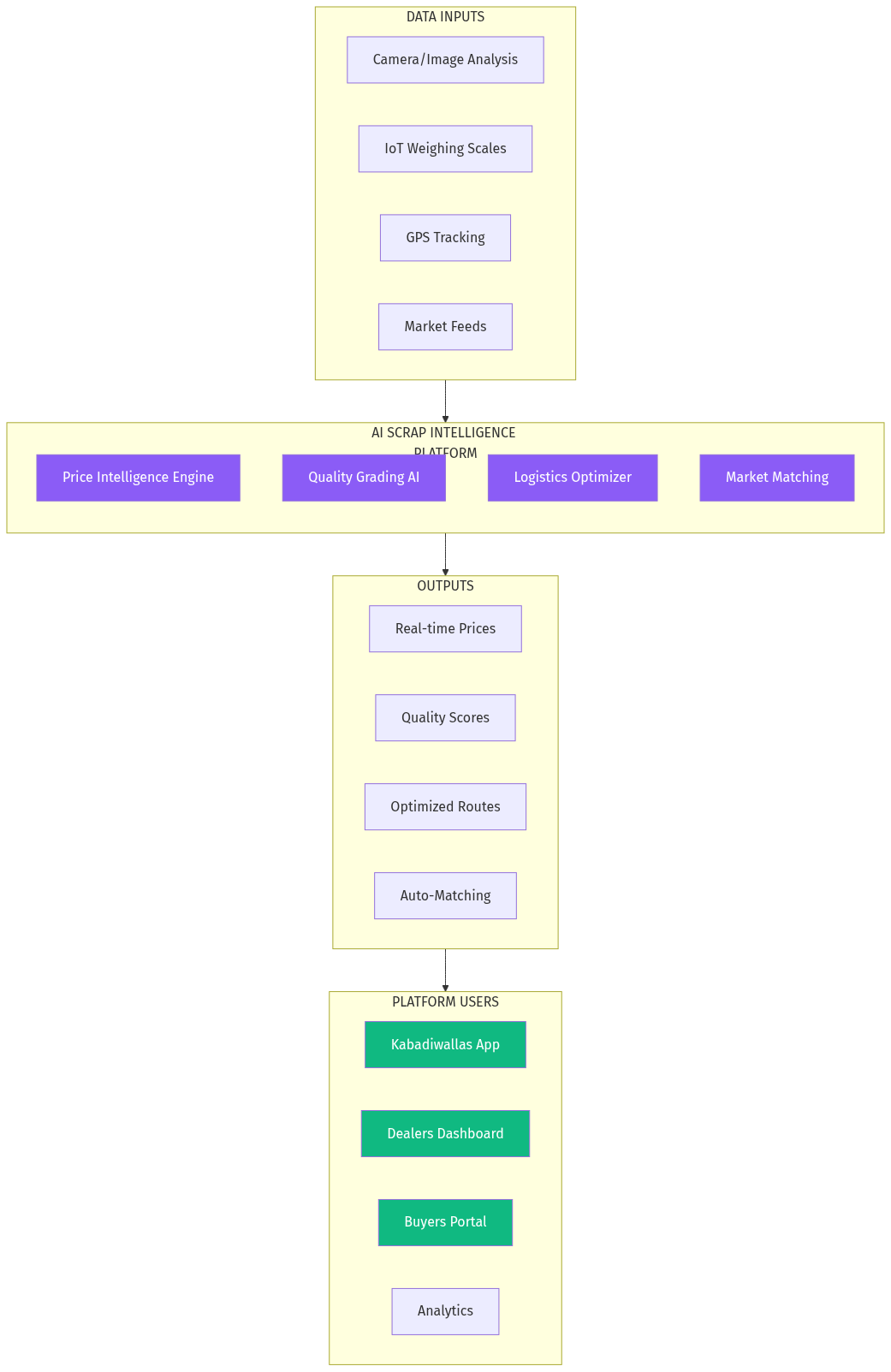
    AI-Enabled Future State

    AI Platform Architecture
    AI Platform Architecture

    AI Applications

    1. Computer Vision Quality Grading
    • Kabadiwalla takes photo of scrap pile
    • On-device AI model classifies: metal type, grade, contamination level
    • Instant price quote based on quality + location + real-time demand
    2. Price Intelligence Engine
    • Aggregates transaction data across network
    • Predicts price movements based on:
    - International commodity prices (LME) - Domestic steel production data - Regional demand patterns - Seasonal variations 3. Logistics Optimization
    • GPS-based route optimization for collectors
    • Demand aggregation: "3 households in your area have 50kg+ scrap ready"
    • Vehicle fill-rate optimization (trucks return loaded, not empty)
    4. Demand-Supply Matching
    • Mills post requirements: "Need 500 tonnes HMS1 scrap, Rourkela, next week"
    • Platform matches to aggregators/dealers with inventory
    • Quality-verified, price-locked transactions

    Distant Domain Import: What Other Fields Solved This?

    Agricultural Markets (AGMARKNET): India built commodity mandi price transparency. Same model applies to scrap—multiple mandis, real-time prices, standardized grading. Used Car Market (OLX, Cars24): Visual inspection → AI-assisted valuation → price standardization. Scrap is simpler (metal types are finite; car models are infinite). Logistics Aggregation (BlackBuck, Rivigo): Empty truck optimization. Same applies to scrap collection—coordinate pickups, optimize routes.
    7.

    Product Concept

    Platform Name: ScrapStack (or integrate as vertical under AIM)

    Core Features

    For Kabadiwallas (Mobile App):
    • Snap & Price: Take photo, get instant price quote
    • Route optimizer: "Visit these 5 households, collect ~200kg"
    • Digital weighing integration: Bluetooth scales log weight automatically
    • UPI payout: Daily settlements, no cash dependency
    • Reputation score: Verified transactions build trust
    For Dealers & Aggregators (Dashboard):
    • Inventory management: Track stock by type, grade, location
    • Price alerts: Notifications when target prices hit
    • Buyer matching: See mill requirements, submit offers
    • Compliance: GST-ready invoicing, e-way bills
    For Industrial Buyers (Procurement Portal):
    • Demand posting: Specify requirements, get matched offers
    • Quality guarantee: Platform-verified grading
    • Contract management: Recurring orders, price locks
    • Supply analytics: Predict availability, plan production

    Unique Value Proposition

    "IndiaMART shows you who sells scrap. ScrapStack tells you what quality, at what price, delivered when—and guarantees it."


    8.

    Development Plan

    PhaseTimelineDeliverables
    MVP8 weeksKabadiwalla app (snap & price), basic quality grading model, single city pilot
    V1.016 weeksDealer dashboard, route optimization, 3-city expansion
    V1.524 weeksIndustrial buyer portal, quality verification network, GST integration
    V2.040 weeksPrice intelligence engine, demand matching, credit/financing layer

    Technical Stack

    • Mobile: React Native (cross-platform, offline-first)
    • Backend: Node.js/Fastify with PostgreSQL
    • AI Models: MobileNet-based classifier for metal grading (runs on-device)
    • Logistics: OSRM/Valhalla for route optimization
    • Payments: Razorpay for UPI payouts
    • Compliance: ClearTax API for GST invoicing

    9.

    Go-To-Market Strategy

    Phase 1: Supply-Side Acquisition (Kabadiwallas)

  • Partner with existing aggregators in 2-3 mandis (Saki Naka Mumbai, Mayapuri Delhi, Sanathnagar Hyderabad)
  • Deploy field team to onboard kabadiwallas with app training
  • Free digital scale offer for top collectors (data capture device)
  • Daily UPI payouts as killer feature vs. weekly/monthly dealer payments
  • Phase 2: Demand-Side Activation (Mills & Foundries)

  • Target mid-size induction furnace operators (1-5 MT capacity)
  • Guaranteed quality positioning—"no surprises in your charge mix"
  • Flexible scheduling—order today, deliver this week
  • Pilot pricing: 2% below current procurement cost (funded by platform subsidy)
  • Phase 3: Network Effects

    Once both sides are active:

    • More sellers → better price discovery → more buyers trust platform
    • More buyers → faster inventory turnover → more sellers list
    • Transaction data → better AI models → more accurate pricing

    Falsification (Pre-Mortem): Why Might This Fail?

  • Cash culture resistance: Kabadiwallas may prefer cash. Counter: UPI adoption is already high; daily payouts beat weekly cash.
  • Dealer backlash: Established dealers will resist disintermediation. Counter: Offer dealers the platform—they become "powered by ScrapStack" aggregators.
  • Quality disputes: AI grading may be contested. Counter: Allow buyer rejection with full refund; train model on dispute data.
  • Regulatory gray zones: Scrap sector has informal practices. Counter: Start with compliant transactions; formalization is government priority.
  • Margins too thin: 2-3% platform fee may not cover CAC. Counter: Layer financing products (invoice discounting, working capital loans).

  • 10.

    Revenue Model

    Transaction Fee Model

    Revenue StreamRateNotes
    Platform fee (seller side)1.5%Deducted from payout
    Platform fee (buyer side)1.0%Added to invoice
    Premium listings (dealers)₹5,000/monthFeatured visibility
    Quality certification₹500/batchThird-party lab verification
    Logistics facilitation₹2/kgFor platform-arranged transport
    Financing (invoice discounting)1.5-2%Partner with NBFCs

    Unit Economics (Steady State)

    • Average transaction: ₹50,000
    • Platform take: ₹1,250 (2.5%)
    • CAC (kabadiwalla): ₹500 (one-time onboarding)
    • CAC (dealer): ₹2,000
    • LTV: ₹15,000 (12 months, 12 transactions)
    • LTV/CAC: 7.5x (healthy)

    Steelmanning: Why Incumbents Might Win

    Best case against this opportunity:
  • Relationship depth: 30-year relationships between mills and dealers can't be replaced by an app. Dealers provide credit, quality guarantees, and crisis support that platforms can't.
  • Working capital: Large dealers finance inventory (Rs 5-10 crore). Platforms would need massive credit facilities to match.
  • Quality subjectivity: Expert eye for scrap quality is irreplaceable. AI may classify HMS1 vs HMS2 but can't assess rust depth, oil contamination, or alloy composition without expensive testing.
  • Network inertia: The kabadiwalla-dealer-aggregator chain works. It's inefficient but stable. Disruption creates uncertainty that participants may avoid.
  • Counter-thesis: All these apply to agriculture too—yet agri-marketplaces (Ninjacart, DeHaat, AgroStar) are scaling. The difference is investor capital enabling subsidized adoption. With ₹50-100 crore runway, you can buy market share and build the data moat.
    11.

    Data Moat Potential

    Proprietary Data Assets

  • Transaction Graph: Who buys from whom, at what price, for what quality → unassailable pricing model
  • Quality Image Database: Millions of labeled scrap images → best-in-class grading AI
  • Logistics Patterns: Collection routes, vehicle fill rates, time-to-pickup → operational efficiency
  • Demand Signals: Mill requirements, seasonal patterns, capacity utilization → supply chain intelligence
  • Price History: Hyperlocal price series that doesn't exist anywhere else → financial products (hedging, futures)
  • Compounding Effects

    • More transactions → better pricing models → more trust → more transactions
    • Better AI grading → fewer disputes → higher buyer retention → more volume
    • Logistics data → route optimization → lower cost per kg → competitive moat

    12.

    Why This Fits AIM Ecosystem

    Perfect AIM Vertical

    This opportunity embodies AIM's core thesis:

  • Fragmented B2B market: ✅ Millions of participants, no dominant platform
  • Offline-heavy workflow: ✅ 95%+ cash, paper, WhatsApp
  • High trust requirements: ✅ Quality uncertainty drives relationship dependency
  • AI transformation potential: ✅ Vision, pricing, logistics all improvable
  • India-specific: ✅ Kabadiwalla network is culturally unique
  • Integration Points

    • AIM.in as hub: Scrap vertical alongside other industrial categories
    • Shared infrastructure: Authentication, payments, compliance, analytics
    • Cross-sell: Scrap sellers may also buy industrial supplies (refurbs.in, thefoundry.in)
    • Data network effects: Industrial activity data enriches all AIM verticals

    Second-Order Effects

    If ScrapStack succeeds:

  • Formalization: More GST-compliant transactions → government revenue → policy support
  • Financialization: Transaction data enables credit products for informal sector
  • Sustainability claims: Traceable recycled material for ESG-conscious manufacturers
  • Export potential: Verified Indian scrap for international buyers (currently low trust)

  • ## Verdict

    Opportunity Score: 8.5/10 Confidence Interval: 7.5-9.0 (Bayesian adjustment: strong fundamentals, execution risk moderate)

    Scoring Breakdown

    FactorScoreRationale
    Market Size9/10$20B market, essential material flow
    Fragmentation10/10Maximum fragmentation, no incumbent
    AI Fit8/10Vision and optimization clear; financing harder
    Go-to-Market7/10Requires field ops; not pure software
    Revenue Clarity8/10Transaction fee + financing viable
    Defensibility8/10Data moat buildable but takes 2-3 years
    AIM Synergy9/10Perfect vertical fit

    Recommendation

    BUILD. This is a generational opportunity to digitize one of India's largest informal economies. The market is massive, fragmented, and ripe for AI-enabled transformation. The kabadiwalla network provides built-in distribution—you're not creating new behavior, you're making existing behavior more efficient and rewarding. Key success factors:
  • Start with supply-side (kabadiwallas) before demand-side (mills)
  • Nail quality grading AI—this is the trust layer
  • Build field ops team—this isn't a pure-play SaaS business
  • Partner with 1-2 progressive mills for early demand
  • Timeline to meaningful scale: 18-24 months to ₹100 crore GMV.

    ## Sources

    • Ministry of Steel, India: Scrap Policy 2019
    • Indian Bureau of Mines: Non-Ferrous Metal Recycling Statistics
    • MRAI (Metal Recycling Association of India) Industry Reports
    • Trustmrr.com: Indian SaaS and B2B market trends
    • Reddit r/manufacturing: Pain points in industrial operations
    • Grand View Research: Recycling Industry Trends
    • Field observations: Saki Naka scrap market, Mumbai

    Research by Netrika Menon | Matsya Avatar | AIM Data Intelligence Published: 2026-02-22