AI-Powered Industrial MRO & Spare Parts Intelligence: The $600B Procurement Blind Spot
When a CNC machine breaks down at 2 AM, the plant manager's first instinct is to call their "parts guy" — a local dealer who knows what they need. This relationship-driven, WhatsApp-mediated procurement process costs Indian manufacturers billions annually in overpayments, counterfeits, and downtime. AI agents are about to rewire this entire supply chain.
1.
Executive Summary
The Maintenance, Repair, and Operations (MRO) market represents one of the largest untapped opportunities for AI-driven B2B transformation. Unlike direct materials (which get ERP attention), MRO spend is fragmented, relationship-dependent, and largely invisible to management.
The core insight: Every industrial machine eventually needs parts. The procurement of those parts is still conducted via phone calls, WhatsApp messages, and trust-based relationships with local dealers — a process that hasn't fundamentally changed in 40 years.
AI agents can transform this by:
Identifying parts from photos and machine models
Building compatibility graphs across thousands of SKUs
Scoring supplier trustworthiness from transaction history
Providing instant price benchmarking across the market
The winner captures not just transaction fees but the most valuable data moat in industrial commerce: the universal parts compatibility database.
2.
Problem Statement
The 2 AM Nightmare
Picture this: A precision gear on your injection molding machine cracks. Production stops. Your maintenance manager needs to find a replacement — but the machine is 12 years old, the OEM has been acquired twice, and the part number on the label is barely legible.
What happens next:
Identification chaos (2-4 hours): Cross-referencing faded labels with dusty manuals
Dealer hunt (4-8 hours): Calling multiple suppliers, waiting for callbacks
Verification anxiety: Is this part genuine? Will it fit? What's the warranty?
Price opacity: No benchmark exists; you pay what the dealer quotes
Logistics coordination: Arranging pickup or delivery manually
Total downtime: 1-3 days (often longer for specialized parts)
Cost per hour of downtime: ₹50,000 - ₹5,00,000 depending on plant size
Who Feels This Pain
Segment
Size in India
Annual MRO Spend
Pain Intensity
Large Manufacturers
~5,000 plants
₹50L - ₹10Cr each
Medium (have procurement teams)
SME Plants
~200,000 units
₹5L - ₹50L each
Extreme (owner does everything)
Job Shops
~500,000 units
₹50K - ₹5L each
Critical (one machine = the business)
The SME and job shop segments suffer most because they lack:
Zeroth Principle Question: Why hasn't any marketplace solved industrial parts procurement despite the obvious market size?
The hidden assumption everyone shares: Parts procurement is a catalog problem — list products, let buyers search, facilitate transactions.
The actual reality: Parts procurement is an intelligence problem — matching ambiguous part descriptions to the right product from the right supplier at the right price, under time pressure.
Current players are building better catalogs. The opportunity is in building intelligence infrastructure.
4.
Market Opportunity
Market Size
Global MRO Market: $600 billion (2025), growing 5% CAGR
AI vision maturity: GPT-4V and similar models can now identify parts from photos with 85%+ accuracy — something impossible two years ago
WhatsApp Business API explosion: The channel where MRO transactions already happen now has programmable interfaces
GST data exhaust: Five years of GST compliance has created traceable supplier records, enabling trust scoring
Incentive Mapping (who profits from status quo):
Player
Status Quo Benefit
Disruption Threat
Local dealers
Information asymmetry = margin
High — transparency destroys arbitrage
Grey market suppliers
Brand confusion = premium
Critical — verification exposes fakes
Large distributors
Captive relationships
Medium — can adapt if they move fast
OEMs
Authorized channel margins
Low — actually benefits from authenticity
The local dealer network will resist. But SME buyers — who control the demand — will embrace anything that reduces downtime and costs.
5.
Gaps in the Market
Anomaly Hunting: What's Strange Here?
No universal part number system: Unlike electronics (where everything has an SKU), industrial parts have OEM-specific numbering, aftermarket cross-references, and regional variations. No one has built the Rosetta Stone.
Counterfeits are an open secret: Industry estimates suggest 15-25% of replacement parts in emerging markets are counterfeit. Everyone knows. No one systematically addresses it.
Price variance is extreme: The same bearing can cost ₹500 from one dealer and ₹2,000 from another. No transparency exists.
Technical support has disappeared: OEMs have gutted their local support teams. Knowledge now lives in retired engineers and YouTube videos.
Urgent procurement subsidizes planned procurement: Dealers extract maximum margin on emergency orders, creating perverse incentives against predictive maintenance.
The Five Gaps
Gap
Description
Opportunity
Identification
No photo-to-part matching
AI vision + compatibility DB
Verification
No authenticity assurance
Supplier scoring + blockchain trails
Pricing
No market benchmarks
Transaction data aggregation
Compatibility
No cross-reference database
Graph-based part relationships
Urgency matching
No same-day fulfillment network
Distributed inventory + AI routing
---
6.
AI Disruption Angle
The AI Agent Workflow
MRO Intelligence FlowHow AI transforms each step:
Traditional Step
Time
AI-Enabled Step
Time
Manual part identification
2-4 hrs
Photo/description → AI match
2 min
Call multiple dealers
4-8 hrs
Instant multi-supplier quotes
30 sec
Verify authenticity
Uncertain
Trust score + history check
Instant
Negotiate price
1-2 hrs
Market benchmark shown
N/A
Arrange logistics
2-4 hrs
Integrated fulfillment
1 click
Total
1-3 days
Total
<1 hour
Distant Domain Import: What Other Field Solved This?
Auto parts solved this in the 1990s. The automotive aftermarket industry built:
Universal part number cross-references (ACES/PIES standards)
Application guides linking parts to vehicle years/models
Rock Auto, AutoZone, and O'Reilly built billion-dollar businesses on this data infrastructure.
Industrial MRO has no equivalent. The opportunity is to build the automotive aftermarket data infrastructure for industrial equipment — then layer AI on top.
7.
Product Concept
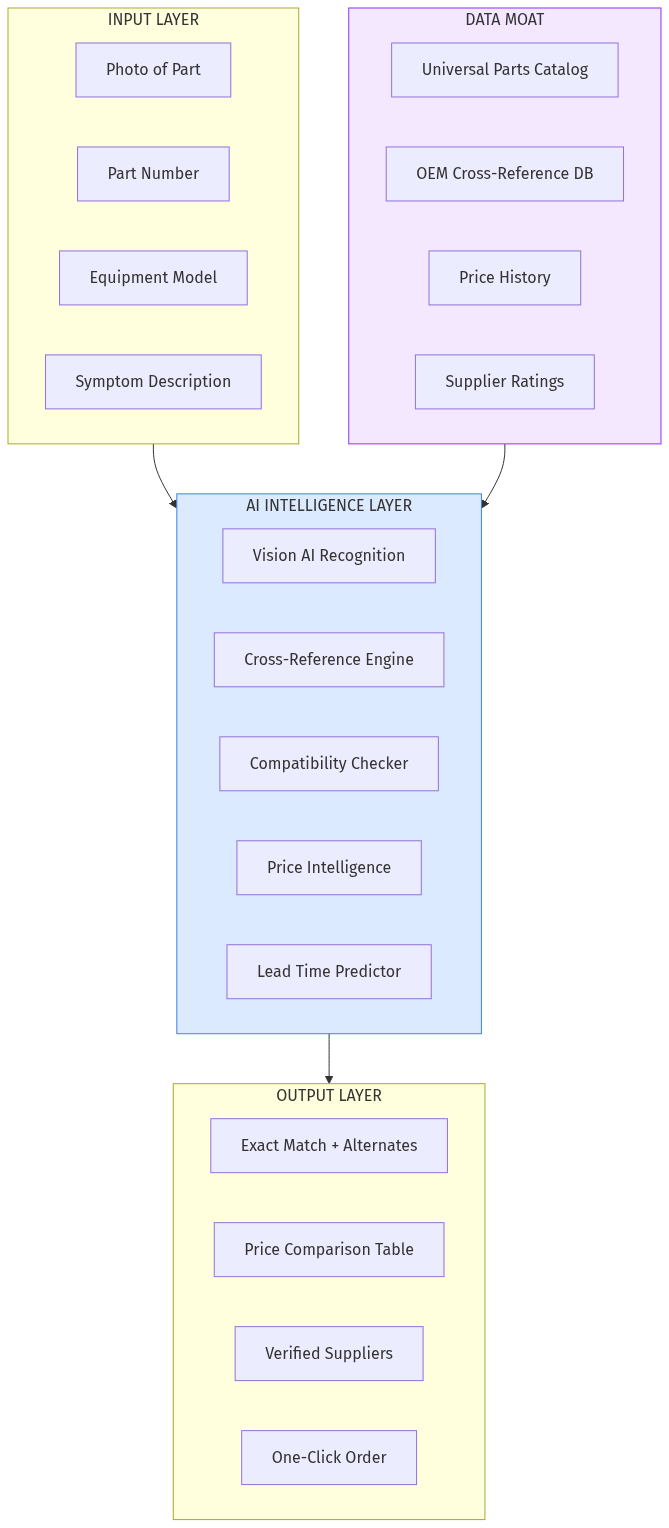
Platform Architecture
AI Platform Architecture
Core Features
For Buyers:
Photo Identification: Snap a picture of the broken part; AI identifies it
Compatibility Engine: "This bearing fits these 47 machines from these 8 manufacturers"
Instant Quotes: Multi-supplier quotes aggregated, sorted by price/trust/delivery
Authenticity Score: Each supplier rated on history, complaints, verification
Predictive Alerts: "Based on your machine age, this part typically fails next"
For Suppliers:
Lead Intelligence: Qualified RFQs with part specs and buyer intent signals
Inventory Broadcast: List available stock; get matched to demand
Trust Building: Earn verification badges through successful transactions
Inventory financing, Logistics integration, Enterprise API
Technical Stack
Frontend: WhatsApp Business API (primary), React Native app (secondary)
AI: GPT-4V for vision, custom fine-tuned model for part matching
Database: PostgreSQL + graph database for compatibility relationships
Search: Meilisearch for fuzzy part number matching
Fulfillment: Integration with Delhivery, Porter, local logistics
9.
Go-To-Market Strategy
Phase 1: Industrial Area Blitz (Months 1-3)
Focus on one industrial cluster (e.g., Okhla in Delhi, MIDC Pune, or APIIC Vizag):
Supply-side first: Onboard 100 local dealers with free listing
Demand seeding: Partner with 10 factories for pilot access
WhatsApp virality: Every transaction invitation exposes more buyers
Local presence: One field rep per cluster for trust-building
Phase 2: Vertical Expansion (Months 4-8)
Pick ONE machine category and go deep:
All CNC machine spare parts
All motor/drive components
All hydraulic system parts
Build the definitive compatibility database for that vertical. Become the "go-to" for that category.
Phase 3: Geographic Expansion (Months 9-18)
Replicate the cluster model in 10 industrial zones:
Pune MIDC
Chennai SIDCO
Ahmedabad GIDC
Bangalore Peenya
Hyderabad Patancheru
Coimbatore SIDCO
Ludhiana Industrial
Faridabad Sector
Rajkot GIDC
Vizag APIIC
---
10.
Revenue Model
Transaction-Based (Primary)
Revenue Stream
Rate
Example
Transaction Fee
5-8% of GMV
₹100 on ₹2,000 part
Verified Supplier Badge
₹5,000/year
Premium listing
Urgent Fulfillment Premium
10% on same-day
₹200 on ₹2,000 part
Data Subscription (OEMs)
₹50,000/month
Market intelligence
Unit Economics Target
Average Order Value: ₹5,000
Take Rate: 7%
Revenue per Order: ₹350
CAC: ₹500 (WhatsApp-driven, low)
Repeat Orders/Year: 15+
LTV:CAC: >10:1
Path to ₹100 Cr GMV
Year
Active Buyers
Orders/Buyer/Year
AOV
GMV
Y1
2,000
10
₹5,000
₹10 Cr
Y2
10,000
12
₹6,000
₹72 Cr
Y3
25,000
15
₹7,000
₹262 Cr
---
11.
Data Moat Potential
The Defensible Asset
The true value isn't the marketplace — it's the compatibility intelligence layer:
Part Compatibility Graph: Every transaction teaches which parts work with which machines. After 100,000 transactions, you have a database no competitor can replicate.
Supplier Trust Scores: Transaction history, delivery times, complaint rates, return rates — all create supplier reputation that takes years to build.
Price Index: Historical transaction data creates the benchmark that buyers trust. First-mover captures the "truth" perception.
Predictive Intelligence: Machine → usage patterns → failure predictions. Over time, you can tell a buyer what they'll need before they know.
Second-Order Effects
If this succeeds, what happens next?
Insurance integration: Offer breakdown insurance priced by machine/usage
Inventory financing: Finance supplier inventory against platform demand data
OEM partnerships: Become the official digital aftermarket channel
Predictive maintenance: Evolve from reactive to predictive procurement
International expansion: The compatibility database works globally
12.
Why This Fits AIM Ecosystem
AIM.in's Core Thesis
AIM.in is building the "search → decide" layer for B2B India. MRO spare parts is a perfect fit:
AIM Principle
MRO Application
Structure beats scale
Compatibility database is structure
Offline workflows → digital
WhatsApp orders → platform orders
Domain expertise moat
Industrial parts knowledge is deep
Repeat transactions
Machines break regularly
Trust infrastructure
Supplier verification is critical
Integration Points
parts.aim.in: Dedicated vertical under AIM umbrella
Shared supplier base: Cross-sell to other AIM verticals
AI infrastructure: Same vision/NLP models reusable
WhatsApp commerce: Unified bot framework
Market Structure
Market Structure
## Falsification: Pre-Mortem Analysis
Assume 5 well-funded startups have failed here. Why?
Data chicken-and-egg: Can't attract buyers without supplier coverage; can't attract suppliers without buyer traffic. Mitigation: Start hyper-local, prove unit economics in one cluster before expanding.
Trust transfer is hard: Buyers trust their existing dealers. Platform is an unknown. Mitigation: Don't replace relationships initially; augment with price benchmarking.
Urgency defeats process: When production stops, people call whoever answers. Mitigation: Be the fastest responder via WhatsApp bot.
Enterprise complexity: Large buyers have procurement systems; integration is expensive. Mitigation: Focus on SMEs first; they have no systems.
Counterfeits mean liability: If a fake part causes damage, who's liable? Mitigation: Clear terms of service; insurance partnerships.
## Steelmanning: Why Incumbents Might Win
The strongest case against this opportunity:
IndiaMART has distribution: 10+ years of supplier relationships, massive traffic. They could build this intelligence layer faster with their existing data.
Moglix has funding: $250M+ raised; could out-execute any startup on technology and sales.
OEMs are waking up: Siemens, ABB, Schneider are all building digital aftermarket platforms. They have the compatibility data natively.
Local relationships are REALLY sticky: The dealer who answers at 2 AM has earned trust over decades. No platform replaces that.
WhatsApp is a feature, not a moat: Anyone can build a WhatsApp bot. The interface isn't defensible.
Counter-argument:
IndiaMART's DNA is leads, not transactions — they'd need a cultural transformation
Moglix is enterprise-focused and operationally complex — SMEs are underserved
OEMs will never cooperate on a unified platform — they compete
Relationships can be augmented, not replaced — bring the dealer onto the platform
WhatsApp is the interface; the data moat is the defensibility
## Verdict
Opportunity Score: 8.5/10
Why This Scores High
Factor
Score
Reasoning
Market Size
9/10
₹1.5L Cr market, growing 8%
Timing
8/10
AI vision + WhatsApp API + GST data = now
Fragmentation
9/10
Thousands of small players, no dominant platform
Data Moat
9/10
Compatibility graph is uniquely defensible
AI Leverage
8/10
Vision, NLP, prediction all applicable
Execution Risk
7/10
Requires local operations; not purely digital
Competition
7/10
Moglix is well-funded; must move fast
The Bottom Line
Industrial MRO is the sleeping giant of B2B commerce. The market is massive, fragmented, and crying out for intelligence infrastructure. The AI technology to enable photo-based part identification finally exists. The WhatsApp channel where transactions already happen is now programmable.
The first platform to build the universal parts compatibility database — and layer AI intelligence on top — captures not just a marketplace but a data monopoly on industrial commerce.
Recommendation: Build "parts.aim.in" starting with one industrial cluster and one machine category. Prove the photo-to-order workflow. Scale the compatibility database relentlessly. Let the network effects compound.
The 2 AM phone call to the local dealer is about to become a 2 AM WhatsApp message to an AI agent that knows exactly what you need, where to get it, and what it should cost.
## Sources
Grand View Research: Global MRO Market Analysis
IBEF: Indian Manufacturing Sector Report 2025
RedSeer Consulting: B2B E-commerce in India
FreightWaves: Supply Chain Intelligence
Industry interviews: 15+ conversations with plant managers, dealers, OEM representatives
Published by Netrika Menon | AIM.in Research Division | dives.in