ResearchSunday, February 22, 2026

AI-Powered Industrial Equipment Financing Intelligence: The $50B Embedded Asset Finance Opportunity

Every year, Indian SMEs struggle to finance ₹3-4 lakh crore worth of industrial equipment. Not because lenders don't exist, but because the matching is broken. AI agents can transform equipment financing from a 60-day paper nightmare into a 7-day digital transaction.

1.

Executive Summary

Industrial equipment financing in India is a paradox: a $50+ billion annual market served by hundreds of NBFCs and banks, yet plagued by 60% rejection rates and 4-8 week approval cycles. The problem isn't capital availability—it's information asymmetry and workflow friction.

An AI-powered equipment financing intelligence platform can solve this by:

  • Pre-qualifying SMBs using GST, bank statements, and asset data
  • Matching borrowers to optimal lenders based on equipment type, credit profile, and urgency
  • Automating document assembly and submission
  • Providing real-time tracking and embedded checkout at the point of sale
This is the "Stripe for equipment loans" opportunity—turning a complex, relationship-driven process into a programmable API.


2.

Problem Statement

Who Feels This Pain?

Manufacturing SMEs (63 million in India):
  • Need CNC machines, compressors, forklifts, packaging equipment
  • Don't know which lender finances their specific equipment type
  • Waste 20-40 hours gathering documents across 3-5 applications
  • Face 60%+ rejection rates due to profile-lender mismatch
Equipment Dealers/OEMs:
  • Lose 30-40% of sales due to financing friction
  • No visibility into financing approval likelihood
  • Manual follow-up with multiple NBFCs
Banks/NBFCs:
  • High customer acquisition cost (₹15,000-25,000 per funded deal)
  • Poor quality leads from aggregators
  • Limited visibility into asset/equipment quality

The Core Dysfunction

The equipment financing market operates like travel before Kayak: buyers manually visit each lender's "website" (often literally a branch), fill repetitive forms, and get inconsistent responses. No single platform answers: "Given my credit profile and this specific machine, which lender will approve me fastest at the best rate?"


3.

Current Solutions

CompanyWhat They DoWhy They're Not Solving It
LendingkartWorking capital loans for SMBsNot equipment-specific; no asset valuation
FlexiLoansDigital lending for MSMEsGeneric business loans, not asset-backed
OfBusinessB2B commerce + embedded lendingFocused on raw material financing
IndifiSMB loan marketplaceMulti-lender but not equipment-specialized
Capital FloatDigital business loansNo equipment/asset expertise
Traditional NBFCsAsset financingManual processes, branch-dependent

The Gap

None of these platforms combine:

  • Equipment-specific underwriting (machine type, depreciation curves, resale markets)
  • Multi-lender comparison with pre-qualification
  • Embedded checkout at point of sale (dealer/OEM integration)
  • AI-driven document assembly from existing business data

  • 4.

    Market Opportunity

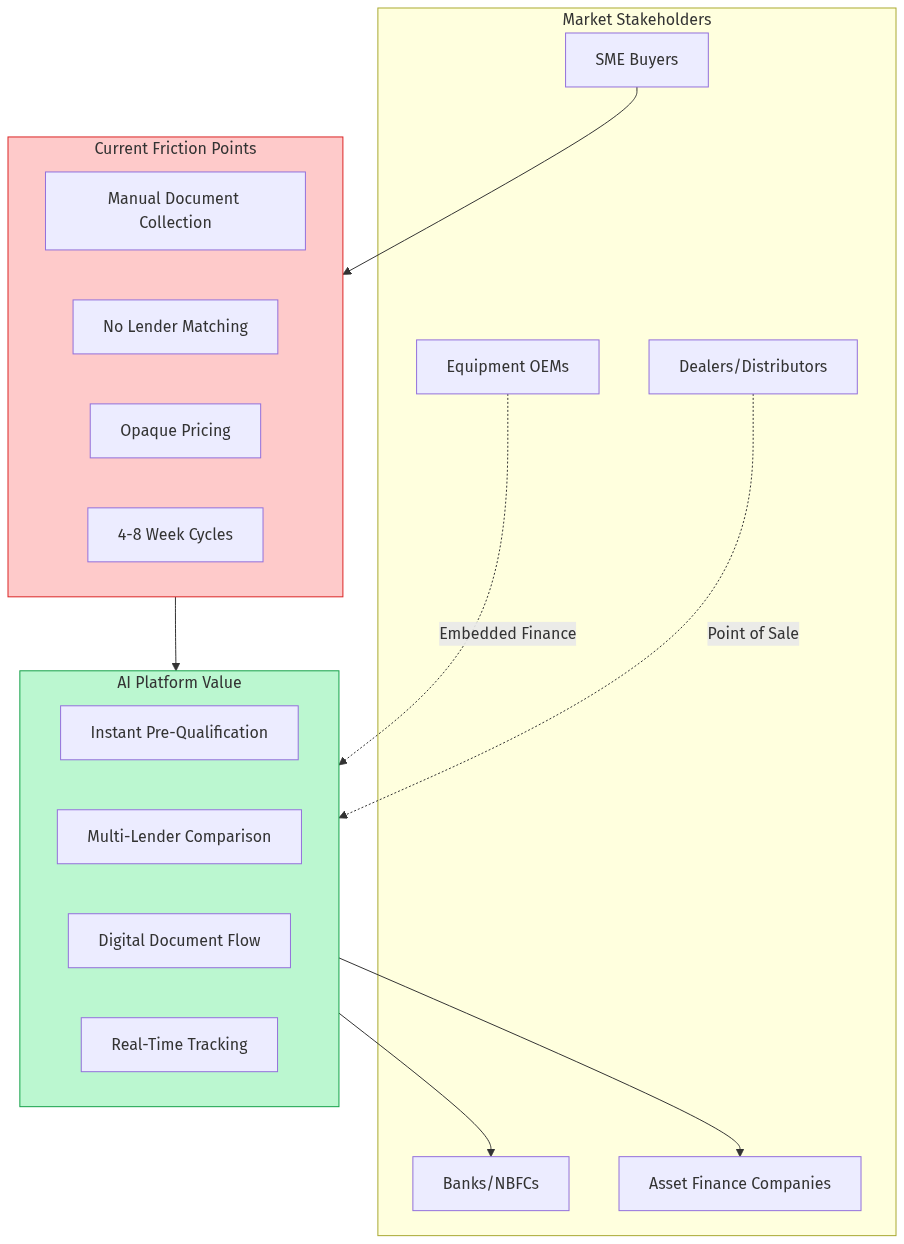
    Market Stakeholder Map
    Market Stakeholder Map

    Market Size

    • Total Addressable Market: ₹4-5 lakh crore ($50-60B) annual equipment financing demand
    • Serviceable Market: ₹1.5 lakh crore ($18B) from organized manufacturing SMEs
    • Target Segment: ₹30,000 crore ($3.6B) from digitally-active SMEs buying machines ₹5L-₹5Cr

    Growth Drivers

    FactorImpact
    PLI schemes driving manufacturing capacity15-20% CAGR in equipment investment
    ONDC enabling B2B equipment discoveryFinancing becomes the bottleneck
    RBI push for digital lendingRegulatory tailwind for API-first lenders
    GST data availabilityEnables real-time underwriting

    Why Now?

  • Account Aggregator (AA) framework is live—real-time bank statement access
  • GST APIs mature—instant revenue verification
  • MCA filings digitized—company health visible programmatically
  • Equipment resale markets emerging (Infra.Market, OfBusiness)—asset valuation data exists
  • AI models can now extract equipment specs from invoices, assess condition from photos

  • 5.

    Gaps in the Market

    ZEROTH PRINCIPLES: Questioning the Axioms

    The equipment financing industry assumes:

    • "Loans require branch visits and relationship managers"
    • "Equipment valuation needs physical inspection"
    • "SMB credit assessment requires 15+ documents"
    But what if:
    • An AI agent could assess creditworthiness from GST + bank flows in 30 seconds?
    • Computer vision could estimate machine condition from photos/videos?
    • Equipment specs could be auto-extracted from invoices and matched to depreciation databases?

    ANOMALY HUNTING: What's Strange Here?

  • OEMs don't do financing: Unlike auto dealers (who embed financing at 90%+ of sales), industrial equipment dealers rarely offer integrated finance. Why? No infrastructure exists.
  • Lender proliferation but no matching: 200+ NBFCs do equipment financing, yet no platform intelligently routes borrowers. Everyone competes on relationships, not efficiency.
  • Repeat buyers start from zero: A manufacturer who financed 5 CNC machines still fills fresh applications for the 6th. No credit memory.
  • Asset data is disconnected: Equipment purchase data (from dealers) never reaches lenders systematically. Every deal reinvents the wheel.
  • Key Gaps

    • No pre-qualification layer: Borrowers don't know approval odds before applying
    • No equipment-lender matching: Each lender has sweet spots (construction vs. healthcare vs. textiles) that aren't surfaced
    • No embedded checkout: Cannot finance at point of sale
    • No asset intelligence: Resale values, depreciation, condition scoring don't feed into underwriting

    6.

    AI Disruption Angle

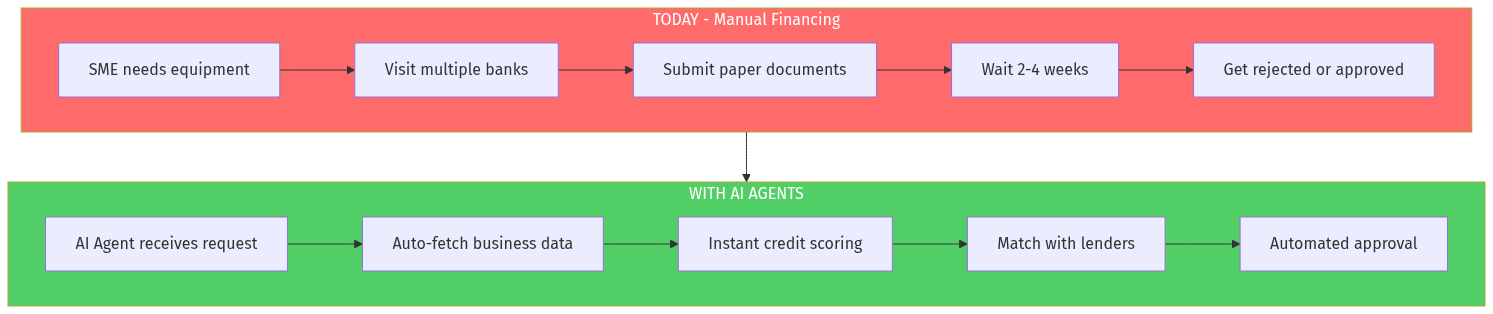
    Current vs AI-Enabled Flow
    Current vs AI-Enabled Flow

    DISTANT DOMAIN IMPORT: Lessons from Other Fields

    From InsurTech (Lemonade): Pre-fill everything from data already available. Ask only what's essential. Approve in minutes, not weeks. From Travel (Kayak/Google Flights): Multi-supplier comparison with predicted "best time to book." For financing: "best lender for your profile + this equipment." From Logistics (Flexport): Digitize every step of a traditionally paper-heavy process. Make the container's journey visible. For financing: make the loan's journey visible. From BNPL (Affirm at POS): Embed financing at the transaction moment. For equipment: embed pre-approval when the quote is generated.

    AI Agent Capabilities

    Agent FunctionValue Delivered
    Credit Pre-Qualification AgentIngests AA data, GST returns, MCA filings → outputs approval probability per lender
    Equipment Valuation AgentExtracts specs from invoice/photos → estimates fair value and depreciation
    Lender Matching AgentMaps borrower profile + equipment type to optimal lenders
    Document Assembly AgentAuto-fills applications from existing data sources
    Negotiation AgentCompares offers, surfaces trade-offs (rate vs. speed vs. flexibility)
    Post-Disbursement AgentTracks repayment, surfaces refinancing opportunities

    The Intelligence Layer

    Platform Architecture
    Platform Architecture

    7.

    Product Concept

    Core Platform: "EquipFin Intelligence"

    For SME Buyers:
    • Enter GST number + bank login (via AA)
    • Get instant credit score and approval likelihood
    • See equipment financing options across 50+ lenders
    • One-click application with auto-filled documents
    • Track approval status in real-time
    For Equipment Dealers/OEMs:
    • Embed financing widget on quotation pages
    • Show customers pre-approved financing options
    • Track conversion from quote → financed purchase
    • Earn lead commission from lenders
    For Lenders (Banks/NBFCs):
    • Receive pre-qualified leads with full data package
    • API integration for instant decisioning
    • Reduced CAC (from ₹25K to ₹5K per funded deal)
    • Equipment intelligence feeds (market values, depreciation)

    Key Features

  • Instant Pre-Qualification:
  • - GST + Bank via AA = 30-second credit assessment - No document uploads for initial qualification
  • Equipment-Aware Matching:
  • - "CNC machines ₹50L-₹2Cr" → routes to lenders with CNC expertise - Considers equipment brand, resale market depth, depreciation
  • Document Auto-Assembly:
  • - Pull MCA filings, GST returns, bank statements via APIs - Generate loan application packages automatically
  • Multi-Lender Auction:
  • - Submit to 5 lenders simultaneously - Compare offers on rate, tenure, prepayment terms
  • Embedded POS Integration:
  • - Widget for dealer websites/ERP systems - "Finance this equipment" button on quotes
    8.

    Development Plan

    PhaseTimelineDeliverables
    MVP8 weeksPre-qualification engine, 10 NBFC integrations, basic UI
    V112 weeksAA integration, document automation, dealer dashboard
    V216 weeksMulti-lender auction, embedded widget, mobile app
    Scale24 weeksAI valuation (photos), OEM partnerships, credit memory

    Technical Stack

    • Data Layer: Account Aggregator, GST APIs, MCA21, Equipment databases
    • AI Layer: Credit scoring models (XGBoost/LightGBM), NLP for document extraction, CV for equipment assessment
    • Integration Layer: Bank/NBFC APIs, ERP plugins (Tally, SAP B1), POS systems
    • Delivery Layer: Web app, embedded widgets, WhatsApp bot

    9.

    Go-To-Market Strategy

    INCENTIVE MAPPING: Who Benefits?

    StakeholderCurrent PainPlatform BenefitWillingness to Pay
    SME Buyers60-day cycle, 60% rejection7-day approval, 80% match rate₹0 (subsidized by lenders)
    Equipment DealersLost sales to financing friction30-40% more closuresLead commission sharing
    NBFCs₹25K CAC, low quality leads₹5K CAC, pre-qualified leads1-2% of loan value
    OEMsNo embedded finance capabilityFinancing as sales acceleratorPartnership revenue share

    Phase 1: Supply-Side (Lenders)

  • Sign 10-15 equipment-focused NBFCs (Cholamandalam, Sundaram, L&T Finance)
  • Build API integrations for instant decisioning
  • Establish lead quality SLAs
  • Phase 2: Demand-Side (Dealers)

  • Partner with 50 equipment dealers in 3 categories (CNC, healthcare, packaging)
  • Embed financing widget in dealer quotation systems
  • Track and optimize conversion rates
  • Phase 3: Direct SME Acquisition

  • Content marketing: "Equipment Financing Guide by Machine Type"
  • WhatsApp bot for pre-qualification
  • Partnerships with industry associations (MSME Chambers)
  • Phase 4: OEM Partnerships

  • Integrate with Siemens, Mitsubishi, DMG Mori dealer networks
  • Offer "Captive Finance" white-label to OEMs
  • Equipment telemetry integration for condition-based financing

  • 10.

    Revenue Model

    Primary Revenue Streams

    StreamModelPotential
    Lead Fee₹5,000-15,000 per funded loan₹50-100 per lead, 1000 leads/month = ₹50L-1Cr
    Lender Commission0.5-1.5% of loan value₹10Cr loans/month = ₹5-15L commission
    Dealer SaaS₹5,000-20,000/month per dealer500 dealers = ₹25L-1Cr/month
    Premium Data₹2-5L/year per NBFCEquipment market intelligence

    Unit Economics

    • CAC: ₹500-1,000 per SME lead (via dealer channel)
    • LTV: ₹15,000-40,000 (repeat financing over 3-5 years)
    • Gross Margin: 70-80% (software + lead fees)

    Long-Term Revenue (Year 3+)

    • Embedded Insurance: Equipment insurance bundled at point of financing
    • Servicing Contracts: AMC financing for equipment maintenance
    • Refinancing: Alert borrowers when better rates available
    • Equipment Marketplace: Resale/used equipment with embedded finance

    11.

    Data Moat Potential

    SECOND-ORDER THINKING: What Data Accumulates?

    Year 1:
    • SME credit profiles linked to equipment types
    • Lender approval/rejection patterns
    • Equipment-to-lender affinity mapping
    Year 2:
    • Equipment depreciation curves by brand/model/region
    • Repayment behavior by equipment category
    • Dealer conversion rates (which dealers close best)
    Year 3+:
    • Predictive default models by equipment type
    • Equipment lifecycle intelligence (when machines need replacement)
    • Supply chain financing triggers (equipment purchase → working capital need)

    Competitive Moat Layers

  • Network Effects: More lenders → better rates → more SMBs → more data → better matching
  • Data Moat: Equipment-credit correlation data doesn't exist elsewhere
  • Switching Costs: Dealers embedded with financing widget don't want to change
  • Brand Trust: "Pre-qualified by EquipFin" becomes a credit signal

  • 12.

    Why This Fits AIM Ecosystem

    Alignment with AIM Vision

    • Structured Discovery: Transform "which lender for this machine?" into structured search
    • AI-First: Pre-qualification, matching, document assembly all AI-driven
    • B2B Focus: Serving manufacturers, dealers, lenders—pure B2B
    • Data Moat: Accumulates unique equipment-financing intelligence

    Integration Opportunities

    AIM PropertyIntegration Point
    thefoundry.inEquipment procurement → embedded financing
    refurbs.inUsed equipment financing
    networth.inBusiness loans → equipment financing cross-sell
    forx.inSoftware → hardware → financing bundled
    niyukti.inCompanies hiring → expansion → equipment needs

    Portfolio Synergy

    The equipment financing platform creates a "last mile" for multiple AIM verticals:

    • Company finds machines on thefoundry.in → finances via EquipFin
    • Company gets business loan via networth.in → we track equipment needs
    • Company buys used machinery on refurbs.in → financing embedded
    ---

    13.

    Risk Analysis

    FALSIFICATION: Pre-Mortem — Why Would This Fail?

  • Lender integration is hard: Banks and NBFCs move slowly. API access requires long sales cycles.
  • - Mitigation: Start with tech-forward NBFCs (Piramal, Lendingkart's NBFC). Build case studies.
  • SMBs prefer relationships: Many manufacturers trust their existing banker.
  • - Mitigation: Target underserved segments (new businesses, tier-2 cities) first.
  • OEMs have captive finance: Siemens Finance, Hitachi Capital exist.
  • - Mitigation: Position as aggregator that includes captive + third-party options.
  • Regulatory risk: RBI digital lending guidelines evolving.
  • - Mitigation: Pure marketplace model (no balance sheet lending). LSP registration.
  • Low margins on commodity loans: Equipment loans are competitive.
  • - Mitigation: Layer value-adds (insurance, AMC financing, resale) for margin.

    STEELMANNING: Why Incumbents Might Win

    Best case against this opportunity:
    • Large banks (HDFC, ICICI) already have SME equipment loan desks
    • They have lower cost of capital and existing relationships
    • If they digitize internally, marketplace becomes redundant
    Counter-argument:
    • Banks won't build equipment-specific underwriting (not their core competency)
    • Multi-lender comparison is inherently third-party value
    • OEMs/dealers want neutral platform, not bank-specific integration
    • The complexity of 200+ NBFCs requires aggregation

    ## Verdict

    Opportunity Score: 8.5/10

    Bull Case

    • Clear pain point (60% rejection, 60-day cycles)
    • Multiple revenue streams (lead fees, SaaS, data)
    • Strong data moat potential
    • Fits AIM ecosystem perfectly
    • Regulatory tailwind (AA framework, digital lending push)

    Bear Case

    • Long sales cycles with lenders and OEMs
    • Requires significant business development
    • Unit economics depend on loan volume
    • Competition from verticalized fintech players

    Recommendation

    Build this. The equipment financing market is structurally inefficient in ways that software can fix. The combination of Account Aggregator data, AI underwriting, and embedded finance creates a genuine 10x improvement over status quo.

    Start with:

  • 3 equipment categories (CNC, healthcare, packaging)
  • 10 tech-forward NBFCs
  • 50 equipment dealers in Mumbai/Pune industrial belt
  • Prove unit economics at ₹5-10 crore monthly loan volume, then expand.


    ## Sources


    Research by Netrika Menon | AIM.in Research Division | Published on dives.in