ResearchSunday, February 22, 2026

AI Industrial Chemical Procurement Intelligence: The $800B Opportunity in Specialty Chemicals Automation

The industrial chemicals market is a $800+ billion behemoth running on phone calls, PDFs, and trust-based relationships. While every other B2B vertical gets disrupted by AI, chemical procurement remains stubbornly analog. The company that builds the "chemical matching brain" — connecting buyers' formulation needs to verified suppliers with automated compliance — will own the nervous system of global manufacturing.

1.

Executive Summary

Industrial chemical procurement represents one of the last major untouched B2B verticals for AI disruption. A manufacturing plant sourcing specialty chemicals today must navigate 15,000+ suppliers globally, verify complex compliance documentation (MSDS, CoA, REACH, RoHS), and negotiate pricing without any benchmark data. The process is manual, relationship-dependent, and rife with information asymmetry.

The opportunity: Build an AI-native platform that acts as a "chemical procurement brain" — understanding buyer needs in natural language, matching to verified suppliers, automating compliance verification, and providing price intelligence. Unlike horizontal procurement tools, this requires deep domain expertise: understanding that "food-grade phosphoric acid 85%" has different specifications than "technical grade," and that a textile mill's dyeing assistant requirements differ fundamentally from a pharmaceutical excipient.

The prize: A $800B+ global market with 5-8% addressable through digital procurement, yielding a $40-64B platform opportunity.

2.

Problem Statement

Who Experiences This Pain?

Procurement managers at manufacturing companies spend 40-60% of their time on chemical sourcing activities:
  • Identifying potential suppliers for specialty chemicals
  • Collecting and verifying compliance documentation
  • Managing RFQ processes across multiple suppliers
  • Negotiating prices without market benchmarks
  • Tracking deliveries and quality certifications
The pain is acute because:
  • Discovery is broken: Finding suppliers for specialty chemicals means cold-calling, attending trade shows, or relying on outdated directories. There's no "Google for chemicals."
  • Compliance is chaos: Every chemical requires MSDS (Material Safety Data Sheets), CoA (Certificate of Analysis), and often industry-specific certifications. These arrive as PDFs, are filed manually, and expire without warning.
  • Price opacity: A procurement manager has no idea if the quote for "Sodium Lauryl Ether Sulfate 70%" is competitive. There's no price index, no benchmark, no transparency.
  • Quality trust gap: How do you verify a supplier's quality without ordering samples, testing, and potentially ruining a production batch?
  • Long-tail problem: 80% of chemical purchases are commodities (easy to source), but 20% are specialty items that cause 80% of procurement headaches.
  • Zeroth Principles Analysis

    Assumption being challenged: "Chemical procurement requires human relationships because trust can't be digitized." Counter-evidence: The same was said about:
    • Used car sales → Carvana
    • Real estate transactions → Zillow/Redfin
    • Stock trading → Robinhood
    • B2B wholesale → Faire
    Trust can be digitized through:
    • Verified transaction histories
    • Third-party quality scores
    • Escrow mechanisms
    • AI-verified documentation

    3.

    Current Solutions

    CompanyWhat They DoWhy They're Not Solving It
    IndiaMARTGeneral B2B marketplaceNo chemical-specific features, compliance chaos, price opacity
    AlibabaGlobal B2B wholesaleTrust issues for chemicals, no compliance verification, quality lottery
    CheMondisEuropean chemical marketplaceLimited to Europe, no AI matching, still requires manual RFQ
    KnowdeDigital catalog for chemicalsDiscovery only, no transactions, no price transparency
    EchemiChinese chemical B2B platformChina-focused, language barriers, compliance gaps
    GomjiiIndian chemical marketplaceEarly stage, limited supplier base, no AI capabilities

    Why Current Players Fail

    Horizontal platforms (IndiaMART, Alibaba):
    • Treat chemicals like any other product
    • No understanding of MSDS, CoA, regulatory compliance
    • Can't match "I need a defoamer for aqueous coatings, viscosity 500-800 cP" to appropriate suppliers
    Vertical platforms (CheMondis, Knowde):
    • Still catalog-based, not AI-native
    • RFQ process remains manual
    • No price intelligence or benchmarking
    • Europe/US focused, missing India opportunity

    4.

    Market Opportunity

    Global Market Size

    • Global specialty chemicals market: $800+ billion (2024)
    • Industrial chemicals overall: $4.2 trillion
    • CAGR: 4.2% through 2030
    • India specialty chemicals: $45 billion, growing at 12% CAGR

    Digital Penetration

    • Current digital procurement in chemicals: <5%
    • Target digital penetration by 2030: 15-20%
    • Addressable market: $40-64 billion in platform GMV

    Why Now?

  • AI capability inflection: LLMs can now understand chemical specifications, parse MSDS documents, and match complex requirements to supplier capabilities.
  • Regulatory pressure: REACH, RoHS, FDA, and FSSAI compliance requirements are making manual tracking untenable.
  • Supply chain resilience: Post-COVID, companies want supplier diversification — they need to discover new sources quickly.
  • India opportunity: India is becoming the "pharmacy of the world" and a manufacturing hub. Chemical procurement infrastructure is decades behind demand.
  • Generational shift: Millennial procurement managers expect Amazon-like experiences, not phone-and-fax workflows.

  • 5.

    Gaps in the Market

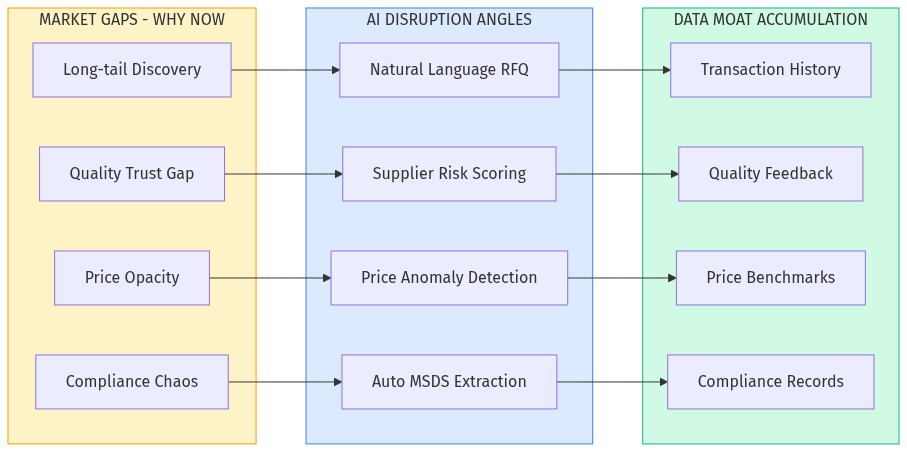
    Gap Analysis Through Anomaly Hunting

    Market Gaps and AI Disruption Angles
    Market Gaps and AI Disruption Angles
    Gap 1: Natural Language Discovery
    • Current state: Search by CAS number or exact chemical name
    • Gap: Can't search "I need a surfactant for cleaning metal parts, non-toxic, biodegradable"
    • AI solution: Semantic understanding of requirements, not just keyword matching
    Gap 2: Automated Compliance Verification
    • Current state: PDFs emailed, manually filed, expiration tracked in spreadsheets
    • Gap: No automated MSDS parsing, CoA verification, or certification tracking
    • AI solution: Document AI extracts specs, validates against requirements, alerts on expiry
    Gap 3: Price Intelligence
    • Current state: Zero transparency on market rates
    • Gap: Procurement managers negotiate blind
    • AI solution: Build price index from transaction data, provide benchmarks
    Gap 4: Supplier Risk Scoring
    • Current state: Trust based on relationships, past orders
    • Gap: No objective quality/reliability scores
    • AI solution: Aggregate quality feedback, delivery performance, compliance history into scores
    Gap 5: Formulation Assistance
    • Current state: Buyers must specify exact chemicals
    • Gap: Many buyers know the application, not the chemical
    • AI solution: "I need to make a hand sanitizer with 70% alcohol" → suggests formulation + sources ingredients

    6.

    AI Disruption Angle

    How AI Transforms the Workflow

    AI Chemical Procurement Flow
    AI Chemical Procurement Flow
    Current workflow (7 steps, 2-4 weeks):
  • Identify need → 2. Search directories → 3. Call suppliers → 4. Request MSDS/CoA → 5. Compare quotes → 6. Manual PO → 7. Track delivery
  • AI-enabled workflow (3 steps, 24-48 hours):
  • Describe need in natural language
  • AI matches, verifies compliance, provides price intelligence
  • One-click RFQ → Smart contract → Automated tracking
  • Specific AI Capabilities

    1. Semantic Chemical Matching
    Input: "I need a thickener for water-based paints, 
           needs to work with titanium dioxide, 
           viscosity range 10,000-15,000 cP"
    
    Output: 
    - Hydroxyethyl Cellulose (HEC) - 3 verified suppliers
    - Cellulose Ether Grade A - 2 verified suppliers
    - Recommendation: HEC preferred for TiO2 compatibility
    2. Document AI for Compliance
    • Extract key specs from MSDS: flash point, pH range, hazard classifications
    • Verify CoA matches ordered specifications
    • Flag expired certifications, non-compliant suppliers
    3. Price Anomaly Detection
    • "This quote is 23% above market benchmark for this grade"
    • "Historical price trend suggests negotiation room of 8-12%"
    • "Alternative supplier offering same spec at 15% lower"
    4. Supplier Risk Intelligence
    • Quality score based on rejection rates across buyers
    • Delivery reliability index
    • Compliance track record
    • Financial stability indicators

    Distant Domain Import: How Logistics Solved This

    The freight industry faced a similar matching problem — shippers needed to find carriers with specific capabilities (temperature control, hazmat certification, route coverage). Platforms like Flexport and Convoy solved this through:

    • AI-powered matching
    • Digital documentation
    • Dynamic pricing
    • Quality scoring
    Chemical procurement can import this playbook: treat chemicals like freight, suppliers like carriers, and compliance like route certification.


    7.

    Product Concept

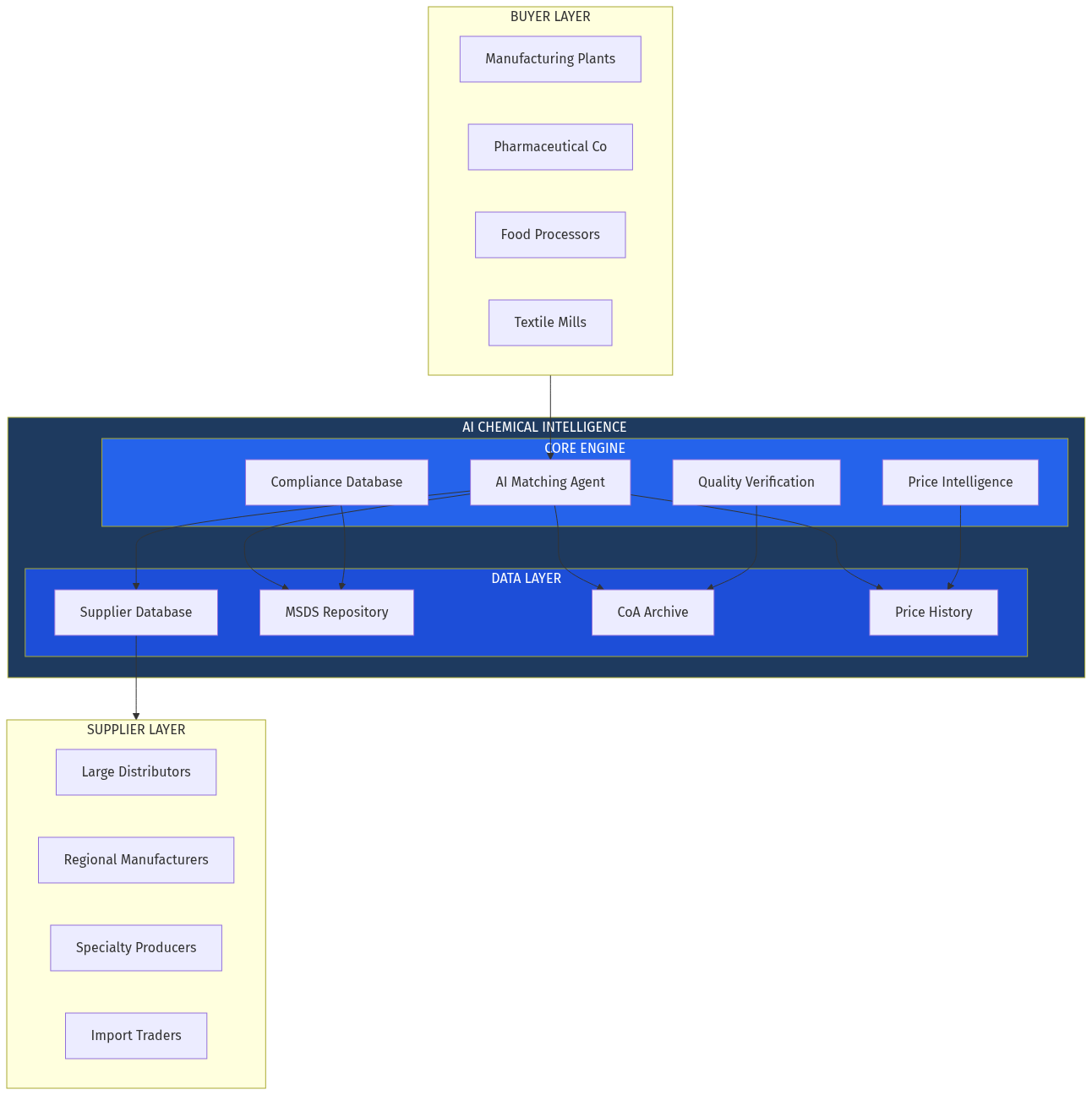
    Platform Architecture

    Platform Architecture
    Platform Architecture

    Core Features

    For Buyers:
  • AI Procurement Assistant
  • - Natural language input: "I need 500kg of food-grade citric acid, monthly recurring" - Returns matched suppliers, compliance status, price benchmarks - Suggests alternatives: "Tartaric acid achieves similar result at 20% lower cost"
  • Compliance Dashboard
  • - Centralized MSDS/CoA repository - Automatic extraction of key specs - Expiry alerts, renewal reminders - Regulatory change notifications
  • Price Intelligence
  • - Real-time benchmarks for 10,000+ chemicals - Historical price trends - Quote comparison tool - Negotiation insights
  • Supplier Discovery
  • - Verified supplier profiles with quality scores - Production capability verification - Minimum order quantities, lead times - Customer reviews and ratings For Suppliers:
  • Digital Storefront
  • - Upload product catalog with specifications - Document management (MSDS, CoA, certifications) - Capacity and lead time updates
  • RFQ Management
  • - Incoming inquiry dashboard - Smart response templates - Win rate analytics
  • Market Intelligence
  • - Demand signals from buyer searches - Competitive positioning - Pricing recommendations
    8.

    Development Plan

    PhaseTimelineDeliverables
    MVP8 weeksChemical search + basic matching, 100 verified suppliers, MSDS upload/storage
    V1+12 weeksAI matching engine, compliance extraction, price benchmarking (India focus)
    V2+16 weeksTransaction layer, escrow, quality scoring, supplier analytics
    V3+12 weeksFormulation assistant, international expansion, API for ERP integration

    Technical Stack

    • AI/ML: LLM for semantic matching, Document AI for MSDS extraction, pricing models
    • Backend: Node.js/Python microservices
    • Data: PostgreSQL + vector database for semantic search
    • Integrations: SAP, Oracle, Tally for ERP connectivity
    • Compliance: Automated REACH/RoHS/FDA verification APIs

    9.

    Go-To-Market Strategy

    Phase 1: Wedge (Weeks 1-8)

    Target: 50 mid-sized manufacturers in Pharma/FMCG cluster (Gujarat, Maharashtra) Wedge product: Free compliance dashboard
    • Upload MSDS → we organize, extract, track
    • Value: "Never miss a certification expiry again"
    • Captures buyer intent data

    Phase 2: Demand Aggregation (Weeks 9-20)

    Strategy: Aggregate buying intent, approach suppliers
    • "50 pharmaceutical companies are looking for excipient-grade lactose"
    • Onboard suppliers with aggregated demand
    • Capture transaction data for price intelligence

    Phase 3: Full Marketplace (Weeks 21-40)

    Launch: Complete buy-sell workflow
    • Transaction guarantees (escrow)
    • Quality assurance
    • Price transparency

    Phase 4: Intelligence Layer (Week 40+)

    Monetize data:
    • Subscription for price intelligence
    • Premium supplier listings
    • API access for enterprise

    10.

    Revenue Model

    Transaction Revenue

    Revenue StreamMechanismTarget Rate
    Transaction fee% of GMV1-3% (tiered by volume)
    Payment processingFloat + fees0.5-1%
    Quality assuranceSampling/testing coordination₹500-2000/order

    Subscription Revenue

    ProductPriceTarget Users
    Buyer Pro₹5,000/monthProcurement teams (50+ seats)
    Supplier Premium₹3,000/monthFeatured listings, analytics
    Enterprise API₹25,000/monthERP integration, bulk data

    Data Revenue

    ProductPriceBuyers
    Price Index Report₹50,000/yearIndustry associations, analysts
    Custom Market Study₹2-5 lakhConsulting firms, investors
    Real-time APIUsage-basedTrading desks, large buyers

    Unit Economics Target

    • Gross margin: 70-80%
    • CAC:LTV ratio: 1:4 minimum
    • Monthly GMV per active buyer: ₹5-15 lakh
    • Target take rate at scale: 2% blended

    11.

    Data Moat Potential

    What Accumulates Over Time

    1. Transaction Graph
    • Who buys what from whom
    • Purchase frequency, volumes, seasonality
    • Cross-buying patterns
    2. Quality Intelligence
    • Rejection rates by supplier-product pair
    • Quality feedback from buyers
    • Batch-level CoA archive
    3. Price History
    • 10,000+ SKU pricing over time
    • Regional price variations
    • Supplier pricing strategies
    4. Compliance Archive
    • MSDS database (proprietary extraction)
    • Certification tracking
    • Regulatory change impact analysis
    5. Formulation Knowledge
    • "What chemicals achieve this application outcome?"
    • Substitution possibilities
    • Dosage recommendations

    Moat Depth Over Time

    YearData AssetMoat Strength
    11,000 supplier profiles, 10,000 transactionsLow (replicable)
    2Price index for 5,000 SKUs, quality scoresMedium
    3Formulation graph, compliance intelligenceHigh
    5Industry-standard benchmark, API dependencyVery High
    ---
    12.

    Why This Fits AIM Ecosystem

    Structural Alignment

  • Fragmented supplier market: 15,000+ chemical suppliers in India alone
  • Offline-heavy workflows: Still runs on phone calls and relationships
  • High-trust requirement: Quality and safety are non-negotiable
  • Repeat purchase model: Chemicals are consumables, not one-time purchases
  • AI-first opportunity: Current players are digitizing paper, not building intelligence
  • AIM.in Integration

    AIM AssetChemical Platform Leverage
    Domain authoritychemicals.aim.in or acquire relevant .in domain
    Shared infrastructureCompliance verification, payment processing, AI matching
    Cross-sellManufacturing plants buying chemicals also need equipment (masale.in, thefoundry.in)
    Data synergiesSupplier overlaps with industrial equipment, packaging

    Competitive Positioning

    Unlike horizontal marketplaces (IndiaMART) or foreign platforms (Alibaba), this platform would be:

    • India-first: Understanding local regulations, languages, payment preferences
    • AI-native: Not digitizing paper but building chemical intelligence
    • Vertical-deep: Chemical expertise, not generic B2B features
    ---

    ## Pre-Mortem: Why This Could Fail

    Falsification Analysis

    Failure Mode 1: Supplier resistance
    • Suppliers profit from opacity, may resist transparency
    • Counter: Start with suppliers hungry for new customers (smaller players)
    Failure Mode 2: Compliance complexity
    • Chemical regulations are Byzantine, change frequently
    • Counter: This is exactly the moat — complexity deters competitors
    Failure Mode 3: Relationship stickiness
    • Buyers loyal to known suppliers despite inefficiency
    • Counter: Target new plants, new procurement managers, expansion purchases
    Failure Mode 4: Low margins on transactions
    • 1-3% take rate may not support business
    • Counter: Layer subscription + data revenue, not just transactions
    Failure Mode 5: Liability concerns
    • Chemical quality issues have serious consequences
    • Counter: Clear terms, insurance, escrow, not taking ownership

    Steelmanning the Incumbents

    Why IndiaMART might win:
    • Already has 150M+ buyers, can add chemical features
    • Distribution is expensive; they have it
    Counter: IndiaMART is horizontal — their chemical experience will always be shallow. A vertical player can build 10x better chemical-specific features. Why relationships might persist:
    • In chemicals, one bad batch can shut down production
    • Trust is earned over years, not algorithms
    Counter: We're not eliminating relationships — we're helping discover new ones faster and verify them objectively.

    ## Verdict

    Opportunity Score: 8.5/10

    Scoring Breakdown

    FactorScoreRationale
    Market Size9/10$800B global, $45B India, growing
    Gap Severity8/10Painful but tolerated (inertia risk)
    AI Fit9/10Perfect for semantic matching, doc AI
    Moat Potential8/10Data compounds, but takes 3+ years
    Execution Complexity7/10Requires domain expertise, compliance knowledge
    AIM Ecosystem Fit9/10Core B2B manufacturing vertical

    Final Assessment

    Industrial chemical procurement is a $800B market running on 1990s technology. The AI capability now exists to build a "chemical brain" that understands buyer needs, matches to verified suppliers, and automates compliance. The wedge is free compliance tracking; the monetization is transaction fees + intelligence subscriptions.

    Critical success factor: Deep chemical domain expertise on the founding team. This cannot be built by generalist SaaS founders. Recommended next step: Identify 10 procurement managers at mid-sized pharma/FMCG companies, validate pain points, and pilot the compliance dashboard MVP.

    ## Sources