ResearchSunday, February 22, 2026

AI-Powered Commercial Printing & Packaging Procurement Intelligence: The $501B Fragmented Market Ripe for Agent Disruption

A $501 billion global market dominated by phone calls, WhatsApp messages, and PDF quotes is about to meet AI agents that can parse briefs in natural language, standardize specifications across 10,000+ printers, and deliver real-time quotes with quality scores. The opportunity isn't building another print-on-demand platform—it's becoming the intelligent procurement layer for B2B packaging and commercial print.

1.

Executive Summary

Commercial printing and packaging is a $501 billion market (2024) growing to $598 billion by 2030. Yet it remains stubbornly fragmented—"highly fragmented" per every industry report—with thousands of small printers, no price transparency, and purchasing decisions made over phone calls and WhatsApp.

The AI disruption angle is clear: procurement agents that can translate a business's natural language brief ("I need 10,000 kraft mailer boxes with my logo, delivered to Mumbai by March 15") into structured specifications, match against a verified printer network, and return ranked quotes with quality predictions.

This isn't print-on-demand for consumers. This is procurement intelligence for the 54.2% of the market that's B2B packaging—the boxes, labels, and flexible packaging that e-commerce, FMCG, and D2C brands order repeatedly.
2.

Problem Statement

Who Experiences This Pain?

Brand Procurement Managers at D2C startups, FMCG companies, and e-commerce sellers spend 2-3 days every quarter:
  • Calling 5-10 printers for quotes on packaging
  • Explaining the same specifications repeatedly
  • Receiving quotes in different formats (some per piece, some per thousand, some with shipping, some without)
  • Creating comparison spreadsheets manually
  • Having no historical data on printer quality or delivery reliability
Small Printers (the 10,000+ fragmented suppliers) struggle to:
  • Get discovered by new clients beyond their local network
  • Compete on anything other than price (no quality reputation system)
  • Predict their capacity utilization
  • Access working capital for large orders

The Zeroth Principles Question

What are we assuming about print procurement that everyone takes for granted? Assumption 1: "Custom specs require human interpretation" Reality: 95% of print jobs fall into standardized categories (GSM, dimensions, finish, colors). The "custom" part is usually just combining known parameters. Assumption 2: "Quality varies too much to standardize" Reality: Quality is measurable—color accuracy (Delta-E), registration tolerance, substrate consistency. We just don't measure it because there's no platform aggregating this data. Assumption 3: "Relationships matter more than price" Reality: Relationships are a proxy for trust. Trust can be algorithmically derived from transaction history, QC data, and delivery performance.
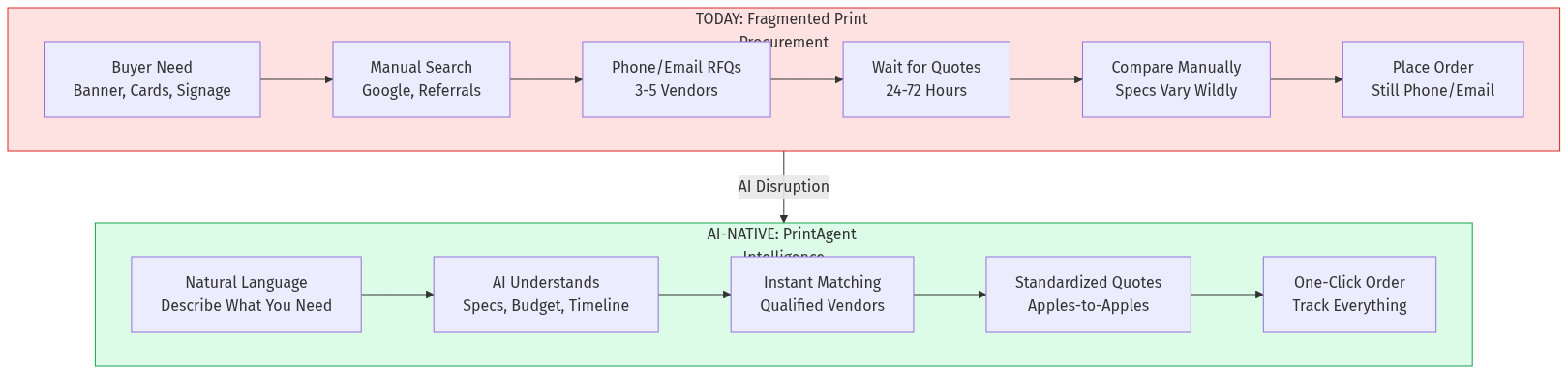
Current vs AI-Powered Print Procurement Flow

3.

Current Solutions

CompanyWhat They DoWhy They're Not Solving It
PrintfulPrint-on-demand for merch (consumer/SMB)POD model—single-unit economics. Not B2B bulk packaging.
PackhelpCustom packaging e-commerce (Europe-focused)Transaction-based marketplace. No AI specification parsing. No quality intelligence.
BizongoVendor digitization + financing (India)Focus on vendor management, not procurement intelligence. Platform connects existing relationships rather than discovering new optimal suppliers. $50M+ raised.
ArkaCustom packaging for e-commerce brandsUS-focused. Standard catalog with customization. No India presence.
NoissueSustainable packaging marketplaceNiche sustainability angle. Limited SKU range.

Incentive Mapping: Who Profits from Status Quo?

  • Printing Brokers — Earn 15-30% markup by aggregating quotes and managing relationships. An AI agent threatens their livelihood.
  • Large Integrated Printers — Companies like R.R. Donnelley benefit from opacity. If prices become transparent, their premium positioning erodes.
  • WhatsApp/Phone Culture — The informal nature of ordering suits printers who prefer flexibility over accountability.
  • Insight: The status quo persists because the transaction cost of finding and vetting new printers exceeds the savings from better pricing. AI agents collapse this transaction cost to near-zero.
    4.

    Market Opportunity

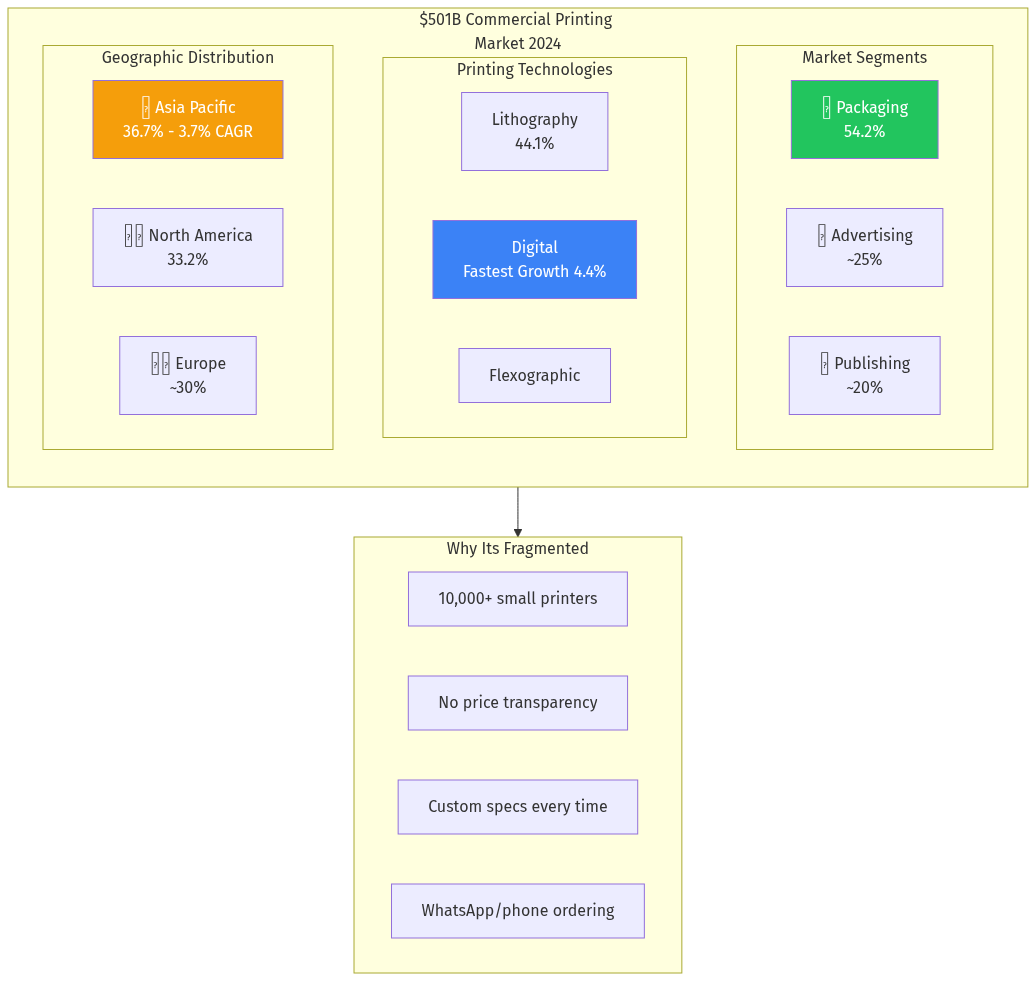
    Commercial Printing Market Structure
    Commercial Printing Market Structure
    • Global Market Size: $501.36 billion (2024) → $598.06 billion (2030)
    • CAGR: 3.2% globally, 3.7% in Asia Pacific
    • Packaging Segment: 54.2% of market (~$272 billion)
    • Digital Printing: Fastest growing at 4.4% CAGR

    India Specifically

    • E-commerce boom driving packaging demand
    • Unorganized sector dominates (estimated 80%+ of printers)
    • D2C brand explosion creating new packaging buyers monthly
    • MRP/labeling regulations require compliant printing

    Why Now?

  • LLMs can parse specifications — "300 GSM kraft with matt lamination" is now parseable by AI
  • D2C brands need flexibility — Traditional MOQs (minimum order quantities) are being disrupted
  • E-commerce packaging growth — Online retail drives repeat packaging orders
  • WhatsApp API maturity — Meet buyers where they already transact

  • 5.

    Gaps in the Market

    Anomaly Hunting: What's Strange Here?

  • No quality reputation system exists — Amazon has seller ratings. Uber has driver ratings. Commercial printing has... nothing. Buyers rely on samples and gut feel.
  • Pricing is opaque despite commodity inputs — Paper, ink, and plates are commodities with known pricing. Yet final quotes vary 2-5x for identical specs.
  • No spec standardization — Every printer uses different terminology. "Matt lamination" vs "matte finish" vs "laminated matt" — same thing, different quotes.
  • Repeat orders require re-quoting — Even for identical jobs, brands often re-negotiate or re-quote rather than having automated reorder pricing.
  • Quality control is post-hoc — Defects discovered at delivery, not during production. No real-time QC integration.
  • Distant Domain Import: What Field Solved This?

    Freight/Logistics: Flexport, Freightos, and others created "freight intelligence" by:
    • Standardizing shipping specs (container type, weight, route)
    • Aggregating carrier capacity and pricing
    • Building quality scores from delivery performance
    The same playbook applies to print: Standardize specs, aggregate printer capacity, build quality scores from production data.
    6.

    AI Disruption Angle

    The Agent-Native Procurement Flow

    Today:
    Brand → Phone/WhatsApp → Broker → 5 Printers → 5 PDFs → Spreadsheet → Decision
    Timeline: 2-3 days
    With AI Agents:
    Brand → "I need 10K mailer boxes, kraft, my logo here" → AI Agent → Structured RFQ → Network API → Ranked Quotes with Quality Scores → Decision
    Timeline: 10 minutes

    Specific AI Capabilities

  • Natural Language Spec Parsing
  • - Input: "Brown cardboard boxes, fits shoes, with our logo" - Output: Structured spec (E-flute corrugated, 300x200x120mm, 200 GSM, 4-color offset)
  • Printer Matching Algorithm
  • - Capability matching (offset vs digital, max sheet size, finishing options) - Capacity availability (lead time calendar integration) - Quality score (historical performance data) - Geographic optimization (shipping cost calculation)
  • Real-Time Quoting
  • - API connections to printer pricing systems - Dynamic pricing based on capacity utilization - Instant comparison across 50+ qualified suppliers
  • Production Monitoring
  • - QC image upload from production floor - AI-based defect detection (color variance, registration errors) - Proactive alerts before delivery

    Second-Order Thinking: If This Succeeds...

    • Printer pricing becomes transparent → Margin compression for inefficient printers
    • Quality data accumulates → First-mover advantage in quality prediction
    • D2C brands switch easily → Reduced switching costs create churn risk for printers
    • Financing becomes possible → Transaction data enables embedded lending

    7.

    Product Concept

    Platform: PrintX.in

    Core Value Proposition: "Tell us what you need. Get ranked quotes in 10 minutes."
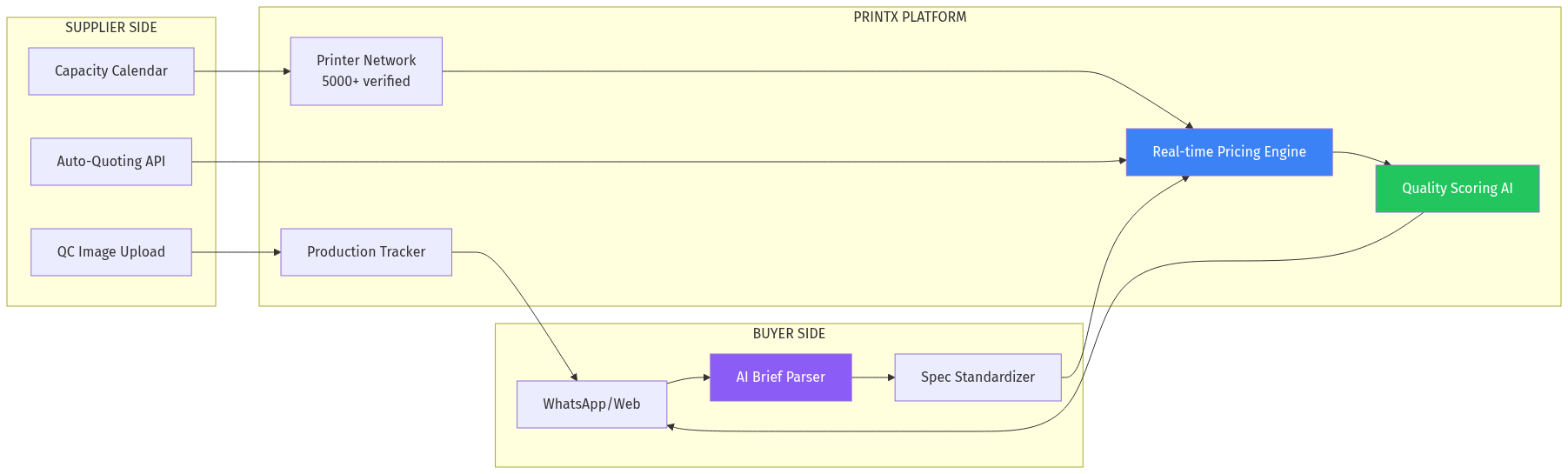
    PrintX Platform Architecture
    PrintX Platform Architecture

    Key Features

    For Buyers (Brands/Businesses):
    • WhatsApp-native brief submission
    • AI spec standardization with human verification
    • Instant quotes from verified network
    • Quality scores and delivery predictions
    • One-click reorder with price lock
    For Suppliers (Printers):
    • Capacity calendar management
    • Auto-quoting based on specs + margin rules
    • Quality score building (the "Uber rating" for printers)
    • Working capital access based on transaction history
    Intelligence Layer:
    • Specification parser (LLM-based)
    • Pricing engine (ML-based, learns market rates)
    • Quality predictor (historical performance + spec complexity)
    • Delivery estimator (capacity + logistics)

    8.

    Development Plan

    PhaseTimelineDeliverables
    MVP8 weeksWhatsApp brief intake → Human spec standardization → 10 verified printers → Manual quote aggregation → Comparison dashboard
    V1+6 weeksAI spec parser → 50 printers API-connected → Auto-quoting → Quality score v1 (delivery performance)
    V2+8 weeksProduction QC integration → Real-time tracking → Embedded financing pilot → 200 printers
    Scale+12 weeksOpen API for integrations → Brand procurement dashboard → India-wide printer network

    Tech Stack

    • Brief Intake: WhatsApp Business API + Web portal
    • Spec Parser: Claude/GPT with fine-tuned packaging taxonomy
    • Printer Network: PostgreSQL + Meilisearch
    • Quoting Engine: Node.js microservice with Redis caching
    • QC Vision: CNN-based defect detection (color variance, registration)

    9.

    Go-To-Market Strategy

    Pre-Mortem: Why Would This Fail?

  • Printers refuse to join — Fear of price transparency, preference for relationship selling
  • Quality data is garbage — Printers game the ratings, buyers don't report issues
  • WhatsApp competitors — Buyers prefer informal WhatsApp groups over platform
  • Bizongo locks up enterprise — Existing relationships with large brands are sticky
  • Counter-Strategy

  • Start with demand, not supply — Aggregate D2C brand briefs first. Approach printers with "we have orders."
  • QC verification at delivery — Platform rep physically inspects samples. Quality scores based on objective data.
  • Be the WhatsApp bot — Don't fight WhatsApp. BE the WhatsApp bot that printers add to their workflow.
  • SMB focus — Let Bizongo have enterprise. Own the long-tail of D2C brands ordering ₹50K-₹5L/month.
  • Acquisition Sequence

  • Month 1-2: Partner with 3 D2C brand aggregators (LaunchPad, D2C Insider) for access to brands
  • Month 3-4: Onboard 50 printers in Mumbai/Delhi NCR with "free quote distribution" pitch
  • Month 5-6: Launch WhatsApp bot for brief submission
  • Month 7+: Introduce quality scores, drive printer competition on quality not just price

  • 10.

    Revenue Model

    Revenue StreamMechanismProjected Take Rate
    Transaction Fee% of GMV on completed orders3-5%
    Subscription (Buyers)Pro features: analytics, reorder automation₹5,000/month
    Subscription (Printers)Premium listing, capacity tools, insights₹3,000/month
    Embedded FinancingInterest spread on working capital loans2-3% of loan value
    Data ProductsMarket intelligence reports, pricing benchmarksCustom pricing

    Unit Economics Target

    • Average Order Value: ₹75,000
    • Take Rate: 4%
    • Revenue per Order: ₹3,000
    • CAC Target: ₹1,500 (2 orders to payback)
    • LTV: ₹36,000 (12 orders/year × 3 years)

    11.

    Data Moat Potential

    Proprietary Data Assets

  • Specification Corpus — Every brief becomes training data for the spec parser. Over time, the parser becomes unbeatable at understanding packaging requirements.
  • Printer Quality Database — Objective quality scores based on delivery performance, QC inspections, and buyer feedback. This doesn't exist anywhere.
  • Pricing Intelligence — Market-wide pricing data by spec, region, and season. Valuable for both buyers (benchmarking) and printers (competitive positioning).
  • Capacity Utilization Data — Real-time view of printer capacity across India. Enables predictive matching and dynamic pricing.
  • Network Effects

    • More buyers → More orders for printers → More printers join
    • More printers → Better matching → Better experience for buyers
    • More transactions → Better quality data → More trust → More transactions

    12.

    Why This Fits AIM Ecosystem

    Steelmanning: Why Might This Fail as an AIM Vertical?

  • Physical logistics complexity — Unlike pure digital marketplaces, print involves shipping heavy goods
  • Quality subjectivity — "Good enough" varies by brand; hard to standardize
  • Relationship stickiness — Brands often stick with "their printer" even at higher prices
  • Counter-Arguments

  • Logistics is solvable — Focus on B2B delivery where brands have receiving infrastructure
  • Quality is measurable — Color accuracy, delivery timing, defect rates are objective
  • New brands have no relationships — Target D2C brands launching, not incumbents with entrenched vendors
  • AIM Integration Points

    • Domain: PrintX.in or packaging.aim.in
    • Shared Infrastructure: Supplier verification, payment processing, communication layer
    • Cross-Sell: Brands ordering packaging also need logistics (tie to potential logistics vertical)
    • Data Synergy: Understanding brand packaging needs reveals product categories, volumes, growth rates

    Positioning

    IndiaMART: "Find a printer" (discovery, no intelligence) Bizongo: "Manage your vendors" (digitization, no discovery) PrintX: "Tell us what you need, get the best printer matched with quality guarantee" (intelligent procurement)


    ## Verdict

    Opportunity Score: 8.5/10
    CriterionScoreReasoning
    Market Size9/10$272B packaging segment, 3.7% growth in APAC
    Fragmentation9/10"Highly fragmented" is literally in every report
    AI Disruption Potential8/10Spec parsing, quality prediction, matching—all AI-native
    Defensibility7/10Quality data moat is strong but takes time to build
    GTM Feasibility8/10WhatsApp-native approach meets users where they are
    Competition8/10Bizongo is enterprise-focused; SMB/D2C underserved

    Final Assessment

    This is a massive, fragmented market where AI can genuinely collapse transaction costs. The key insight is that print procurement is a specification-matching problem disguised as a relationship problem. Once you standardize specs and aggregate quality data, the relationship advantage disappears.

    Recommended Next Steps:
  • Build WhatsApp bot for brief intake (2 weeks)
  • Partner with 3 D2C brand communities for demand
  • Onboard 20 printers in Mumbai with manual quote aggregation
  • Validate spec parser with 100 real briefs
  • Measure: brief-to-quote time, quote acceptance rate, reorder rate
  • The winner here will be whoever accumulates quality data fastest. Start now.


    ## Sources


    Research by Netrika (Matsya) | dives.in | AIM Ecosystem