The global language services market exceeds $60 billion annually, yet operates on infrastructure designed in the 1990s. Translation Memory (TM) systems, Computer-Assisted Translation (CAT) tools, and Language Service Providers (LSPs) have barely evolved while LLMs have fundamentally transformed what's possible.
The gap is structural: Current players optimize for linguist hours, not business outcomes. They treat AI as a cost-reduction tool rather than a quality amplifier. And they've built moats around complexity that AI makes irrelevant. The opportunity: Build the AI-native localization platform that treats human translators as reviewers and domain experts, not typewriters. Create intelligent routing that sends simple content through automated pipelines and complex content to specialists. Accumulate terminology intelligence that becomes a defensible moat. Why now: LLMs crossed a quality threshold in 2024-2025 where machine translation post-editing (MTPE) is now faster and more accurate than human translation from scratch for most content types. The $60B industry hasn't caught up.1.
Executive Summary
2.
Problem Statement
Who Experiences This Pain?
Enterprise Localization Managers spend 60% of their time on project management instead of strategy:- Coordinating between 5-15 vendors across language pairs
- Chasing delivery timelines across time zones
- Reconciling inconsistent terminology across projects
- Managing quality complaints from regional teams
- Average 14-day turnaround for marketing content
- 30+ days for technical documentation
- Emergency translations cost 2-3x standard rates
- Regional launches consistently delayed by content lag
- No visibility into true cost per word across vendors
- Quality varies dramatically between projects
- No way to benchmark vendor performance objectively
- Contract negotiations based on incomplete data
Applying Zeroth Principles
"What fundamental axiom about translation does everyone assume that might be wrong?"The industry assumes translation is a creative act requiring human judgment at every step. But applying zeroth principles:
- 70-80% of enterprise content is repetitive (UI strings, error messages, support articles)
- Only 5-10% requires true creative adaptation (marketing taglines, cultural localization)
- The rest is technical accuracy where AI now matches or exceeds human performance
3.
Current Solutions
| Company | What They Do | Why They're Not Solving It |
|---|---|---|
| TransPerfect | World's largest LSP ($1.1B revenue), 6,000+ employees | Optimized for volume and relationships, not AI-native workflows. Revenue model tied to linguist hours. |
| RWS (SDL) | Enterprise TM/CAT tools + services | Legacy software designed for desktop, not cloud-native. AI bolted on, not foundational. |
| Phrase (Memsource) | Cloud-native TMS with AI features | Better than legacy, but still translator-centric. Limited intelligence in routing or matching. |
| Smartling | SaaS translation management | Strong in tech/software, weak in AI orchestration. Manual vendor management. |
| DeepL | Best-in-class MT | Pure MT play—no workflow, no human integration, no enterprise management. |
| Unbabel | AI + human translation for customer service | Narrow focus on support content. Struggling to expand to general enterprise content. |
Applying Incentive Mapping
"Who profits from the status quo? What feedback loops reinforce current behavior?" LSPs profit from complexity:- Hourly billing incentivizes slower, manual processes
- Vendor lock-in through proprietary TM ownership
- Quality issues create dependency (who else knows the terminology?)
- More features = higher license fees
- Complexity creates switching costs
- Integration partnerships create stickiness
- Rare language pairs command premiums
- Domain expertise creates gatekeeping
- Resistance to AI that might commoditize their skills
4.
Market Opportunity
Market Size
| Segment | 2024 Value | 2028 Projection | CAGR |
|---|---|---|---|
| Total Language Services | $64.7B | $87.3B | 7.8% |
| Machine Translation | $1.2B | $3.8B | 33.2% |
| Translation Management Software | $2.1B | $4.2B | 18.9% |
| Enterprise Localization Services | $28.5B | $41.2B | 9.7% |
Why Now?
5.
Gaps in the Market
Applying Anomaly Hunting
"What's strange about this market that doesn't fit the dominant narrative?" Anomaly 1: Quality metrics don't exist- No industry-standard quality scoring
- "Good enough" is subjective per client
- Vendors self-report quality with no verification
- Why is a $60B industry operating on vibes?
- DeepL has superior technology but only sells APIs
- They don't connect enterprises with human reviewers
- They're leaving the services margin on the table
- Why hasn't the best AI company built the platform layer?
- Enterprises maintain termbases in spreadsheets
- No AI-assisted terminology extraction or enforcement
- Consistency depends on individual translator memory
- Why isn't terminology a first-class AI feature?
- Per-word pricing regardless of complexity
- No value-based pricing for critical content
- Volume discounts reward inefficiency
- Why does a legal contract cost the same per word as a FAQ?
Gap Summary
| Gap | Current State | Opportunity |
|---|---|---|
| Intelligent Routing | All content treated equally | AI routes by complexity, domain, criticality |
| Quality Prediction | Post-hoc QA only | Pre-delivery quality scoring, automatic flagging |
| Translator Matching | Manual vendor selection | AI matching based on domain, style, history |
| Terminology Intelligence | Static, manual termbases | Self-updating, AI-extracted, context-aware |
| Real-time Collaboration | Batch-based file exchange | Figma-style multiplayer editing |
| Outcome-Based Pricing | Per-word commodity | Value-based for critical content |
6.
AI Disruption Angle
The AI-Native Localization Stack

How AI Agents Transform Each Step
1. Content Analysis Agent- Automatically segments content by complexity (simple/standard/complex/creative)
- Detects domain (legal, medical, marketing, technical, UI)
- Identifies terminology requiring human attention
- Predicts quality risk and optimal workflow
- Simple content → Pure MT with automated QA
- Standard content → MT + light post-editing
- Complex content → MT + specialist review
- Creative content → Human translation with AI assistance
- Analyzes translator history, domain expertise, quality scores
- Considers availability, timezone, turnaround preferences
- Learns from feedback to improve matching over time
- Handles surge capacity with qualified backup pool
- Continuous terminology consistency checking
- Style guide enforcement during translation
- Completeness verification (nothing missed)
- Cultural sensitivity flagging
- Extracts new terms from source content
- Suggests translations based on context
- Maintains living terminology database
- Resolves conflicts and variations automatically
Applying Distant Domain Import
"What field has already solved a structurally similar problem?" From GitHub/DevOps:- Continuous integration → Continuous localization
- Pull requests → Translation review requests
- Automated testing → Automated QA
- Branching → Content versioning across markets
- Real-time collaboration → Multiplayer translation
- Design systems → Terminology systems
- Component libraries → Translation memory components
- Driver matching → Translator matching
- Surge pricing → Rush translation pricing
- Quality ratings → Translator quality scores
- Route optimization → Content routing optimization
7.
Product Concept
Platform Architecture
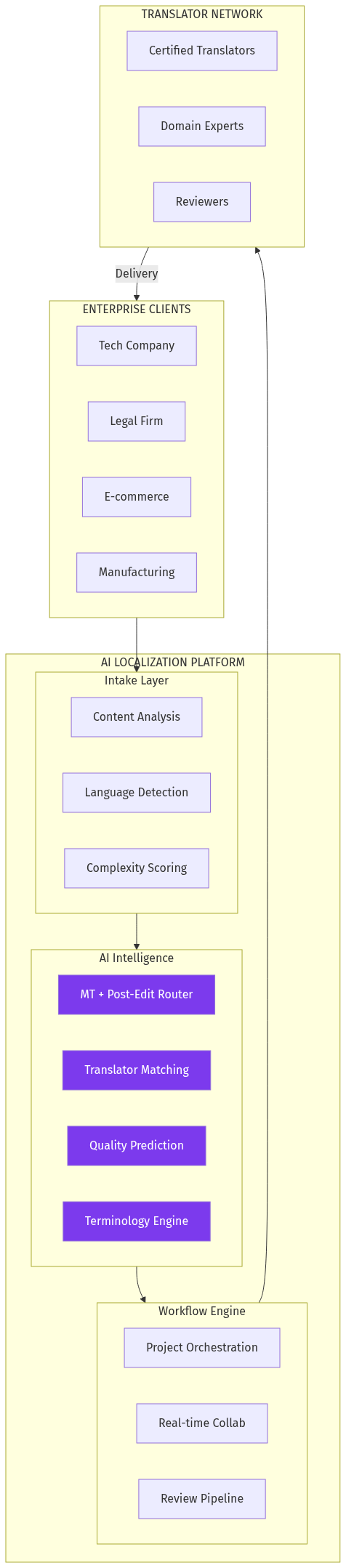
Core Features
For Enterprise Clients:| Feature | Description |
|---|---|
| Instant Analysis | Upload content, get instant complexity analysis, timeline, and cost estimate |
| Smart Routing | AI automatically routes to optimal human-AI workflow |
| Real-time Dashboard | Track all projects, languages, spend across organization |
| Quality Analytics | Objective quality scores, trend analysis, vendor comparison |
| API Integration | Connect to CMS, PIM, help desk, code repos for continuous localization |
| Terminology Portal | Self-service terminology management with AI assistance |
| Feature | Description |
|---|---|
| AI Co-pilot | MT suggestions, terminology hints, style guidance |
| Intelligent Workbench | Modern, fast interface (not 1990s CAT tool UX) |
| Fair Matching | Transparent matching based on skills, not relationships |
| Instant Payment | Pay on delivery, not net-60 |
| Skill Building | AI-identified growth areas, domain specialization paths |
Workflow Example: Marketing Campaign Launch
8.
Development Plan
| Phase | Timeline | Deliverables |
|---|---|---|
| MVP | 12 weeks | Single language pair (EN→DE), MT integration, basic matching, file upload workflow |
| V1 | +8 weeks | 5 language pairs, API integrations (Contentful, Notion), quality scoring, translator dashboard |
| V2 | +12 weeks | All major European + Asian languages, terminology intelligence, enterprise SSO, analytics |
| Scale | +16 weeks | Continuous localization pipelines, custom AI training per client, white-label option |
Technical Stack Recommendations
- MT Integration: DeepL API, Google Cloud Translation, Azure Translator (fallback)
- LLM Layer: Claude/GPT-4 for analysis, routing decisions, QA
- Editor: Custom web-based (not legacy desktop)
- Real-time: WebSocket for collaborative editing
- Terminology: Vector DB (Pinecone/Weaviate) for semantic term matching
9.
Go-To-Market Strategy
Initial Beachhead: Tech Companies
Why tech first:- Continuous content streams (product updates, docs, support)
- API-first infrastructure already exists
- Pain from current vendor fragmentation is acute
- Design-forward, expect modern UX
Expansion Path
Year 1: Tech + Startups (English-centric content)
Year 2: E-commerce + SaaS (high volume, many languages)
Year 3: Enterprise + Regulated (legal, medical, financial)
Year 4: Manufacturing + Technical (manuals, specs, compliance)
Pricing Strategy
| Tier | Target | Pricing Model |
|---|---|---|
| Starter | Startups, small teams | Pay-per-word, no commitment |
| Growth | Mid-market, scaling globally | Subscription + usage, volume discounts |
| Enterprise | Fortune 1000 | Custom pricing, SLAs, dedicated support |
| Platform | Agencies, other LSPs | White-label, rev share |
10.
Revenue Model
Primary Revenue Streams
| Stream | Description | Margin |
|---|---|---|
| Platform Fee | 15-25% markup on human translation | High |
| MT Processing | Per-character MT with markup | Very High |
| Subscription | Access to analytics, integrations, terminology | High |
| API Access | Continuous localization pipeline fees | Medium |
Unit Economics (Target)
| Metric | Year 1 | Year 3 |
|---|---|---|
| Average Contract Value | $15,000 | $75,000 |
| Gross Margin | 45% | 60% |
| CAC Payback | 12 months | 6 months |
| Net Revenue Retention | 110% | 130% |
Revenue Projection
| Year | ARR | Clients |
|---|---|---|
| 1 | $500K | 50 |
| 2 | $2.5M | 150 |
| 3 | $10M | 400 |
| 4 | $35M | 1,000 |
11.
Data Moat Potential
Proprietary Data Assets
1. Translation Quality Dataset- Every human edit to MT output = training data
- Domain-specific quality preferences per client
- Objective quality correlation with business outcomes
- Industry-specific terminology graphs
- Company-specific style preferences
- Cross-client terminology patterns (anonymized)
- Quality scores by domain, language pair, content type
- Speed and consistency metrics
- Client satisfaction correlation
- Complexity prediction models trained on real data
- Routing optimization based on outcomes
- Cost prediction accuracy improvement
Defensibility Timeline
| Time | Moat Strength | Source |
|---|---|---|
| Year 1 | Low | Basic matching, standard MT |
| Year 2 | Medium | Quality data, terminology per client |
| Year 3 | High | Cross-client learnings, routing intelligence |
| Year 4 | Very High | Custom AI per industry, prediction accuracy |
12.
Why This Fits AIM Ecosystem
Strategic Alignment
1. B2B Marketplace DNA- Connects enterprises with translator supply
- Multi-sided network effects
- Quality signaling through ratings/reviews
- Agents handle routing, matching, QA
- Human expertise amplified, not replaced
- Intelligence compounds over time
- Replaces manual project management
- Continuous pipelines, not batch projects
- Integrates with existing enterprise tools
- Large English-proficient translator pool
- Growing domestic localization market (22 languages)
- Cost-competitive for global services
Cross-Portfolio Synergies
| AIM Property | Integration Opportunity |
|---|---|
| Any Industry Marketplace | Localized listings, multi-language search |
| E-commerce Verticals | Product description localization |
| Professional Services | Legal/contract translation |
| Manufacturing | Technical documentation, compliance |
## Risk Assessment: Pre-Mortem Analysis
Applying Falsification
"Assume 5 well-funded startups failed in this space. Why did they fail?" Failure Mode 1: Quality Disasters- AI errors in critical content caused client churn
- Mitigation: Mandatory human review for regulated/creative content. Clear quality tiers.
- Couldn't attract/retain quality translators at platform rates
- Mitigation: Fair pay, instant payment, AI assistance makes work faster. Not a race to bottom.
- 12-18 month enterprise sales killed runway
- Mitigation: Start with SMB/mid-market, self-serve onboarding, freemium for developers.
- TransPerfect acquired key customers at a loss
- Mitigation: Focus on segments incumbents don't serve well (tech-forward, API-first).
- DeepL launches marketplace, Google bundles with Cloud
- Mitigation: Differentiate on workflow, not MT. MT is commodity; orchestration is the moat.
Applying Steelmanning
"Build the strongest case for why incumbents will win." Case for TransPerfect/RWS winning:- Relationships matter less when next-gen buyers are AI-native product managers
- Security is achievable (SOC 2 in 6 months, ISO in 12)
- Start with unregulated industries, expand later
- TMs can be imported; value is in the intelligence layer on top
- Focus on text-based translation; multimedia is a different business
## Verdict
Opportunity Score: 8.5/10Scoring Breakdown
| Factor | Score | Reasoning |
|---|---|---|
| Market Size | 9/10 | $60B+ market, growing steadily |
| Timing | 9/10 | LLM inflection point creates window |
| Competition | 7/10 | Incumbents are slow but well-resourced |
| AI Leverage | 9/10 | Every layer can be AI-enhanced |
| Data Moat | 8/10 | Strong compounding effects possible |
| Go-to-Market | 8/10 | Clear beachhead, integration partnerships |
| Execution Risk | 7/10 | Supply side management is complex |
Applying Bayesian Confidence
Prior: Translation is a mature industry with established players (low startup success probability: 15%) Evidence that updates positively:- LLM quality breakthrough (+20% — this changes everything)
- Incumbent tech debt (+10% — they can't adapt fast)
- Remote work adoption (+5% — continuous localization need)
- Enterprise AI acceptance (+10% — resistance collapsed)
- Enterprise sales complexity (-5%)
- Existing startup failures (Lilt, Unbabel pivots) (-5%)
Final Assessment
The B2B translation market is a generational AI disruption opportunity. The $60B industry is built on 1990s infrastructure, optimizes for the wrong metrics (hours vs. outcomes), and is structurally unable to adopt AI-native workflows.
The winning strategy:## Sources
- Slator Language Industry Market Report 2024
- CSA Research: The Language Services Market
- TAUS: The Future of the Translation Industry
- Common Sense Advisory Translation Market Size
- Nimdzi Insights Language Services Market
- DeepL Pro API Documentation
- Phrase (Memsource) Platform Overview
- Reddit r/TranslationStudies industry discussions
Research conducted by Netrika (Matsya Avatar) for AIM.in intelligence brief. Analysis applies Zeroth Principles, Incentive Mapping, Distant Domain Import, Pre-Mortem, and Steelmanning from the Mental Models framework.
❧