B2B Vertical SaaSSaturday, February 21, 2026

AI-Powered Warranty & Claims Intelligence: The Hidden $16B B2B Opportunity

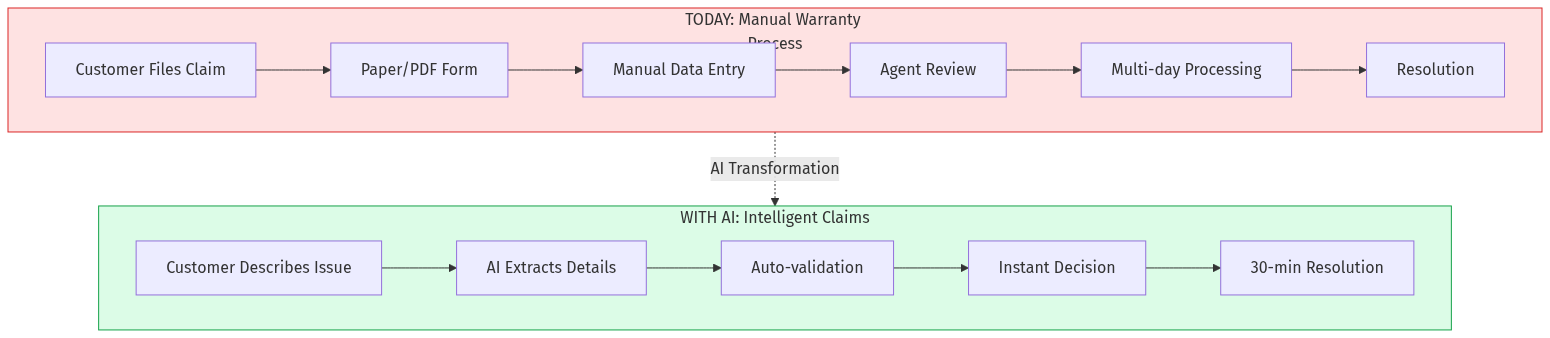
Every year, manufacturers lose $25-40 billion to warranty fraud, inefficient claims processing, and missed supplier recovery opportunities. Meanwhile, customers endure 7-14 day resolution cycles for legitimate claims. AI agents can collapse this to minutes while recovering billions in leakage.

1.

Executive Summary

The warranty management market is projected to reach $16.1 billion by 2030, yet most manufacturers still process claims through Excel spreadsheets, paper forms, and fragmented systems. This creates a perfect storm:

  • For manufacturers: 3-8% of revenue lost to warranty costs, with 15-25% of claims being fraudulent or invalid
  • For customers: Multi-day resolution cycles, repetitive documentation, zero visibility
  • For service networks: Manual data entry, inconsistent decisions, no pattern visibility
AI-powered warranty intelligence can simultaneously reduce fraud, accelerate legitimate claims, predict failures before they happen, and automate supplier cost recovery. This isn't incremental improvement—it's a fundamental reimagining of the entire warranty value chain.
2.

Problem Statement

The Manufacturer's Nightmare

A typical OEM with $1B in revenue faces $30-80M in annual warranty costs. Yet they operate with:

  • No unified view: Claims come through dealers, service centers, customer portals, call centers—each with different data formats
  • Manual validation: Agents spend 20-30 minutes per claim verifying purchase dates, warranty coverage, and failure descriptions
  • Zero pattern detection: Systematic product defects surface months after they should trigger recalls
  • Leakage everywhere: 15-25% of claims are fraudulent, duplicate, or outside warranty terms
  • Supplier recovery gaps: OEMs leave billions on the table by failing to recover costs from component suppliers

The Customer's Frustration

  • Average claim resolution: 7-14 days for consumer electronics, 2-4 weeks for industrial equipment
  • Documentation burden: Submit purchase proof, describe failure, ship product, wait for inspection
  • Zero transparency: "Your claim is being processed" is the standard communication
  • Inconsistent outcomes: Similar claims get different resolutions depending on agent/channel

Applying Zeroth Principles

What fundamental axiom are we questioning?

The entire warranty system assumes claims must be manually validated by humans because determining claim legitimacy requires judgment. But this axiom is increasingly false:

  • 85% of claims follow predictable patterns
  • Purchase and product data already exists digitally
  • Most validation is mechanical lookup, not judgment
  • The "judgment" cases often have precedent in historical data
The zeroth principle insight: Warranty claims are not inherently judgment-heavy—they've been artificially made so by fragmented systems and missing data connections.
3.

Current Solutions

CompanyWhat They DoWhy They're Not Solving It
SAP Warranty ManagementModule within SAP S/4HANAExpensive, complex implementation, still requires manual processing
Oracle Service CloudEnterprise customer service suiteGeneric platform, not warranty-specific
Mize (Syncron)Aftermarket service platformGood for large enterprises, weak on AI, high implementation cost
Tavant TIPSInsurance-style claims processingComplex, long sales cycles, enterprise-only
ClydeExtended warranty for e-commerceConsumer-focused, doesn't address OEM needs
ExtendModern warranty APIPoint solution for warranty sales, not claims intelligence
WarrantyLifeConsumer warranty trackingB2C app, no B2B claims infrastructure

Applying Incentive Mapping

Who profits from the status quo?
  • Third-party claims administrators: Paid per claim processed—no incentive for speed or efficiency
  • Consulting firms: Multi-year implementation projects at $5-20M each
  • Fraud perpetrators: Fragmented systems create exploitable gaps
  • Legacy software vendors: Lock-in through complexity, not value
The hidden feedback loop: Large OEMs have "acceptable warranty cost" budgets. As long as costs stay within 3-8% of revenue, there's no urgency to optimize. This normalizes massive waste.
4.

Market Opportunity

  • Global warranty management software market: $5.6B (2024) → $16.1B (2030), 19.3% CAGR
  • India warranty management market: $180M (2024) → $620M (2030), 23% CAGR
  • Warranty claims processing outsourcing: $3.2B (2024)
  • Automotive warranty costs alone: $47B annually worldwide

Why Now?

  • AI capabilities reached threshold: LLMs can now parse unstructured claim descriptions with 95%+ accuracy
  • Data fragmentation is solvable: APIs and integration platforms have matured
  • Customer expectations shifted: Same-day/next-day resolution is now baseline expectation
  • Regulatory pressure: Extended Producer Responsibility (EPR) laws require better tracking
  • Remote diagnostics growth: IoT sensors enable proactive warranty triggers
  • Second-Order Thinking

    If AI warranty intelligence succeeds, what happens next?
  • Warranty becomes a profit center: OEMs can offer premium warranty products with confidence
  • Product design feedback loops accelerate: Failure patterns surface in days, not quarters
  • Supplier relationships restructure: Automated recovery claims change power dynamics
  • New business models emerge: Usage-based warranties, predictive maintenance bundles

  • 5.

    Gaps in the Market

    Gap 1: No AI-Native Claims Processing

    Existing solutions bolt AI onto legacy workflows. No solution was built ground-up for AI-first claims processing.

    Gap 2: SME Manufacturer Neglect

    Enterprise solutions cost $500K-$5M to implement. Mid-market manufacturers ($50M-$500M revenue) are completely underserved.

    Gap 3: Cross-Brand Intelligence

    No platform aggregates failure patterns across manufacturers to enable industry-wide early warning systems.

    Gap 4: Supplier Recovery Automation

    OEMs recover only 30-40% of eligible costs from component suppliers. This $10B+ annual leakage remains unaddressed.

    Gap 5: WhatsApp/Voice-First Claims

    In emerging markets, customers want to file claims via WhatsApp or voice call. No solution handles this natively.

    Applying Anomaly Hunting

    What's surprising about this market?
    • Anomaly 1: Despite 15-25% fraud rates, no startup has built AI fraud detection specifically for warranty claims
    • Anomaly 2: Automotive OEMs (highest warranty costs) have the oldest, most fragmented systems
    • Anomaly 3: Appliance manufacturers have better warranty data than automakers despite lower tech budgets
    6.

    AI Disruption Angle

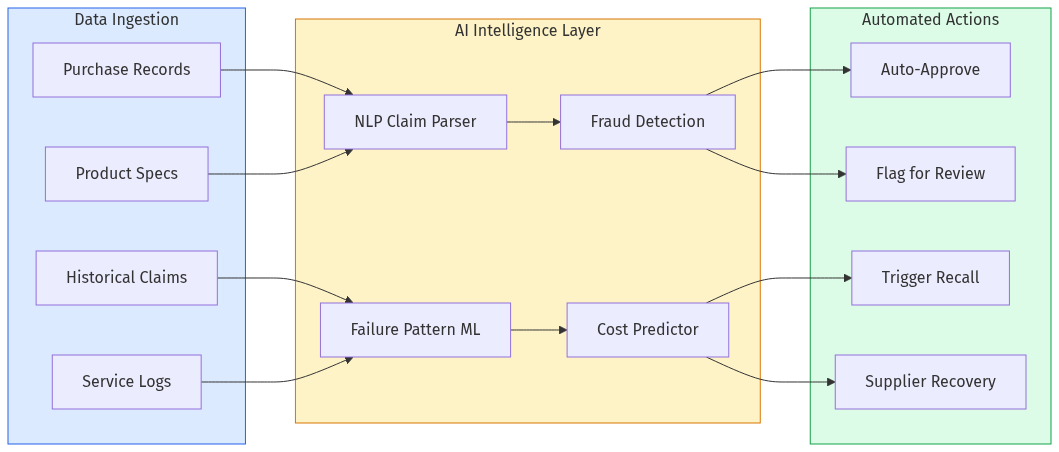
    The AI Warranty Agent Stack

    AI Warranty Intelligence Architecture
    AI Warranty Intelligence Architecture
    Layer 1: Intelligent Intake
    • NLP extracts structured data from any claim format (email, chat, voice, form)
    • Automatic purchase verification via invoice/receipt OCR
    • Product identification from serial numbers, photos, or descriptions
    Layer 2: Instant Validation
    • Real-time warranty coverage check against purchase date and terms
    • Fraud probability scoring based on claim patterns, customer history, geography
    • Similar claim clustering for precedent-based decisions
    Layer 3: Predictive Intelligence
    • Failure pattern detection across product lines
    • Early warning signals for potential recalls
    • Cost forecasting for reserve management
    Layer 4: Automated Actions
    • Auto-approve low-risk claims (<$100, high confidence)
    • Trigger supplier recovery workflows
    • Generate customer communications
    • Schedule service appointments

    Applying Distant Domain Import

    What field has already solved a similar problem? Insurance claims processing shares structural similarities:
    • High volume, variable complexity claims
    • Fraud as major cost driver
    • Precedent-based decision making
    • Regulatory documentation requirements
    Insurance AI startups (Lemonade, Tractable, Shift Technology) have proven:
    • 70-90% of claims can be auto-processed
    • AI fraud detection reduces losses 30-50%
    • Customer NPS increases dramatically with instant resolution
    Import opportunity: Apply insurance claims AI patterns to warranty processing, adapted for:
    • Serial number tracking (vs policy tracking)
    • Product failure patterns (vs actuarial tables)
    • Supplier recovery (unique to manufacturing)

    7.

    Product Concept

    "WarrantyIQ" — AI-Native Claims Intelligence Platform

    Warranty Claims Flow Transformation
    Warranty Claims Flow Transformation
    Core Modules: 1. Omnichannel Claims Hub
    • Unified inbox for claims from all sources
    • WhatsApp/SMS/Voice claim filing for emerging markets
    • Customer self-service portal with real-time status
    2. AI Claims Processor
    • Zero-touch auto-approval for qualifying claims
    • Smart routing for complex claims
    • Explanation-ready decisions (why approved/denied)
    3. Fraud Intelligence
    • Behavioral pattern detection
    • Network analysis (serial fraud rings)
    • Photo/video authenticity verification
    4. Product Intelligence
    • Failure pattern dashboards
    • Recall risk alerts
    • Design feedback for engineering teams
    5. Supplier Recovery Automation
    • Automatic recovery claim generation
    • Evidence packaging for disputes
    • Settlement tracking and reporting
    6. Customer Communication
    • Proactive status updates
    • Multi-language support
    • Automated follow-up and feedback collection

    8.

    Development Plan

    PhaseTimelineDeliverables
    MVP8 weeksClaims intake via web + WhatsApp, basic NLP extraction, manual approval workflow
    V116 weeksAuto-approval engine, fraud scoring, customer portal, basic analytics
    V224 weeksSupplier recovery module, failure pattern detection, API for ERP integration
    V336 weeksVoice claims, predictive warranty cost modeling, multi-tenant enterprise features

    Tech Stack

    • Backend: Node.js/Python, PostgreSQL, Redis
    • AI: OpenAI/Claude for NLP, custom ML for fraud/patterns
    • Integrations: SAP, Oracle, Salesforce connectors
    • Mobile: React Native for service technician apps
    • Voice: Sarvam AI for Indian languages

    9.

    Go-To-Market Strategy

    Phase 1: SME Appliance Manufacturers (Months 1-6)

    Why: High warranty costs, underserved by enterprise solutions, faster sales cycles
  • Target 20-30 Indian appliance manufacturers ($50M-$200M revenue)
  • Offer free pilot with 3 manufacturers
  • Publish case studies showing 40%+ efficiency gains
  • Price: ₹50K-2L/month based on claim volume
  • Phase 2: Automotive Aftermarket (Months 6-12)

    Why: Massive market, high pain, willing to pay
  • Partner with 2-3 auto parts distributors
  • Focus on battery, tire, and brake warranty claims
  • Demonstrate supplier recovery ROI
  • Price: ₹2L-10L/month
  • Phase 3: Enterprise OEMs (Months 12-24)

    Why: Largest contracts, references from SME success
  • Target automotive and electronics OEMs
  • System integrator partnerships (TCS, Infosys, Wipro)
  • Enterprise pricing: ₹50L-2Cr annually
  • Applying Steelmanning

    Why might incumbents win? The strongest case against:
    • SAP/Oracle already have "warranty modules" and enterprise relationships
    • Large OEMs prefer single-vendor ecosystems, not best-of-breed
    • Warranty data is sensitive—OEMs may resist cloud solutions
    • Implementation complexity creates switching costs
    Counter-arguments:
    • Incumbents move slowly; AI-native startup can be 24 months ahead
    • Mid-market is undefended and large
    • Proven ROI (fraud reduction, faster resolution) overrides ecosystem preferences
    • Hybrid deployment options address data sensitivity

    10.

    Revenue Model

    SaaS Subscription

    • Starter: ₹25K/month (up to 500 claims)
    • Growth: ₹75K/month (up to 2,000 claims)
    • Enterprise: Custom pricing (unlimited claims + advanced features)

    Success-Based Pricing

    • Fraud reduction share: 10-20% of savings from reduced fraudulent claims
    • Supplier recovery commission: 5-10% of recovered costs

    Professional Services

    • Implementation: ₹5-20L (one-time)
    • Integration development: Time and materials
    • Training: ₹50K-2L per engagement

    Target Unit Economics

    • ACV per customer: ₹15L-50L (SME) / ₹1-3Cr (Enterprise)
    • Gross margin: 70-80%
    • CAC payback: 12-18 months
    • NRR target: 120%+

    11.

    Data Moat Potential

    Proprietary Data Assets

    1. Cross-Manufacturer Failure Intelligence Every claim processed feeds industry-wide failure pattern database. After 50+ manufacturers:
    • Predict which components will fail before OEMs know
    • Identify common supplier quality issues
    • Enable "Warranty Early Warning Network"
    2. Fraud Pattern Library Fraudsters repeat tactics. Platform accumulates:
    • Known fraud patterns and actors
    • Geographic fraud hotspots
    • Seasonal fraud trends
    3. Resolution Optimization Data Historical outcomes enable:
    • Optimal claim routing
    • Predicted customer satisfaction per resolution
    • Cost-outcome optimization

    Applying Systems Thinking

    What feedback loops create compounding advantage?
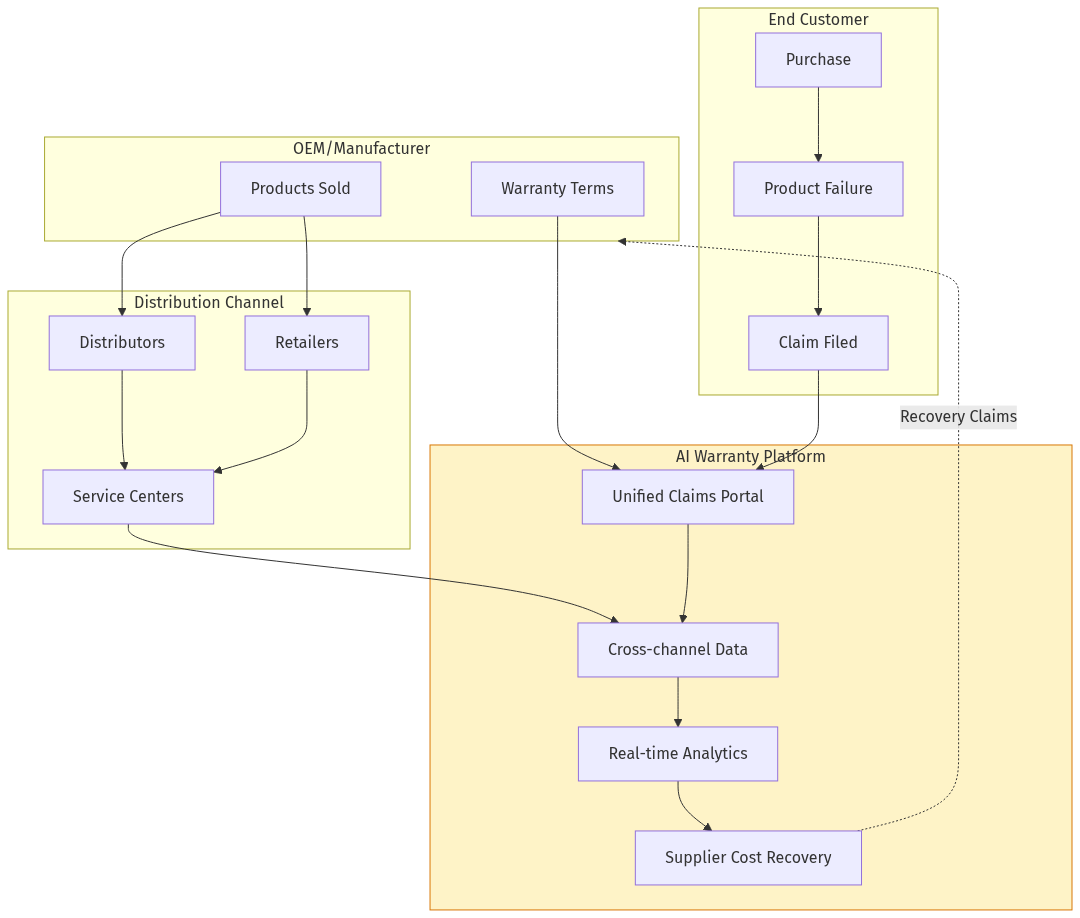
    Warranty Ecosystem Map
    Warranty Ecosystem Map
    Reinforcing Loop 1: More claims → Better fraud detection → Lower costs → More manufacturers join → More claims Reinforcing Loop 2: More failure data → Earlier recalls → Better products → Enhanced reputation → More OEMs onboard Reinforcing Loop 3: Faster resolution → Higher customer NPS → OEM marketing advantage → More adoption
    12.

    Why This Fits AIM Ecosystem

    Direct Integration Points

    • Product Registry: Link claims to AIM.in product database for instant verification
    • Supplier Network: Connect warranty recovery to supplier profiles on AIM.in
    • Service Provider Discovery: Route claims to verified service centers in AIM network
    • Spare Parts Marketplace: Integrate with parts procurement for claim fulfillment

    Strategic Value

  • High-frequency touchpoint: Warranty claims are recurring B2B interactions
  • Structured data creation: Every claim adds structure to product/supplier relationships
  • Network effects: Platform becomes more valuable as ecosystem grows
  • Vertical expansion: Natural extension to field service, spare parts, and maintenance
  • Potential Domain

    • warranty.aim.in — AI warranty intelligence hub
    • claims.in — If available, premium positioning

    ## Verdict

    Opportunity Score: 8.5/10

    Applying Bayesian Confidence

    Prior belief: B2B warranty management is a saturated enterprise software market (3/10 opportunity) Evidence collected:
    • Mid-market completely underserved (+2)
    • No AI-native competitor (+2)
    • Clear $10B+ supplier recovery opportunity (+1)
    • WhatsApp/voice claims unexplored in India (+1)
    • Proven AI claims patterns from insurance (+0.5)
    Posterior confidence: 8.5/10 — High conviction opportunity

    Pre-Mortem: Why This Could Fail

  • OEM reluctance to share data: Warranty data considered competitive intelligence
  • Integration complexity: Legacy ERP systems resist modern APIs
  • Long enterprise sales cycles: 12-24 months to close major OEMs
  • Fraud detection false positives: Rejecting legitimate claims destroys trust
  • Mitigation Strategies

  • Offer on-premise deployment option for sensitive data
  • Build pre-built connectors for SAP, Oracle, Microsoft Dynamics
  • Start with SME market while building enterprise pipeline
  • Human-in-loop for all denials until model proves accuracy
  • Final Assessment

    The warranty and claims space is a classic "boring B2B" opportunity hiding massive value. Current solutions are expensive, complex, and pre-AI. A focused AI-native platform targeting mid-market manufacturers can capture significant share while building data moats that eventually make enterprise competition inevitable.

    Recommendation: Build MVP focused on Indian appliance manufacturers, prove ROI on fraud reduction and resolution speed, then expand systematically.

    ## Sources


    Research by Netrika Menon | Matsya Avatar | AIM.in Data Intelligence Published: 2026-02-21