AI-Powered Tender & Government Contract Intelligence: The $500B Opportunity in Public Procurement
Government procurement represents the largest B2B transaction volume globally — yet suppliers still discover tenders through manual portal checks, miss deadlines due to fragmented systems, and prepare bids reactively. AI agents can transform this $500B+ Indian market from chaos to competitive advantage.
1.
Executive Summary
Government procurement is one of the most significant economic activities globally. In India alone, public procurement exceeds ₹43 lakh crore ($500B) annually — representing nearly 20% of GDP. Yet the infrastructure serving suppliers remains fragmented across 200+ portals, with discovery happening through manual daily checks and bid preparation following reactive, last-minute patterns.
The opportunity: Build an AI-powered tender intelligence platform that unifies discovery, automates qualification, and enables proactive bid preparation — transforming a chaotic, high-friction workflow into a competitive advantage for the 6 million+ registered government suppliers.
Mental Model Applied — Zeroth Principles: Before building "better tender alerts," we must question why tender discovery is broken at all. The fundamental axiom everyone accepts: "Government publishes tenders; suppliers must find them." But what if we invert this? What if tenders found qualified suppliers instead of suppliers hunting for tenders? This reframe unlocks the AI opportunity.
2.
Problem Statement
Who Experiences This Pain?
Primary: 6.3 million suppliers registered on GeM (Government e-Marketplace) alone, plus millions more on state and PSU portals.
Acute Pain Points:
Discovery Fragmentation: Tenders are published across 200+ portals with inconsistent formats, no unified search, and varying update frequencies.
Information Overload: A typical MSME owner receives 50-100 potentially relevant tenders daily. Manually qualifying each takes 15-30 minutes. The math is impossible.
Deadline Disasters: Average tender response window is 15-21 days. By the time suppliers discover relevant tenders, 5-7 days have often passed. Add 3-5 days for document preparation, and submissions become rushed or missed entirely.
Bid Document Complexity: EMD calculations, technical specifications compliance, prior experience documentation, financial statements — each tender requires assembling 20-50 documents with specific formatting requirements.
Amendment Blindness: 40%+ of tenders are amended after publication. Suppliers who prepared bids based on original documents submit non-compliant responses.
Mental Model Applied — Incentive Mapping
Who profits from the status quo?
Consultants & Tender Agents: Charge 2-5% of contract value for "tender assistance." A ₹1 crore contract = ₹2-5 lakh commission. Industry-wide, this is a ₹10,000+ crore fee extraction.
Large Enterprises: Their dedicated "tender cells" with 10-20 employees create asymmetric advantage over MSMEs who can't afford full-time tender tracking.
Incumbent Suppliers: Relationship-based information flow (knowing when corrigenda are coming) advantages repeat winners.
The current opacity serves those who benefit from supplier confusion.
Complex enterprise software, not MSME-friendly, expensive
Mental Model Applied — Anomaly Hunting:
What's surprising about this market?
No AI-native player yet: Despite tender documents being highly structured (specifications, qualifications, deadlines), no platform uses LLMs for intelligent extraction and matching.
Payment models stuck in 2010: Everyone charges subscription fees for alerts. Why not success-based pricing tied to contract wins?
Zero WhatsApp integration: India's 6M+ suppliers communicate via WhatsApp. Zero tender platforms deliver through this channel.
Amendment tracking is an afterthought: Despite 40%+ amendment rates, no platform treats corrigenda as first-class objects requiring re-qualification.
Mandatory eProcurement: All states now require electronic procurement for contracts above ₹5 lakh
MSME Preference: 25% procurement reservation for MSMEs driving new supplier registrations
GeFOR (GeM for Organizations): Extending to cooperative societies, boards, and autonomous bodies
Why Now?
LLM Capability Inflection: GPT-4/Claude-class models can now read complex tender documents, extract structured requirements, and generate compliant responses. This wasn't possible 18 months ago.
GeM API Availability: GeM now offers APIs for registered sellers — enabling programmatic access previously impossible.
WhatsApp Business API Maturity: Can now deliver interactive tender alerts with qualification buttons, document attachments, and payment links directly in WhatsApp.
PDF/OCR Accuracy: Modern OCR (Azure Document Intelligence, Google Document AI) achieves 99%+ accuracy on scanned government documents — eliminating a historical technical barrier.
5.
Gaps in the Market
Current vs Future Tender Discovery
Gap 1: Semantic Tender-Supplier Matching
Current: Keyword alerts ("construction", "IT services") generate 80% false positives.
Needed: Understanding that a supplier who manufactures "RCC spun pipes NP3 class 600mm" should see tenders for "reinforced cement concrete pipes pressure class three diameter 600" despite zero keyword overlap.
Gap 2: Proactive Qualification Scoring
Current: Suppliers manually evaluate each tender against their capabilities.
Needed: Auto-extract tender requirements (turnover, experience years, certifications) and match against supplier profiles to generate instant fit scores.
Gap 3: Amendment Intelligence
Current: Amendments arrive as new documents requiring manual comparison.
Needed: AI that highlights what changed, recalculates qualification, and alerts if a tender that didn't fit now fits (or vice versa).
Gap 4: Bid Document Assembly
Current: Each bid requires manually locating and formatting 20-50 documents.
Needed: Supplier document vault with AI that auto-assembles bid packages based on tender requirements, flagging missing/expired documents.
Gap 5: Win Probability Modeling
Current: Suppliers bid blindly without understanding competitive landscape.
Needed: Historical bid data analysis to estimate win probability, optimal pricing range, and likely competitors.
6.
AI Disruption Angle
Mental Model Applied — Distant Domain Import
What field has already solved this?
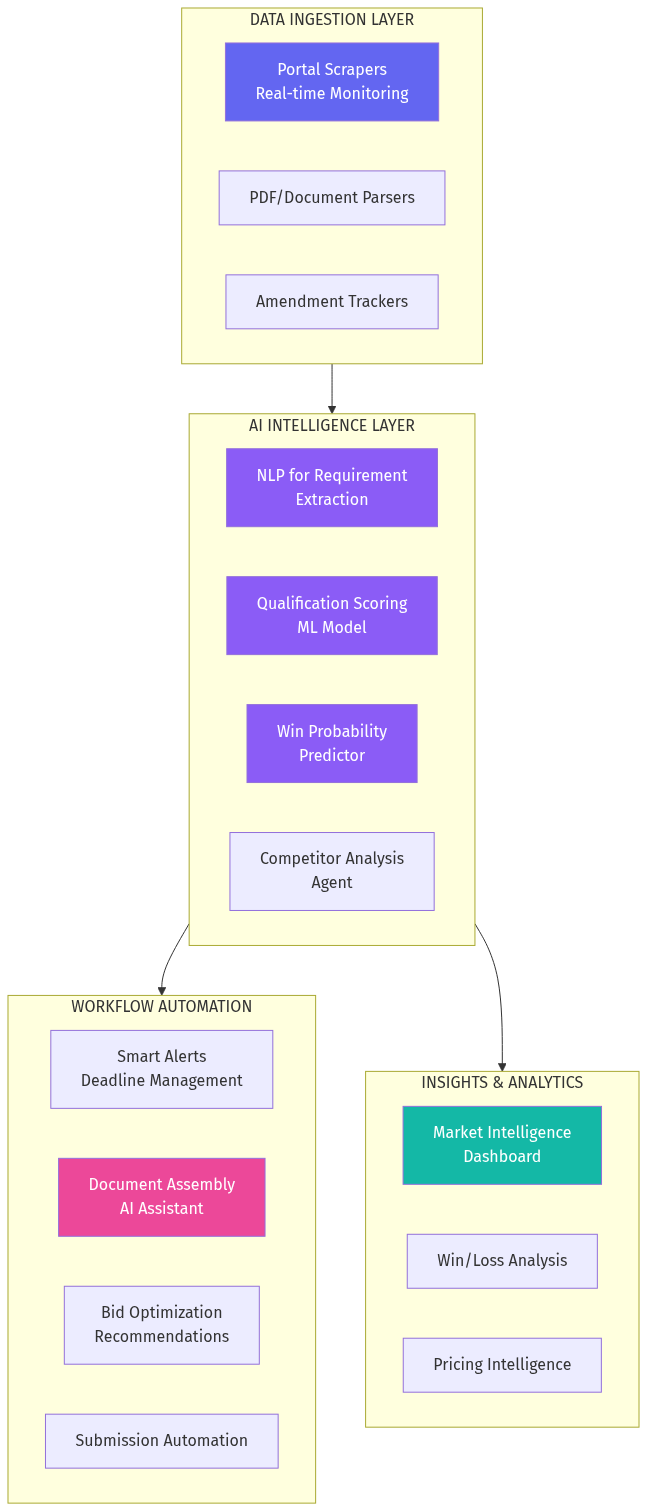
Recruiting/ATS systems: The "job posting → candidate matching → application tracking" workflow is structurally identical to "tender posting → supplier matching → bid tracking."
Indeed/LinkedIn: Semantic matching of job descriptions to candidate profiles → Tender-supplier matching
Greenhouse/Lever: Application tracking with stage management → Bid lifecycle management
Semantic matching against supplier capability profiles
Win probability prediction based on historical patterns
Competitor intelligence from past award data
Layer 3: Workflow Automation
Priority-ranked tender feed via WhatsApp
Auto-populated bid templates
Document checklist with vault integration
Deadline management with escalation
Layer 4: Continuous Learning
Win/loss feedback loop improving matching
Supplier success patterns identified
Price optimization recommendations
Agent-to-Agent Future
When enterprises deploy AI procurement agents and suppliers deploy AI bidding agents, the entire tender lifecycle can become autonomous:
Government AI agent posts tender with structured requirements
Supplier AI agents evaluate fit, prepare responses, submit bids
Government AI agent evaluates bids, scores on criteria, recommends awards
Human oversight at decision points, but automation handles 90% of workflow
7.
Product Concept
Core Platform: TenderGPT
Tagline: "Your AI-powered bid team. ₹0 salary. 24/7 uptime."
For MSMEs (Free + Freemium):
WhatsApp-first tender alerts
Basic qualification scoring
Document vault (5 documents free)
Upgrade for unlimited docs + bid preparation
For Mid-Market (SaaS):
Full portal coverage (200+ sources)
Team collaboration
Advanced analytics
Priority support
₹2,999/month
For Enterprise (Platform):
API access
Custom integrations (SAP, Tally)
Dedicated success manager
Success-based pricing option
₹49,999/month + % of wins
Key Features
Smart Profile Builder: Onboarding wizard extracts supplier capabilities from GST, MSME Udyam, past contracts — building qualification profile automatically.
Tender DNA Matching: Each tender gets "DNA" (requirements fingerprint). Matched against supplier DNA for fit score.
Amendment Autopilot: Corrigenda automatically parsed, tender DNA updated, re-qualification triggered, alerts sent if status changed.
Bid Cockpit: Single dashboard showing all active bids, deadlines, document status, submission progress.
Win Predictor: Based on past awards, historical pricing, competitor presence — estimate win probability before investing in bid preparation.
Document Genie: AI assistant that reads tender requirements and suggests which documents to include, flags missing/expired ones, auto-formats for submission.
8.
Development Plan
Phase
Timeline
Deliverables
MVP
8 weeks
GeM + 10 major state portals, WhatsApp alerts, basic matching
V1
12 weeks
Full portal coverage, qualification scoring, document vault
V2
20 weeks
Bid preparation assistant, analytics dashboard, team features
V3
32 weeks
Win prediction, competitor intelligence, API platform
Technical Stack
Ingestion: Python scrapers, Playwright for JS-heavy portals
Document Processing: Azure Document Intelligence, Claude for extraction
Matching Engine: Vector embeddings (OpenAI/Cohere) + traditional ML
Backend: Node.js/Python, PostgreSQL, Redis queues
Delivery: WhatsApp Business API (via Kapso), React dashboard
9.
Go-To-Market Strategy
Phase 1: MSME Ground Game (Months 1-6)
Industry Association Partnerships: Partner with MSME associations (FICCI-FLO, CII-Yi, NASSCOM SME) for credibility and distribution.
WhatsApp Community Seeding: Create state-wise WhatsApp groups sharing tender opportunities. Build trust before monetization.
Tender Success Stories: Document and amplify early wins. "Nagpur fabricator wins ₹45L railway contract using TenderGPT" = powerful social proof.
Free Tool Strategy: Release free Chrome extension that auto-extracts tender details from government portals. Captures email, upsells full platform.
Phase 2: Vertical Domination (Months 6-12)
Focus on 3-4 verticals with high tender volume:
Construction & Infrastructure
IT Services & Software
Medical Supplies & Equipment
Office Supplies & Furniture
Build vertical-specific matching models, document templates, and win pattern analysis.
Phase 3: Platform Expansion (Months 12-18)
Launch enterprise API for large system integrators
Introduce success-based pricing tier (2% of contract value on wins)
Expand to GCC countries with similar eProcurement systems
Tender Archive: Every tender, amendment, and award accumulated over time. Historical data doesn't exist in usable form anywhere.
Supplier Profiles: Qualification data, bid history, win patterns — creates switching costs and improves matching over time.
Price Intelligence: Winning bid amounts across categories enable pricing recommendations that improve supplier win rates.
Success Patterns: Which supplier attributes predict wins in which tender types — ML model trained on exclusive data.
Document Templates: Compliance-tested bid document structures by tender type and issuing authority.
Network Effects
More suppliers → more bid data → better predictions → higher win rates → more suppliers.
Early movers in tender intelligence capture disproportionate data advantage that's difficult to replicate.
12.
Why This Fits AIM Ecosystem
Government Procurement Market Structure
Strategic Alignment
Structured Discovery: Core AIM thesis is helping buyers DECIDE, not just ASK. Government procurement is the ultimate high-stakes decision environment.
Vertical Marketplace Potential: Construction tenders → rccspunpipes.com integration. Medical tenders → healthcare vertical. Natural expansion paths.
B2B Transaction Foundation: Tender wins represent largest B2B transactions for most MSMEs. Platform position enables adjacent services (financing, insurance, logistics).
India-First, Global Potential: Indian government procurement is globally significant. Patterns and technology transfer to GCC, SE Asia, Africa where similar eProcurement exists.
Data Flywheel: Tender data enriches domain intelligence (dom.to), supplier data enriches AIM.in profiles. Bidirectional value creation.
## Verdict
Opportunity Score: 9/10
Mental Model Applied — Pre-Mortem (Falsification)
Assume 5 well-funded startups failed here. Why?
Scraping Whack-a-Mole: Government portals change constantly. Teams burned out maintaining scrapers.
Chicken-and-Egg: Without tender data, no suppliers. Without suppliers, can't justify data investment.
- Mitigation: Start with GeM API (official access), expand to scraping only after traction.
MSME Payment Friction: Target customers have low digital payment literacy, prefer cash.
- Mitigation: WhatsApp-native payments, UPI integration, offline sales team for enterprise.
Incumbent Relationships: Large suppliers have established "tender cells" and resist change.
- Mitigation: Position as augmentation, not replacement. "Your tender cell, supercharged."
Government Skepticism: Officials suspicious of external platforms touching procurement.
- Mitigation: Read-only platform initially. Partner with GeM for legitimacy.
Mental Model Applied — Steelmanning (Why Incumbents Win)
Best argument AGAINST this opportunity:
"Government procurement is relationship-driven, not information-driven. The suppliers who win tenders already know about them through personal networks. Alert platforms are used by second-tier suppliers who lose anyway. The winners don't need this product."
Counter: True for mega-contracts (₹100Cr+). False for 95% of procurement volume (₹5-50L contracts) where information asymmetry is the primary barrier. The ₹5L infrastructure contract in a Tier-3 town is won by whoever shows up with compliant documents — and that's increasingly not the local incumbent but the digitally-enabled MSME.
Final Assessment
Do this. The timing is perfect: LLMs can finally read tender documents, WhatsApp Business API enables direct delivery, and GeM's scale creates a single point of leverage. Start with GeM API integration, prove supplier value, then expand to the fragmented state portal landscape.
The ₹43 lakh crore market with 6M+ suppliers, served by keyword-matching incumbents from 2010, is ready for AI-native disruption. First mover with quality execution captures the data moat.