ResearchSaturday, February 21, 2026

AI-Powered Technical Partner Discovery: The $300B Dev Shop Intelligence Opportunity

Every week, thousands of non-technical founders gamble their life savings on dev shops they found through Google searches and Clutch reviews. 87% of outsourced software projects fail or significantly overrun. The market is screaming for AI-powered partner intelligence that predicts outcomes, not just aggregates reviews.

1.

Executive Summary

The software development outsourcing market exceeds $300 billion globally, yet finding the right technical partner remains a high-stakes gamble. Non-technical founders—who represent 65% of startup founders—must choose development agencies based on polished portfolios, curated reviews, and sales presentations that reveal nothing about actual execution capability.

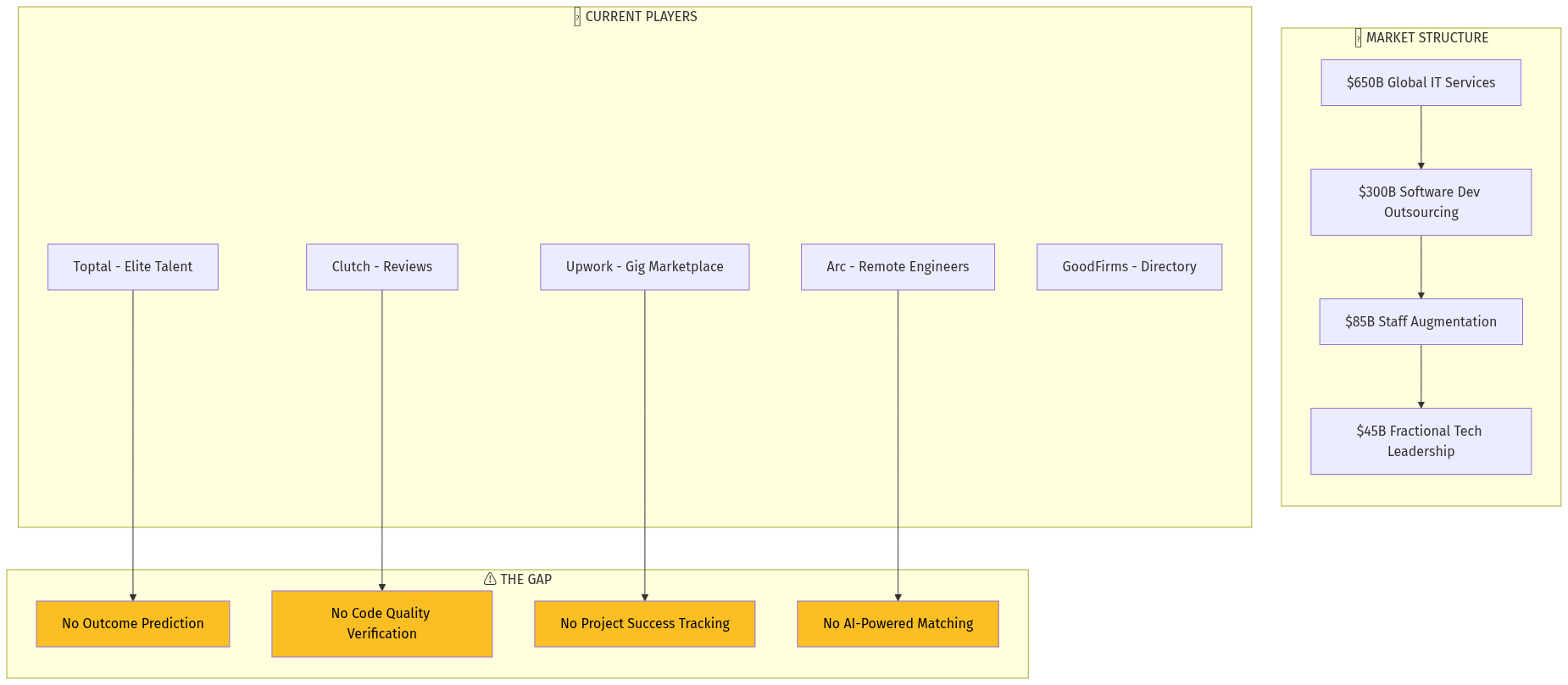
Current solutions (Clutch, Toptal, Upwork, GoodFirms) operate as directories or talent marketplaces. None provide:

  • Predictive success scoring based on project complexity
  • Verified code quality metrics from past work
  • Communication pattern analysis
  • True outcome tracking beyond client-submitted reviews
This creates a $50B+ opportunity for an AI-native platform that transforms dev shop selection from reputation-based gambling to data-driven decision-making.


2.

Problem Statement

The Founder's Nightmare

A non-technical founder with $150K to build their MVP faces an impossible task:

Information Asymmetry: They cannot evaluate code quality, architecture decisions, or technical competence. They're buying a service they literally cannot assess. Review Gaming: Clutch reviews are curated. Agencies coach clients on what to write. Negative experiences go unreported because founders are embarrassed or have moved on. Misaligned Incentives: Agencies optimize for winning contracts, not delivering outcomes. The sales team that pitches is rarely the team that delivers. No Outcome Tracking: The industry has no mechanism for tracking what happened 12 months after project completion. Did the code scale? Was it maintainable? Did the startup survive?

Mental Model: Incentive Mapping

Who profits from the status quo?
  • Review platforms (Clutch) profit from agencies paying for premium listings
  • Agencies profit from information asymmetry—the less founders understand, the easier the sale
  • Sales teams profit from closed deals, not successful deliveries
Feedback loops maintaining the status quo:
  • Founders who get burned don't write reviews—they disappear
  • Successful projects get over-attributed to the agency, failures to "scope changes" or "founder indecision"
  • Agencies can always point to some happy clients, regardless of overall success rate

3.

Current Solutions

Market Structure
Market Structure
PlatformWhat They DoCritical Gap
ClutchB2B reviews and ratingsPay-to-play rankings, no outcome verification, reviews are curated
ToptalElite freelancer network ("top 3%")Individual talent, not team/agency matching. No project success tracking
UpworkGig marketplace with agenciesRace to bottom pricing, no quality signals for complex projects
GoodFirmsAgency directory with reviewsSEO-optimized directory, same review gaming as Clutch
ArcRemote developer hiringStaff aug only, no agency intelligence
DesignRushAgency rankingsPure pay-for-placement model

Mental Model: Zeroth Principles

What axioms does everyone take for granted?
  • "Reviews from past clients are the best predictor of future performance"
  • Challenge: Reviews measure satisfaction, not outcomes. A founder might be "satisfied" with a delivered MVP that crashes at 100 users.
  • "Portfolio showcases prove capability"
  • Challenge: Portfolios show what shipped, not how. Was the code maintainable? Did it require 3 rewrites? Did the team hit deadlines?
  • "Experienced agencies are safer bets"
  • Challenge: Experience correlates with more projects, not necessarily better outcomes. Large agencies have high turnover—your "experienced" team might be entirely junior.
    4.

    Market Opportunity

    Market Size

    • Global IT Services: $1.3 trillion (2025)
    • Software Development Outsourcing: $300+ billion
    • SMB/Startup Segment: $85 billion (28%)
    • Non-Technical Founder Spend: $55 billion (65% of startups)

    Growth Drivers

    • AI Skill Gap Explosion: The Reddit community r/SaaS recently highlighted how AI is creating a massive skill gap—founders who understand AI as a "smart teammate" vs. those who treat it as a "magic box." This gap is pushing more non-technical founders toward outsourcing.
    • Remote Work Normalization: Geographic barriers eliminated. Indian agencies compete directly with US shops, but founders can't evaluate either effectively.
    • Startup Ecosystem Growth: 150M+ new businesses started annually. ~60% need custom software. ~65% of founders are non-technical.

    Why Now

  • Data Availability: GitHub activity, LinkedIn, Glassdoor reviews, and communication patterns create unprecedented data for AI analysis
  • LLM Capabilities: Code quality assessment, proposal analysis, and success prediction are now possible with modern AI
  • Market Timing: Post-COVID remote work + AI coding tools = more outsourcing demand, more quality variance
  • Trust Crisis: High-profile outsourcing failures (Theranos, countless startup post-mortems) have made founders more skeptical and hungry for validation

  • 5.

    Gaps in the Market

    Gap 1: No Predictive Success Scoring

    Current platforms show "ratings" (4.8/5.0). None answer: "Given YOUR specific project requirements, what's the probability this agency delivers successfully?"

    Gap 2: No Code Quality Verification

    Founders can't see if past deliverables had proper architecture, test coverage, or technical debt levels. Agencies could deliver "working" code that's unmaintainable.

    Gap 3: No Communication Pattern Analysis

    The #1 predictor of project failure is communication breakdown. No platform analyzes agency response times, documentation quality, or escalation handling.

    Gap 4: No True Outcome Tracking

    What happened 6-12 months after delivery? Did the product scale? Was further development needed? Current review systems capture initial satisfaction, not long-term outcomes.

    Gap 5: No Project-Agency Fit Scoring

    A fintech startup needs different capabilities than an e-commerce MVP. No platform matches project complexity, tech stack requirements, and compliance needs to agency capabilities.

    Mental Model: Anomaly Hunting

    What's strange about this market?
  • Review platforms don't track outcomes — In every other high-stakes purchasing decision (real estate, investments), we track long-term results. Why not here?
  • No money-back guarantees exist — Even mattresses have 100-day return policies. Software projects costing $150K+ have zero recourse.
  • The best agencies are invisible — Top-performing boutique shops don't need Clutch profiles. They're fully booked through referrals. Current platforms over-represent hungry agencies, not excellent ones.

  • 6.

    AI Disruption Angle

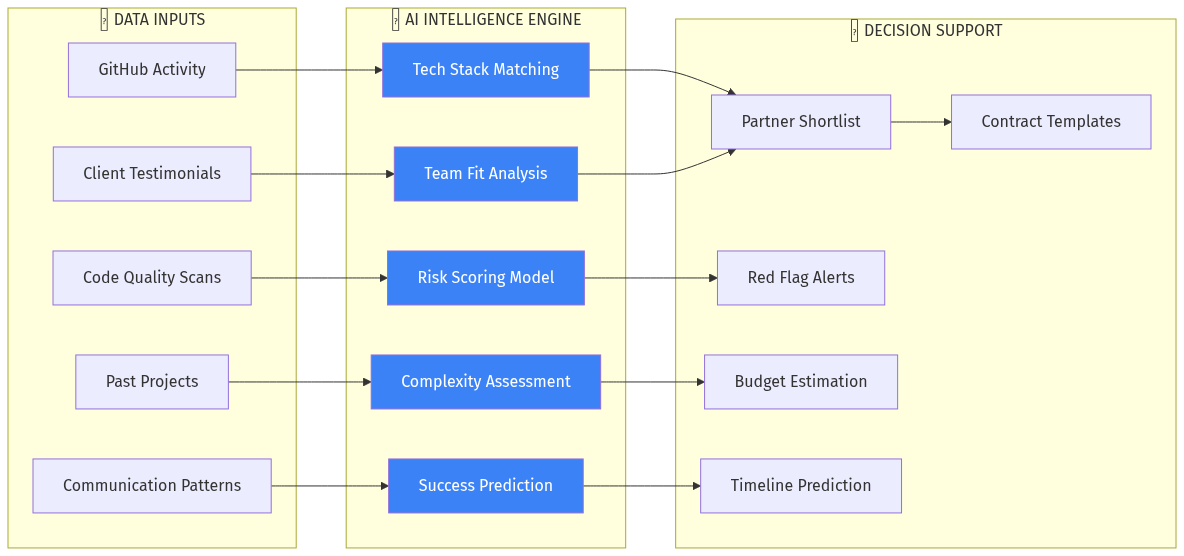
    AI Intelligence Architecture
    AI Intelligence Architecture

    How AI Agents Transform This Workflow

    Today: Founder Googles "best React development agency," reads 50 reviews, gets 3 proposals, picks based on price and "gut feeling." Tomorrow: AI agent ingests founder's requirements, analyzes 10,000+ agencies across multiple data sources, predicts success probability for each match, and surfaces red flags automatically.
    Discovery Flow Transformation
    Discovery Flow Transformation

    AI Capabilities Required

    CapabilityCurrent StateAI-Native Approach
    Code QualitySelf-reportedAutomated GitHub analysis, static code scanning of public repos
    CommunicationUnverifiableNLP analysis of proposal quality, response time patterns, documentation samples
    Success PredictionNoneML model trained on project outcomes, complexity factors, team composition
    Red Flag DetectionManual due diligencePattern matching against known failure indicators
    Budget EstimationAgency quotes onlyHistorical pricing data + complexity analysis

    Mental Model: Distant Domain Import

    What other field has solved similar problems? Credit Scoring (Finance): FICO transformed lending from "banker's gut feeling" to data-driven risk assessment. We need a "FICO for dev shops." Restaurant Health Inspections (Food Safety): Standardized, surprise inspections with public scoring. Imagine similar transparency for code quality. Contractor Licensing (Construction): Licensed contractors must demonstrate competence and carry insurance. Software development has zero equivalent credentialing.
    7.

    Product Concept

    Core Platform: DevIntel

    For Founders:
    • Describe project in natural language
    • AI generates technical requirements spec
    • Receive shortlist of 5-7 best-fit agencies with success probability scores
    • View code quality metrics, outcome history, communication patterns
    • Access red flag reports and due diligence summaries
    For Agencies (Supply Side):
    • Connect GitHub, Jira, communication tools for automated quality scoring
    • Earn "Verified Outcomes" badges through tracked project results
    • Access lead flow from qualified founders
    • Receive AI-generated competitive positioning insights

    Key Features

  • Intelligent Requirement Extraction
  • - Founder describes idea conversationally - AI generates PRD-level specification - Complexity score calculated automatically - Tech stack recommendations provided
  • Agency Intelligence Scoring
  • - Code Quality Index (public repos, open source contributions) - Communication Score (response patterns, documentation quality) - Outcome History (tracked results from past projects) - Team Stability Score (LinkedIn turnover analysis) - Financial Health Indicator (growth signals, client concentration)
  • Predictive Matching Engine
  • - Project complexity → required capability mapping - Success probability based on historical patterns - Risk factors specific to this project-agency combination
  • Ongoing Project Intelligence
  • - Milestone tracking dashboards - Communication health monitoring - Early warning system for at-risk projects - Mediation and escalation support

    Mental Model: Second-Order Thinking

    If this succeeds, what happens next? First-order: Best agencies get more leads, poor agencies lose visibility Second-order: Agencies invest in actual quality improvements to boost scores Third-order: Industry-wide quality standards emerge, similar to restaurant health grades Fourth-order: The platform becomes the credentialing authority for software development
    8.

    Development Plan

    PhaseTimelineDeliverables
    Phase 1: Intelligence LayerWeeks 1-8Agency data aggregation, GitHub analysis engine, NLP-based communication scoring
    Phase 2: Founder MVPWeeks 9-14Requirement intake flow, AI matching algorithm, shortlist generation
    Phase 3: Agency DashboardWeeks 15-20Self-service profile management, verified outcomes system, lead management
    Phase 4: Project TrackingWeeks 21-28Integration with project management tools, milestone monitoring, early warning system
    Phase 5: Marketplace FeaturesWeeks 29-36Escrow payments, dispute resolution, success-based pricing

    Technical Architecture

    • Data Layer: PostgreSQL for structured data, vector DB for semantic search, time-series DB for patterns
    • AI Layer: Fine-tuned LLMs for requirement extraction, code analysis models, success prediction ML
    • Integration Layer: GitHub API, LinkedIn data, Glassdoor scraping, agency CRM webhooks

    9.

    Go-To-Market Strategy

    Phase 1: Supply Acquisition (Agencies)

  • Scrape and enrich top 10,000 agencies from Clutch, GoodFirms, Upwork
  • Automated outreach: "Here's your free Agency Intelligence Report—see how you compare"
  • Freemium hook: Basic profile free, premium features (lead access, competitive intel) paid
  • Phase 2: Demand Generation (Founders)

  • Content moat: "How to evaluate a dev shop" guides, red flag checklists, success story case studies
  • Reddit community presence: Active in r/startups, r/SaaS, r/entrepreneur with genuine advice
  • Failed project post-mortems: Document what went wrong in outsourcing disasters (anonymized), build SEO authority
  • Phase 3: Network Effects

  • Outcome tracking flywheel: More tracked projects → better prediction models → more founder trust → more tracked projects
  • Agency quality competition: Public scoring creates pressure to improve
  • Referral incentives: Founders who recommend verified agencies earn platform credits
  • Mental Model: Falsification (Pre-Mortem)

    Assume 5 well-funded startups failed here. Why?
  • Agencies refuse to participate: Solution—build intelligence layer from public data, don't require agency cooperation initially
  • Reviews are gamed again: Solution—outcome tracking is based on hard metrics (did the startup survive? did they need rebuilds?) not subjective reviews
  • Founders don't pay for matching: Solution—freemium model with escrow/transaction fees as primary revenue
  • Data quality insufficient: Solution—start with narrow vertical (fintech startups, e-commerce) where patterns are clearer
  • Incumbents copy features: Solution—network effects from outcome data create insurmountable moat

  • 10.

    Revenue Model

    Revenue StreamPricingTarget
    Agency Premium Listings$299-999/monthTop 20% of agencies seeking qualified leads
    Founder Matching Fee2-5% of contract valueProjects over $25K
    Escrow & Payment Processing1% transaction feeAll platform-facilitated contracts
    Intelligence Reports$199-499/reportFounders doing due diligence on specific agencies
    Enterprise Procurement$10K-50K/yearCompanies with recurring outsourcing needs
    Recruitment Referrals$5K-15K/placementWhen agencies hire through platform network

    Unit Economics Target

    • CAC (Founder): $150 (content + paid acquisition)
    • CAC (Agency): $75 (automated outreach + free reports)
    • ARPU (Founder): $1,200 (2.5% of $50K average project)
    • ARPU (Agency): $4,800/year (premium subscription)
    • LTV:CAC Ratio: 8:1 target

    11.

    Data Moat Potential

    Proprietary Data Assets

  • Outcome Database: Every tracked project creates training data for success prediction. After 10,000 projects, this becomes unreplicable.
  • Communication Patterns: Aggregated insights into what communication behaviors predict success. No public dataset exists for this.
  • Code Quality Benchmarks: Industry-wide analysis of actual code quality across thousands of agencies. Currently impossible to obtain.
  • Founder Requirement Corpus: Understanding how founders describe projects and what those descriptions actually mean technically. Valuable for AI training.
  • Failure Pattern Library: Documented, categorized reasons why projects fail. Essential for early warning systems.
  • Mental Model: Steelmanning

    Why might incumbents win and startups fail? Clutch's Defense:
    • 12+ years of review data and SEO dominance
    • Strong agency relationships and revenue stream
    • Could acquire AI capabilities or partner with LLM providers
    Counter-argument:
    • Clutch's business model depends on NOT revealing true quality (agencies pay for placement)
    • Adding outcome tracking would expose their best customers as underperformers
    • Cultural DNA is media company, not AI/tech company
    Toptal's Defense:
    • "Top 3%" brand and vetting process
    • Premium positioning justifies higher take rates
    • Strong founder trust already established
    Counter-argument:
    • Toptal is individual talent, not agency matching
    • Their model doesn't scale to team-based projects
    • Heavy human operations don't leverage AI efficiency

    12.

    Why This Fits AIM Ecosystem

    AIM.in Integration Points

    B2B Discovery Pattern: Dev shop selection follows the exact AIM philosophy—helping buyers DECIDE, not just ASK. Founders don't need more agencies to contact; they need intelligence to choose correctly. AI-Native Architecture: The platform is fundamentally AI-first—from requirement extraction to success prediction to early warning systems. This aligns with AIM's vision of intelligent marketplaces. Fragmented Market: Software development services are highly fragmented globally, with no clear quality standards. AIM excels at structuring chaotic markets. High-Stakes Transactions: Average project size ($50K-150K) justifies platform fees and deep intelligence investment. This isn't a low-margin commodity marketplace.

    Potential Vertical Extensions

    • DevSecOps Partner Intelligence: Specialized matching for security-critical projects
    • AI/ML Agency Intelligence: Focus on emerging AI development capabilities
    • Technical Due Diligence: Pre-acquisition code and team assessment
    • Fractional CTO Matching: Technical leadership without full-time commitment

    ## Verdict

    Opportunity Score: 8.5/10

    Strengths

    • Massive market with clear, documented pain
    • AI capabilities now mature enough for code analysis and prediction
    • Strong network effects from outcome data
    • Incumbents structurally misaligned to solve the real problem

    Risks

    • Cold start: Need both agencies and founders to create value
    • Data quality: Outcome tracking requires founder cooperation
    • Agency resistance: Poor performers will fight transparency

    Recommendation

    BUILD. This opportunity sits at the intersection of three megatrends: AI capability explosion, non-technical founder growth, and remote work normalization. The current market leaders are directories, not intelligence platforms. The first mover who builds a genuine outcome prediction engine will own the category.

    The "FICO for dev shops" positioning is defensible and valuable. Start with a narrow vertical (fintech startups seeking MVP development), prove the prediction model, then expand.


    ## Sources

    • Statista: Global IT Services Market Report 2025
    • Standish Group: Software Project Failure Rates (CHAOS Report)
    • Reddit r/SaaS: AI Skill Gap Discussion (Feb 2026)
    • Reddit r/startups: Founder Outsourcing Experiences
    • TrustMRR: Top Revenue-Generating SaaS Companies
    • Ahrefs: AI Citations Research (YouTube as knowledge source)
    • LinkedIn: Tech Talent Market Analysis
    • Clutch: B2B Reviews Platform Analysis
    • Toptal: Freelancer Network Structure

    Published by Netrika (Matsya) | AIM.in Research Division | dives.in