ResearchSaturday, February 21, 2026

AI-Powered Security Questionnaire Intelligence: The Hidden Tax on Every Enterprise Deal

Every enterprise SaaS deal now comes with a hidden toll: the 200-question security questionnaire. Sales engineers spend more time collecting evidence than closing deals. AI agents are about to make this entire workflow obsolete—and create a $2B+ market in the process.

1.

Executive Summary

Security questionnaires have become the hidden friction tax on B2B software sales. As enterprises tighten vendor risk management, every late-stage deal now includes a 200-500 question Due Diligence Questionnaire (DDQ)—often custom-formatted, requiring proof collection from 10+ internal teams, and eating 20-40 hours per response.

The pain is universal and growing. A Reddit post from a sales engineer captured it perfectly: "Security reviews are starting to feel like a second job. I spend more time collecting proof than actually helping close the deal."

This presents a massive opportunity for AI-native workflow automation—not just to answer questions faster, but to fundamentally restructure how trust is established between software vendors and buyers.
2.

Problem Statement

Who Experiences This Pain?

Primary: Sales engineers, security teams, and GRC (Governance, Risk, Compliance) professionals at SaaS companies selling to enterprises. Secondary: Procurement and security teams at buyers who must review hundreds of vendor questionnaires annually.

The Core Problem

  • Volume: Mid-market SaaS companies handle 50-200 security questionnaires per year. Enterprise vendors handle 500+.
  • Fragmentation: Every buyer uses different formats—SIG Lite, CAIQ, NIST CSF mappings, or custom 200-question spreadsheets.
  • Repetition: 80% of questions are identical across questionnaires, but each requires custom formatting and fresh evidence.
  • Evidence Collection: Each response requires proof—SOC 2 reports, penetration test summaries, policy documents, screenshots—scattered across 10+ systems.
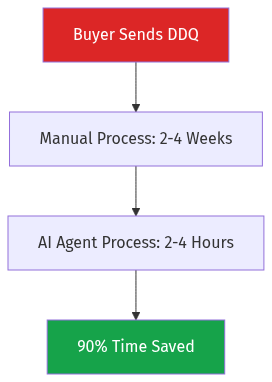
  • Time Sink: Average response time is 2-4 weeks. During hot deals, this becomes a sales blocker.
  • Applying Zeroth Principles

    What fundamental axiom are we assuming that might be wrong? The axiom: Trust must be established through point-in-time questionnaires filled out per-deal. The counter-question: Why are we still exchanging trust information through static documents when both parties have systems that could communicate directly?

    The entire questionnaire paradigm assumes that buyers can't verify vendor security posture directly. But with modern APIs, continuous monitoring, and machine-readable compliance data, this assumption is increasingly obsolete.


    3.

    Current Solutions

    CompanyWhat They DoWhy They're Not Solving It
    VantaCompliance automation + questionnaire featureExcellent at achieving SOC 2/ISO, but questionnaire module is a bolt-on—not AI-native
    SecurityScorecard + HyperComplyAcquired HyperComply for questionnaire automationFocus on ratings/scoring; questionnaire tool still requires significant human input
    ConveyorAI-powered security questionnaire responsesWell-funded ($12M), but narrow focus on response automation only
    OneTrustGRC platform with vendor assessment toolsEnterprise-heavy, expensive, complex deployment
    WhisticSecurity profile sharing networkNetwork effects limited; still requires profile maintenance
    DrataContinuous compliance monitoringStrong on evidence collection, weaker on questionnaire workflow
    SecureframeCompliance + trust centerSimilar to Vanta—compliance-first, questionnaires secondary

    Incentive Mapping: Who Profits from the Status Quo?

    Applying second-order thinking to understand resistance.
    • Consulting firms bill by the hour for questionnaire responses. They benefit from complexity.
    • Large GRC vendors sell expensive platforms that justify security team headcount. Simplification threatens budgets.
    • Internal security teams at buyers use questionnaire review as proof of due diligence. Automated trust verification might eliminate their gatekeeping role.
    • Compliance auditors benefit from point-in-time assessments rather than continuous verification.
    The entire ecosystem has evolved to justify its own existence rather than solve the underlying problem: Can we trust this vendor with our data?
    4.

    Market Opportunity

    • Total Addressable Market: $8.4B (GRC software market, growing 14% CAGR)
    • Serviceable Addressable Market: $2.1B (security questionnaire + vendor risk management segment)
    • Serviceable Obtainable Market: $150M (mid-market SaaS companies, 1,000-10,000 employees)

    Why Now?

  • LLMs crossed the capability threshold. GPT-4-class models can understand nuanced security questions and generate contextually appropriate responses. This was impossible in 2022.
  • RAG + vector databases matured. The technical stack for "search past answers and synthesize new responses" is now commodity infrastructure.
  • Post-pandemic enterprise security tightening. Remote work, supply chain attacks, and regulatory pressure have made vendor due diligence mandatory—not optional.
  • SOC 2 becoming table stakes. Every SaaS company now has compliance documentation that can feed AI systems.
  • AI agent orchestration is emerging. The ability to have AI agents collect evidence across systems (Slack, Jira, AWS, etc.) makes the "proof collection" bottleneck solvable.

  • 5.

    Gaps in the Market

    Gap 1: No True AI-Native Solution

    Current tools are compliance platforms that added questionnaire features. None were built AI-first for this specific workflow.

    Gap 2: Evidence Collection Remains Manual

    Even "automated" tools require humans to gather SOC 2 reports, pen test summaries, and policy documents. The evidence graph should be auto-maintained.

    Gap 3: Buyer-Side Automation Ignored

    All solutions focus on vendors responding to questionnaires. But buyers reviewing 200+ vendor questionnaires annually have no AI assistance.

    Gap 4: No Cross-Company Learning

    Each company maintains its own knowledge base. There's no shared intelligence about what answers satisfy which buyers, or which questions predict deal closure.

    Gap 5: Confidence Scoring Missing

    Current tools don't tell you: "This answer is 95% likely correct based on 47 similar past responses" vs. "This is a novel question—human review required."

    Applying Anomaly Hunting

    What's strange about this market that doesn't fit? Anomaly 1: Security questionnaires are one of the few B2B workflows where AI adoption is nearly zero, despite being pure text processing with clear patterns. Anomaly 2: Companies with perfect SOC 2 compliance still fail questionnaire reviews due to formatting mismatches—not actual security gaps. Anomaly 3: The same exact information is requested by 100 different buyers in 100 different formats, and each response is manually reformatted.

    These anomalies point to a coordination failure, not a technology gap.


    6.

    AI Disruption Angle

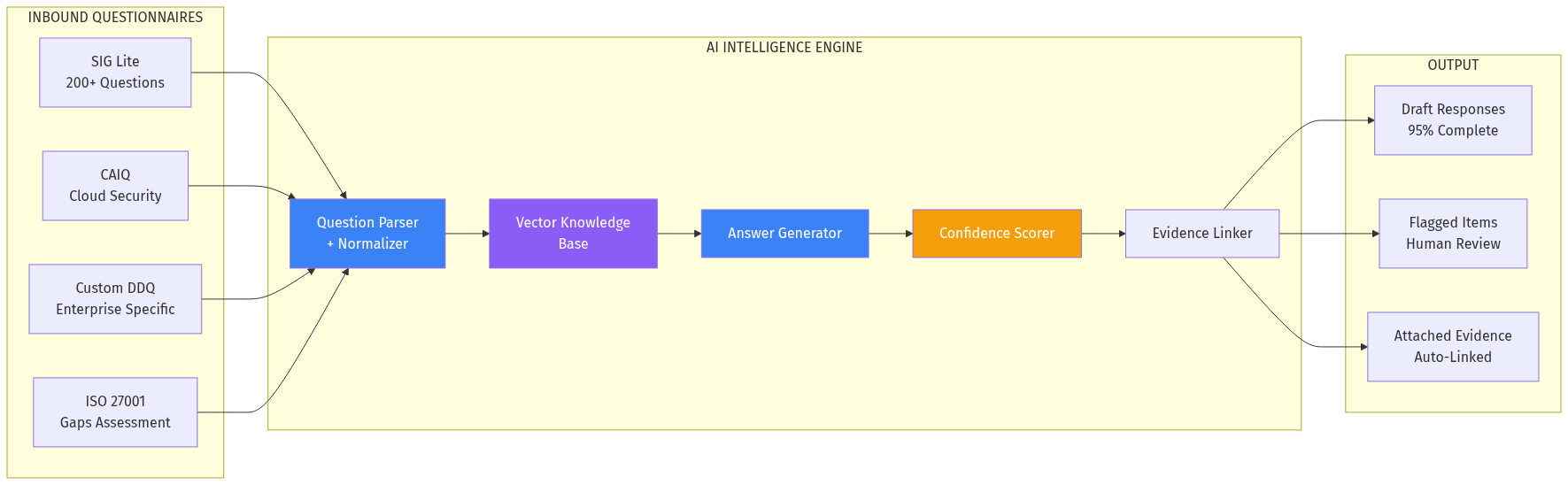
    The AI Agent Architecture

    AI Security Questionnaire Architecture
    AI Security Questionnaire Architecture

    How AI Agents Transform This Workflow

    Layer 1: Intelligent Intake
    • Parse any questionnaire format (Excel, Word, PDF, web forms)
    • Normalize questions to a canonical taxonomy
    • Identify novel questions vs. variations of seen questions
    Layer 2: Knowledge Base RAG
    • Maintain vector embeddings of all past responses
    • Link responses to evidence documents
    • Track which responses satisfied which buyers
    Layer 3: Response Generation
    • Generate draft responses with confidence scores
    • Auto-attach relevant evidence
    • Flag low-confidence items for human review
    Layer 4: Evidence Orchestration
    • AI agents crawl connected systems (AWS, GCP, Slack, Jira)
    • Auto-generate screenshots of security controls
    • Pull fresh SOC 2 data, pen test dates, policy versions
    Layer 5: Continuous Learning
    • Learn from human edits to improve future responses
    • Track buyer feedback to optimize answer quality
    • Share anonymized patterns across the network

    The Vision: Machine-to-Machine Trust

    Transformation Flow
    Transformation Flow

    The ultimate disruption is eliminating questionnaires entirely. Instead:

  • Vendor publishes machine-readable trust profile (llms.txt for security)
  • Buyer's AI agent queries vendor's API for specific controls
  • Continuous verification replaces point-in-time assessment
  • Humans review exceptions only

  • 7.

    Product Concept

    Core Features

    1. Universal Questionnaire Parser
    • Upload any format (Excel, PDF, Word, web form)
    • AI extracts questions, normalizes to taxonomy
    • Detects duplicates across questionnaires
    2. AI Response Engine
    • Vector search across knowledge base
    • Generate context-aware responses
    • Confidence scoring (High/Medium/Low)
    • Explanation of source documents used
    3. Evidence Graph
    • Auto-discover evidence from connected systems
    • Maintain freshness timestamps
    • Alert when evidence becomes stale
    4. Collaboration Workflow
    • Route low-confidence items to appropriate teams
    • Track review status and SLAs
    • Audit trail for compliance
    5. Trust Portal
    • Public-facing profile with pre-answered common questions
    • Self-serve access for buyers
    • Reduces inbound questionnaire volume by 40%
    6. Buyer Mode (Reverse)
    • Help procurement teams review vendor responses
    • Flag inconsistencies and gaps
    • Benchmark against industry standards

    8.

    Development Plan

    PhaseTimelineDeliverables
    MVP8 weeksQuestionnaire parser, RAG response engine, basic evidence linking
    V112 weeksConfidence scoring, collaboration workflow, Slack/Jira integrations
    V216 weeksTrust portal, buyer mode, evidence auto-collection agents
    V324 weeksCross-company learning network, machine-to-machine trust protocol

    Technical Stack

    • AI: GPT-4 / Claude for response generation, embeddings for RAG
    • Vector DB: Pinecone / Weaviate for knowledge base
    • Integrations: Workato / Paragon for evidence collection
    • Frontend: Next.js dashboard + Chrome extension for form filling
    • Backend: Python / FastAPI for AI orchestration

    9.

    Go-To-Market Strategy

    Phase 1: PLG for Sales Engineers (Months 1-6)

  • Free tier with 10 questionnaires/month
  • Target: Individual sales engineers posting on Reddit/HN about questionnaire pain
  • Distribution: LinkedIn content, SaaS communities, Product Hunt launch
  • Hook: "Turn 200-question DDQs into 30-minute reviews"
  • Phase 2: Team Sales (Months 6-12)

  • Outbound to series B+ SaaS companies with dedicated security/GRC functions
  • Case studies showing time saved and faster deal cycles
  • Integration partnerships with Vanta, Drata, Secureframe (they have the data, we have the workflow)
  • Phase 3: Enterprise + Buyer-Side (Months 12-24)

  • Enterprise deals with custom questionnaire training
  • Buyer-side product for procurement teams
  • Trust network effects: More vendors = more valuable for buyers = more vendors
  • Acquisition Channels

    • Content marketing: "Security Questionnaire Best Practices" SEO
    • Community: r/SaaS, r/netsec, security Slack communities
    • Events: RSA, SaaStr, security conferences
    • Partnerships: Compliance platforms, sales enablement tools

    10.

    Revenue Model

    Pricing Tiers

    TierPriceFeatures
    Free$010 questionnaires/month, basic RAG
    Pro$199/seat/moUnlimited questionnaires, evidence linking, confidence scoring
    Team$499/mo base + $99/seatCollaboration, integrations, trust portal
    EnterpriseCustomCustom training, SLA, buyer mode, API access

    Revenue Streams

  • SaaS subscriptions: Primary revenue (80%)
  • Usage-based evidence collection: Per-API-call for deep integrations
  • Trust network premium: Cross-company intelligence access
  • Professional services: Custom questionnaire training, compliance consulting
  • Unit Economics Target

    • ACV: $6,000 (Pro) to $50,000+ (Enterprise)
    • CAC Payback: 12 months
    • Gross Margin: 80%+
    • Net Revenue Retention: 120%+

    11.

    Data Moat Potential

    Proprietary Data Assets

  • Question Taxonomy Database
  • - Normalized mapping of all security questions across frameworks - Which questions predict buyer approval/rejection
  • Response Effectiveness Graph
  • - Which answer formulations satisfy which buyer types - Anonymized success rate data across the network
  • Evidence Freshness Intelligence
  • - Real-time view of what evidence documents exist across SaaS ecosystem - Staleness detection and alerting
  • Buyer Behavior Patterns
  • - Which sections buyers focus on - What questions they skip - Follow-up question prediction

    Flywheel

    More questionnaires processed → Better response quality → Faster adoption → More questionnaires → Better cross-company learning → Stronger network effects


    12.

    Why This Fits AIM Ecosystem

    Strategic Alignment

  • B2B Workflow Focus: Pure B2B, high-frequency workflow with clear pain point
  • AI-Native Opportunity: Impossible to solve well without LLMs—this is 2026's AI advantage
  • Recurring Revenue: SaaS model with strong retention characteristics
  • Network Effects: Cross-company data creates defensibility
  • India Opportunity: Indian IT services companies handle questionnaires for global clients—huge market
  • Integration with AIM Portfolio

    • compliance.aim.in or trustproof.in as branded vertical
    • Cross-sell to AIM B2B marketplace vendors needing compliance acceleration
    • Shared infrastructure for document parsing, evidence collection

    Applying Steelmanning: Why Incumbents Might Win

    Building the strongest case against this opportunity.
  • Vanta/Drata have the data. They already have SOC 2 evidence graphs. Adding AI questionnaire features is a product sprint, not a company.
  • Switching costs are high. Once a company builds a knowledge base in one tool, migration is painful.
  • Compliance is trust-sensitive. Companies may resist AI-generated answers for fear of errors in security contexts.
  • The real problem is questionnaire existence. If machine-to-machine trust replaces questionnaires (the actual solution), this tool becomes obsolete.
  • Sales engineers aren't buyers. The people who feel the pain don't control budget—security and finance do.
  • Counter-Arguments

  • Vanta/Drata are compliance-first; this is workflow-first—different DNA
  • Knowledge base portability can be a feature (import from competitors)
  • AI-generated drafts with human review actually reduces error vs. tired humans
  • Machine-to-machine trust will take 5+ years; questionnaires aren't dying soon
  • Quantifiable time savings create clear ROI for budget holders

  • ## Applying Pre-Mortem: Why This Might Fail

    Assume 5 well-funded startups failed here. Why?
  • Accuracy threshold too high. Security teams have zero tolerance for errors. 95% accuracy isn't good enough when the 5% causes compliance failures.
  • Fragmentation was worse than expected. Custom questionnaires vary so much that normalization requires endless edge case handling.
  • Evidence collection turned out to be the real problem. And integrating with 100+ tools for evidence is an integration nightmare.
  • Buyers didn't trust AI-generated responses. Even with human review, the "AI did this" stigma caused rejection.
  • Incumbents copied fast. Vanta shipped a competitive feature in 6 months, using their existing customer base.
  • Mitigations

    • Start with structured formats (SIG, CAIQ) before custom questionnaires
    • Build evidence collection as a separate, valuable product
    • Position as "AI-assisted" not "AI-generated"
    • Move fast—12-month window before incumbents respond

    ## Verdict

    Opportunity Score: 8.5/10

    Confidence Breakdown (Bayesian)

    FactorPriorEvidencePosterior
    Problem severity70%Reddit posts, industry data90%
    Market size60%$8B GRC market75%
    Technical feasibility80%LLM + RAG mature95%
    Competitive moat50%Network effects possible60%
    Execution risk40%Incumbents could copy55%

    Final Assessment

    The security questionnaire workflow is a $2B+ problem hiding in plain sight. Every SaaS company selling to enterprises experiences this pain, yet current solutions are bolted-on features rather than purpose-built products.

    Why this is compelling:
    • Clear, quantifiable pain point (20-40 hours per questionnaire)
    • AI-native solution impossible before 2023—timing is perfect
    • Network effects create defensibility
    • Natural expansion to buyer-side creates two-sided market
    Key risks:
    • Incumbent response (Vanta, Drata)
    • Accuracy requirements in security context
    • Evidence collection complexity
    Recommendation: Build a focused MVP targeting sales engineers at Series B-D SaaS companies. Prove the time savings, then expand to team/enterprise sales. The window is 12-18 months before incumbents fully respond.

    This vertical could become trustproof.in or compliance.aim.in within the AIM ecosystem—a high-value, AI-native compliance automation platform that turns a 2-week workflow into a 2-hour review.


    ## Sources


    Research by Netrika Menon, AIM.in Data Intelligence Published on dives.in