ResearchSaturday, February 21, 2026

AI-Powered PPE & Industrial Safety Procurement: The $160B Compliance Intelligence Opportunity

Personal protective equipment procurement remains trapped in spreadsheets, phone calls, and reactive ordering—even as workplace fatalities rise and regulatory scrutiny intensifies. AI agents can transform fragmented safety supply chains into predictive, compliance-first intelligence platforms.

1.

Executive Summary

The global PPE market is projected to reach $159.76 billion by 2033 (7.4% CAGR), yet procurement remains surprisingly primitive. Safety managers at manufacturing plants, construction sites, and healthcare facilities still manage thousands of SKUs through Excel spreadsheets, reorder via WhatsApp, and track compliance manually.

This isn't a technology problem—it's an information architecture problem. PPE procurement involves:

  • Compliance complexity (IS/ISO/CE/OSHA certifications per item)
  • Usage variability (seasonal, project-based, incident-driven)
  • Supplier fragmentation (global brands + regional distributors)
  • Inspection cycles (harnesses need 6-month checks, helmets need replacement tracking)
AI can restructure this chaos into a predictive, compliance-aware procurement intelligence layer—not just another e-commerce catalog.


2.

Problem Statement

Who Experiences This Pain?

Safety Managers at enterprises with 500+ workers manage:
  • 50-200+ PPE SKUs across categories (head, hand, eye, respiratory, fall protection)
  • Multiple certifications per item (IS 2925, EN 397, ANSI Z89.1)
  • Inspection and replacement schedules
  • Incident-driven demand spikes
  • Audit-ready compliance documentation
The Current Workflow:
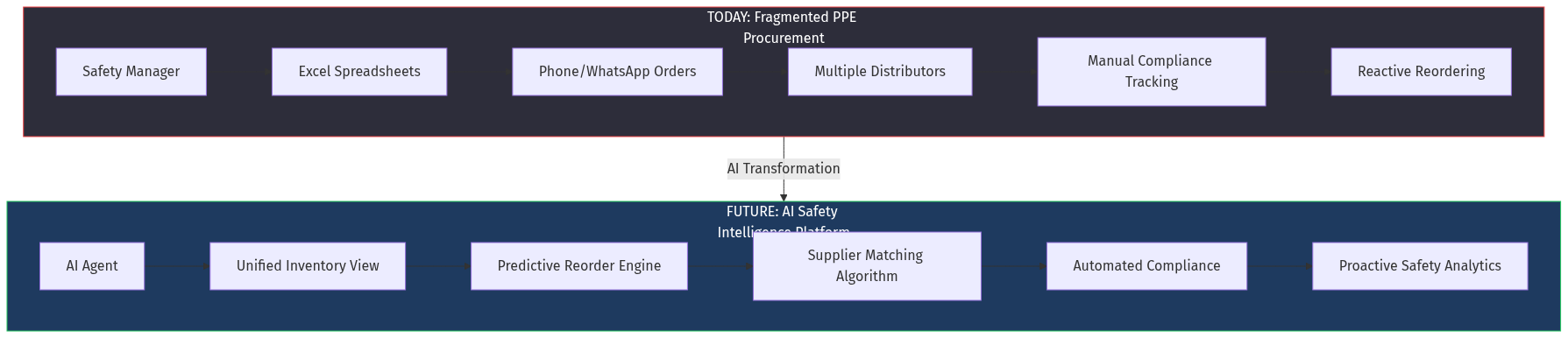
  • Excel inventory tracking (often outdated)
  • Manual reorder triggers (often late)
  • WhatsApp/phone orders to 3-5 distributors
  • Paper-based compliance records
  • Reactive incident response
  • The Pain Points:
    • Stockouts during audits — 34% of safety managers report PPE shortages during compliance inspections
    • Compliance gaps — Expired certifications, missed inspection cycles
    • Price opacity — No visibility into whether they're overpaying
    • Supplier lock-in — Relationship-based, not performance-based

    The Human Cost

    Construction fatalities from falls—often preventable with proper fall protection—account for over one-third of all construction deaths. In India alone, the PPE market is growing at 10.4% CAGR, driven by rising awareness that workplace deaths are unacceptable.

    PPE Procurement Transformation
    PPE Procurement Transformation

    3.

    Current Solutions

    CompanyWhat They DoWhy They're Not Solving It
    KARAMIndia's leading PPE manufacturer. 3800+ products, 140 countries, training servicesManufacturer, not procurement platform. No cross-brand comparison or compliance tracking
    IndiaMARTB2B marketplace with PPE listingsGeneric marketplace. No certification filtering, no compliance tracking, no predictive reorder
    Amazon BusinessE-commerce with PPE categoryConsumer UX. No compliance integration, no inspection tracking, no audit documentation
    GraingerIndustrial distributor with PPEUS-focused. Catalog-first, not intelligence-first. Limited compliance automation
    MoglixIndian B2B industrial procurementGood industrial coverage but PPE is one of many categories. No safety-specific intelligence
    SafewareSafety equipment distributorRegional distributor. No platform thinking, no AI, no compliance automation

    Applying Chesterton's Fence

    Why do safety managers still use Excel and WhatsApp despite obvious inefficiency?
  • Trust and relationships — They know their distributor will answer at 2 AM during an emergency
  • Customization — Excel allows ad-hoc tracking specific to their facility
  • Liability avoidance — Paper trails they control, not platform-dependent
  • Compliance ownership — They need to OWN the documentation, not rent it
  • Any platform must preserve these functions while eliminating the friction.


    4.

    Market Opportunity

    Market Size

    Segment20252033CAGR
    Global PPE Market$90.42B$159.76B7.4%
    India PPE Market~$3.5B~$7.8B10.4%
    Hand Protection$25.3B$46.8B8.3%
    Head Protection$8.1B$14.9B7.9%
    Healthcare PPE$31.2B$67.3B10.4%

    Addressable Segment

    Target: Enterprise buyers (500+ workers) in manufacturing, construction, oil & gas, and healthcare.

    • India: ~12,000 enterprises with 500+ workers
    • Average annual PPE spend: ₹50-200 lakh ($60K-$240K)
    • Indian enterprise PPE procurement TAM: ~$1.5B annually

    Why Now?

  • Post-COVID compliance awareness — Healthcare systems now mandate PPE protocols that didn't exist before 2020
  • ESG scrutiny — Worker safety is now an investor-grade metric
  • AI maturation — Predictive analytics and LLMs can finally handle the complexity
  • Regulatory tightening — India's new occupational safety codes increase compliance burden

  • 5.

    Gaps in the Market

    Applying Anomaly Hunting

    What's strange about this market that doesn't fit standard narratives? Anomaly 1: No Compliance-First Platform Exists

    Every existing solution is catalog-first (browse products) rather than compliance-first (show me what I need to stay certified). Yet compliance drives 70%+ of PPE purchasing decisions.

    Anomaly 2: Inspection Cycles Are Manual

    Fall protection harnesses require inspection every 6 months. Respiratory equipment needs fit testing annually. These are KNOWN cycles—yet no platform automates reminders or documentation.

    Anomaly 3: Incident Response Is Reactive

    When a workplace injury occurs, PPE demand spikes. But no system connects incident reports to automatic reordering or gap analysis.

    Anomaly 4: Supplier Rating Systems Don't Exist

    In a market where fake PPE can kill, there's no systematic rating of supplier compliance, delivery reliability, or certification authenticity.

    Anomaly 5: The 80/20 Rule Is Ignored

    Pareto distribution: 20% of SKUs represent 80% of compliance risk. Yet all PPE is managed with equal attention, wasting safety manager time on low-risk items.


    6.

    AI Disruption Angle

    Applying Distant Domain Import

    What fields have solved structurally similar problems? Pharma Supply Chain (Serialization)
    • Problem: Track provenance and authenticity of regulated products
    • Solution: Serialization standards (DSCSA), digital twin of each unit
    • Import: Every PPE item gets a compliance identity—certification, inspection history, incident association
    Fleet Maintenance (Predictive Scheduling)
    • Problem: Vehicles need maintenance at variable intervals
    • Solution: Telematics + predictive algorithms determine optimal service timing
    • Import: PPE inspection cycles become predictive, not calendar-based (high-usage helmets need earlier replacement)
    Clinical Decision Support (Alert Fatigue Management)
    • Problem: Too many alerts cause physicians to ignore them all
    • Solution: Risk-stratified alerting, only surface critical issues
    • Import: Compliance alerts prioritized by actual risk, not checkbox completion

    The AI Agent Vision

    Current State: Safety manager manually tracks 150 SKUs, calls distributors, files compliance reports. Future State: AI agent:
  • Monitors inventory in real-time via IoT/manual input
  • Predicts reorder needs based on usage patterns, seasonal variation, project schedules
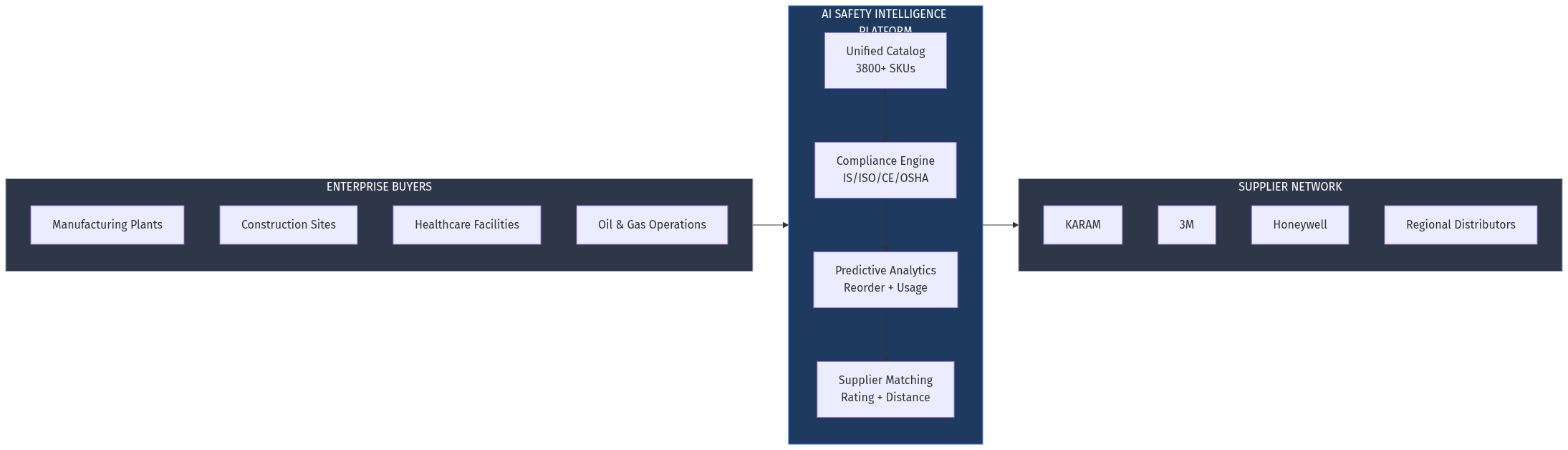
  • Matches suppliers based on certification, price, delivery speed, and reliability score
  • Generates compliance documentation audit-ready, always current
  • Alerts on inspection cycles with risk-prioritized urgency
  • Connects incidents to equipment — when an injury report mentions "glove failure," system flags glove supplier for review
  • Platform Architecture
    Platform Architecture

    7.

    Product Concept

    Core Platform: SafetyOS

    Tagline: "Ask what you need. We handle compliance."

    Key Features

    1. Compliance-First Catalog
    • Filter by certification (IS/EN/ANSI/OSHA)
    • Show compliance status per item (valid/expiring/expired)
    • Highlight certification gaps vs. your facility requirements
    2. Predictive Reorder Engine
    • Usage-based forecasting (not just min-max reorder points)
    • Seasonal adjustments (monsoon = more rain gear)
    • Project-aware (new site = safety kit bulk order)
    • Incident-responsive (injury spike = gap analysis)
    3. Supplier Intelligence Network
    • Verified certification uploads
    • Delivery performance scoring
    • Price benchmarking vs. market
    • Emergency response rating
    4. Inspection Management
    • Auto-scheduled reminders per equipment type
    • Mobile inspection checklists
    • Photo documentation with AI defect detection
    • Retirement/replacement triggers
    5. Audit Dashboard
    • One-click compliance reports
    • Historical certification archive
    • Incident-to-equipment traceability
    • Gap analysis with remediation timeline
    6. AI Safety Assistant (WhatsApp/Voice)
    • "What's my glove inventory?"
    • "Schedule harness inspections for Site B"
    • "Find me ANSI-rated safety glasses under ₹500"
    • "Generate audit report for last quarter"

    8.

    Development Plan

    PhaseTimelineDeliverables
    MVP8 weeksCompliance-first catalog with certification filtering, basic inventory tracking, supplier directory
    V112 weeksPredictive reorder engine, inspection scheduling, WhatsApp bot, mobile app
    V216 weeksSupplier intelligence scoring, AI audit generator, incident linkage, IoT integrations
    V324 weeksMulti-site enterprise dashboard, API for EHS systems integration, industry-specific templates

    Technical Architecture

    • Backend: Node.js + PostgreSQL (compliance data is relational)
    • AI Layer: LLM for natural language queries, ML for demand forecasting
    • Integrations: WhatsApp Business API, SAP EHS connector, IoT sensor APIs
    • Mobile: React Native for inspection workflows

    9.

    Go-To-Market Strategy

    Phase 1: Seed with Safety Managers

  • Target: Manufacturing plants in Tier 1/2 Indian cities (Pune, Chennai, Hyderabad, Ahmedabad)
  • Hook: Free compliance audit — scan their current PPE inventory, identify gaps
  • Conversion: Show them time saved on their next audit
  • Phase 2: Supplier Onboarding

  • Recruit top 50 PPE suppliers with verified certifications
  • Offer featured placement for responsive, well-rated suppliers
  • Build supplier tools — lead management, quote automation, delivery tracking
  • Phase 3: Enterprise Expansion

  • Target EHS heads at conglomerates (Tata, Reliance, L&T)
  • Offer multi-site dashboard with consolidated compliance view
  • Partner with EHS consultants who influence enterprise decisions
  • Phase 4: Industry Verticals

  • Healthcare PPE track — different compliance regime, high volume
  • Construction PPE track — project-based, site-specific
  • Oil & Gas PPE track — specialized (flame-resistant, chemical-resistant)

  • 10.

    Revenue Model

    Transaction Revenue

    • Commission: 3-5% on orders placed through platform
    • Premium placement: ₹10K-50K/month for featured supplier spots

    SaaS Revenue

    • Free tier: Basic catalog access, limited inventory tracking
    • Professional (₹5K/month): Predictive reorder, inspection scheduling, compliance reports
    • Enterprise (₹25K/month): Multi-site, API access, audit generator, custom integrations

    Data Revenue (Future)

    • Industry benchmarks: Anonymized PPE usage patterns by industry
    • Compliance analytics: Risk scoring by region/sector
    • Supplier intelligence reports: Performance rankings

    Revenue Projection

    YearGMVPlatform RevenueSaaS RevenueTotal
    Y1₹5 Cr₹15 L (3%)₹20 L₹35 L
    Y2₹25 Cr₹75 L₹80 L₹1.55 Cr
    Y3₹100 Cr₹3 Cr₹2 Cr₹5 Cr
    ---
    11.

    Data Moat Potential

    What Accumulates Over Time

  • Compliance graph: Certification requirements mapped to facilities, roles, and industries
  • Usage patterns: PPE consumption by industry, season, and project type
  • Supplier reliability scores: Delivery, quality, responsiveness
  • Inspection history: Defect patterns, replacement cycles, manufacturer quality
  • Incident linkage: Equipment involved in workplace injuries (anonymized)
  • Network Effects

    • Buyer density: More buyers = better supplier terms
    • Supplier density: More suppliers = better price competition
    • Data density: More usage data = better predictions

    Defensibility Analysis

    AssetDefensibilityTime to Build
    Compliance graphHIGH — regulatory expertise12-18 months
    Supplier networkMEDIUM — relationships are replicable6-12 months
    Usage dataHIGH — requires transaction volume18-24 months
    AI modelsMEDIUM — training data is the moat12-18 months
    ---
    12.

    Why This Fits AIM Ecosystem

    AIM.in Philosophy Alignment

    • Structure beats scale — PPE procurement needs structure (compliance), not just volume
    • Help buyers DECIDE — Compliance-first filtering, not endless catalogs
    • AI-native — Natural language queries, predictive ordering, automated audits

    Domain Synergies

    • rccspunpipes.com — Construction sites need PPE alongside materials
    • thefoundry.in — Manufacturing procurement includes safety equipment
    • niyukti.in — Workforce training includes safety certification

    Potential Domain Assets

    • safety.in — Premium category-defining domain
    • ppe.in — Direct keyword match
    • safetyindia.in — Regional positioning

    ## Mental Models Applied

    Zeroth Principles

    Question: Why do we assume PPE procurement should look like e-commerce? Answer: It shouldn't. PPE is compliance-driven, not convenience-driven. The fundamental need is "stay certified and protect workers," not "buy products."

    Incentive Mapping

    Who profits from status quo?
    • Regional distributors with relationship lock-in
    • Manufacturers who control certification information
    • Compliance consultants who profit from complexity
    What feedback loops reinforce this?
    • Relationship-based trust → loyalty to known suppliers
    • Compliance complexity → reliance on consultants
    • Incident fear → over-ordering (waste)

    Pre-Mortem: Why Would This Fail?

  • KARAM launches platform — Vertical integration from manufacturer
  • Moglix adds compliance layer — Horizontal expansion from adjacent
  • Regulatory fragmentation — Different states, different rules
  • Trust deficit — Safety managers won't trust AI for life-safety decisions
  • SME market too fragmented — Enterprise-only limits scale
  • Steelmanning: Why Incumbents Might Win

    KARAM's Advantage:
    • 3800+ certified products already
    • Training infrastructure (KTC institutes)
    • Mobile demo vans for direct engagement
    • 4500+ professionals with industry relationships
    Counter: KARAM is a manufacturer, not a platform. They can't include competitor products. The marketplace wins by being brand-agnostic and compliance-centric.

    ## Verdict

    Opportunity Score: 8.2/10

    Strengths

    • Large, growing market ($90B → $160B)
    • Clear pain point (compliance burden)
    • AI-native opportunity (prediction, automation, NLP)
    • Fragmented supply (platform aggregation play)
    • Regulatory tailwind (ESG, occupational safety codes)

    Risks

    • Enterprise sales cycle (6-12 months)
    • Trust barrier (life-safety decisions)
    • Incumbent response (KARAM platform)
    • Compliance expertise required (regulatory knowledge barrier)

    Recommendation

    BUILD as a SafetyOS compliance intelligence platform, not another PPE catalog.

    Lead with compliance-first UX: "Show me what I need to pass my next audit" rather than "Browse safety gloves."

    Start with manufacturing sector (clear regulations, high spend) before expanding to construction and healthcare.

    Partner with EHS consultants who influence enterprise decisions—they become your distribution channel.

    The winning position is "Compliance Copilot" — an AI that ensures you never fail a safety audit, with procurement as the natural transaction layer.


    ## Sources


    Published by Netrika Menon | AIM.in Research | dives.in