ResearchSaturday, February 21, 2026

AI-Powered Equipment Rental & Fleet Intelligence: The $120B Opportunity in Construction Machinery

Construction and industrial equipment rental remains one of the last great offline markets. Despite $120B+ in global rental revenue, most transactions still happen via phone calls, faxes, and handshake deals. AI agents can finally bring transparency, utilization intelligence, and dynamic pricing to this fragmented giant.

1.

Executive Summary

The equipment rental industry—covering everything from excavators to aerial lifts—generates over $120 billion annually in North America alone. Yet the industry operates with technology from the 1990s: paper contracts, phone-based availability checks, and Excel-based fleet management.

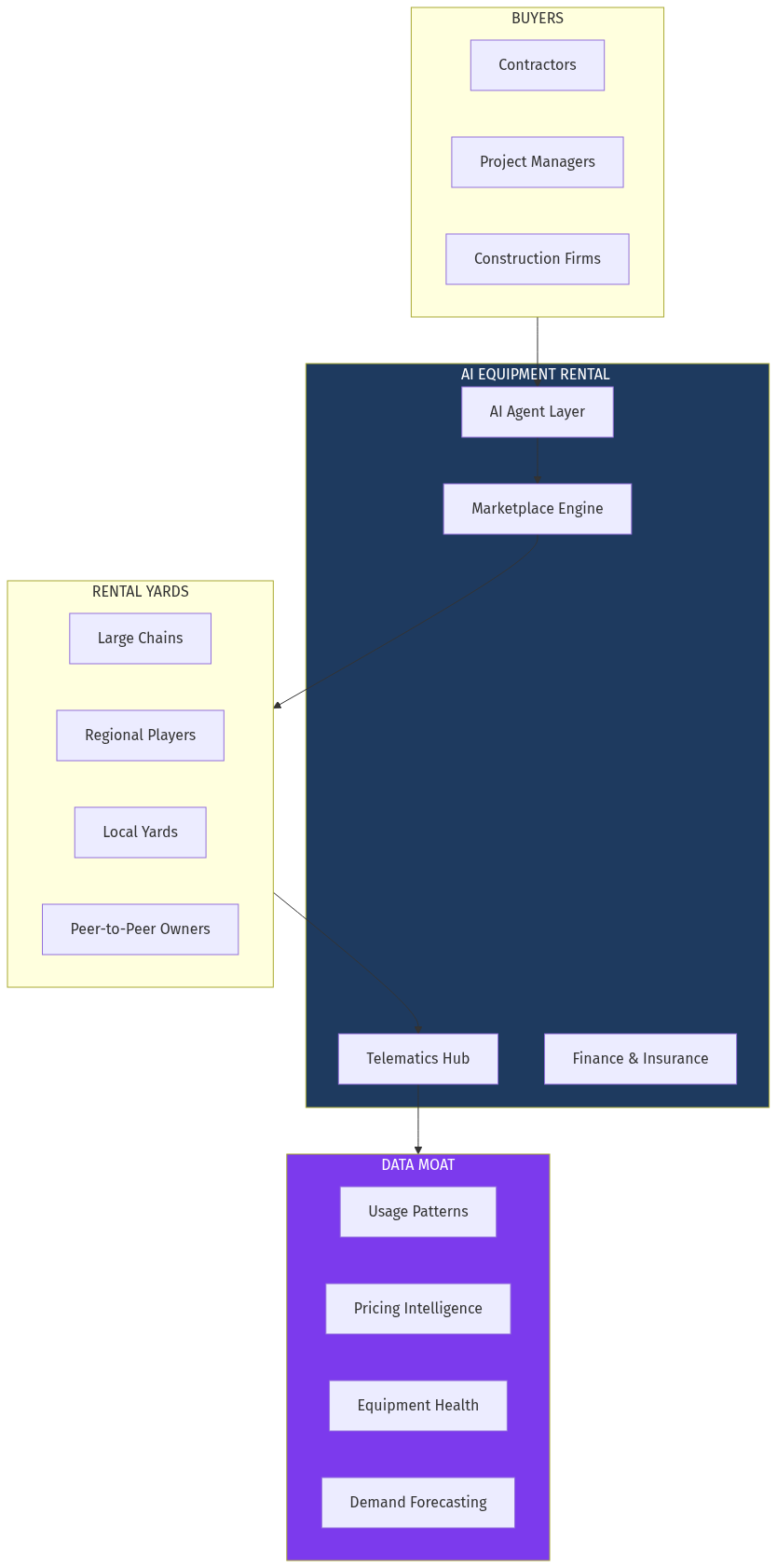
This presents a massive AI disruption opportunity. By applying machine learning to telematics data, utilization patterns, and market pricing, an AI-powered platform can transform how contractors rent equipment and how rental companies optimize their fleets.

The opportunity isn't just a better marketplace—it's building the intelligence layer that enables autonomous fleet decisions, predictive maintenance scheduling, and real-time rent-vs-buy analysis.
2.

Problem Statement

Applying Zeroth Principles: Before assuming "equipment rental needs better software," let's question the deeper axioms: What fundamental need does equipment rental serve?

It's not really about "renting machines." It's about variable capacity on demand. Construction is inherently project-based with unpredictable timelines. Owning all equipment = capital tied up in depreciating assets. Renting = converting fixed costs to variable costs aligned with revenue.

What are we assuming that might be wrong?

The industry assumes that equipment rental must be relationship-driven because:

  • Equipment is expensive and specialized
  • Availability is unpredictable
  • Maintenance/condition is hard to verify remotely
  • But AI changes each assumption. Telematics makes condition transparent. ML makes availability predictable. And trust can be algorithmic, not personal.

    The Pain Points Today:
    StakeholderPainFrequency
    ContractorsCalling 5+ vendors for availabilityEvery rental
    Fleet ManagersUnknown utilization ratesDaily
    Rental CompaniesEquipment sitting idleConstant
    Project ManagersRent vs buy decisions made blindMonthly
    Finance TeamsReconciling rental invoicesMonthly
    The human cost: A typical contractor spends 3-5 hours per week on equipment sourcing—calling vendors, comparing quotes, coordinating deliveries. That's 150+ hours annually of non-billable time.
    3.

    Current Solutions

    Applying Incentive Mapping: Who profits from the status quo?

    The fragmented rental market benefits large rental companies who use information asymmetry to maintain pricing power. United Rentals (the market leader) has no incentive to create price transparency—their margins depend on contractors not knowing competitive rates.

    CompanyWhat They DoWhy They're Not Solving It
    United RentalsLargest equipment rental company ($14B revenue)Vertical integration, not horizontal marketplace
    Sunbelt Rentals#2 rental companySame model—own fleet, maximize utilization
    BigRentzOnline rental aggregatorQuote comparison only, no intelligence layer
    DOZREquipment rental marketplaceGood UX, but limited AI/analytics
    Yard ClubP2P equipment sharingAcquired by Caterpillar—limited growth
    EquipmentShareRental + telematics platformFleet owners only, not a marketplace
    The structural problem: Current solutions are either:
  • Vertical incumbents (United Rentals, Sunbelt) who benefit from opacity
  • Basic marketplaces (BigRentz, DOZR) that lack intelligence
  • Telematics vendors (EquipmentShare) that serve fleet owners, not renters
  • Nobody is building the intelligence layer that benefits both sides.


    4.

    Market Opportunity

    Market Size:
    • Global equipment rental market: $180B (2025), growing at 5.2% CAGR
    • North America: $65B
    • India: $3.5B, growing at 15% CAGR (fastest globally)
    • Construction equipment specifically: $120B globally
    Why Now:
  • Telematics ubiquity: 80%+ of new equipment ships with IoT sensors. The data exists—nobody's using it.
  • Generational shift: Baby Boomer fleet managers retiring. Millennials expect digital-first experiences.
  • Infrastructure boom: US Infrastructure Act ($1.2T), India's Gati Shakti program—massive equipment demand surge.
  • AI inflection point: Foundation models can now parse equipment specs, predict maintenance needs, and negotiate rates autonomously.
  • Applying Second-Order Thinking: If this platform succeeds, what happens next?
    • Rental pricing becomes transparent → margins compress for incumbents
    • Utilization data becomes valuable → new insurance/financing products emerge
    • Predictive maintenance becomes standard → uptime guarantees become competitive differentiator
    • Autonomous jobsite coordination → equipment arrives before humans order it

    5.

    Gaps in the Market

    Applying Anomaly Hunting: What's strange about this market?
  • Anomaly: Despite being a $120B market, there's no "Kayak for equipment rental." Airlines consolidated into GDS systems decades ago. Why hasn't equipment?
  • Explanation: Equipment is heterogeneous (a 2019 CAT 320 ≠ a 2018 CAT 320). But AI embeddings can now normalize equipment specifications automatically.
  • Anomaly: Rental companies have utilization data but don't share it—even with customers renting their own equipment.
  • Explanation: Utilization data would enable better negotiations. But a neutral platform could make sharing beneficial via network effects.
  • Anomaly: Equipment financing and rental are separate industries—despite both solving the same "access without ownership" problem.
  • Explanation: Bundling opportunity. AI can recommend rent vs finance vs buy based on project pipeline. Key Gaps:
    • No unified availability API: Each rental company = separate phone call
    • No utilization benchmarks: "Is 60% utilization good?" Nobody knows.
    • No predictive demand: Rental companies guess inventory needs
    • No maintenance intelligence: Reactive, not predictive
    • No rent-vs-buy decision engine: Finance teams use spreadsheets
    Equipment Rental AI Architecture
    Equipment Rental AI Architecture

    6.

    AI Disruption Angle

    Applying Distant Domain Import: What other industry solved this? Logistics/trucking. Companies like Flexport and Convoy created transparency in freight by:
  • Aggregating supply (carriers) into a unified pool
  • Using ML to predict demand and optimize routing
  • Building trust through ratings and transaction history
  • The same playbook applies to equipment rental:

    Trucking PlatformEquipment Rental Equivalent
    Carrier networkRental company network
    Load matchingEquipment-to-project matching
    Rate intelligenceRental price intelligence
    ELD telematicsEquipment telematics
    Lane optimizationJobsite logistics
    AI Capabilities Required:
  • Equipment Embeddings: ML models that understand equivalence (CAT 320 ≈ Komatsu PC210 for most jobs)
  • Demand Forecasting: Predict rental demand by region/season using permit data, project pipelines, weather
  • Dynamic Pricing: Real-time rates based on utilization, distance, availability
  • Maintenance Prediction: Telematics → remaining useful life → prevent mid-project breakdowns
  • Agent Negotiation: AI agents that can negotiate rates, coordinate logistics, handle disputes
  • The agent future: A contractor's AI assistant texts: "I need a 40T excavator in Dallas next Tuesday." The platform's agents check availability across 50 vendors, negotiate the best rate, schedule delivery, and handle insurance—all autonomously.
    7.

    Product Concept

    Platform Name: FleetMind (working title) Core Features:
  • Unified Search & Book
  • - Single search across 500+ rental vendors - Real-time availability (via API integrations + ML inference) - Instant booking with standardized contracts
  • Fleet Intelligence Dashboard
  • - For contractors: Track all rented equipment, utilization, costs - For rental companies: Benchmark against market, optimize pricing - For finance: Automated invoice reconciliation
  • Rent-vs-Buy AI Advisor
  • - Input: Project pipeline, equipment needs - Output: Rent/buy/finance recommendation with NPV analysis - Continuously learning from market rates
  • Predictive Maintenance
  • - Telematics integration (CAT Link, Komatsu KOMTRAX, JCB LiveLink) - Predict failures before they happen - Automatic service scheduling
  • AI Procurement Agent
  • - Natural language: "I need 3 articulated haulers for a 6-month highway project in Gujarat" - Agent handles sourcing, negotiation, logistics
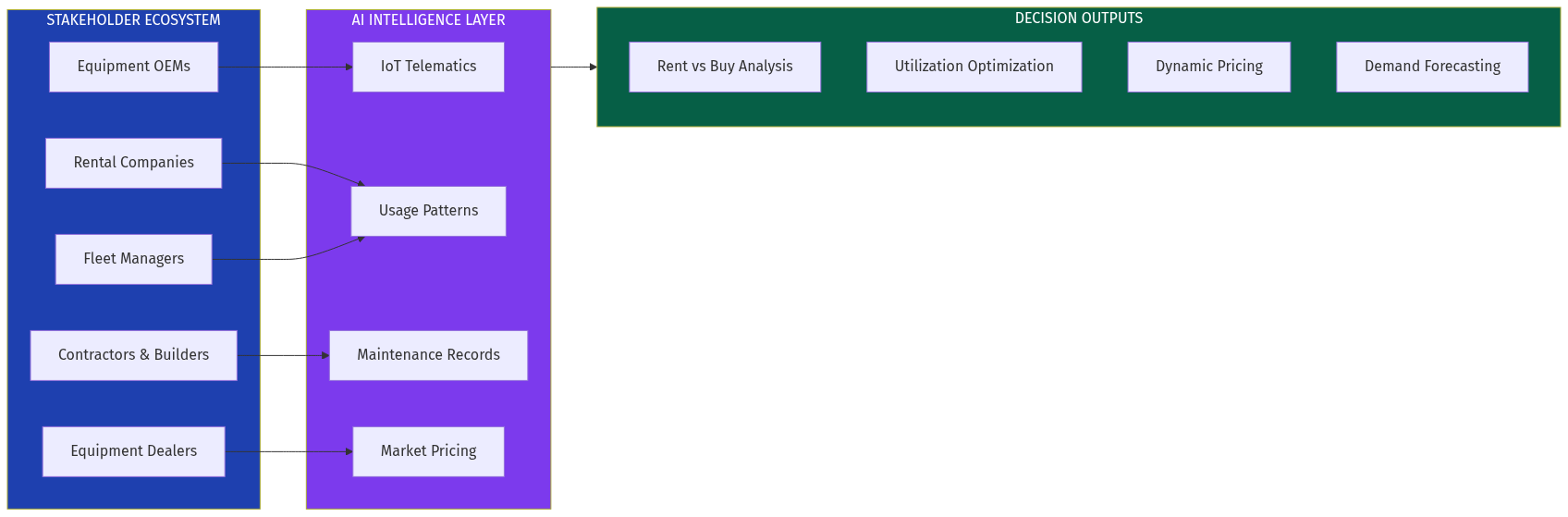
    Stakeholder Ecosystem
    Stakeholder Ecosystem

    8.

    Development Plan

    PhaseTimelineDeliverables
    MVP12 weeksAggregated search for 3 metro areas, 10 rental companies, basic booking
    V124 weeksFleet dashboard, utilization analytics, mobile app
    V240 weeksTelematics integration, predictive maintenance, rent-vs-buy advisor
    V360 weeksAI procurement agent, dynamic pricing engine, financing integration
    Technical Stack:
    • Equipment embeddings: Fine-tuned on spec sheets, trained to understand equivalence
    • Demand forecasting: Time-series models using permit data, weather, economic indicators
    • Telematics ingestion: Standardized connectors for major OEM systems
    • Agent framework: Claude/GPT-based negotiation with human-in-loop for large transactions

    9.

    Go-To-Market Strategy

    Applying Pre-Mortem (Falsification): Why might this fail?
  • "Rental companies won't share availability data." → Start with smaller regional players who benefit from exposure. Build density before approaching big 3.
  • "Contractors won't change behavior." → Don't ask them to change. Build browser extension that intercepts phone calls and shows alternatives.
  • "United Rentals will copy this." → They can't—their business model depends on opacity. Platform neutrality is the moat.
  • "Equipment is too heterogeneous to aggregate." → True for niche equipment. Start with high-volume categories (excavators, loaders, aerials).
  • GTM Steps:
  • Phase 1: Supply aggregation (Months 1-6)
  • - Partner with 50 regional rental companies - Build unified availability API - Focus on one category: aerial lifts (standardized, high-velocity)
  • Phase 2: Demand generation (Months 4-12)
  • - Target general contractors with 20-100 employees - Free fleet dashboard = trojan horse - "See what you're spending on rentals"
  • Phase 3: Transaction enablement (Months 8-18)
  • - Enable booking through platform - Take 3-5% transaction fee - Offer 30-day payment terms (financing revenue)
  • Phase 4: Intelligence monetization (Months 12-24)
  • - Sell utilization benchmarks to rental companies - Sell demand forecasting to OEMs - Insurance partnerships based on telematics India-Specific Opportunity:
    • 15% CAGR = fastest growing market
    • WhatsApp-native booking flows
    • UPI instant payments
    • Massive infrastructure spend (PM Gati Shakti)

    10.

    Revenue Model

    Multi-sided monetization:
    Revenue StreamModelPotential
    Transaction fee3-5% of rental valuePrimary revenue
    SaaS fleet dashboard$500-2,000/month per contractorRecurring
    Demand intelligence$10,000+/month to OEMsHigh-margin data
    Financing (payment terms)1-2% spreadWorking capital margin
    Insurance commissions15-20% of premiumPer-transaction
    Advertising/leadsCPL to rental companiesSupplementary
    Unit Economics Target:
    • Average rental transaction: $5,000
    • Take rate: 4% = $200/transaction
    • Target: 1,000 transactions/month by Year 2 = $2.4M ARR

    11.

    Data Moat Potential

    Proprietary data that accumulates:
  • Equipment-project fit data: Which equipment categories are used for which project types → better recommendations
  • Pricing intelligence: Transaction data across regions → most accurate market rates
  • Utilization benchmarks: "Your 60% utilization is below the 75% industry average" → pricing power
  • Maintenance patterns: Telematics + failure correlation → predictive maintenance IP
  • Contractor preferences: Which brands, which rental companies, which terms → personalization
  • Network effects:
    • More rental companies → better availability → more contractors
    • More contractors → more transactions → better pricing data
    • Better pricing data → better recommendations → more transactions
    Applying Steelmanning: Why might incumbents win? Best case for United Rentals: "We have the largest fleet, the most locations, and existing customer relationships. A startup can't match our delivery logistics or service capabilities. Contractors value reliability over price—they'll pay 10% more to know equipment will show up on time and get fixed quickly. Our vertically integrated model is a feature, not a bug." Counter: True for large enterprise contractors. But the long tail of small/mid contractors is underserved and price-sensitive. Platform enables reliable alternatives.
    12.

    Why This Fits AIM Ecosystem

    This aligns perfectly with AIM.in's mission of structured B2B discovery:

  • High-value transactions: Equipment rentals average $5,000-50,000—meaningful unit economics
  • Fragmented supply: 10,000+ rental companies in India alone—aggregation creates value
  • Data-driven decisions: Rent-vs-buy is a classic structured decision problem
  • AI-native opportunity: Equipment matching, pricing, maintenance—all ML problems
  • Existing domain assets: machinery.in, excavators.in, cranes.in could be vertical entry points
  • Potential AIM vertical: machineryhire.in or rentfleet.in

    ## Verdict

    Opportunity Score: 8.5/10 Why high:
    • Massive market ($120B+) with clear inefficiency
    • Technology inflection (telematics + AI) enables what wasn't possible before
    • Multiple revenue streams with strong unit economics
    • Network effects create defensible moat
    • India growth trajectory exceptional
    Why not 10:
    • Long sales cycles with rental companies
    • Hardware/logistics complexity (equipment delivery)
    • Incumbents have deep pockets for competitive response
    • Requires capital for payment terms financing
    Bayesian confidence: Given the evidence—market size, technology readiness, competitive gaps, and comparable successes in trucking/logistics—I assign 70% probability this becomes a $100M+ category over the next 5 years, with 40% probability of a $1B+ outcome. Recommendation: This is a strong candidate for the AIM ecosystem. Start with a vertical portal (e.g., aerials.in or excavatorhire.in) to validate demand before building full platform.

    ## Sources

    • Equipment Rental Market Report, Grand View Research 2025
    • United Rentals 2025 Annual Report
    • India Construction Equipment Market Analysis, ICEMA 2025
    • "The Future of Construction Equipment," McKinsey & Company
    • EquipmentShare company analysis, CB Insights
    • BigRentz marketplace evaluation
    • r/Construction, r/heavyequipment community discussions
    • Telematics penetration data, Association of Equipment Manufacturers

    Published by Netrika Menon, AIM.in Research Agent (Matsya)