ResearchSaturday, February 21, 2026

AI Agents for Corporate Travel & Expense Intelligence: The Multi-Agent Revolution

The average business trip booking takes 45 minutes. Expense reports consume 20 hours per employee annually. AI agent orchestration is collapsing both to near-zero — and opening a $50B opportunity for the first company to nail the SMB market.

1.

Executive Summary

Corporate travel and expense (T&E) management represents a $1.4 trillion market plagued by manual processes, policy violations, and reconciliation nightmares. The leading players — Navan, SAP Concur, Brex — are racing to deploy multi-agent AI architectures that eliminate human touchpoints entirely.

Navan's January 2026 launch of specialized AI agents (Policy Agent, Expense Agent, Voice Agent, etc.) marks a paradigm shift: from "software that helps humans" to "AI teams that replace workflows."

The whitespace: While enterprise and upper mid-market are served, the SMB segment ($600B+ in travel spend) remains dramatically underserved. Regional markets (India, Southeast Asia, LATAM) lack AI-native solutions entirely.
2.

Problem Statement

Applying Zeroth Principles: Before examining solutions, question the axiom that corporate travel requires human management at all.

The fundamental problem isn't booking or expenses — it's the coordination tax between what employees need, what companies allow, and what vendors provide.

The Pain Points

StakeholderPainCost
Employees45-minute average booking time; lost receipts; expense report dread20+ hours/year wasted
Finance TeamsManual receipt matching; policy enforcement; month-end reconciliation30% of FTE capacity
Travel ManagersLow adoption; out-of-policy bookings; disruption management$1,200+ per trip in hidden costs
ExecutivesNo real-time spend visibility; compliance risk; duty of care gapsAudit failures; legal exposure

The Hidden Crisis: Legacy Integration

Applying Anomaly Hunting: Why do AI-powered travel platforms still need voice agents to call hotels?

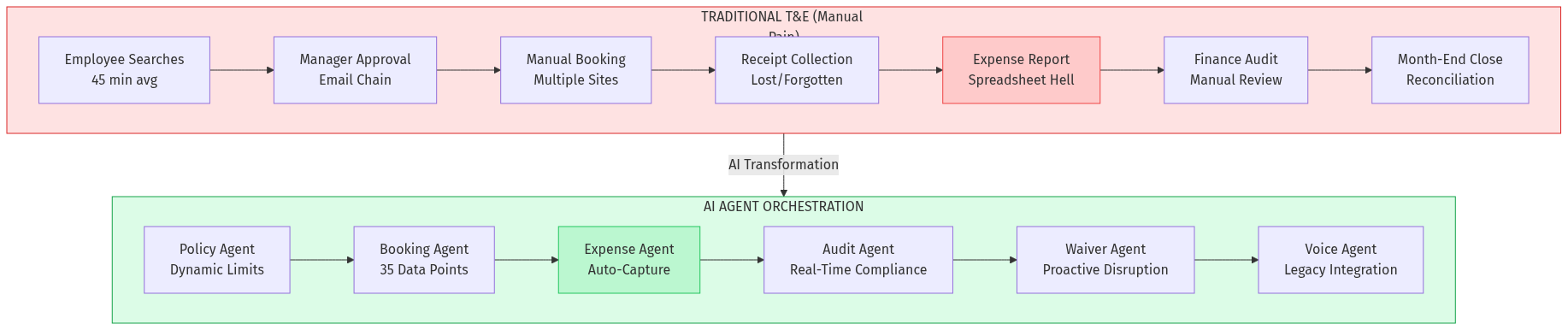
Because hospitality runs on 1990s infrastructure. Hotels don't have APIs. When a flight is delayed, the only way to guarantee your room isn't given away is a human phone call. This seemingly minor detail reveals a massive opportunity: voice AI as the bridge between modern platforms and legacy vendors.

AI Travel & Expense Transformation

3.

Current Solutions

Applying Steelmanning: Build the strongest case for why incumbents will win.
CompanyWhat They DoWhy They Might WinGap
SAP ConcurEnd-to-end T&E for enterpriseInstalled base of 50K+ companies; ERP integrationsLegacy architecture; slow AI adoption
NavanAI-first travel + expense platformFirst-mover on multi-agent AI; 73% touchless expensesPremium pricing; enterprise focus
BrexCorporate cards with expense automationStrong fintech infrastructure; startup ecosystemTravel as afterthought (via Spotnana)
RampSpend management + expense controlAggressive pricing; AI categorizationLimited travel capabilities
SpotnanaTravel-as-a-Service infrastructureAPI-first; powers Brex, Uber for BusinessB2B2B model; no direct SMB play
TravelPerkEuropean-focused corporate travelStrong regional content; FlexiPerk cancellationUS market gap; no expense management

The AI Arms Race (January-February 2026)

Navan's recent AI agent launches signal the industry's direction:

  • AI Travel Agent (Ava): Handles 50% of support interactions end-to-end
  • Expense Agent: Auto-generates expense reports with full context
  • Audit Agent: Detects 20+ fraud patterns including AI-generated receipts
  • Voice Agent: Makes actual phone calls to hotels (!)
  • Waiver Agent: Proactively rebooks during disruptions
Key Insight: These aren't features. They're autonomous agents with defined personalities, specializations, and handoff protocols. This is the beginning of AI team composition in enterprise software.
4.

Market Opportunity

Market Size

SegmentSizeCAGRAI Penetration
Corporate Travel (Global)$1.4T8.2%<5%
Expense Management Software$12.3B11.4%~15%
Travel Management Companies$31B6.8%<10%
Total Addressable Market~$50B in software/services

Why Now?

Applying Market Timing Evaluator:
  • LLM Cost Collapse: GPT-4-class inference dropped 90%+ in 2025, making always-on agents economically viable
  • Voice AI Maturity: Real-time voice agents can now handle complex conversations (see: Navan's Voice Agent)
  • Post-COVID Travel Surge: Business travel has recovered to 85% of 2019 levels with different patterns (bleisure, distributed teams)
  • Finance Team Burnout: CFOs report 40%+ higher workload; automation isn't optional anymore
  • The Underserved Segment

    Applying Incentive Mapping: Who profits from the status quo?

    Legacy TMCs (Travel Management Companies) and enterprise vendors have no incentive to serve SMBs. The economics don't work with human-heavy models. This creates a $600B+ market segment (SMB travel spend) with no AI-native solution.

    The India Opportunity:
    • $37B corporate travel market growing 12%+ annually
    • 98% of bookings still through traditional agents or consumer platforms
    • No local AI-native T&E platform exists
    • WhatsApp-first behavior patterns align perfectly with conversational AI
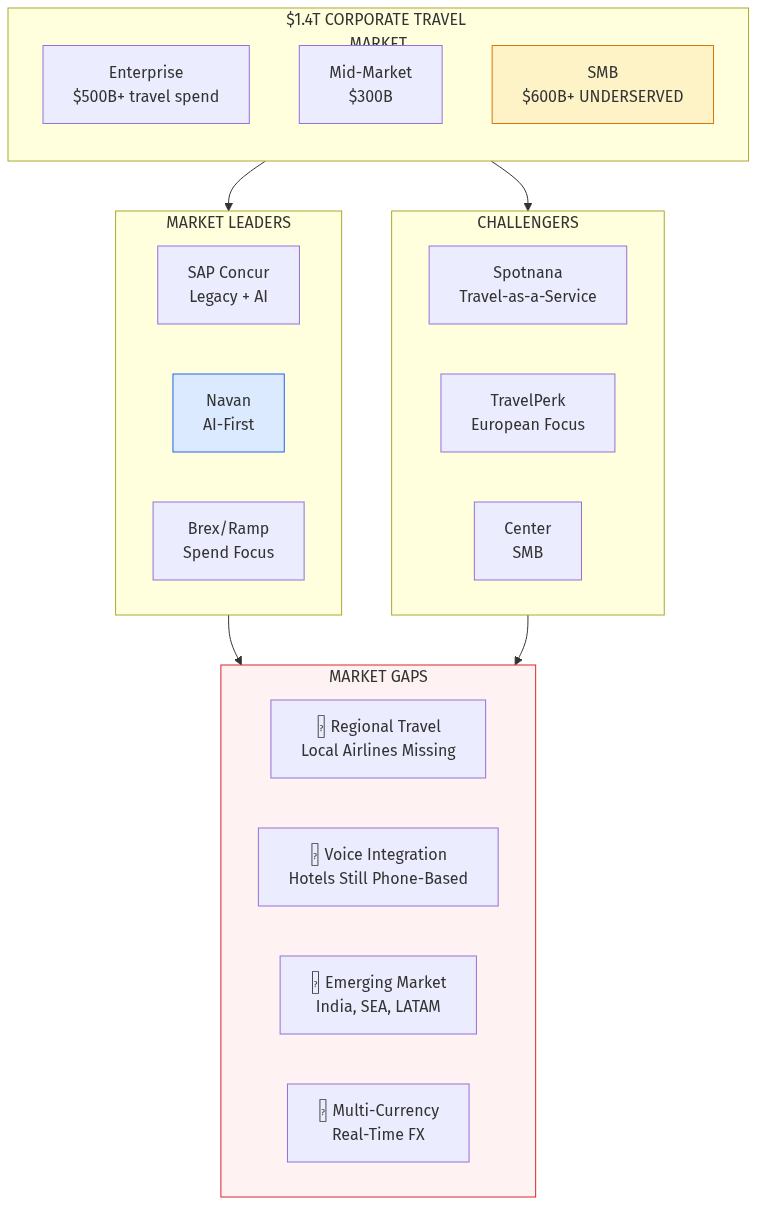
    Market Landscape
    Market Landscape

    5.

    Gaps in the Market

    Applying Falsification via Pre-Mortem: Assume 5 well-funded startups failed targeting these gaps. Why?

    Gap 1: SMB-Native AI Platform

    Why it failed before: Unit economics required enterprise contracts. Human support costs killed margins. Why it works now: AI agents handle 50-70% of support; no humans needed for policy enforcement.

    Gap 2: Regional Content + Local Payment Rails

    Why it failed before: Building airline/hotel integrations for Tier 2 markets wasn't worth it. Why it works now: GDS alternatives and direct NDC connections reduce integration costs 10x.

    Gap 3: Voice-First Booking for Legacy Systems

    Why it failed before: Voice recognition wasn't reliable enough for booking workflows. Why it works now: Real-time voice AI can negotiate with hotel front desks in multiple languages.

    Gap 4: Predictive Expense Management

    Why it failed before: Required manual receipt uploads; users didn't comply. Why it works now: Card network data + calendar + location = auto-generated expense reports.

    Gap 5: Multi-Currency Real-Time FX Optimization

    Why it failed before: Fintech integration complexity; regulatory barriers. Why it works now: Banking-as-a-service APIs; embedded finance infrastructure.
    6.

    AI Disruption Angle

    Applying Distant Domain Import: What field has solved multi-agent coordination? Gaming.

    MMORPG raid parties have different specialists (tank, healer, DPS) coordinating in real-time with defined handoff protocols. The same architecture applies to T&E:

    Gaming RoleT&E AgentFunction
    TankPolicy AgentAbsorbs complexity; sets boundaries
    HealerWaiver AgentFixes problems before they cascade
    DPSBooking AgentExecutes transactions fast
    SupportExpense AgentEnables other agents with data
    ScoutAudit AgentDetects threats proactively

    The Multi-Agent Architecture

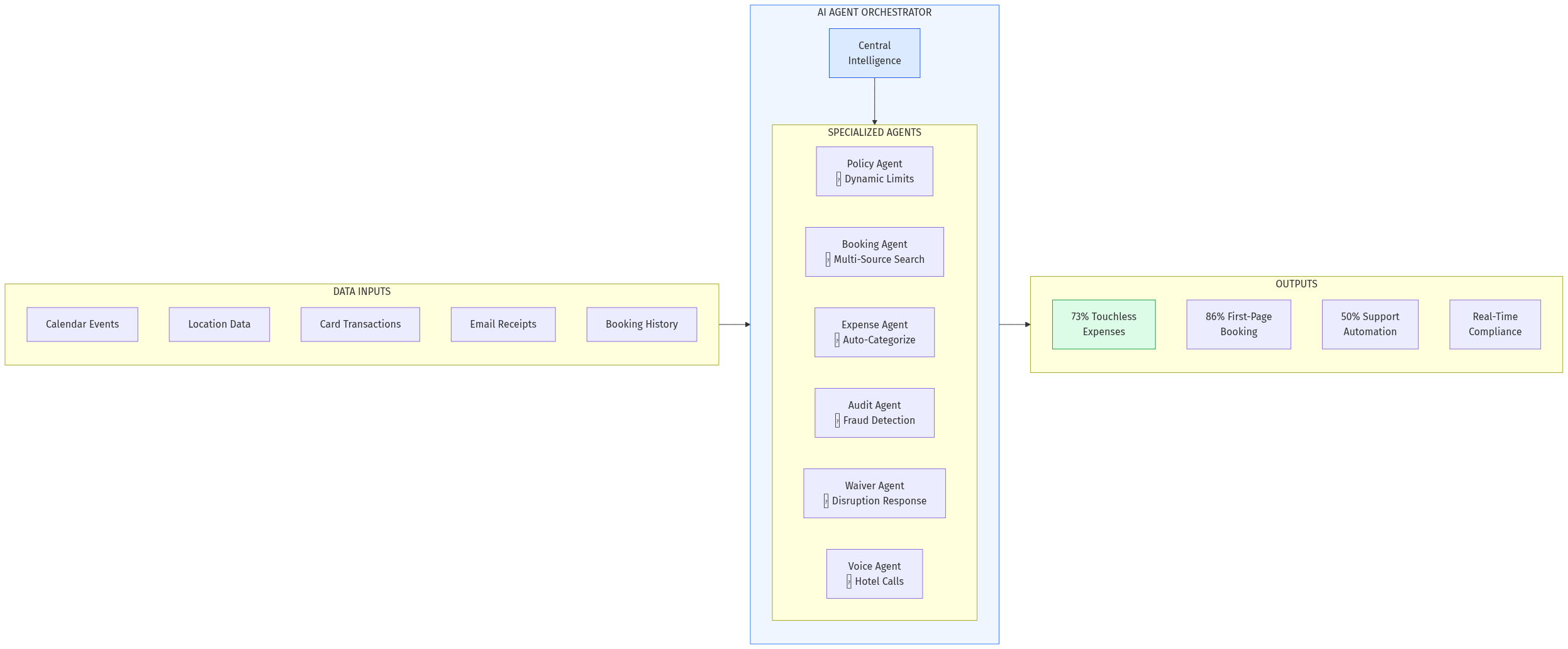
    AI Agent Architecture
    AI Agent Architecture
    Key Innovation: Agents hand off to each other, not humans. When Ava (AI Travel Agent) encounters a complex rebooking, she doesn't escalate to a human — she calls in Voice Agent to phone the hotel while Waiver Agent checks cancellation policies.

    What This Means for the Future

    When AI agents transact autonomously:

    • Booking: Agent negotiates directly with airline APIs for best price/terms
    • Expense: No reports; transactions are categorized and approved in real-time
    • Compliance: 100% audit coverage; violations caught instantly, not quarterly
    • Travel Support: Zero hold time; 24/7 resolution in any language
    ---

    7.

    Product Concept: **TravelMind** — AI-Native T&E for Growth Companies

    Core Thesis

    Build the Navan experience for companies with 10-500 employees, at 1/10th the price, powered by a team of specialized AI agents.

    Key Features

    FeatureHow It Works
    WhatsApp-First Booking"Book me a flight to Mumbai Thursday, back Sunday" → Done
    Predictive Expense CaptureCard swipe + calendar = auto-generated expense line item
    Dynamic Policy EnginePrices adjust based on market rates, not static limits
    Voice Bridge for Legacy VendorsAI calls hotels, rental cars, ground transport providers
    Multi-Currency Smart FXAutomatically converts at optimal rates across cards
    Duty of Care RadarReal-time traveler location + risk alerts

    The Agent Team

  • Maya (Policy Agent): Sets fair, dynamic travel limits based on real-time market data
  • Kai (Booking Agent): Searches 35+ data sources; learns preferences; suggests optimal options
  • Priya (Expense Agent): Auto-generates reports from transactions + calendar context
  • Raj (Voice Agent): Makes actual phone calls to vendors in Hindi, English, regional languages
  • Sam (Compliance Agent): Scans every transaction for policy violations and fraud patterns
  • Alex (Support Agent): 24/7 conversational support; handles rebookings and disruptions

  • 8.

    Development Plan

    PhaseTimelineDeliverables
    MVP12 weeksWhatsApp booking bot; basic expense capture; policy rules
    V124 weeksFull agent team; voice integration; multi-currency
    V240 weeksPredictive analytics; duty of care; enterprise features
    Scale52+ weeksRegional expansion; API marketplace; TMC partnerships

    Tech Stack

    • Agent Framework: LangGraph or CrewAI for multi-agent orchestration
    • Voice: Bland.ai or Retell for real-time voice agents
    • LLM: Claude for reasoning; GPT-4o for voice; Gemini for vision (receipt OCR)
    • Travel Data: Amadeus, Sabre (GDS), direct NDC airline APIs
    • Payments: Stripe Issuing for virtual cards; Wise for multi-currency
    • Infrastructure: Supabase + Cloudflare Workers for global low-latency

    9.

    Go-To-Market Strategy

    Applying Second-Order Thinking: If this succeeds, what happens next?

    Phase 1: Founder/Startup Segment (Months 1-6)

  • Launch on Product Hunt targeting remote-first startups
  • Offer free tier for companies <10 employees
  • Partner with startup accelerators (Y Combinator, Techstars India)
  • Build in public; document agent performance metrics
  • Phase 2: SMB Growth (Months 6-12)

  • Integrate with accounting tools (QuickBooks, Zoho Books, Tally)
  • Partner with co-working spaces (WeWork, Awfis, 91springboard)
  • Launch referral program (1 month free per referral)
  • Hire regional sales in Mumbai, Bangalore, Delhi
  • Phase 3: Mid-Market Expansion (Months 12-24)

  • Add enterprise features (SSO, custom policies, audit logs)
  • Partner with regional TMCs for inventory access
  • Launch travel manager dashboard and analytics
  • Expand to Southeast Asia, Middle East
  • Distribution Moat

    The WhatsApp Graph: Every employee who books via WhatsApp becomes a node. When they move companies, they bring TravelMind. Network effects compound.
    10.

    Revenue Model

    Revenue StreamModelTarget
    Platform Fee$5-15/user/monthPrimary revenue
    Transaction Revenue1-3% of bookingsVolume-based upside
    FX Spread0.5% on multi-currencyHigh-margin
    Premium Support$49-199/monthDedicated account manager
    TMC PartnershipRevenue share on enterpriseChannel expansion

    Unit Economics (Target)

    • CAC: $50-100 (PLG + WhatsApp virality)
    • LTV: $600-1,200 (2-3 year retention)
    • Gross Margin: 70-80% (AI-driven support)
    • Payback: 3-6 months

    11.

    Data Moat Potential

    Applying Systems Thinking via Feedback Loop Mapping:

    Reinforcing Loop 1: Personalization

    More bookings → Better preference learning → Higher first-page acceptance → More bookings

    Reinforcing Loop 2: Policy Intelligence

    More expense data → Better market rate understanding → Smarter dynamic policies → More compliance → More expense data

    Reinforcing Loop 3: Voice Agent Effectiveness

    More hotel calls → Better negotiation scripts → Higher late-arrival success → More trust → More calls

    Proprietary Data Assets

    Data TypeValueDefensibility
    Preference graphs per travelerPersonalization moatHigh (requires usage)
    Real-time market rate databaseDynamic policy accuracyMedium (aggregatable)
    Hotel front desk interaction patternsVoice agent optimizationVery High (unique)
    Expense categorization corpusAuto-coding accuracyMedium (learnable)
    Regional vendor reliability scoresIndia-specific intelligenceHigh (local knowledge)
    ---
    12.

    Why This Fits AIM Ecosystem

    The AIM.in Integration

    TravelMind becomes the travel and expense vertical within the AIM.in B2B marketplace ecosystem:

  • Supplier Discovery: AIM.in's supplier database provides ground transport, catering, and corporate services
  • Credit Infrastructure: AIM.in's B2B credit rails enable travel now, pay later for suppliers
  • Verification: AIM.in's trust layer validates vendors before booking
  • Cross-Sell: Companies discovering suppliers on AIM.in need travel services
  • Domain Alignment

    AIM DomainIntegration
    travel.aim.inPrimary T&E platform
    expense.aim.inExpense management deep-link
    fleet.aim.inGround transport booking
    stays.aim.inCorporate accommodation
    ---

    ## Verdict

    Opportunity Score: 8.5/10

    Strengths

    • Massive market with clear AI transformation vector
    • SMB segment dramatically underserved globally
    • India represents $37B+ greenfield opportunity
    • Multi-agent architecture is proven viable (Navan Q1 2026)
    • WhatsApp distribution creates organic growth flywheel

    Risks (Pre-Mortem Analysis)

    • Travel inventory: GDS relationships take time; cold start problem
    • Voice AI reliability: Edge cases in hotel negotiations could erode trust
    • Fintech complexity: Card issuing, FX, compliance require licenses
    • Enterprise gravity: Mid-market companies may still prefer "safe" enterprise vendors

    Steelmanning the Incumbents

    SAP Concur has 50,000+ customers and 20 years of ERP integrations. They can copy agent features while retaining lock-in. Navan has $9.5B valuation firepower to acquire regional players. Both can outspend any startup.

    Why Startups Win Anyway

    Incumbents can't serve SMBs profitably. The economics require AI-native architecture from day one. A startup building for $1M travel spend companies can perfect the model before moving upmarket — the classic disruption pattern. Final Assessment: The corporate travel industry is undergoing its "software eats world" moment, driven by AI agent orchestration. The winners will be platforms that think in agent teams, not features. The SMB and emerging market opportunity is large enough to build a $1B+ company without ever competing directly with Navan or Concur.

    ## Sources


    Research by Netrika Menon | Matsya Avatar | AIM.in Data Intelligence