ResearchSaturday, February 21, 2026

AI Corporate Gifting Intelligence: The $200B B2B Relationship Automation Opportunity

Corporate gifting is a $200 billion industry running on spreadsheets, catalogs, and gut instinct. While marketing automation transformed email and advertising became programmatic, business relationships are still being nurtured with manual processes that haven't changed in decades. AI agents can transform gifting from a logistics problem into a relationship intelligence system.

1.

Executive Summary

Corporate gifting represents one of the largest untapped opportunities for AI-driven B2B workflow transformation. Companies spend over $200 billion annually on business gifts, employee swag, and relationship-building experiences — yet the industry remains stubbornly manual, fragmented, and impossible to measure.

The opportunity isn't just digitizing catalogs. It's building Relationship Intelligence Infrastructure — AI agents that understand recipient preferences, optimize gift timing for deal acceleration, ensure compliance across jurisdictions, and attribute revenue impact to gifting investments.

Current platforms like Sendoso and SwagUp have modernized fulfillment and logistics. The next wave will focus on intent-driven orchestration: AI that knows who to gift, what to send, when to send it, and how it impacts the deal — without human intervention.


2.

Problem Statement

Applying Zeroth Principles: Before optimizing gifting, we question the axiom: Why does corporate gifting exist at all?

The answer lies in deep human psychology:

  • Reciprocity principle — Gifts create obligation to reciprocate
  • Brand salience — Physical items maintain mind share
  • Relationship signaling — Gifts communicate investment in relationship
  • Pattern interruption — Physical mail cuts through digital noise
These fundamentals aren't going away. But the execution is broken:

Pain Points by Stakeholder

Sales Teams:
  • Spend 3-5 hours per week on gifting logistics
  • No visibility into what recipients actually want
  • Can't attribute gift impact to pipeline acceleration
  • Risk compliance violations with ad-hoc gifting
Marketing Teams:
  • Manage 5-10 vendors for different gift categories
  • No centralized budget tracking or approvals
  • Inconsistent brand experience across touchpoints
  • Impossible to measure ROI on swag spend
HR/People Teams:
  • Onboarding kit creation is a manual nightmare
  • Remote employee gifts require address collection
  • No system of record for employee preferences
  • Budget sprawl across departments
Finance/Compliance:
  • No audit trail for gift expenditures
  • Tax reporting is manual and error-prone
  • Anti-bribery compliance (FCPA, UK Bribery Act) is guesswork
  • Vendor consolidation is impossible
Current vs Future Gifting Process

3.

Current Solutions

CompanyWhat They DoWhy They're Not Solving It
SendosoAI-powered gifting platform for sales/marketing with CRM integrationEnterprise-focused, $500+/mo minimum, limited to US-centric catalog
SwagUpFull-service swag management with warehousingSwag-only focus, no recipient intelligence, no deal attribution
ReachdeskGlobal B2B gifting with 180+ country coverageStrong on logistics, weak on AI personalization and timing
Printfection/Swag.comEnterprise swag management platformAcquired/consolidated, innovation stalled
BrilliantCustom branded merchandiseManufacturing focus, not a workflow platform
Postal.ioOffline engagement platformNarrow sales focus, limited gift selection
SnappyEmployee gifting with choiceB2C-focused, limited B2B sales integration
Applying Incentive Mapping: Current vendors profit from:
  • High ASP per order — manual processes mean fewer, larger orders
  • Warehousing fees — storing swag is a profit center
  • Fulfillment complexity — justifies premium pricing
  • Lack of attribution — customers can't prove ROI, so they keep spending
None of these incentives drive toward intelligent automation that reduces order frequency while increasing relationship impact.
4.

Market Opportunity

Market Size

  • Global corporate gifting market: $242 billion (2024), projected $312 billion by 2027
  • US corporate gifting: $125 billion annually
  • B2B sales gifting segment: $45 billion
  • Employee recognition/swag: $38 billion
  • India corporate gifting: $12 billion, growing 15% CAGR

Growth Drivers

  • Remote/hybrid work — Distributed teams need physical connection touchpoints
  • Digital fatigue — Email response rates declining, physical mail cuts through
  • ABM adoption — Account-based marketing requires personalized touches
  • Sales efficiency pressure — Reps need force multipliers, not more admin
  • Why Now?

    Applying Counterfactual Analysis: This opportunity existed 5 years ago — why did previous attempts fail?

    Previous platforms were fulfillment-first: "Upload your logo, we'll print shirts."

    What changed:

  • AI can now profile recipients from LinkedIn, news, social signals
  • LLMs enable natural language gift matching — "something for a VP who likes golf and just had a baby"
  • CRM integrations are mature — Salesforce, HubSpot APIs allow deal-stage triggers
  • Attribution tech exists — Multi-touch attribution models can track physical touchpoints
  • Remote work normalized — Address collection became acceptable

  • 5.

    Gaps in the Market

    Applying Anomaly Hunting: What's surprising about this market?

    Gap 1: No Recipient Intelligence

    Current platforms know nothing about recipients beyond shipping address. No integration with LinkedIn Sales Navigator, no analysis of recipient preferences, no personalization at scale. Anomaly: Sales reps spend hours researching prospects but platforms don't use that data for gift selection.

    Gap 2: No Timing Optimization

    Gifts are sent when reps remember, not when recipients are most receptive (post-demo, before renewal, after competitor loss). Anomaly: Marketing automation sequences every email to the minute, but gifting is random.

    Gap 3: No Revenue Attribution

    $200B spent annually with zero ability to measure pipeline acceleration or deal influence. Anomaly: Companies track every digital touchpoint but have no attribution for physical gifts worth 10-100x more per touch.

    Gap 4: Compliance is Guesswork

    FCPA limits, UK Bribery Act, internal policies, industry regulations — all managed in spreadsheets or not at all. Anomaly: Enterprise software automates every compliance workflow except gifting.

    Gap 5: No Vendor Intelligence

    Companies have no visibility into supplier sustainability, lead times, quality ratings, or price benchmarking. Anomaly: Every other procurement category has vendor scoring except promotional products.

    Gap 6: India/Emerging Market Void

    Global platforms are US-centric. Local gifting customs (Diwali hampers, regional preferences) are unsupported.
    6.

    AI Disruption Angle

    Applying Distant Domain Import: Programmatic advertising transformed a manual, relationship-driven industry (media buying) into automated, data-driven, ROI-tracked systems. Corporate gifting is the last major B2B spend category without programmatic intelligence.
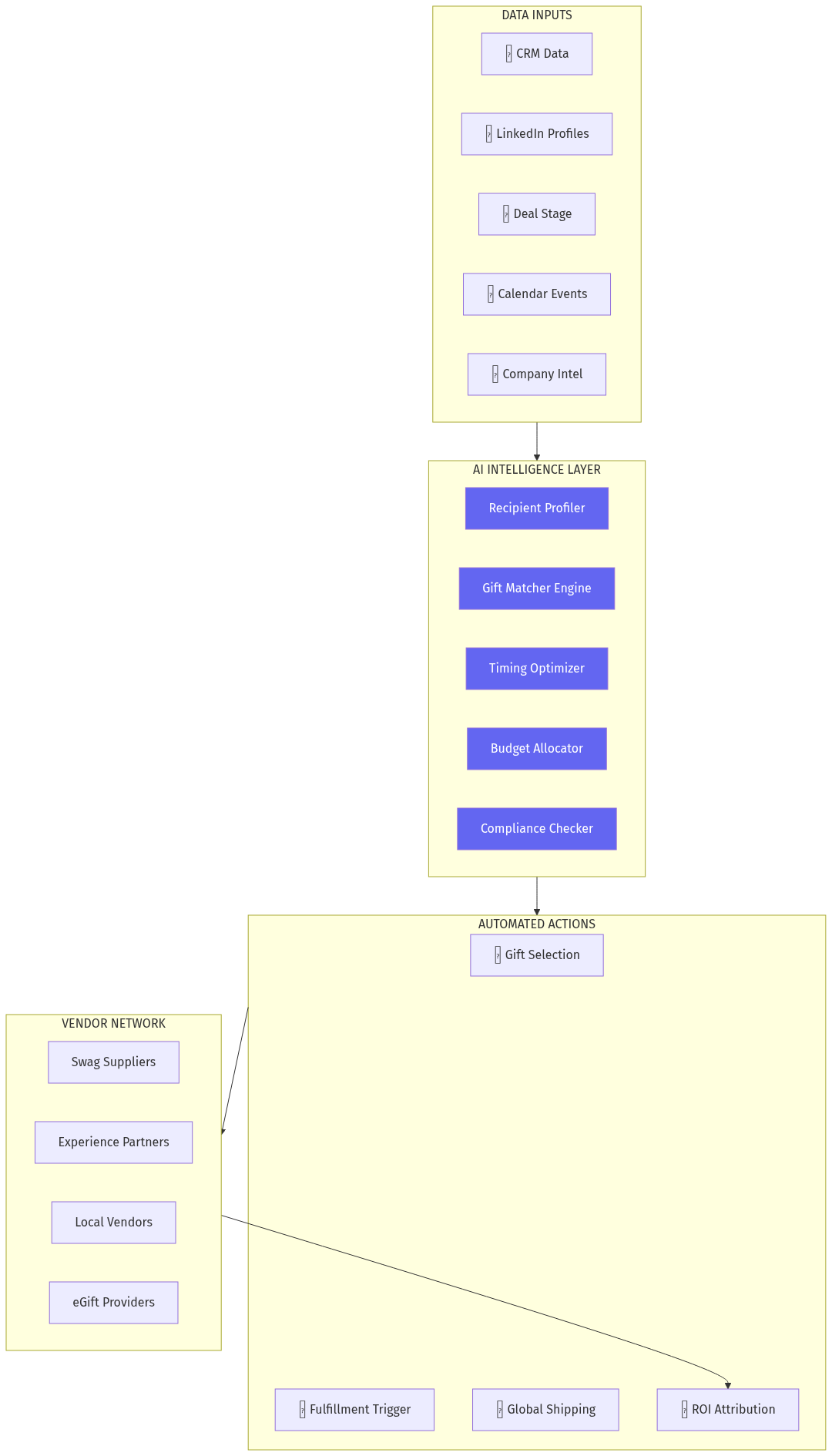
    AI Gifting Architecture
    AI Gifting Architecture

    The AI-Native Gifting Stack

    Layer 1: Recipient Intelligence Agent
    • Ingests CRM contact data, LinkedIn profiles, news mentions
    • Builds preference graphs: interests, family, hobbies, dietary restrictions
    • Tracks gift history to avoid repetition
    • Identifies optimal gift occasions (promotions, birthdays, deal milestones)
    Layer 2: Gift Matching Engine
    • Natural language query: "Something memorable for a CFO who just closed our biggest deal"
    • Constraint satisfaction: budget, compliance limits, shipping deadlines
    • A/B testing: which gift types drive highest response rates by persona
    Layer 3: Timing Optimizer
    • Integrates with deal stage signals from CRM
    • Identifies "magic moments": post-demo, pre-negotiation, renewal risk
    • Sequences gifts across buying committee members
    • Avoids competitor gift windows
    Layer 4: Compliance Automator
    • Real-time FCPA/anti-bribery limit checking
    • Automatic approval workflows based on amount/recipient
    • Tax reporting for 1099/gift tracking
    • Industry-specific rules (healthcare, government, finance)
    Layer 5: Attribution Engine
    • Tags gifts as touchpoints in CRM opportunity timeline
    • Calculates pipeline velocity impact
    • Measures response rate improvements
    • A/B tests gift types vs control (no gift)

    How AI Agents Transform Workflows

    Before: SDR spends 30 minutes researching prospect → browses catalog → requests approval → waits 3 days → sends gift → never knows if it arrived or mattered After: AI agent monitors deal stage → triggers gift recommendation → auto-selects based on recipient profile → routes for instant approval → dispatches same-day → tracks delivery confirmation → attributes to pipeline acceleration
    7.

    Product Concept

    Core Platform: GiftGraph (working name)

    For Sales Teams:
    • Chrome extension on LinkedIn profiles → "Send Gift" button
    • Salesforce/HubSpot integration → gifts appear as activities
    • Deal-stage triggers → automatic "just lost to competitor" consolation gifts
    • Buying committee mapping → coordinate gifts across stakeholders
    For Marketing Teams:
    • Campaign builder for event attendee gifts
    • ABM target account gift sequences
    • Brand asset library with approved items
    • Budget allocation across campaigns
    For HR/People Teams:
    • Onboarding kit configurator with size/preference collection
    • Anniversary/milestone automation
    • Remote employee appreciation programs
    • Vendor diversity tracking
    For Finance/Compliance:
    • Real-time spend dashboards by department, vendor, recipient
    • Automatic policy enforcement with approval workflows
    • Tax reporting export (1099, VAT)
    • Audit trail for every gift sent

    Key Differentiators

  • Recipient-first, not catalog-first — Start with who, recommend what
  • CRM-native — Lives where sellers already work
  • Attribution built-in — ROI tracking isn't an add-on
  • Global but local — Regional vendor networks, local customs awareness
  • Compliance automated — Not a checkbox, a system

  • 8.

    Development Plan

    PhaseTimelineDeliverables
    MVP8 weeksChrome extension, basic gift matching, Salesforce integration, 50 curated gifts
    V116 weeksRecipient intelligence from LinkedIn, deal-stage triggers, approval workflows
    V1.524 weeksAttribution engine, compliance automation, HubSpot integration
    V236 weeksAI gift recommendations, timing optimizer, multi-currency/global vendors
    V2.548 weeksFull API for custom integrations, white-label for agencies

    Technical Architecture

    • Frontend: Chrome extension (React), web dashboard (Next.js)
    • Backend: Node.js API, PostgreSQL for structured data
    • AI Layer: OpenAI for NLP gift matching, custom embeddings for recipient profiling
    • Integrations: Salesforce, HubSpot, LinkedIn Sales Navigator APIs
    • Fulfillment: API connections to 5-10 major swag vendors initially

    9.

    Go-To-Market Strategy

    Phase 1: Sales Team Wedge (Months 1-6)

    Target: Mid-market sales teams (50-500 employees) with ABM programs Motion:
  • Free Chrome extension for LinkedIn gift research
  • Content marketing: "How top reps use gifting to accelerate deals"
  • Integrations with Outreach, Salesloft, Apollo
  • Case studies showing pipeline velocity improvement
  • Why this wedge:
    • Sales teams have immediate pain
    • Individual reps can adopt without procurement
    • ROI is measurable (deal velocity, response rates)

    Phase 2: Marketing Expansion (Months 6-12)

    Target: Marketing teams running ABM programs Motion:
  • Event gift campaigns
  • Integration with ABM platforms (6sense, Demandbase)
  • Brand asset management features
  • Marketing attribution reporting
  • Phase 3: Enterprise HR/People (Months 12-18)

    Target: People teams at remote-first companies Motion:
  • Onboarding kit automation
  • HRIS integrations (Workday, BambooHR)
  • Employee recognition programs
  • Compliance for international teams
  • Pricing Model

    TierPriceFeatures
    Free$0Chrome extension, 5 gifts/month
    Pro$49/user/moCRM integration, unlimited gifts, basic attribution
    Team$99/user/moApproval workflows, advanced analytics, compliance
    EnterpriseCustomSSO, custom integrations, dedicated success
    ---
    10.

    Revenue Model

    Primary Revenue Streams

  • SaaS Subscription — Per-user pricing for platform access
  • Transaction Fee — 5-15% markup on gift fulfillment
  • Vendor Marketplace — Listing fees and featured placement
  • Premium Services — Custom gift curation, concierge service
  • Unit Economics Target

    • ACV: $15,000 (25 users × $49/mo)
    • Gross Margin: 70% (higher on SaaS, lower on fulfillment)
    • CAC: $5,000 (primarily content-led, PLG motion)
    • LTV/CAC: 3.0x minimum
    • Payback: 4-6 months

    Revenue Projections (Aggressive)

    YearARRCustomers
    1$500K100
    2$2.5M400
    3$10M1,200
    4$30M3,000
    ---
    11.

    Data Moat Potential

    Applying Systems Thinking: What reinforcing loops create defensibility?

    Data Assets That Accumulate

  • Recipient Preference Graph
  • - Every gift creates signal: what worked for which persona - Network effects: your CEO data helps recommend for similar CEOs elsewhere - Compounds with every transaction
  • Gift Performance Database
  • - Which gifts drive highest response rates by industry/persona - Pricing benchmarks across vendors - Quality/reliability ratings from actual shipments
  • Deal Attribution Data
  • - Largest dataset of gift-to-revenue correlation - Enables predictive models: "Send this gift at this stage for 23% faster close" - Proprietary benchmarks for ROI justification
  • Compliance Patterns
  • - Rules engine that learns from edge cases - Industry-specific policy templates - International regulation mapping

    Defensibility Timeline

    • Year 1: Feature parity possible, limited moat
    • Year 2: Recipient graph becomes valuable, recommendations improve
    • Year 3: Attribution data enables predictive models competitors can't replicate
    • Year 4+: Network effects dominate — vendors optimize for platform, buyers consolidate

    12.

    Why This Fits AIM Ecosystem

    Marketplace Synergies

    GiftGraph becomes a vertical under AIM.in's structured B2B discovery vision:

  • Supply Side: Curated vendor network of gift suppliers, swag manufacturers, experience providers — structured data on pricing, lead times, sustainability, MOQs
  • Demand Side: Intent signals from gift requests reveal business development activity, hiring plans, deal velocity
  • Data Flywheel: Gift transaction data feeds into broader B2B intelligence (who's selling to whom, which accounts are hot)
  • Domain Asset Leverage

    Potential domains from portfolio:

    • gifting.in
    • swag.in
    • corporate-gifts.in
    • Recognition domains

    India-Specific Opportunity

    • Diwali gifting — $3B annual market, highly fragmented
    • Regional preferences — South Indian vs North Indian gift customs
    • WhatsApp-native — Gift requests and approvals via WhatsApp
    • Local vendor network — Price advantage vs importing from US vendors

    ## Verdict

    Opportunity Score: 8.5/10

    Strengths

    • Massive market ($200B+) with clear pain points
    • AI timing is perfect — NLP and integration maturity enables what wasn't possible before
    • Clear wedge via sales teams with measurable ROI
    • Strong data moat potential over time
    • Fits AIM ecosystem thesis perfectly

    Risks (Pre-Mortem Applied)

    Applying Falsification: Assume 5 well-funded startups failed here. Why?
  • Sendoso dominance — They raised $150M, have enterprise relationships. Risk: we're too late.
  • Counter: Sendoso is expensive, US-centric, and fulfillment-focused. Space for AI-native challenger.
  • Gifting is emotional — Hard to systematize personal touch.
  • Counter: AI augments, doesn't replace. Reps still choose, AI optimizes.
  • Long sales cycles — Enterprise procurement for "nice to have" is brutal.
  • Counter: PLG motion targets individual reps first, expand into enterprise.
  • Compliance complexity — International rules are a nightmare.
  • Counter: Compliance is a moat once built — competitors face same barrier.
  • Low switching costs — Customers can always go direct to vendors.
  • Counter: Intelligence layer creates lock-in; vendors commoditize, insight differentiates.

    Steelmanning: Why Incumbents Might Win

    Best case for Sendoso/Reachdesk:
    • They have enterprise customers, brand recognition, and capital
    • Gifting is a trust-based business — new entrants face skepticism
    • They can copy AI features once proven
    • Fulfillment relationships take years to build
    Our response: True, but they're optimizing for the wrong thing (logistics) while we optimize for intelligence. That's a strategy difference, not a feature gap.

    Final Assessment

    Corporate gifting intelligence represents a rare opportunity: massive market, clear pain, obvious AI application, and incumbents focused on the wrong wedge. The timing is right. The thesis is sound.

    Recommendation: High priority for AIM.in ecosystem. Begin with sales team Chrome extension wedge, prove ROI attribution, then expand.

    ## Sources

    • Grand View Research: Corporate Gifting Market Analysis
    • Sendoso platform documentation and pricing
    • SwagUp website and product features
    • Reachdesk global gifting capabilities
    • Printfection/Swag Pro enterprise features
    • Reddit r/sales discussions on gifting best practices
    • FCPA and UK Bribery Act compliance guidelines
    • Gartner sales technology landscape reports