ResearchSaturday, February 21, 2026

AI-Powered Commercial Lab Testing & Certification Intelligence: The $320B Trust Infrastructure Opportunity

Every manufactured product in India—from the food on your plate to the steel in your buildings—passes through a testing laboratory. Yet this $320 billion global industry operates on email chains, WhatsApp groups, and PDF certificates stored in filing cabinets. The opportunity to build AI-native infrastructure for testing, inspection, and certification is massive and largely untapped.

1.

Executive Summary

The Testing, Inspection, and Certification (TIC) industry is a $320+ billion global market growing at 5.8% CAGR. In India alone, the market exceeds $5 billion with over 4,000 accredited laboratories. Yet the industry remains stubbornly analog: manufacturers find labs through Google searches, request quotes via email, coordinate samples over WhatsApp, and receive results as PDF attachments that get filed in physical folders.

This is a trust infrastructure problem masquerading as a logistics problem. When a food manufacturer needs FSSAI-compliant testing, they're not just buying a lab report—they're buying regulatory peace of mind. The current fragmented system makes this process expensive, slow, and opaque.

An AI-native platform can transform this by:

  • Parsing testing requirements in natural language
  • Matching to accredited labs based on capability, proximity, and reliability
  • Providing transparent, comparable pricing
  • Managing sample chain-of-custody
  • Digitizing certificates with blockchain verification
  • Automating compliance tracking and renewal alerts

The winner in this space becomes critical infrastructure—the "stripe for testing compliance."


2.

Problem Statement

The Pain Points Are Universal Across Industries

For Manufacturers:
  • Discovery Friction: Finding the right lab for specific tests (NABL-accredited, FSSAI-approved, ISO 17025 certified) requires hours of research
  • Pricing Opacity: No standardized pricing; each lab quotes differently; comparison requires multiple calls
  • Coordination Chaos: Sample collection, tracking, and result retrieval involve 15-20 touchpoints
  • Compliance Anxiety: Certificates expire, accreditations change, regulations evolve—tracking this manually is error-prone
  • Audit Terror: When auditors arrive, scrambling to locate certificates from 50+ suppliers
For Laboratories:
  • Capacity Underutilization: Small labs operate at 40-60% capacity due to poor visibility
  • Payment Delays: 60-90 day payment cycles due to invoice processing friction
  • Client Concentration Risk: Dependent on few large clients; no systematic way to reach SME manufacturers

Applying ZEROTH PRINCIPLES

What axioms are we assuming about lab testing that might be wrong?

The fundamental assumption is that "testing requires physical samples moving to physical labs." But this is partially false:

  • Many tests have standard protocols—results depend on methodology, not lab
  • Accreditation ensures consistency—a NABL lab in Delhi and Mumbai should produce identical results
  • The "trust" is in the accreditation, not the specific lab
Zeroth Principle Insight: Labs are fungible commodities. The real product is verified compliance, not the lab relationship. This means the market is ripe for aggregation and commoditization—exactly where platforms win.


3.

Current Solutions

CompanyWhat They DoWhy They're Not Solving It
TUV SUDLarge global TIC providerEnterprise-only; no SME access; opaque pricing
Bureau VeritasTesting, inspection, certificationVertically integrated; doesn't aggregate competitors
SGSGlobal leader in TICSame as above—operates own labs, not a marketplace
NABL WebsiteLists accredited labsStatic directory; no matching, pricing, or workflow
IndiaMARTHas "testing lab" listingsLead gen only; no understanding of accreditations, capabilities
Just DialLab directory listingsConsumer-grade; no B2B workflow; trust signals absent

Applying INCENTIVE MAPPING

Who profits from the status quo?
  • Large TIC companies (SGS, Bureau Veritas, TUV): Benefit from opacity—they can charge premium for "trusted brand" when underlying test is identical
  • Procurement middlemen: Consultants who "know the right labs" charge for relationship access
  • Compliance consultants: Complexity creates demand for their services
  • Paper certificate economy: Printers, couriers, filing cabinets—entire industries exist around physical documentation
  • Feedback Loops Keeping Status Quo:
    • Large brands prefer established TIC relationships → they don't push for change
    • SMEs lack bargaining power → accept whatever pricing they get
    • Labs have no incentive to standardize → differentiation happens on relationship, not capability
    • Regulations specify "accredited lab" not "specific lab" → should enable switching, but trust friction prevents it

    4.

    Market Opportunity

    Global TIC Market

    • Market Size (2024): $320 billion
    • Growth: 5.8% CAGR (2024-2030)
    • India Market: $5.2 billion (2024), growing at 8.5% CAGR

    India Lab Testing Landscape

    • NABL Accredited Labs: 4,200+
    • FSSAI Approved Labs: 850+
    • BIS Recognized Labs: 600+
    • Total Registered Labs: 15,000+

    Why Now?

  • Regulatory Tightening: FSSAI, BIS, pollution control boards are tightening enforcement—more testing required
  • Export Push: PLI schemes and "Make in India" require international certification—compliance burden increasing
  • SME Formalization: GST and digital payment adoption means SMEs are entering formal compliance
  • AI Maturity: NLP can finally parse "I need pesticide residue testing for my basmati rice export to EU" into actionable lab matching
  • Trust Infrastructure: Blockchain/verifiable credentials now mature enough for certificate verification
  • Applying DISTANT DOMAIN IMPORT

    What field has already solved a structurally similar problem? Parallel 1: Healthcare Diagnostics (1mg, Lybrate Labs)
    • Aggregated diagnostic labs
    • Standardized test pricing
    • Home sample collection
    • Digital reports
    • What we learn: Sample logistics is solvable; price transparency drives adoption
    Parallel 2: Legal Services (LegalZoom, Vakilsearch)
    • Complex compliance → simplified interface
    • Trust-critical but commoditized at task level
    • Self-serve for SMEs
    • What we learn: Even trust industries can be platformized if UX hides complexity
    Parallel 3: Freight (Freightos, Flexport)
    • Fragmented supplier market → aggregated marketplace
    • Pricing opacity → transparent quoting
    • Complex compliance → handled by platform
    • What we learn: B2B complexity is feature not bug—platforms that handle it capture massive value

    5.

    Gaps in the Market

    Gap 1: No Intelligent Lab Discovery

    Current state: Google "NABL accredited lab for [test type] near [city]" Needed: "I need to test my new spice blend for FSSAI compliance before launch" → matched to 5 labs with pricing

    Gap 2: No Pricing Transparency

    Current state: Request quotes via email, wait 2-3 days, get incomparable formats Needed: Instant, standardized quotes with capability verification

    Gap 3: No Sample Logistics Integration

    Current state: Manufacturer arranges courier, lab confirms receipt via WhatsApp Needed: Scheduled pickup with chain-of-custody tracking, temperature monitoring for sensitive samples

    Gap 4: No Certificate Lifecycle Management

    Current state: PDF certificates in email folders, manual expiry tracking Needed: Digital certificate vault with automatic renewal reminders, auditor-ready reports

    Gap 5: No Cross-Referencing with Regulations

    Current state: Manufacturer must know which tests are required for their product/market Needed: AI that maps product + target market → required certifications → available labs

    Applying ANOMALY HUNTING

    What's surprising about this market that doesn't fit the narrative? Anomaly 1: Labs are desperate for business but manufacturers struggle to find good labs. Classic information asymmetry—a platform would unlock latent supply and demand. Anomaly 2: Large TIC companies have software (LIMS systems) but don't expose it as a platform. They're protecting margin, not serving customers. Anomaly 3: The NABL accreditation database is public but barely usable. Government has created trust infrastructure but not discovery infrastructure. Anomaly 4: Insurance companies pay for product liability but don't invest in testing platforms that would reduce claims. Misaligned incentives.
    6.

    AI Disruption Angle

    AI Lab Testing Transformation
    AI Lab Testing Transformation

    Natural Language Test Requirement Parsing

    Current: "We need ISO 9001 certification for our manufacturing unit" AI interprets:
    • Type: Certification (not testing)
    • Standard: ISO 9001 (Quality Management)
    • Scope: Manufacturing unit (need site details)
    • Required: Initial certification or surveillance audit?
    • Output: Matched to certification bodies with availability and pricing

    Intelligent Lab Matching

    Beyond simple filtering, AI can:

    • Parse lab capability statements (unstructured text → structured capabilities)
    • Predict turnaround times based on historical data
    • Identify labs with spare capacity willing to offer discounts
    • Match sample sensitivity to lab cold-chain capabilities
    • Cross-reference accreditation validity with NABL/FSSAI databases

    Compliance Knowledge Graph

    Build a graph connecting:

    • Products → Required tests (by market)
    • Tests → Accreditations needed
    • Accreditations → Labs holding them
    • Labs → Capabilities, pricing, ratings
    • Regulations → Test requirements
    This enables: "I'm exporting organic turmeric to Germany" → complete testing + certification roadmap

    AI Agents for Lab Coordination

    When an AI agent represents a food manufacturer:

  • Receives sample arrival notification from courier
  • Confirms with lab's LIMS system
  • Monitors test progress
  • Retrieves results when ready
  • Verifies certificate authenticity
  • Updates manufacturer's compliance dashboard
  • Schedules re-testing based on expiry

  • 7.

    Product Concept

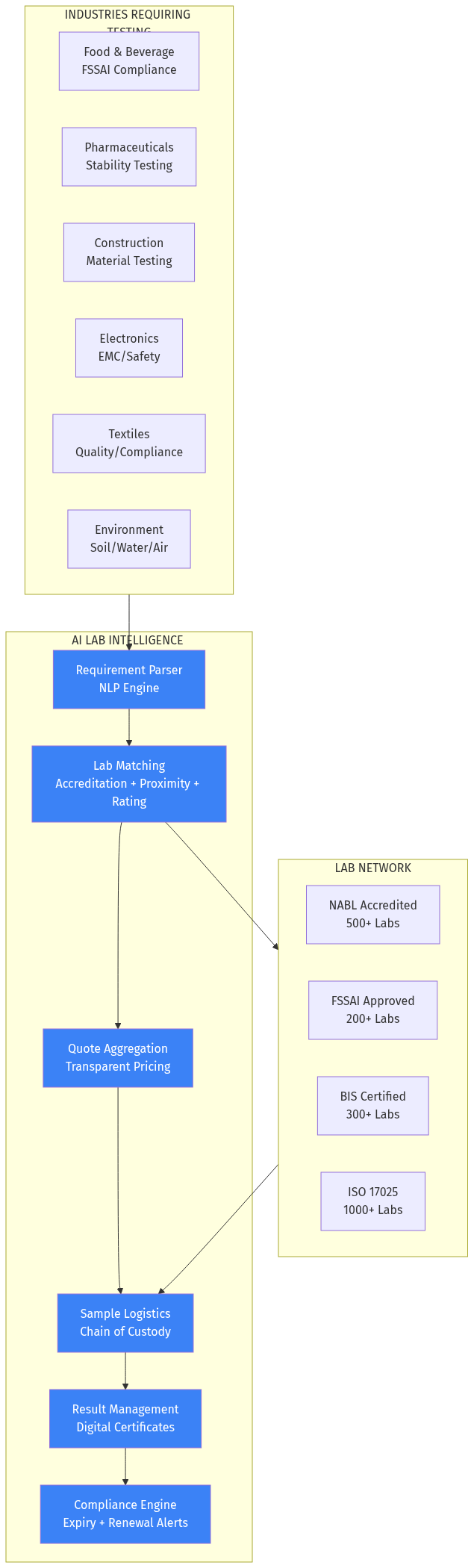
    Platform Architecture
    Platform Architecture

    Core Modules

    1. Requirement Parser
    • Natural language input for testing needs
    • Regulatory reference database (FSSAI, BIS, EPA, EU standards)
    • Product-to-test mapping
    2. Lab Discovery & Matching
    • Accreditation verification (live NABL/FSSAI/BIS checks)
    • Capability matching (tests offered, equipment, certifications)
    • Proximity-based ranking
    • Price comparison with historical data
    • Availability calendar integration
    3. Quote Management
    • Standardized quote format
    • Instant pricing for common tests
    • RFQ for specialized requirements
    • Price guarantee and dispute resolution
    4. Sample Logistics
    • Pickup scheduling with partner couriers
    • Chain-of-custody documentation
    • Temperature monitoring for sensitive samples
    • Delivery confirmation to lab
    5. Result Management
    • Digital report delivery
    • Structured data extraction from reports
    • Trend analysis across tests
    • Anomaly flagging
    6. Certificate Vault
    • Blockchain-verified certificate storage
    • Expiry tracking and renewal alerts
    • Auditor access portal
    • Supplier certificate aggregation
    7. Compliance Engine
    • Regulatory update monitoring
    • Gap analysis (current certs vs. required)
    • Renewal scheduling
    • Audit preparation reports

    8.

    Development Plan

    PhaseTimelineDeliverables
    MVP8 weeksLab directory (scraped + enriched), requirement parser, basic matching, quote request workflow
    V112 weeksSample logistics integration, digital certificate storage, 100+ lab partnerships
    V216 weeksAI-powered matching, compliance knowledge graph, mobile app
    V324 weeksAPI for enterprise integration, auditor portal, blockchain certificates

    MVP Scope

    • Focus: Food testing (FSSAI compliance)
    • Geography: Maharashtra, Gujarat, Karnataka (manufacturing hubs)
    • Labs: 50 partnerships with NABL-accredited food testing labs
    • Features: Test discovery, quote comparison, basic sample tracking

    9.

    Go-To-Market Strategy

    Phase 1: Food Manufacturers (Months 1-6)

    Why food first:
    • Regulatory pressure high (FSSAI enforcement increasing)
    • Testing frequency high (batch testing, shelf-life, nutritional)
    • SME segment underserved
    • Clear compliance requirements
    Acquisition:
  • Partner with food industry associations (AIFPA, FIC)
  • Content marketing: "Complete FSSAI compliance guide for food startups"
  • Outbound to D2C food brands (Slurrp Farm, Yoga Bar, Raw Pressery competitors)
  • Attend food processing exhibitions (AAHAR, India Food Forum)
  • Phase 2: Expand to Pharma & Construction (Months 6-12)

    Pharma: Stability testing, bioequivalence, raw material testing Construction: Cement testing, steel testing, soil analysis

    Phase 3: Enterprise & Export (Months 12-18)

    • API integration with ERP systems (SAP, Oracle)
    • Export compliance modules (EU, FDA, HALAL)
    • Multi-site certificate management

    Key Partnerships

    • Logistics: BlueDart, Delhivery, DTDC (cold-chain partners)
    • Insurance: New India Assurance, ICICI Lombard (product liability)
    • Fintech: Payment integration, invoice financing for labs
    • ERP: SAP, Zoho (compliance module integration)

    10.

    Revenue Model

    Transaction Fee

    • 5-12% of test value on transactions facilitated
    • Higher margin on specialized tests, lower on commoditized tests
    • Volume discounts for enterprise accounts

    Subscription (Certificate Vault)

    • Free: 10 certificates, basic tracking
    • Pro (₹2,999/mo): Unlimited certificates, renewal alerts, audit reports
    • Enterprise: Custom pricing, API access, SSO

    Value-Added Services

    • Rush Processing: Premium for expedited testing (platform + lab split)
    • Sample Logistics: Markup on pickup/delivery (5-10%)
    • Compliance Consulting: Audit preparation, gap analysis
    • Insurance: Testing-linked product liability insurance

    Lab Services

    • Premium Listing: Enhanced visibility for labs
    • Capacity Management: Tools for labs to optimize utilization
    • Invoicing & Collections: 2% for payment processing + collections
    Estimated Unit Economics (Year 2):
    • Average transaction value: ₹15,000
    • Take rate: 8%
    • Revenue per transaction: ₹1,200
    • Monthly transactions: 2,000
    • Monthly revenue: ₹24,00,000

    11.

    Data Moat Potential

    Proprietary Data Assets

    1. Test Result Database
    • Aggregate, anonymized test results across categories
    • Enable benchmarking: "Your product's shelf-life is in 80th percentile"
    • Identify quality trends by region, supplier, season
    2. Lab Performance Data
    • Turnaround time accuracy
    • Result consistency (same sample, multiple labs)
    • Communication responsiveness
    • Payment behavior
    3. Compliance Intelligence
    • Which regulations are changing
    • Which tests are becoming mandatory
    • Which labs are gaining/losing accreditations
    4. Pricing Database
    • Historical pricing across test types, labs, regions
    • Price elasticity by urgency, volume, relationship length

    Network Effects

    Demand-side: More manufacturers → better data → better matching → more manufacturers Supply-side: More labs → better coverage → more manufacturer choice → more volume → more labs Cross-side: Manufacturer compliance data → interesting for suppliers, insurers, regulators
    12.

    Why This Fits AIM Ecosystem

    Structural Fit

    This opportunity exemplifies the AIM philosophy:

    • Structure over Scale: Labs are commodities; the structured data about capabilities, accreditations, and performance is the moat
    • Decision over Discovery: IndiaMART helps you find labs; this helps you decide which lab to use
    • Trust Infrastructure: Testing is fundamentally about trust—verified, structured trust data

    Integration Points

    With Other AIM Verticals:
    • thefoundry.in (Industrial): Material testing for procurement
    • masale.in (Ingredients): FSSAI testing for spice suppliers
    • instabox.in (Logistics): Cold-chain sample transport
    • niyukti.in (Recruitment): Lab technician staffing

    Domain Synergy

    Potential domains to develop/acquire:

    • labtest.in, testlab.in
    • nabl.in (NABL-approved labs directory)
    • fssaitest.in, fssailab.in
    • certify.in, certified.in
    ---

    ## Verdict

    Opportunity Score: 8.5/10

    Applying PRE-MORTEM (Falsification)

    Assume 5 well-funded startups failed here. Why?
  • Lab Onboarding Friction: Labs are traditional businesses; getting them to use software is hard
  • Trust Transfer: Manufacturers trust their existing labs; switching requires overcoming relationship inertia
  • Regulatory Capture: Large TIC companies could lobby for regulations favoring their integrated model
  • Sample Sensitivity: Cold-chain logistics for biological samples is complex and expensive
  • Payment Terms: Labs expect 60-day terms; platform would need working capital for instant payments
  • Applying STEELMANNING

    Why might incumbents win?
    • SGS, Bureau Veritas, TUV have decades of brand trust
    • They're investing in digital capabilities (LIMS, portals)
    • Enterprise customers prefer one-stop-shop integrated providers
    • Regulatory relationships (being invited to standards committees) create moats
    • They could acquire any successful platform player

    Why This Still Works

  • SME Market Untouched: Incumbents chase enterprise; SMEs are underserved
  • Aggregation > Integration: Platform doesn't need to run labs; aggregation wins on selection
  • India-First: Global TIC players optimize for developed markets; India-specific platform has local context
  • AI Timing: NLP capabilities now mature enough to parse compliance requirements; wasn't possible 3 years ago
  • Trust Portability: If platform verifies accreditations directly with NABL/FSSAI, trust transfers from lab brand to platform
  • Second-Order Effects

    If this succeeds:

    • Labs compete on capability and price, not relationships → quality improves
    • SMEs can afford systematic testing → product quality across India improves
    • Compliance data aggregation → regulators can enforce more efficiently
    • Insurance companies get loss data → better product liability pricing

    Final Assessment

    This is a high-conviction opportunity for the following reasons:

  • Large, growing market with regulatory tailwinds
  • Clear pain points across both sides of the marketplace
  • Structural commoditization waiting for platform aggregation
  • AI timing enables capabilities that weren't previously possible
  • Strong AIM ecosystem fit as trust infrastructure
  • The main execution risks are lab onboarding and working capital for payment terms—both solvable with focus and capital.

    Recommendation: Build MVP focused on food testing in Maharashtra. Prove lab supply acquisition and manufacturer demand. Then expand.

    ## Sources