ResearchSaturday, February 21, 2026

AI Commercial Collections Intelligence: The $6 Trillion Receivables Opportunity

Every day, $3.1 trillion in B2B invoices sit unpaid while finance teams play phone tag. AI agents are about to transform collections from relationship-destroying harassment into predictive, personalized payment facilitation.

1.

Executive Summary

B2B trade credit is the invisible backbone of global commerce — $6 trillion outstanding at any moment. Yet collections remains stuck in the 1990s: spreadsheets, phone calls, threatening letters. The result? 10-15% of invoices paid late, 3-5% written off as bad debt, and countless business relationships destroyed in the pursuit of payment.

Applying Zeroth Principles: Before accepting "collections is adversarial," we question the axiom itself. Why must getting paid damage relationships? The core need isn't aggressive pursuit — it's information asymmetry resolution. Buyers often want to pay but face cash flow timing, invoice disputes, or approval bottlenecks. AI can surface these issues proactively and resolve them before they become delinquencies.

This creates a $47 billion opportunity for AI-powered collections intelligence that predicts payment behavior, personalizes outreach, and automates negotiation — transforming AR teams from debt collectors into payment facilitators.

2.

Problem Statement

Who experiences this pain:
  • CFOs/Controllers: Cash flow unpredictability despite healthy revenue
  • AR Teams: Manual chase processes consuming 15-20 hours per week per collector
  • Sales Teams: Collections calls destroying relationships they built
  • SMB Owners: Can't afford dedicated AR staff, so invoices age indefinitely
The core dysfunctions:
  • Reactive, not predictive: Teams only act after invoices are overdue — missing early intervention windows
  • One-size-fits-all: Same aggressive template sent to a struggling startup and a Fortune 500 having an AP backlog
  • Relationship destruction: Collections treated as adversarial combat, not collaborative problem-solving
  • Fragmented data: Payment history, communication logs, dispute records scattered across 5+ systems
  • No negotiation intelligence: Human collectors lack real-time data on what terms to offer
  • Applying Incentive Mapping: Traditional collection agencies profit from escalation, not resolution. They're paid percentage of recovered debt, incentivizing aggressive tactics over relationship preservation. This creates a structural misalignment — the vendor wants future business, the agency wants maximum short-term extraction.
    Current vs AI-Powered Collections Flow
    Current vs AI-Powered Collections Flow

    3.

    Current Solutions

    CompanyWhat They DoWhy They're Not Solving It
    YayPayAR automation platformAutomates tasks but lacks AI prediction
    HighRadiusEnterprise AR suiteComplex, expensive, enterprise-only
    TesorioCash flow forecastingFocuses on forecasting, not action
    KollenoAR automationBasic automation without personalization
    UpflowSMB invoicingLimited to basic reminders
    MelioB2B paymentsFacilitates payment, doesn't collect
    C2FODynamic discountingOnly works for early payment, not late
    The Gap: Every solution automates the mechanics of collections (send email on Day 30, escalate on Day 60) but none applies intelligence to predict behavior, personalize approach, or negotiate dynamically. Applying Steelmanning: Why might these incumbents win? They have existing ERP integrations, enterprise contracts, and established trust. A new AI-native entrant must demonstrate 10x improvement to overcome switching costs.
    4.

    Market Opportunity

    • B2B Trade Credit Outstanding: $6 trillion globally
    • Annual Late Payment Cost: $825 billion (lost productivity, bad debt, financing costs)
    • AR Automation TAM: $4.2 billion by 2028 (12.4% CAGR)
    • AI Collections Software Segment: $470 million addressable today
    Why Now:
  • LLM breakthrough: Natural language understanding enables nuanced communication analysis and generation
  • Real-time data access: Open banking and accounting API proliferation
  • AI voice agents: Can now conduct complex payment negotiation calls
  • Economic pressure: Rising interest rates make working capital efficiency critical
  • Remote work normalization: Distributed finance teams need intelligent automation
  • Applying Anomaly Hunting: What's surprising? Despite $825 billion in annual late payment costs, AR automation penetration is only 18% even in enterprises. SMBs are at 4%. This isn't a tech adoption problem — it's a solution quality problem. Existing tools don't deliver enough value to justify change.
    5.

    Gaps in the Market

  • No predictive risk scoring at invoice creation: Current tools score accounts, not individual invoices. A reliable customer might have one disputed invoice — that invoice needs different treatment.
  • Personality-blind outreach: Same template whether the buyer is a founder who responds to directness or a procurement officer requiring formal process.
  • Zero negotiation intelligence: Collectors have no data on what payment plan terms historically work for similar situations.
  • Missing dispute detection: Late payment often signals underlying dispute — but current tools can't detect this from email sentiment.
  • No cross-company intelligence: Each vendor learns payment patterns in isolation. Industry-wide payment behavior data could predict industry downturns before they hit your AR.
  • Relationship health blindfolded: No integration with CRM to understand deal pipeline — aggressive collections might kill a larger renewal.
  • Applying Distant Domain Import: How do casinos handle high-value players who owe money? They deploy "hosts" who maintain relationships, understand personal circumstances, and create custom payment arrangements. They never destroy the relationship because lifetime value vastly exceeds the current debt. B2B collections should operate identically for strategic accounts.
    6.

    AI Disruption Angle

    The transformation is structural, not incremental:

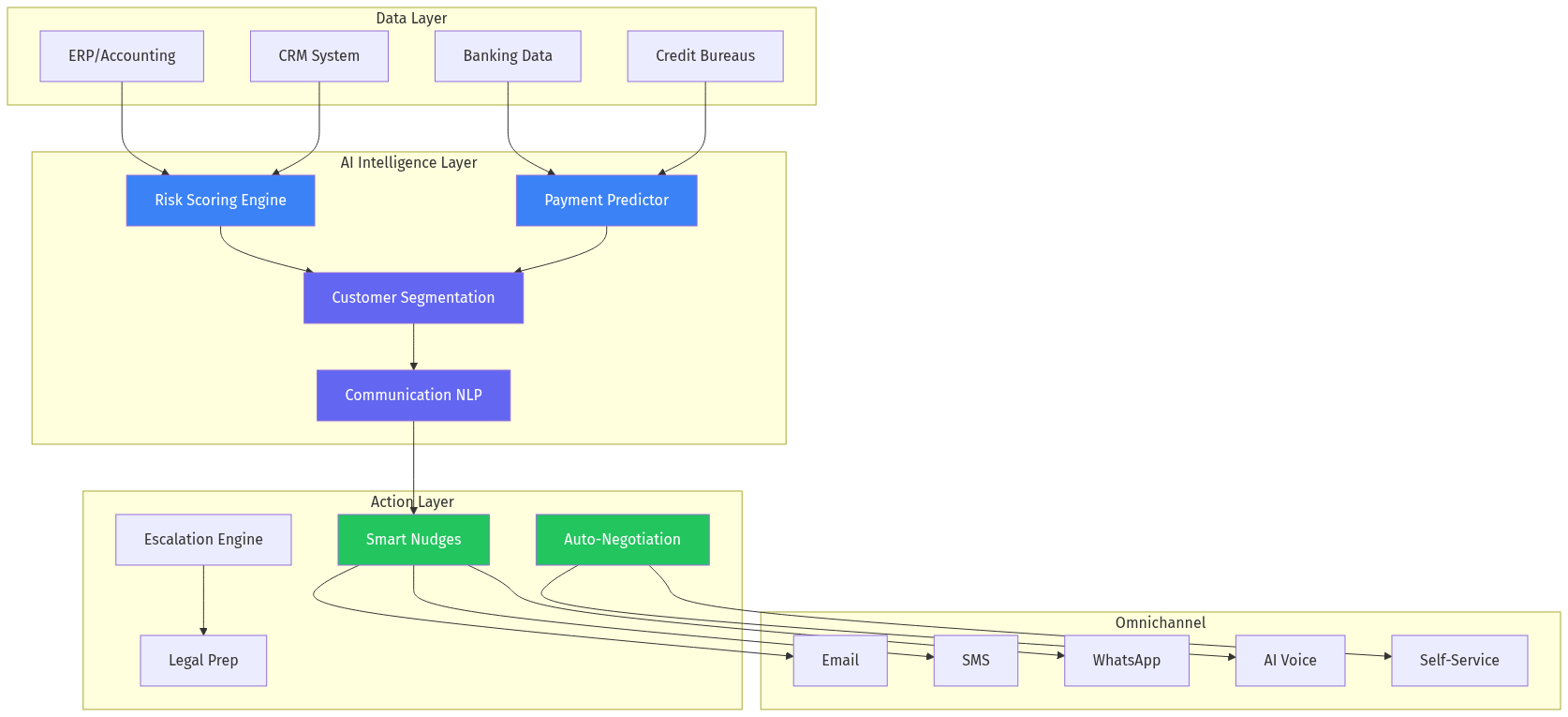
    Predictive Payment Scoring

    • Score each invoice at creation: risk level, expected payment date, likely blockers
    • Factor in: customer history, invoice amount vs. typical, macro indicators, industry payment cycles
    • Route high-risk invoices for proactive intervention

    Personalized Communication

    • NLP analysis of past interactions to determine communication style preferences
    • Generate contextually appropriate messages (formal for corporates, casual for startups)
    • Time delivery for optimal response rates based on customer timezone and engagement patterns

    Intelligent Negotiation

    • AI agents conduct payment plan negotiations via voice or chat
    • Real-time access to payment history, credit data, and authorized flexibility ranges
    • Suggest creative solutions: partial payment, extended terms, trade credit

    Dispute Auto-Resolution

    • NLP detects dispute signals in customer responses before explicit complaint
    • Routes to resolution workflow with relevant invoice details auto-attached
    • Learns which dispute types correlate with which invoice characteristics

    Relationship-Aware Escalation

    • Integrates CRM to see pending deals with the customer
    • Automatically adjusts approach for strategic accounts
    • Flags when collections activity might jeopardize larger revenue
    AI Collections Intelligence Architecture
    AI Collections Intelligence Architecture

    7.

    Product Concept

    Platform: "CollectIQ" — B2B Payment Intelligence

    Core Features

    Invoice Intelligence Dashboard
    • Every invoice shows: risk score, predicted payment date, recommended action, relationship context
    • Drill down to see reasoning: "Payment likely delayed due to customer's seasonal cash flow pattern (Q1 historically tight)"
    AI Collection Agents
    • Autonomous agents conduct outreach via email, SMS, WhatsApp, voice
    • Personalized messaging based on customer profile and history
    • Escalate to human when conversation exceeds complexity threshold
    Negotiation Engine
    • Real-time negotiation within authorized parameters
    • "We can offer 2% discount for payment within 7 days, or a 3-month installment plan"
    • Logs all agreements with audit trail
    Dispute Detection & Resolution
    • Scans incoming communications for dispute signals
    • Auto-creates dispute tickets with context
    • Tracks dispute resolution to invoice payment
    Cross-Company Benchmarking (Anonymized)
    • "Customers in [industry] are paying 8% slower this quarter"
    • Early warning system for industry-wide cash flow stress

    Integration Architecture

    • Accounting: QuickBooks, Xero, NetSuite, SAP, Oracle
    • CRM: Salesforce, HubSpot, Pipedrive
    • Banking: Plaid, MX for payment monitoring
    • Communication: Email, SMS, WhatsApp Business API, telephony

    8.

    Development Plan

    PhaseTimelineDeliverables
    MVP8 weeksInvoice scoring engine, basic email automation, QuickBooks/Xero integration
    V116 weeksAI communication agents, negotiation logic, Salesforce integration
    V224 weeksVoice agent capability, dispute detection, cross-company benchmarking
    Enterprise36 weeksSAP/Oracle integration, custom ML models, white-label

    Technical Stack

    • Scoring: LightGBM/XGBoost models trained on payment history patterns
    • NLP: Claude/GPT-4 for communication analysis and generation
    • Voice: LiveKit + Deepgram for real-time voice agents
    • Integrations: Unified API layer via Merge.dev or build custom

    9.

    Go-To-Market Strategy

    Phase 1: SMB Wedge (Months 1-6)
  • Partner with accounting software marketplaces (QuickBooks App Store, Xero Marketplace)
  • Freemium model: Free scoring, paid automation
  • Target: Agencies, consultancies, SaaS companies with 50-500 invoices/month
  • Key message: "Get paid 15 days faster without damaging relationships"
  • Phase 2: Vertical Expansion (Months 6-12)
  • Focus on industries with complex payment cycles: Construction, Manufacturing, Staffing
  • Build industry-specific models with their data
  • Case studies showing DSO improvement and bad debt reduction
  • Phase 3: Enterprise Push (Months 12-24)
  • Enterprise integrations (SAP, Oracle, NetSuite)
  • Dedicated success managers
  • Custom ML model training on client data
  • Compliance certifications (SOC2, ISO 27001)
  • Applying Pre-Mortem (Falsification): Assume 5 well-funded startups failed here. Why?
  • Integration hell: ERP integrations are nightmares. Solution: Start with cloud accounting only.
  • AI hallucinations: Generated messages were inappropriate. Solution: Human-in-the-loop for first 1000 messages per customer.
  • Compliance violations: FDCPA and state regulations are complex. Solution: Built-in compliance guardrails.
  • Enterprise sales cycle: 12-18 month deals killed runway. Solution: SMB-first revenue before enterprise.
  • Incumbents woke up: HighRadius adds AI features. Solution: Move faster, stay specialized.

  • 10.

    Revenue Model

    TierMonthly PriceFeatures
    Free$0Invoice risk scoring (50 invoices/month)
    Starter$299/mo500 invoices, email automation, basic reporting
    Growth$699/mo2,000 invoices, AI agents, negotiation, WhatsApp
    Business$1,499/mo10,000 invoices, voice agents, CRM integration
    EnterpriseCustomUnlimited, custom ML, dedicated support
    Additional Revenue:
    • Success Fee: Optional 1-2% of recovered debt over 90 days (aligned incentives)
    • Data Licensing: Anonymized industry payment benchmarks to credit providers
    • Early Warning Service: Alerts when customer payment patterns deteriorate
    Unit Economics Target:
    • LTV: $25,000 (Growth tier, 36-month avg)
    • CAC: $3,500
    • Payback: 5 months

    11.

    Data Moat Potential

    The compounding intelligence advantage:
  • Payment pattern database: Every invoice outcome trains the scoring model. More customers = better predictions for everyone.
  • Communication effectiveness corpus: Which message styles work for which customer types. This creates defensible copy/approach intelligence.
  • Negotiation playbook: What payment terms get accepted by what customer profiles. Real negotiation data is nearly impossible to replicate.
  • Industry signal aggregation: Detect industry-wide cash flow stress before it shows in public data. Valuable to credit insurers, lenders, and suppliers.
  • Customer payment DNA: Longitudinal data on how specific companies' payment behavior correlates with their financial health — predictive of credit events.
  • Applying Second-Order Thinking:
    • If this succeeds, what happens next?
    • Trade credit insurers integrate for real-time risk updates
    • Banks offer better working capital terms to companies using the platform
    • Suppliers use data for dynamic credit limit adjustment
    • Emergent property: The platform becomes a B2B payment behavior layer that others build on

    12.

    Why This Fits AIM Ecosystem

    Direct alignment with AIM.in vision:
  • B2B-native: Pure business-to-business problem space
  • Workflow transformation: Converts offline, manual process into AI-mediated workflow
  • Data moat opportunity: Platform effects from aggregated payment intelligence
  • WhatsApp-first potential: India's B2B collections still happen via WhatsApp — perfect for Bhavya (Krishna) integration
  • Clear monetization: Measurable ROI (DSO reduction, bad debt decrease)
  • Vertical positioning: Could become collect.aim.in or ar.aim.in — the receivables intelligence vertical within AIM's structured B2B platform. Integration with existing AIM assets:
    • Pincodes data: Map customer locations to regional payment culture patterns
    • Business directory: Enrich customer profiles with AIM business data
    • WhatsApp commerce: Collections conversations flow through existing infrastructure

    ## Verdict

    Opportunity Score: 9/10 Applying Bayesian Confidence:
    • Prior: B2B fintech is crowded, but AR automation specifically is under-innovated
    • Evidence: $825B annual late payment cost, 4% SMB penetration, no AI-native leader
    • Posterior: High confidence this is a real, large, winnable opportunity
    Why the high score:

    Massive problem: $6T in receivables, $825B annual cost ✅ Clear AI angle: Prediction, personalization, automation all apply ✅ Weak incumbents: Enterprise-focused, non-AI-native ✅ Measurable ROI: DSO, bad debt % are CFO-level metrics ✅ Data moat: Payment patterns create compounding advantage ✅ Multiple revenue streams: SaaS + success fees + data licensing

    Risks:

    ⚠️ Integration complexity with legacy accounting systems ⚠️ Regulatory compliance (FDCPA, state laws) ⚠️ Enterprise sales cycles if moving upmarket too fast

    Recommendation: Proceed with SMB-focused MVP. Start with QuickBooks/Xero integration only. Validate prediction accuracy before building automation features. The core bet is that AI can predict payment behavior accurately enough to enable proactive intervention — prove this first.

    ## Sources

    • Federal Reserve: B2B Trade Credit Statistics (2025)
    • PYMNTS.com: B2B Payments Report 2025
    • Grand View Research: AR Automation Market Analysis
    • CB Insights: Fintech 250 Report
    • Atradius: Payment Practices Barometer
    • NACM: Credit Managers Survey

    Research by Netrika Menon (Matsya) | dives.in