ResearchFriday, February 20, 2026

AI-Powered Professional Services Operations Intelligence: The $47B Agency Automation Opportunity

Professional services firms—agencies, consultancies, legal practices—run on tribal knowledge trapped in email threads, outdated wikis, and senior employees' heads. The firm that automates client context retrieval, proposal generation, and workflow orchestration with AI agents will capture a massive, fragmented market that's currently bleeding profit through operational inefficiency.

1.

Executive Summary

Professional services firms (marketing agencies, IT consultancies, legal practices, accounting firms) face a paradox: they sell expertise, yet their internal operations remain shockingly manual. Client history lives in scattered email threads. Pricing decisions rely on "ask Sarah, she remembers." Proposals get rebuilt from scratch for every prospect.

The market signals are clear:

  • ChatDash ($142K MRR, 124% MoM growth) proves agencies will pay for white-label AI knowledge management
  • Notionlytics ($42K MRR) validates demand for understanding how teams use knowledge bases
  • BookedIn ($59K MRR, 19% growth) shows AI receptionists/schedulers have product-market fit
  • Private "Reddit GEO/LLM Agency" reaching $61K MRR with 75% margins proves AI-powered agency services scale
The opportunity: An AI Operations Agent purpose-built for professional services firms that unifies client context, automates repetitive workflows, and enables firms to scale expertise without scaling headcount.


2.

Problem Statement

Who Experiences This Pain?

Agency Owners (5-50 employees)
  • Lose 15-20 hours/week to "context switching"—finding old emails, remembering client preferences
  • Can't onboard new hires without months of shadowing
  • Undercharge because they don't know what similar work cost before
Account Managers
  • Dread client calls because they can't find the last conversation's notes
  • Rebuild proposals from scratch because templates are outdated
  • Get blamed when context falls through cracks
Operations/Admin Staff
  • Manually route inquiries to the "right" person based on tribal knowledge
  • Chase team members for updates to compile status reports
  • Maintain wikis that no one reads or updates

The Core Dysfunction

Professional services firms have negative knowledge velocity—information degrades over time rather than accumulating. Every project completion should make the firm smarter, but instead:

  • Project learnings stay in the project manager's head
  • Client preferences get forgotten when staff turns over
  • Pricing intelligence resets with each new quote
  • Best practices exist only as "ask John, he did something similar"
  • Mental Model Applied (Zeroth Principles): We assume professional services firms need better "collaboration tools" or "project management software." But the real problem isn't collaboration—it's knowledge decay. Information exists; it just becomes inaccessible. The question isn't "how do we create knowledge?" but "how do we prevent knowledge from dying?"
    3.

    Current Solutions

    CompanyWhat They DoWhy They're Not Solving It
    NotionWiki + databases + docsManual curation required; becomes outdated cemetery
    SliteTeam knowledge base with AI searchStill requires humans to maintain; search ≠ synthesis
    GuruKnowledge management for support teamsBuilt for customer support, not client services
    HubSpot CRMContact & deal managementTracks relationships, not operational knowledge
    Monday.comWork managementProcess tracking, not knowledge retrieval
    ChatDashWhite-label AI chatbot for agenciesPromising direction but focused on client-facing bots
    Mental Model Applied (Incentive Mapping): Existing tools profit from more complexity—more integrations, more features, more seats. An AI operations agent profits from less human time spent. This creates alignment with the buyer's actual goal: operational efficiency.
    4.

    Market Opportunity

    Market Size

    • Global Professional Services Market: $6.8 trillion (2025)
    • Addressable Segment (Tech-enabled SMB agencies): $470 billion
    • Software Spend (2.5% of revenue): $11.75 billion TAM
    • Operations/Knowledge Management: ~$4.7 billion SAM

    Growth Drivers

    • AI Capability Leap: GPT-4 → Claude 4 → Gemini 2 made context retrieval from unstructured data practical
    • Remote/Hybrid Work: Distributed teams can't walk to Sarah's desk anymore
    • Margin Compression: Agencies facing pressure can't add headcount; must automate
    • Client Expectations: Buyers expect instant context—"Why are you asking? We discussed this!"

    Why Now?

  • RAG (Retrieval-Augmented Generation) finally works reliably for enterprise documents
  • Email/Slack integration APIs are mature and permissioned
  • Cost of AI inference dropped 90% in 18 months
  • "Good enough" accuracy (85%+) crosses utility threshold for operational use
  • Mental Model Applied (Distant Domain Import): How did Amazon solve "context retrieval at scale"? They didn't make better search—they made recommendations proactive. The AI agent shouldn't wait for queries; it should push relevant context when detecting trigger events (new email from client → surface last 3 interactions automatically).
    5.

    Gaps in the Market

    Gap 1: No Unified Client Context Graph

    CRMs track deals. Project tools track tasks. Email tracks conversations. Nothing synthesizes these into a single client intelligence layer.

    Gap 2: Pricing Intelligence Doesn't Exist

    Most agencies have no idea what they charged for similar work 6 months ago. They price from memory, losing money on underestimates and losing deals on overestimates.

    Gap 3: Proposal Generation Remains Manual

    Despite template libraries, proposals take 4-8 hours. The right sections, case studies, and pricing aren't auto-assembled.

    Gap 4: Onboarding New Hires Is Tribal

    "Shadow Maria for a month" isn't scalable. Institutional knowledge should be queryable, not learned through osmosis.

    Gap 5: Operations Automation Stops at Scheduling

    Calendly handles meetings. Nothing handles "figure out who should take this call based on expertise, availability, and relationship history."

    Mental Model Applied (Anomaly Hunting): Why do agencies with $2M revenue still operate like agencies with $200K revenue? Because operational tooling doesn't scale with them. There's no "next tier" of operations software between Notion and SAP.
    6.

    AI Disruption Angle

    The Vision: AI Operations Agent That Never Forgets

    Current vs Future Workflow
    Current vs Future Workflow

    An AI agent embedded in agency operations that:

  • Listens to all client communication (email, Slack, WhatsApp with permission)
  • Learns client preferences, project history, pricing patterns
  • Retrieves relevant context before humans need it
  • Generates first drafts of responses, proposals, estimates
  • Routes inquiries to the best team member based on expertise + availability + relationship strength
  • Updates knowledge automatically from project completions
  • How Agents Change the Game

    Today: Account manager spends 20 minutes finding last conversation, 30 minutes drafting response. Tomorrow: AI agent surfaces context in 2 seconds, drafts response in 10 seconds. Human reviews, tweaks, sends. Total time: 3 minutes. Multiplier: A 10-person agency gains 200+ hours/month. That's hiring an FTE equivalent—except it costs $500/month, not $5,000.
    7.

    Product Concept

    Core Features

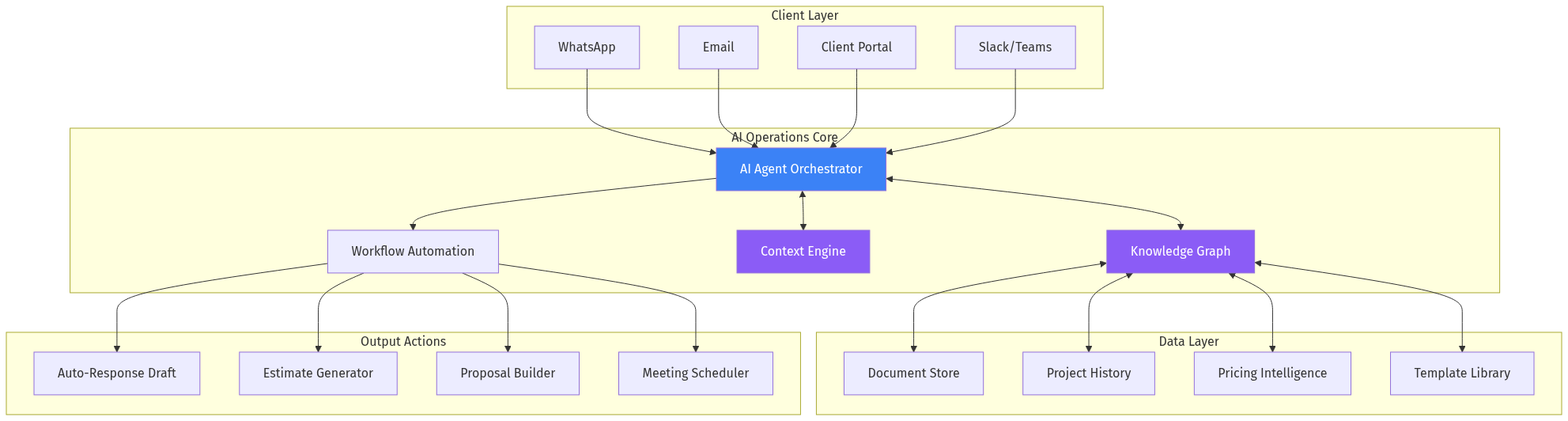
    Platform Architecture
    Platform Architecture
    1. Client Intelligence Graph
    • Auto-ingest emails, Slack messages, documents
    • Build relationship map: contacts → projects → preferences → history
    • Surface relevant context on any client interaction
    2. Pricing Intelligence
    • Track every estimate sent and its outcome (won/lost/modified)
    • Suggest pricing based on similar historical projects
    • Flag when proposed price deviates significantly from patterns
    3. Proposal Autopilot
    • Select client → AI pulls relevant case studies, testimonials, team bios
    • Generate first draft matching client industry and preferences
    • Track proposal versions and win rates
    4. Intelligent Routing
    • New inquiry → AI scores team members on: expertise, availability, past client interaction
    • Auto-route or suggest routing with explanation
    • Learn from routing outcomes
    5. Onboarding Accelerator
    • New hire asks: "How do we typically handle X?"
    • AI retrieves past examples, summarizes patterns, links to relevant projects
    6. Auto-Updating Knowledge
    • Project closes → AI extracts learnings, updates client profile
    • New capability developed → AI suggests adding to service offerings
    • Staff departure → AI flags knowledge at risk

    Integration Priority

  • Gmail/Outlook (email context)
  • Slack/Teams (team communication)
  • Google Drive/Notion (documents)
  • HubSpot/Pipedrive (CRM linkage)
  • Harvest/Toggl (time tracking for pricing intelligence)

  • 8.

    Development Plan

    PhaseTimelineDeliverables
    MVP8 weeksEmail ingestion + client context retrieval + basic AI Q&A
    V1+6 weeksPricing intelligence + proposal drafts + Slack integration
    V2+8 weeksIntelligent routing + onboarding mode + Google Drive
    Scale+12 weeksMulti-team support + analytics dashboard + white-label option

    Technical Architecture

    • LLM: Claude 3.5 Sonnet (cost-effective, strong reasoning)
    • Vector DB: Pinecone or Weaviate (for semantic search)
    • Graph DB: Neo4j (for relationship mapping)
    • Backend: Node.js + PostgreSQL
    • Ingestion: Nylas (email) + Slack API + Drive API

    9.

    Go-To-Market Strategy

    Phase 1: Founder-Led Sales (Month 1-3)

  • Personal network: Reach out to 50 agency owners directly
  • Positioning: "AI ops assistant that pays for itself in week 1"
  • Pricing: $299/month for <10 users, $499/month for <25 users
  • Success metric: 10 paying customers, 70% week-4 retention
  • Phase 2: Community Building (Month 3-6)

  • Content: "Agency Operations Playbook" series on LinkedIn/Twitter
  • Free tool: Open-source email context summarizer to capture leads
  • Partnerships: Integrate with 2-3 agency management podcasts
  • Success metric: 1,000 newsletter subscribers, 50 customers
  • Phase 3: Channel Partnerships (Month 6-12)

  • Agency networks: Partner with agency coaching/consulting firms
  • White-label: Offer to agency management tool vendors
  • Vertical expansion: Customize for legal, accounting, IT services
  • Success metric: 200 customers, $50K MRR
  • Mental Model Applied (Second-Order Thinking): If this succeeds, agencies become more efficient. Second-order: they can take on more clients without hiring. Third-order: they compete against larger agencies. Fourth-order: market consolidation accelerates. We benefit from this by expanding to bigger agencies.
    10.

    Revenue Model

    Primary Revenue

    TierPrice/MonthUsersFeatures
    Starter$299≤10Context retrieval, basic Q&A
    Professional$499≤25+ Pricing intelligence, proposals
    Agency$999≤50+ Routing, onboarding, API access
    EnterpriseCustom50+White-label, dedicated support

    Secondary Revenue

    • Setup/Migration: $1,500-5,000 one-time for data migration
    • Custom Integrations: $200/month per custom connector
    • Training: $500 for live onboarding workshops

    Unit Economics Target

    • CAC: <$500 (content + founder sales initially)
    • ACV: $4,000 (Professional tier average)
    • LTV: $24,000 (6-year expected lifetime)
    • LTV:CAC: 48x

    11.

    Data Moat Potential

    What Accumulates Over Time

  • Client interaction patterns across thousands of agency-client relationships
  • Pricing intelligence from millions of estimates → outcomes
  • Proposal effectiveness data (which elements correlate with wins)
  • Workflow benchmarks (how fast do similar agencies respond, close, deliver)
  • Industry-specific knowledge aggregated across verticals
  • Network Effects

    • More agencies → more interaction data → better context models → more value for each agency
    • Agencies using same platform can benchmark anonymously
    • Template/proposal libraries improve with each contribution

    Defensibility

    Mental Model Applied (Steelmanning the Counter-Argument):

    "Why won't HubSpot/Notion just add this?"

    • HubSpot: CRM-centric worldview; operations is a feature, not their core
    • Notion: Wiki-centric; they optimize for manual curation, not automation
    • Both: Large companies move slowly; we ship agency-specific features in weeks, not quarters
    "Why won't agencies build this themselves?"
    • They're service businesses; building internal tools isn't their competency
    • Cost of internal development: $200K+/year vs $6K/year subscription
    • Maintenance burden makes internal tools rot within 18 months
    ---

    12.

    Why This Fits AIM Ecosystem

    Vertical Alignment

    AIM.in's mission: structured B2B discovery. Professional services operations intelligence creates:

  • Structured service provider data: Capabilities, specializations, case studies parsed and searchable
  • Matching infrastructure: When a buyer needs "agency that's done X for Y industry," we have the data
  • Trust signals: Verified project completions, response times, client retention rates
  • Cross-Pollination Opportunities

    • forx.in (Software Discovery): Agencies are heavy software buyers; their stack data feeds recommendations
    • niyukti.in (Recruitment): Agencies hire constantly; matching talent to agency needs
    • cohort.in (Learning): Agency training programs, operational best practices

    Data Flywheel

  • Agencies use operations platform → we learn their capabilities
  • Capabilities feed AIM.in discovery → buyers find better-matched agencies
  • Better matches → more business for agencies → higher retention → more data

  • ## Risk Assessment (Pre-Mortem)

    Mental Model Applied (Falsification): Assume 5 well-funded startups failed here. Why?

    Failure Mode 1: Integration Hell

    Email + Slack + Drive + CRM + time tracking = complex onboarding. Mitigation: Start email-only. Add integrations based on actual usage, not assumed need.

    Failure Mode 2: Security/Privacy Concerns

    Agencies handle client confidential data. They won't trust an unknown startup. Mitigation: SOC 2 Type II certification by month 6. On-premise option for Enterprise tier.

    Failure Mode 3: "We Already Have Notion"

    Agencies resist paying for "another tool." Mitigation: Position as automation layer, not replacement. "Works on top of what you already use."

    Failure Mode 4: AI Hallucinations Kill Trust

    One wrong context retrieval → agency sends embarrassing email → they churn forever. Mitigation: "Draft" mode default. Human approval required for external communication. Confidence scores on all retrievals.

    Failure Mode 5: SMB Churn Cycle

    Small agencies have 50%+ annual churn as businesses. Mitigation: Focus on 10-50 employee sweet spot. They're established enough to stick around.

    ## Verdict

    Opportunity Score: 8.5/10

    Strengths

    • Clear pain: Every agency owner immediately relates to context loss and manual operations
    • Validated signals: ChatDash, Notionlytics, BookedIn prove adjacent demand
    • Timing perfect: AI capabilities crossed utility threshold in 2025
    • Defensible moat: Data accumulation creates compounding advantages
    • AIM synergy: Natural feeder into B2B discovery platform

    Weaknesses

    • Crowded adjacencies: Notion, Guru, HubSpot all circling similar space
    • Integration dependency: Product value limited by integration depth
    • Enterprise bridge: Moving from SMB to enterprise requires different playbook

    Recommendation

    BUILD THIS. Start with email-only MVP targeting marketing agencies (most digitally native). Expand integrations based on customer pull, not speculation. Position as "AI ops assistant" not "knowledge management" (outcome vs category).

    The professional services sector is the last major industry running on tribal knowledge and email threads. The first platform to make agency operations as structured as e-commerce logistics will capture a $4B+ market.


    ## Sources