AI Industrial Water Treatment & Effluent Intelligence: The $20B Compliance-Driven Opportunity
India's industrial wastewater treatment sector is a regulatory minefield of manual compliance, fragmented suppliers, and offline workflows. With Zero Liquid Discharge mandates expanding and 5,000+ chemical suppliers operating via WhatsApp, this is a marketplace waiting for AI consolidation.
1.
Executive Summary
Industrial water treatment is one of the largest, most regulation-intensive B2B sectors globally — yet it operates almost entirely offline. Factories manage effluent treatment plants (ETPs) through paper logs, order chemicals via phone calls, and submit compliance reports manually to pollution control boards.
The opportunity: Build an AI-powered platform that connects industrial facilities with treatment service providers, automates regulatory compliance, optimizes chemical usage through predictive analytics, and creates a unified data layer for India's fragmented ₹40,000 crore ($5B) industrial water management market.
This isn't just a marketplace play — it's infrastructure for the industrial decarbonization mandate. Every factory in India will need this.
2.
Problem Statement
Who experiences this pain?
Factory Operators & EHS Managers:
Manage effluent treatment plants with manual logs and guesswork
Face ₹1-10 lakh daily penalties for non-compliance
Order chemicals based on fixed schedules, not actual demand
Submit monthly reports to CPCB/SPCB through physical forms or legacy portals
No visibility into whether their treatment process is optimized
Chemical & Equipment Suppliers:
5,000+ fragmented suppliers competing on relationships, not performance
No way to demonstrate value beyond price
Lost sales due to lack of visibility into factory needs
Manual quoting process for every order
Regulators (CPCB, State PCBs, NGT):
Receive delayed, often falsified compliance data
Limited capacity for real-time monitoring
React to violations only after environmental damage occurs
The Core Dysfunction
Industrial wastewater treatment is compliance-driven but compliance-blind. Factories invest ₹50 lakh to ₹5 crore in ETPs, then operate them with:
Manual pH testing 2-3 times daily
Visual sludge monitoring
Fixed chemical dosing schedules (regardless of actual effluent load)
Paper-based logs for inspectors
Result: 60% of industrial units in India violate discharge norms at some point. Not because they want to — because they don't know they're violating until inspectors arrive.
3.
Current Solutions
Company
What They Do
Why They're Not Solving It
Thermax
ETP manufacturing, some IoT monitoring
Hardware-focused; no marketplace or compliance automation
Ion Exchange
Water treatment chemicals & systems
Product sales, not platform; no supplier aggregation
Enviro Control Associates
ETP operation & maintenance
Local service provider; not scalable technology
WaterSmart (US)
Agricultural water analytics
Consumer/ag focus, not industrial effluent
Pani Energy
AI for water treatment optimization
Targets municipal plants, not industrial SMEs
IndiaMART
B2B discovery for water treatment equipment
Lead gen only; no compliance, no intelligence
Why No One Has Solved This
Regulatory fragmentation: 28 State PCBs, each with different portals and requirements
Offline incumbency: Chemical suppliers have 20-year relationships with factories
Technical complexity: Every industry (textiles, pharma, food) has different effluent profiles
Low digitization: Most factory EHS managers are 45+ years old, paper-native
4.
Market Opportunity
India Industrial Water Treatment Market:
2024 Size: ₹38,000 crore (~$4.5 billion)
2030 Projected: ₹72,000 crore (~$8.6 billion)
CAGR: 11.2%
Global Industrial Wastewater Treatment:
2024 Size: $20.4 billion
2030 Projected: $28.6 billion
CAGR: 5.8%
Market Segments
Segment
Annual Spend (India)
Digitization Level
Treatment chemicals
₹12,000 cr
<5%
ETP equipment
₹8,000 cr
10%
AMC & operations
₹6,000 cr
<2%
Testing & compliance
₹4,000 cr
5%
Consulting & design
₹3,000 cr
15%
Why Now?
ZLD Mandates Expanding: Zero Liquid Discharge now required for textile, pharma, distillery, tannery, and sugar industries. More sectors added annually.
NGT Activism: National Green Tribunal ordering shutdowns weekly. Compliance is existential.
Real-time Monitoring Mandate: CPCB requiring online continuous emission/effluent monitoring systems (OCEMS) for 17 categories of industries.
Water Scarcity: Groundwater depletion forcing factories to recycle. Treatment quality directly affects production.
AI Maturity: IoT sensors + edge AI now cheap enough for SME deployment.
5.
Gaps in the Market
Gap 1: No Unified Compliance Layer
Every state PCB has a different portal. No single platform lets a multi-state manufacturer manage compliance across locations. Factories hire compliance consultants just to navigate the paperwork.
Gap 2: Chemical Procurement is Entirely Offline
₹12,000 crore spent annually on treatment chemicals — ordered via phone calls and WhatsApp. No price transparency, no performance benchmarking, no automated reordering.
Gap 3: Treatment Optimization is Guesswork
Most factories don't know if they're using 2x or 0.5x the chemicals they need. No feedback loop between treatment performance and dosing decisions.
Gap 4: No Predictive Maintenance for ETPs
Equipment failures cause compliance violations. Yet maintenance is calendar-based, not condition-based. Sensors exist but aren't connected to decision systems.
Gap 5: Supplier Discovery Broken
How does a new chemical supplier reach 50,000 industrial units? Cold calling. How does a factory find the best supplier for their specific effluent? Ask neighbors.
6.
AI Disruption Angle
Current vs AI-Enabled Water Treatment
From Reactive to Predictive
Today: Factory operator notices effluent color change → calls supervisor → tests pH → realizes violation → scrambles to fix → may or may not report.
With AI: Continuous sensor feed → AI detects anomaly pattern → predicts violation 4 hours ahead → auto-adjusts chemical dosing → logs everything for compliance → alerts only if human intervention needed.
The Agent Architecture
Effluent Monitoring Agent
- Ingests IoT sensor data (pH, COD, BOD, TSS, temperature)
- Detects anomalies against industry-specific baselines
- Predicts treatment failures before they occur
Compliance Agent
- Maps factory to applicable regulations (industry + state + zone)
- Auto-generates reports in PCB-required formats
- Tracks filing deadlines and document requirements
- Alerts before violations, not after
Procurement Agent
- Tracks chemical consumption patterns
- Predicts reorder timing based on production schedule
- Matches requirements to verified supplier network
- Negotiates bulk pricing automatically
Maintenance Agent
- Monitors pump vibration, membrane fouling, blower efficiency
- Predicts maintenance windows
- Schedules AMC visits automatically
- Maintains equipment history for audits
7.
Product Concept
EffluentOS: The Operating System for Industrial Water
Core Platform:
Factory dashboard with real-time ETP status
Multi-site management for enterprises
Mobile app for floor operators
PCB integration layer for automated reporting
Marketplace Layer:
Chemical supplier catalog with verified quality ratings
Equipment and spare parts procurement
AMC service provider matching
Testing lab scheduling and report integration
Intelligence Layer:
Treatment optimization recommendations
Benchmark against similar factories
Cost reduction opportunities
Compliance risk scoring
Target Industries
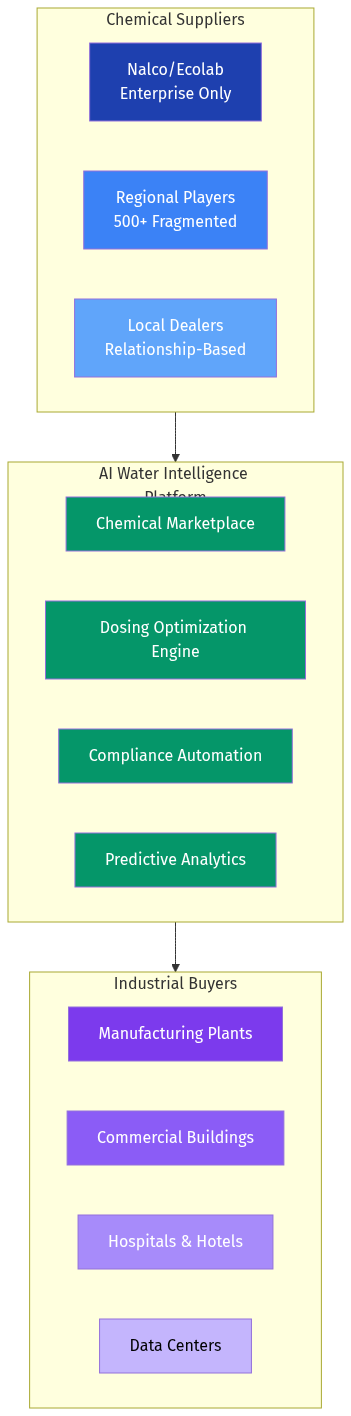
Industrial Water Treatment Architecture
Industry
Effluent Characteristics
ZLD Mandate
Textiles
High color, BOD, salts
✓ Yes
Pharma
Variable, sometimes toxic
✓ Yes
Distilleries
High BOD, acidic
✓ Yes
Food Processing
Organic load, FOG
Some states
Chemicals
Industry-specific
Many
Steel/Metal
Heavy metals, acids
Many
---
8.
Development Plan
Phase
Timeline
Deliverables
MVP
12 weeks
Single-factory dashboard, manual data entry, compliance calendar, supplier directory
V1
24 weeks
IoT integration, automated compliance reports, chemical marketplace with 50 suppliers
V2
40 weeks
Multi-site enterprise version, AI optimization recommendations, PCB API integration
V3
52 weeks
Full agent architecture, predictive maintenance, automated procurement
Technical Stack
IoT Layer: MQTT ingestion, edge processing for anomaly detection
Data Platform: TimescaleDB for sensor data, PostgreSQL for transactional
AI/ML: Time-series forecasting for treatment prediction, NLP for compliance document parsing
Integrations: CPCB/SPCB portals, SAP/Tally for enterprise, WhatsApp for SME communication
9.
Go-To-Market Strategy
Phase 1: Anchor Customers (Months 1-6)
Target 20 factories in one industrial cluster (e.g., Vapi GIDC or Ankleshwar).
Why clusters:
Shared CETP infrastructure = network effects
Same SPCB = one compliance integration
Word of mouth is hyper-local
Chemical suppliers already serve the cluster
Phase 2: Supplier Onboarding (Months 3-9)
Onboard chemical suppliers serving anchor cluster:
Offer dashboard showing customer demand
No commission initially — build supply side
Value prop: "See real-time requirements, not just RFQs"
Chemicals are a high-frequency, low-consideration purchase. Once integrated, switching costs are high.
11.
Data Moat Potential
Proprietary Data Assets
Effluent Signatures: Treatment profiles for every industry × geography combination
Supplier Performance: Delivery times, quality scores, pricing history
Compliance Intelligence: What triggers violations, how different PCBs behave
Optimization Patterns: Which chemical combinations work for which effluents
Equipment Reliability: Failure patterns by manufacturer, age, usage
Compounding Advantages
More factories → better benchmarks → more value per factory
More transactions → better supplier scoring → higher conversion
More compliance data → better prediction → lower violation rates
More sensor data → better AI models → more accurate optimization
Network effect: Factories want to be on the platform with the best supplier network. Suppliers want to be where the factories are. Classic two-sided marketplace dynamics.
12.
Why This Fits AIM Ecosystem
Vertical Opportunity
WaterOS.aim.in (or effluent.aim.in) becomes the industrial water treatment vertical:
Structured supplier discovery (not just leads)
AI matching based on effluent profile
Transaction layer with compliance built-in
Cross-Sell with Existing Verticals
AIM Vertical
Water Treatment Connection
TheFoudry.in
ETP equipment procurement
Masale.in
Food processing ETP chemicals
Niyukti.in
EHS manager hiring
Cohort.in
ETP operator training
Infrastructure Play
Every industrial B2B vertical eventually touches compliance. Building the compliance-first architecture here creates patterns reusable across:
Factory Act compliance
Fire safety
Labor law
Environmental clearances
---
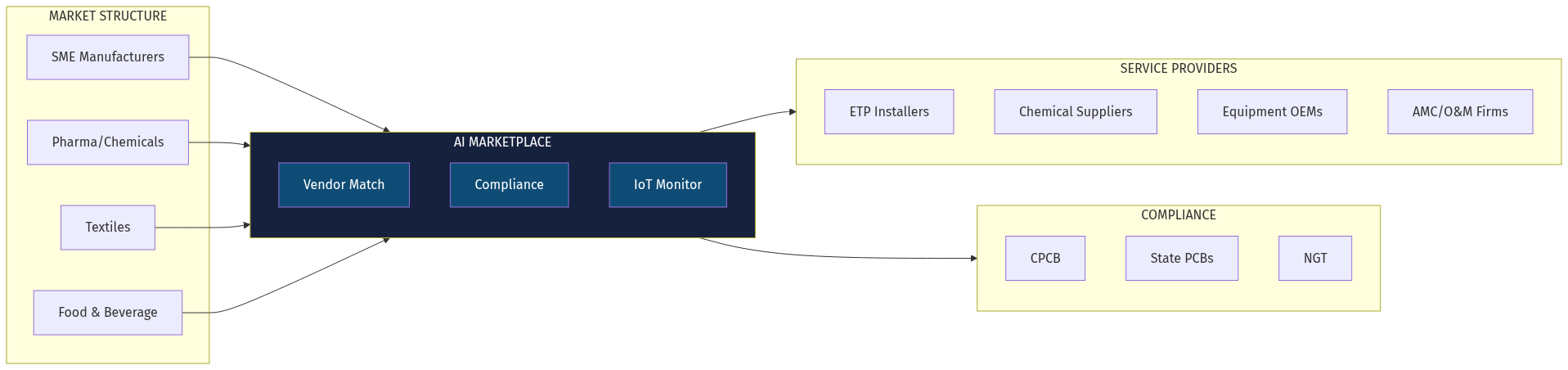
## Market Structure Analysis
Market Structure & Stakeholders
## Mental Models Applied
ZEROTH PRINCIPLES
Axiom questioned: "Factories don't want to comply with regulations."
Reality: Factories desperately want to comply — they just don't know how. Compliance is existential (shutdown risk), but the tools are so poor that even willing factories fail. This isn't a enforcement problem; it's an information problem.
INCENTIVE MAPPING
Who profits from status quo?
Compliance consultants charging ₹50K/month for paperwork
Chemical suppliers with opaque pricing
Equipment vendors selling oversized systems
Inspectors extracting "facilitation fees"
Our disruption: Transparency commoditizes consulting, performance-based pricing pressures inefficient suppliers, right-sizing ETPs reduces equipment waste, digital records eliminate discretionary inspections.
DISTANT DOMAIN IMPORT
Parallel from finance: Credit bureaus transformed lending by creating shared data infrastructure. Banks went from relationship-based lending to score-based lending.
Import: Build the "CIBIL for effluent" — a compliance score for every factory, built from treatment data. Banks can use it for green loans. Buyers can use it for supplier qualification. Regulators can use it for risk-based inspection.
FALSIFICATION (Pre-Mortem)
Assume 5 well-funded startups failed here. Why?
Hardware dependency: Required factories to install expensive sensors before seeing value. We start with manual entry, sensors are upgrade path.
Regulatory capture: PCBs didn't want transparency. We position as "making compliance easier" for PCBs too — fewer manual reviews.
Channel conflict: Disrupted chemical distributors who controlled relationships. We position as channel enhancement — distributors become fulfillment partners.
Complexity: Tried to solve all industries at once. We start with one industry (textiles) in one state (Gujarat).
B2B2B confusion: Sold to large enterprises who move slowly. We start with SMEs who feel compliance pain acutely.
STEELMANNING (Best Case Against)
Why might incumbents win?
Thermax, Ion Exchange, and Veolia could build this themselves. They have:
Customer relationships
Technical expertise
Capital
Counter-arguments:
Hardware margins > software margins; they won't cannibalize
Marketplace conflicts with their product sales
Software DNA is different from engineering DNA
Their SME coverage is weak — enterprise focus
True risk: Google/Microsoft offering free IoT platform that factories use instead. Mitigation: compliance intelligence is India-specific, defensible.
## Verdict
Opportunity Score: 8.5/10Strengths:
Massive TAM with regulatory tailwinds (ZLD expansion)
Fragmented market with no dominant digital player
Clear pain points and willingness to pay
Strong data moat potential
Natural fit for AI agent architecture
Fits AIM.in B2B marketplace thesis perfectly
Risks:
Regulatory complexity across states
Hardware dependency for full value
Slow enterprise sales cycles
Need domain expertise (hire EHS veterans)
Recommendation: Build this. Start with textile ETPs in Gujarat (Vapi/Ankleshwar cluster). Compliance-first, marketplace-second. The regulatory pressure makes this a "when not if" digital transformation — we can be the platform that enables it.
The water crisis is real. The regulation is tightening. The factories are desperate. The suppliers are fragmented. The timing is perfect.