The global corporate training market exceeds $400 billion annually, yet procurement remains stuck in the 1990s: manual provider searches, opaque pricing, paper certifications, and Excel-based compliance tracking. Industrial sectors face acute pain—OSHA violations alone cost U.S. companies $4.5 billion annually, while skills gaps in manufacturing, construction, and energy create cascading safety and productivity failures.
The opportunity: Build an AI-powered training intelligence platform that matches employers with vetted training providers based on specific compliance requirements, tracks certifications automatically, predicts skills gaps before they become violations, and creates a transparent marketplace for the fragmented training industry. Mental Model Applied — Zeroth Principles: We assume corporate training must be "provided" as an event. What if training intelligence became continuous—embedded in work systems, triggered by context, verified in real-time? The axiom of "training as episodic" may be the root constraint.1.
Executive Summary
2.
Problem Statement
Who Experiences This Pain?
Operations Managers & EHS Officers: Spend 15-20 hours monthly tracking certifications, scheduling recertifications, and searching for qualified training providers. A single expired forklift certification can halt operations. HR & L&D Directors: Manage training budgets of $500K-$10M+ without clear visibility into provider quality, outcome effectiveness, or competitive pricing. They buy based on relationships and referrals. Training Providers: Compete in a fragmented market where discovery is word-of-mouth, differentiation is impossible, and clients can't verify quality until after payment. Safety Regulators: Struggle with verification of training claims and certification authenticity in an industry plagued by fraudulent credentials.The Core Problems
3.
Current Solutions
| Company | What They Do | Why They're Not Solving It |
|---|---|---|
| LinkedIn Learning | General online courses | No industrial certifications, no compliance tracking, not industry-specific |
| SafetyCulture (iAuditor) | Inspection & training tools | Focused on checklists, not provider marketplace or procurement |
| Vector Solutions | LMS for safety training | Content provider, not marketplace; no third-party discovery |
| Skillsoft | Enterprise learning platform | General corporate training; weak on industrial/compliance |
| IndiaMART/TradeIndia | B2B listings | No training-specific structure, no certification tracking, no AI matching |
| Coursera for Business | Online learning | Academic focus; lacks hands-on industrial certifications |
4.
Market Opportunity
Market Size
- Global Corporate Training: $400+ billion (2025), growing at 8-10% CAGR
- Industrial & Compliance Training: $85 billion subset
- India Corporate Training: $35 billion, growing at 15% CAGR
- Safety Training Alone (Global): $12 billion
Growth Drivers
Why Now
2026 Inflection Point:- Digital credentialing standards maturing (Open Badges 3.0, blockchain verification)
- AI enables real-time skills gap analysis from HRIS/ERP data
- Post-pandemic hybrid training models create new provider flexibility
- Governments mandating digital compliance records
5.
Gaps in the Market
Gap 1: No Structured Provider Discovery
Training providers exist as website listings without standardized capability data, capacity information, or verified outcomes.Gap 2: Zero Price Transparency
An OSHA 10-hour course ranges from $25 (online, self-paced) to $500 (in-person, customized)—but no platform shows market rates by region, format, or provider tier.Gap 3: Paper-Based Credentialing
90%+ of industrial certifications exist only as paper documents or PDFs. No centralized, verifiable, employer-portable credential record.Gap 4: Reactive Compliance
Companies track certification expiry in spreadsheets, discovering gaps when auditors arrive—not when training can be proactively scheduled.Gap 5: No Outcome Measurement
Training completion is tracked; knowledge retention, behavioral change, and incident reduction are not. Buyers have no data to differentiate effective from ineffective providers.Gap 6: Multi-Site Fragmentation
Enterprises with 50+ locations manage training through dozens of local providers with no consolidated visibility or procurement leverage.6.
AI Disruption Angle
How AI Agents Transform Workforce Training
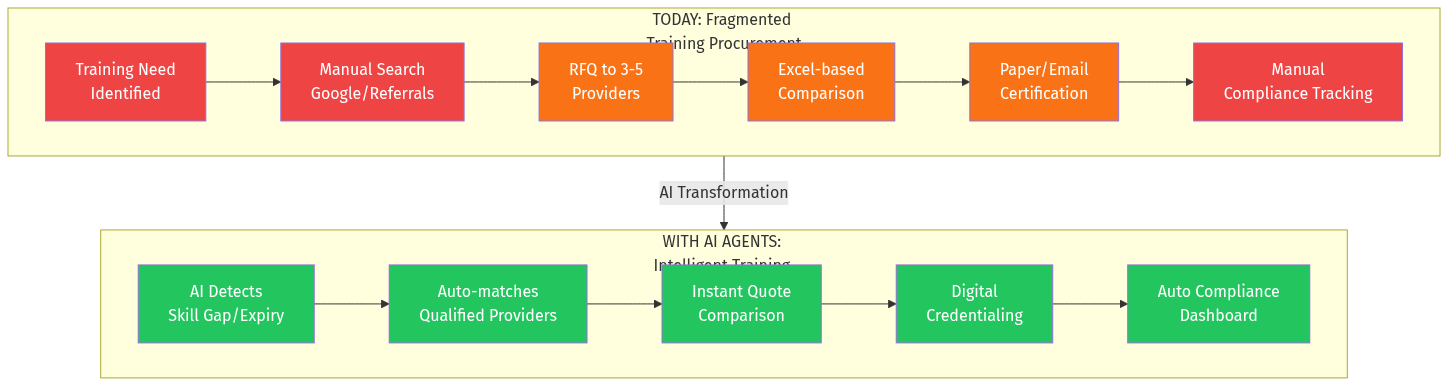
1. Predictive Skills Gap Analysis AI agents continuously analyze HRIS data, project schedules, and regulatory calendars to predict training needs before they become compliance gaps. "Your welders' AWS D1.1 certifications expire in 90 days—here are 3 vetted providers with availability." 2. Intelligent Provider Matching Instead of manual RFQs, describe your training need in natural language. AI matches against structured provider profiles: "We need HAZWOPER 40-hour for 25 field technicians in Vizag, flexible schedule, preferably vendor who can also provide confined space entry." 3. Real-Time Credential Verification Blockchain-anchored digital credentials that employers can verify instantly. No more calling training providers to "confirm this certificate is real." 4. Adaptive Learning Pathways AI identifies not just what certifications are needed, but what learning pathway closes skills gaps most efficiently—combining internal mentorship, online modules, and hands-on training. 5. Outcome-Based Provider Ranking Aggregate anonymized data across employers to identify which providers produce workers who actually demonstrate competency improvements (fewer incidents, faster onboarding, better audit scores).The Agent-to-Agent Future
Imagine: Your CMMS system detects a new equipment installation. It automatically queries the training intelligence platform for required operator certifications. The platform's agent identifies skills gaps in your maintenance team, matches qualified providers, and schedules training—all before the equipment arrives.
Mental Model Applied — Distant Domain Import: Airlines solve this exact problem. Pilots have centralized, verifiable, expiration-tracked certifications managed through integrated systems. Industrial training could adopt aviation's credential infrastructure model.7.
Product Concept

Platform Components
For Employers (Demand Side)- Skills Gap Dashboard: Real-time view of workforce certifications, upcoming expirations, and regulatory requirements by location
- AI Training Concierge: Describe needs naturally, get matched providers with transparent pricing
- Credential Vault: Centralized digital credential storage with verification links for auditors
- Compliance Calendar: Automated scheduling and reminders integrated with HRIS
- Structured Provider Profile: Certifications offered, geographic coverage, formats (online/onsite/hybrid), capacity, languages
- Lead Quality Dashboard: Qualified inquiries from verified employers, not spam
- Outcome Analytics: Aggregate performance data to demonstrate training effectiveness
- Dynamic Pricing Tools: Set rates by format, volume, location; benchmark against market
- Credential Verification API: Instant verification of any certification issued through the platform
- Audit Export: One-click compliance reports by facility, certification type, or time period
Key Features
8.
Development Plan
| Phase | Timeline | Deliverables |
|---|---|---|
| MVP | 8 weeks | Safety training vertical (OSHA, fire safety, first aid); 500 provider profiles in 5 Indian cities; employer search & inquiry flow |
| V1 | 12 weeks | Digital credentialing system; employer dashboard with expiry tracking; provider verification badges |
| V2 | 16 weeks | AI matching engine; price transparency (anonymous benchmarking); mobile credential wallet |
| V3 | 24 weeks | HRIS integrations (SAP, Workday, Darwinbox); outcome analytics; enterprise multi-site management |
Technical Stack
- Backend: Node.js/Python microservices
- Database: PostgreSQL with certification schema + Meilisearch for discovery
- Credentials: Open Badges 3.0 + optional blockchain anchoring
- AI: LLM-powered matching with structured provider data embeddings
- Integrations: HRIS webhooks, calendar APIs, compliance regulation feeds
9.
Go-To-Market Strategy
Phase 1: Safety Training Beachhead (Months 1-6)
Target: Manufacturing clusters (Pune, Chennai, Ahmedabad, Vizag industrial areas) Acquisition Strategy:- Highest compliance urgency (fines, shutdowns, injuries)
- Most fragmented provider landscape
- Clear certification standards (OSHA/DGFASLI equivalents)
- Repeat purchase (annual recertifications)
Phase 2: Industrial Skills Expansion (Months 6-12)
Add Verticals:- Equipment-specific certifications (forklift, crane, welding)
- Process certifications (ISO, HACCP, GMP)
- Technical skills (PLC programming, CNC operation)
- Industrial equipment OEMs (training as value-add)
- Industry associations (ready-made member access)
- Industrial staffing agencies (credential verification need)
Phase 3: Enterprise & Government (Months 12-24)
Enterprise Deals: Multi-site compliance management contracts Government: Skill India integration, NSDC certification tracking International: Gulf, Southeast Asia where Indian trained workforce migrates Mental Model Applied — Second-Order Thinking: If training becomes truly transparent and outcome-measured, second-order effects include: (1) training provider consolidation as quality becomes visible, (2) credential portability increasing worker mobility, (3) insurance companies demanding platform-verified training for risk assessment.10.
Revenue Model
Primary Revenue Streams
| Stream | Model | Estimated Take Rate |
|---|---|---|
| Transaction Fee | % of training booking value | 8-15% |
| Subscription (Employers) | Monthly compliance dashboard | ₹5,000-50,000/month |
| Subscription (Providers) | Premium listing + analytics | ₹3,000-25,000/month |
| Enterprise Contracts | Annual platform + services | ₹5-50 lakhs/year |
| Verification API | Per-verification fee | ₹10-50/verification |
| Advertising/Sponsorship | Provider promotion | ₹5,000-50,000/month |
Unit Economics Target
- Average Training Booking: ₹15,000
- Platform Take: ₹1,500 (10%)
- Provider LTV: ₹2 lakhs/year (active provider)
- Employer LTV: ₹3 lakhs/year (mid-market)
- CAC Target: ₹15,000 (employer), ₹5,000 (provider)
11.
Data Moat Potential
Proprietary Data Assets
Moat Deepening Over Time
- More transactions → better price benchmarks → more employer trust
- More credentials → stronger verification network → more employer adoption
- More outcome data → better provider ranking → quality providers stay
- More integrations → higher switching costs → enterprise stickiness
12.
Why This Fits AIM Ecosystem
Direct AIM.in Vertical Potential
Domain: train.aim.in or skillify.aim.inThis becomes a core AIM vertical because:
Cross-Vertical Synergies
- Equipment Suppliers: Recommend training providers for equipment they sell
- Service Providers: Verify contractor certifications before approving work orders
- Staffing: Certified worker matching for industrial temp labor
- Insurance: Training verification for policy underwriting
AIM Data Advantage
If AIM already knows which manufacturers buy which equipment, we can proactively surface training needs: "You purchased 3 new forklifts from Toyota Material Handling. Here are OSHA-compliant forklift operator training providers in your area."
## Mental Model Analysis
Falsification (Pre-Mortem)
Why might 5 well-funded startups have failed here?Steelmanning (Best Case Against)
Why might incumbents win?## Verdict
Opportunity Score: 8.5/10Strengths
- Massive market ($85B industrial training) with clear inefficiency
- Regulatory tailwinds ensure sustained demand
- AI genuinely improves matching, prediction, verification
- Strong data moat potential
- Natural AIM ecosystem fit
Risks
- Cold-start challenge (need both employers and providers)
- Relationship-driven market resistant to platformization
- Enterprise sales cycles extend path to revenue
- Credential standardization still evolving
Recommendation
Build as AIM vertical with phased approach:The industrial training intelligence opportunity is real, urgent, and underserved. The key is starting narrow (safety training), proving value (compliance calendar), then expanding with data advantage. This isn't a "nice to have"—it's a compliance necessity that AI can finally make efficient.
## Sources
❧