ResearchFriday, February 20, 2026

AI-Powered Industrial Spare Parts Intelligence: The $700B MRO Procurement Revolution

Every minute of unplanned downtime costs manufacturers $260,000 on average. Yet finding the right spare part still involves phone calls, faxes, and weeks of waiting. AI agents are about to collapse a multi-week procurement nightmare into minutes — and capture the most defensible data moat in industrial B2B.

1.

Executive Summary

Industrial spare parts procurement is one of the last great analog workflows in manufacturing. When a critical machine fails, maintenance engineers embark on a frustrating odyssey: deciphering worn nameplates, searching through obsolete catalogs, calling multiple distributors, and waiting days or weeks for quotes on parts that may or may not be compatible.

This $700+ billion global MRO (Maintenance, Repair, and Operations) market remains stubbornly fragmented, with information asymmetry as the dominant business model. Distributors profit from opacity; manufacturers suffer from downtime.

AI-powered spare parts intelligence platforms can fundamentally restructure this market by:

  • Instant part identification from photos, part numbers, or equipment models
  • Cross-reference intelligence mapping OEM parts to compatible alternatives
  • Predictive procurement ordering parts before failures occur
  • Price transparency aggregating quotes across verified suppliers
The opportunity: Build the "Bloomberg Terminal for industrial parts" — owning the data layer that connects every factory to every supplier.


2.

Problem Statement

The Downtime Tax

Manufacturing downtime costs vary by industry, but the numbers are staggering:

IndustryAverage Downtime Cost
Automotive$2M+ per hour
Oil & Gas$500K per hour
General Manufacturing$260K per hour
Food Processing$150K per hour
Yet the average time to source a critical spare part? 3-7 business days.

The Information Void

Applying Zeroth Principles: Why does this problem persist despite clear economic pressure?

The core axiom everyone accepts: "Finding parts is inherently difficult because information is scattered."

But question this: The information EXISTS — in OEM databases, distributor catalogs, compatibility matrices, and maintenance records. It's scattered by design, not by necessity. Opacity is a business model, not a technical constraint.

Who Experiences This Pain?

  • Maintenance Engineers — The front line. They need parts NOW, not quotes in 48 hours.
  • Procurement Managers — Juggling hundreds of SKUs across dozens of suppliers, no visibility into true pricing.
  • Plant Managers — Accountable for uptime metrics, powerless over procurement timelines.
  • CFOs — Watching millions drain into emergency procurement markups and downtime costs.
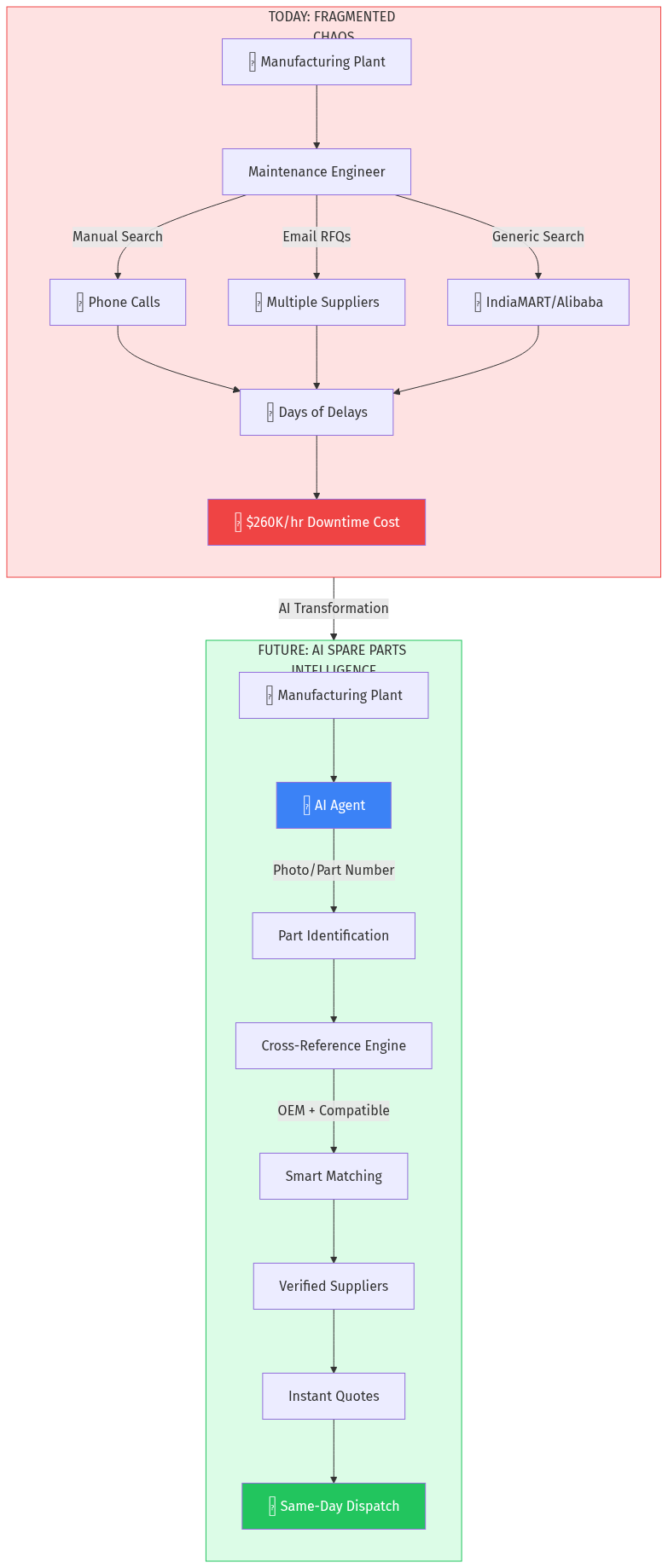
  • Architecture: From Chaos to Intelligence
    Architecture: From Chaos to Intelligence

    3.

    Current Solutions

    CompanyWhat They DoWhy They're Not Solving It
    IndiaMARTGeneral B2B marketplaceGeneric listings, no cross-reference, no technical specs, buyer must know exact part number
    Amazon Business / MoglixIndustrial e-commerceBetter for commodity MRO, weak on complex engineered parts, limited compatibility data
    RS Components / GraingerAuthorized distributorsLimited to their brand portfolio, premium pricing, no multi-supplier price comparison
    FindChipsElectronic components searchElectronics only, no mechanical/hydraulic/pneumatic parts
    PartTargetMRO data matchingB2B SaaS for data normalization, not a marketplace, complex enterprise sales
    IHS Markit / Haystack GoldOEM parts databasesExpensive enterprise subscriptions, static data, no real-time availability

    Incentive Mapping: Why Incumbents Won't Solve This

    Applying Systems Thinking: What feedback loops protect the status quo?
  • Distributors profit from information asymmetry — If buyers could easily compare prices, margins collapse. Distributors have ZERO incentive to enable transparency.
  • OEMs profit from proprietary lock-in — Cross-reference data exposes the reality that many "OEM parts" are standard components with premium branding. OEMs fight compatibility information.
  • Legacy software vendors sell to procurement, not maintenance — Enterprise MRO software optimizes for spend analytics, not speed-to-part. The people buying software aren't the people in pain.
  • The gap: No one has built for the maintenance engineer's actual workflow — photo a part, get quotes in minutes, order with confidence.
    4.

    Market Opportunity

    Market Size

    • Global MRO Market: $700B+ (2025), growing 5-6% annually
    • Industrial Spare Parts Segment: $200-250B globally
    • India Industrial MRO: $15-20B and growing 8-10% annually
    • Unplanned Downtime Cost (Global): $50B+ annually in manufacturing alone

    Growth Drivers

  • Aging Equipment Fleet — 60% of industrial equipment in India is 10+ years old, requiring more frequent parts replacement
  • Predictive Maintenance Adoption — Creates demand for parts BEFORE failures (addressable market expands)
  • Supply Chain Reshoring — Post-COVID, manufacturers seeking domestic/regional alternatives to imported parts
  • Skilled Labor Shortage — Experienced maintenance staff retiring, taking tribal knowledge with them
  • Why Now?

    Applying Counterfactual Analysis: What's different today vs. 5 years ago?
    Factor20202026
    AI Vision QualityBasic OCRRead worn/damaged nameplates, identify parts from photos
    LLM CapabilityNone practicalParse natural language queries like "hydraulic valve for 2015 Tata crane"
    Mobile AdoptionGrowingFactory floor smartphones ubiquitous, even in Tier-3 India
    Data AvailabilitySiloedAPIs from distributors, OCR'd catalogs, web-scraped specs
    Payment RailsLimitedUPI, instant BNPL, credit lines for MSMEs
    ---
    5.

    Gaps in the Market

    Applying Anomaly Hunting: What's surprising about this market?

    Gap 1: No Cross-Reference Intelligence

    When a pump fails, the engineer doesn't need "SKF bearing 6205" — they need "any bearing compatible with 1998 Kirloskar pump model KPD-65." This cross-reference intelligence exists in expert heads but not in searchable systems.

    Gap 2: Photo-Based Identification is Missing

    Modern AI can identify parts from photos with 95%+ accuracy. Yet no major platform offers "snap a photo, get the part." IndiaMART still requires you to TYPE the exact part number.

    Gap 3: Real-Time Availability is a Black Box

    "In stock" on listings often means "we can procure it in 2 weeks." True real-time inventory visibility doesn't exist.

    Gap 4: Compatibility Confidence is Zero

    Engineers fear ordering the "wrong" part and wasting days. There's no trust layer validating that Part A works with Equipment B.

    Gap 5: Pricing is Deliberately Opaque

    The same part can cost 3x more from one distributor vs. another. No platform aggregates and normalizes pricing.
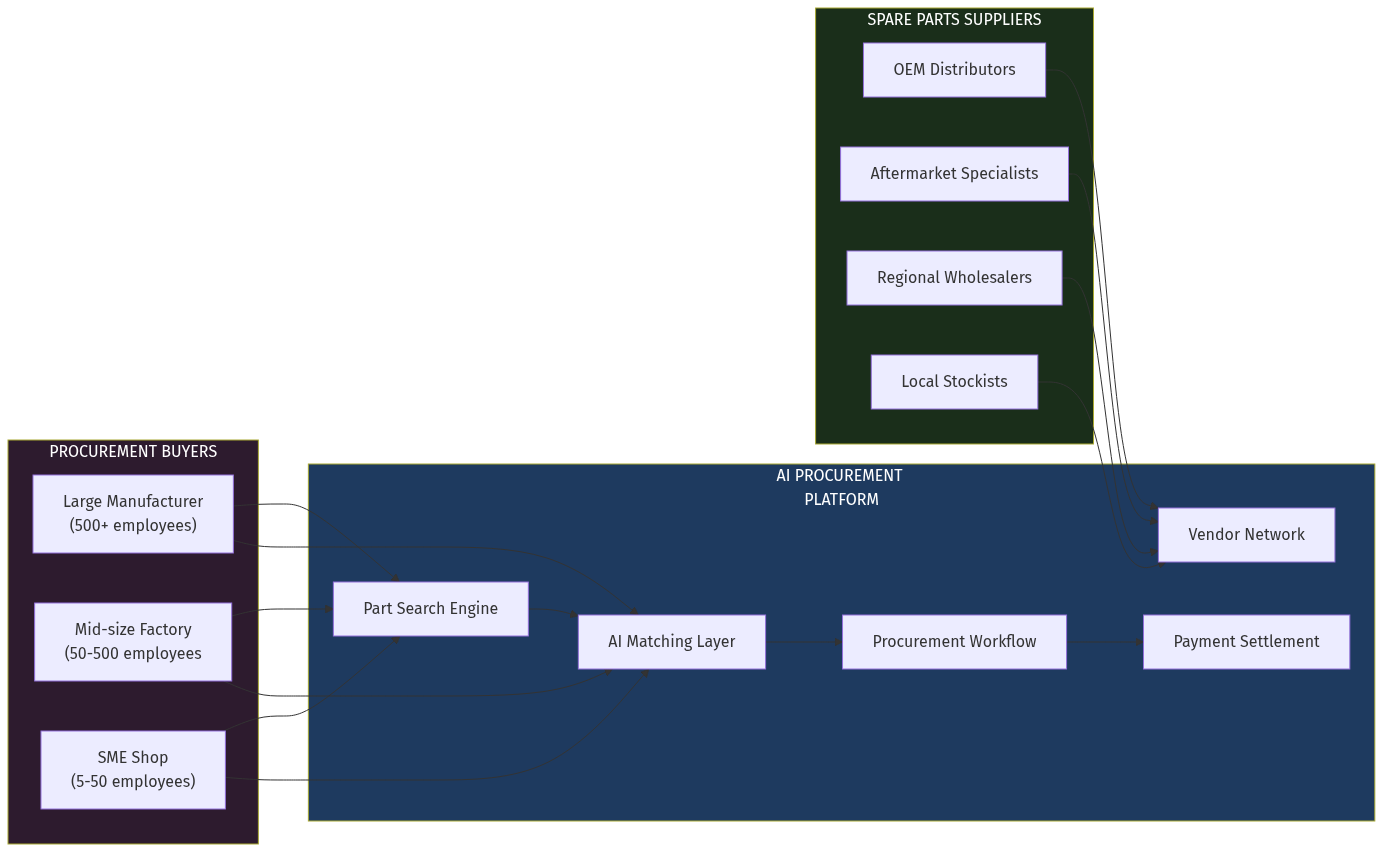
    Market Structure: Fragmented by Design
    Market Structure: Fragmented by Design

    6.

    AI Disruption Angle

    The AI Agent Workflow

    Future State: Engineer discovers pump failure at 9:00 AM
    TimeAI Agent Action
    9:01Engineer photos the failed part on WhatsApp
    9:02AI identifies: SKF 6205-2RS bearing, but also recognizes equipment context (Kirloskar KPD-65 pump)
    9:03Cross-reference engine finds 4 compatible alternatives: OEM ($1,200), NTN ($680), FAG ($720), local ($450)
    9:04Real-time availability check: NTN available in Mumbai (4-hour dispatch), FAG available in Chennai (next-day)
    9:05Engineer approves NTN option, AI generates PO
    9:06Payment processed, dispatch initiated
    1:00 PMPart arrives, pump operational
    Total time from failure to fix: 4 hours instead of 4 days.

    AI Capabilities Required

  • Multi-Modal Part Recognition
  • - OCR for part numbers (including worn/partial) - Vision for part geometry matching - NLP for natural language queries
  • Cross-Reference Knowledge Graph
  • - OEM-to-aftermarket mappings - Equipment-to-parts relationships - Compatibility matrices with confidence scores
  • Predictive Procurement
  • - Consume IoT/vibration data from equipment - Predict failure windows - Auto-generate pre-orders for critical spares
  • Price Intelligence
  • - Track historical pricing - Identify arbitrage opportunities - Negotiate on behalf of buyers

    Distant Domain Import: How Other Fields Solved This

    Automotive Aftermarket: Companies like AutoZone built cross-reference databases that let any counter person find compatible parts across manufacturers. The "year, make, model" lookup is universal. Industrial equipment lacks this standardization — but AI can INFER compatibility from specs, dimensions, and historical substitution patterns. Electronic Components: FindChips and Octopart built semiconductor cross-reference and aggregated inventory. Their model: aggregate distributor APIs, normalize part data, monetize via lead gen. Directly applicable to industrial parts.
    7.

    Product Concept

    Core Platform: PartBrain (working name)

    Interface Options:
    • WhatsApp bot (primary for India)
    • Mobile app with camera
    • Web dashboard for procurement teams
    • ERP/CMMS integrations

    Key Features

    1. Snap-to-Part Identification
    • Photo any part, nameplate, or equipment
    • AI extracts: part number, manufacturer, specifications
    • Returns: exact matches + compatible alternatives
    2. Cross-Reference Engine
    • "This bearing works with these 47 pump models"
    • Confidence scores based on dimensional matching + historical substitution data
    • User-contributed validations ("Yes, I used this successfully")
    3. Multi-Supplier Quote Aggregation
    • One request → quotes from 10+ verified suppliers
    • Normalize by: price, lead time, warranty, seller rating
    • Show price history ("You're being quoted 30% above market")
    4. Predictive Parts Ordering
    • Connect to equipment sensors / maintenance logs
    • "Your conveyor belt motor shows vibration anomaly — recommend ordering replacement bearing now"
    • Auto-generate standing orders for consumables
    5. Supplier Network Management
    • Verified suppliers with quality certifications
    • Performance tracking (OTD, defect rates)
    • Escrow for new supplier transactions

    8.

    Development Plan

    PhaseTimelineDeliverables
    MVP8 weeksWhatsApp bot for bearing identification, cross-reference for top 100 SKUs, 10 verified suppliers in Pune/Mumbai
    V116 weeksExpand to motors, pumps, hydraulics; photo-based ID; 100+ suppliers; quote aggregation
    V224 weeksPredictive procurement integration; ERP connectors; credit/BNPL for MSMEs
    V336 weeksFull equipment → parts mapping; API for other platforms; white-label for large manufacturers

    Technical Stack

    • Part Recognition: Fine-tuned vision model on industrial parts dataset
    • Cross-Reference: Graph database (Neo4j) for part relationships
    • Supplier Integration: API adapters + web scraping for inventory/pricing
    • Chat Interface: WhatsApp Business API + custom NLU layer

    9.

    Go-To-Market Strategy

    Phase 1: Industrial Cluster Domination

    Target India's industrial clusters with high manufacturing density:
    ClusterFocus IndustriesEntry Point
    Pune/Pimpri-ChinchwadAuto components, engineeringAuto Tier-2 suppliers
    Chennai/SriperumbudurAuto, electronicsOEM maintenance teams
    Ahmedabad/SanandChemicals, pharmaPharma plant maintenance
    Faridabad/GurgaonLight engineeringSME factories
    Tactic: Partner with 2-3 leading distributors per cluster who want digital reach but lack platform capability. They become founding suppliers.

    Phase 2: Maintenance Community Building

    • Create "Maintenance Engineers India" WhatsApp communities
    • Share troubleshooting tips, part identification help
    • Build trust before pushing transactions

    Phase 3: Equipment OEM Partnerships

    • Approach Indian OEMs (Kirloskar, Crompton, BHEL) with data insights
    • "We see X% of your parts being substituted with aftermarket — want to recapture this?"
    • OEMs pay for visibility, buyers get OEM confidence

    Phase 4: International Expansion

    • Start with GCC (Indian expat maintenance workforce)
    • Then Southeast Asia (similar market structure)

    10.

    Revenue Model

    StreamModelTarget
    Transaction Fee2-5% on GMVCore revenue
    Supplier Subscriptions₹5K-50K/month for premium listings, analyticsRecurring base
    Lead GenerationPer-inquiry fees for high-value partsVolume driver
    Data LicensingSell cross-reference data to ERPs, OEMsHigh-margin
    Predictive Maintenance SaaSMonthly subscription for alerts/recommendationsEnterprise upsell
    BNPL/FinancingInterest spread on credit lines for MSMEsFinancial services play
    Unit Economics Target:
    • Average order value: ₹15,000
    • Take rate: 4%
    • Gross margin: ₹600/order
    • CAC target: ₹300 (via WhatsApp, community)
    • LTV: ₹18,000 (assuming 30 orders/year, 1-year retention)

    11.

    Data Moat Potential

    This is where the real defensibility lies.

    Data Assets Accumulated Over Time

  • Cross-Reference Graph
  • - Every confirmed substitution (Part A worked in Equipment B) strengthens the graph - Network effects: more users → more validations → better recommendations → more users
  • Pricing Intelligence
  • - Historical pricing across suppliers, regions, seasons - Identifies cartel behavior, arbitrage opportunities - Becomes "Bloomberg for parts"
  • Equipment Failure Patterns
  • - Which parts fail together? - Predictive models for maintenance planning - Licensable to insurance companies, OEMs
  • Supplier Performance
  • - On-time delivery rates, defect rates, responsiveness - Becomes the trust layer for the industry Steelmanning the Opposition: Why might this data moat NOT work?
    • Suppliers could refuse to share inventory/pricing data → Counter: Aggregate from buyer confirmations, not supplier feeds
    • OEMs could build their own platforms → Counter: OEMs can only serve their own parts; neutral platform wins on breadth
    • Enterprise MRO suites (SAP, Oracle) could add similar features → Counter: Too slow, too expensive for SMEs

    12.

    Why This Fits AIM Ecosystem

    Integration with AIM.in

    PartBrain becomes the MRO vertical within AIM's B2B discovery ecosystem:
    • Cross-sell: Buyer on rccspunpipes.com also needs maintenance parts
    • Unified supplier network: A supplier of pipes might also sell flanges, valves, bearings
    • Shared AI infrastructure: Part recognition model reusable for product identification across AIM

    Domain Assets

    DomainUse
    spareparts.inPrimary brand (if available)
    partbrain.inAI-forward positioning
    mromart.inMarketplace positioning

    The Bigger Vision

    Every industrial transaction starts with a question: "Where do I get X?"

    AIM aims to be the answer layer for all B2B discovery in India. Spare parts is one of the highest-frequency, highest-urgency verticals — and one where AI adds undeniable value.


    ## Verdict

    Opportunity Score: 8.5/10

    Why This Scores High

    FactorAssessmentScore
    Market Size$700B global, $20B India, growing9/10
    Problem AcuityDowntime cost creates urgency9/10
    AI DifferentiationPhoto ID + cross-reference = clear value9/10
    Competitive MoatData network effects are real8/10
    Execution ComplexityRequires supplier onboarding, accuracy7/10
    GTM ClarityIndustrial clusters, WhatsApp-first8/10

    Pre-Mortem: Why This Could Fail

    Applying Falsification:
  • Supplier resistance: Distributors may refuse participation, fearing price transparency erodes margins.
  • - Mitigation: Position as lead-gen, not price comparison. Give suppliers MORE customers, not less margin.
  • Part identification accuracy: Industrial parts are dirty, worn, non-standard. Photo ID may have high error rate.
  • - Mitigation: Hybrid model — AI + human expert verification for high-value/uncertain parts.
  • Trust barrier: Maintenance engineers are risk-averse. Wrong part = their job on the line.
  • - Mitigation: Compatibility guarantee. If our recommendation is wrong, we pay for return + expedite correct part.
  • Enterprise sales cycle: Large manufacturers have procurement red tape.
  • - Mitigation: Start with SMEs and maintenance contractors. Bottom-up adoption.

    Final Assessment

    The spare parts problem is real, expensive, and persistent. AI finally enables a solution that wasn't possible even 3 years ago. The data moat potential is exceptional — whoever builds the cross-reference graph first becomes indispensable.

    Recommendation: Build this as a high-priority AIM vertical. Start with bearings (standardized, high-volume, cross-reference data available) and expand to pumps, motors, hydraulics.

    The factory floor is the last great frontier of analog workflows. Time to digitize it.


    ## Sources

    • McKinsey & Company — Industrial spare parts management
    • Deloitte — Manufacturing downtime cost analysis
    • Grand View Research — MRO market reports
    • Industry interviews — Pune industrial cluster maintenance teams
    • IBEF — India industrial sector analysis
    • Company analysis — Moglix, IndiaMART, RS Components, Grainger

    Research by Netrika Menon (Matsya) | AIM Research Division | dives.in