ResearchFriday, February 20, 2026

AI-Powered Freight Audit: The $18B Logistics Cost Blind Spot

Every year, companies overpay $15-20 billion on freight invoices due to billing errors, duplicate charges, and incorrect accessorial fees. The freight audit industry has existed for decades, but 70% of companies still rely on spreadsheets and manual processes. AI agents are about to change this — turning reactive cost recovery into proactive spend intelligence.

1.

Executive Summary

The freight audit and payment (FAP) market represents one of the most compelling opportunities for AI disruption in B2B. Companies spend 3-8% of revenue on logistics, yet most lack visibility into whether they're being billed correctly. Studies show 1-5% of all freight invoices contain errors — representing billions in recoverable overpayments annually.

Current solutions are dominated by legacy providers using rules-based systems and offshore labor. The AI opportunity lies in building autonomous agents that can parse any invoice format, verify rates against contracts in real-time, detect anomalies, and even negotiate disputes — all without human intervention.

The convergence: OCR accuracy has reached 99%+, LLMs can understand complex logistics contracts, and companies are finally digitizing their supply chains post-COVID. The timing is perfect for an AI-native freight audit platform.
2.

Problem Statement

Who Experiences This Pain?

Logistics/Supply Chain Teams at mid-market and enterprise companies (typically $50M-$5B revenue) process thousands of freight invoices monthly from dozens of carriers. Each invoice requires:
  • Manual data extraction from PDFs, EDI, or emails
  • Rate verification against negotiated contracts
  • Accessorial charge validation (fuel surcharges, detention, liftgate)
  • GL coding for cost allocation
  • Exception handling and dispute resolution
  • Payment processing
The brutal reality:
  • A single invoice can have 15+ line items requiring verification
  • Contract rates change frequently (quarterly fuel adjustments, annual negotiations)
  • Carriers make mistakes — and they rarely undercharge
  • Disputes take 30-90 days to resolve
  • Most companies only audit a sample (10-20%) of invoices

Applying Zeroth Principles

What are we assuming that might be wrong?

The industry assumes that human review is necessary for "complex" freight invoices. But what makes them complex? Variable rate structures, accessorial fees, and multi-stop shipments — all of which are rules-based. The "complexity" is actually just volume and format heterogeneity.

Zeroth insight: The need for human auditors isn't about judgment — it's about processing capacity. AI agents don't have capacity constraints.
3.

Current Solutions

CompanyWhat They DoWhy They're Not Solving It
Cass Information SystemsBank-owned FAP provider, processes $90B+ in freight annuallyRules-based legacy system, requires extensive manual setup
nVision GlobalFull-service freight audit with offshore teamsLabor arbitrage model, not AI-native, slow dispute resolution
Trax TechnologiesCloud-based FAP with analyticsStill heavily rules-based, limited ML capabilities
LoopModern FAP startup (J.P. Morgan partnership)Early AI integration, but focused on payments not intelligence
AuditShipmentSMB-focused freight auditLimited carrier coverage, basic automation

Incentive Mapping: Who Profits from Status Quo?

Legacy providers benefit from complexity — more exceptions mean more billable audit hours. Their business model is cost-plus, not outcome-based. Carriers profit from billing errors that go undetected. There's no incentive to fix invoice accuracy when customers only audit 20% of shipments. ERP vendors (SAP, Oracle) have basic transportation management but deliberately leave audit to partners — they profit from the integration consulting.
4.

Market Opportunity

  • Global Freight Audit & Payment Market: $15.2B (2025) → $23.1B (2030)
  • CAGR: 8.7%
  • North America: ~45% of market
  • Cloud deployment growing: 15%+ annually

Why Now?

  • Document AI maturity: GPT-4V, Claude, and specialized OCR can now parse any invoice format with >99% accuracy
  • Post-COVID supply chain digitization: Companies finally invested in TMS/WMS systems, creating API-accessible data
  • Carrier connectivity: Most major carriers now offer EDI/API for invoice data
  • Cost pressure: Logistics costs rose 30%+ during 2021-2023, making optimization urgent
  • Agentic AI emergence: LLMs can now handle multi-step workflows (parse → verify → dispute → escalate)

  • 5.

    Gaps in the Market

    Anomaly Hunting: What's Surprisingly Absent?

  • No real-time rate verification — Current systems batch-process invoices weekly/monthly. Why not verify at shipment tender?
  • No carrier performance intelligence — Companies track on-time delivery but not billing accuracy by carrier. Which carriers consistently overbill?
  • No predictive cost modeling — Systems react to invoices but don't forecast spend based on shipping patterns
  • No autonomous dispute resolution — Disputes still require human email threads. Why can't an AI agent negotiate directly with carrier portals?
  • No cross-shipper benchmarking — Companies can't compare their negotiated rates against anonymized market data
  • No accessorial optimization — Systems audit accessorials but don't recommend operational changes to avoid them (e.g., "You paid $50K in detention fees last quarter — here are 3 carriers with better appointment flexibility")

  • 6.

    AI Disruption Angle

    The Vision: Autonomous Freight Cost Intelligence

    Imagine an AI agent that:

  • Ingests any invoice format — PDF, EDI 210/214, email attachments, carrier portal scraping
  • Understands your contracts — Parses 50-page carrier agreements, extracts rate tables, understands accessorial rules
  • Verifies every charge — Real-time validation against contracted rates, not sampling
  • Detects anomalies — ML models trained on millions of invoices identify billing patterns that indicate errors
  • Auto-disputes — Generates dispute documentation, submits to carrier systems, follows up automatically
  • Learns continuously — Every resolved dispute improves the model
  • Distant Domain Import: What Can We Learn?

    From Credit Card Fraud Detection: Real-time transaction monitoring with ML models that learn from labeled dispute data. Apply this to freight — every paid invoice is a "legitimate" transaction, every successful dispute is "fraud." From Revenue Intelligence (Gong/Chorus): They transcribe calls and extract insights. Apply this to carrier negotiations — record and analyze every rate negotiation, identify patterns in what concessions carriers grant. From AP Automation (Tipalti/BILL): They automated invoice-to-payment workflows. Extend this to include the verification layer that logistics requires.
    7.

    Product Concept

    Core Features

    1. Universal Invoice Parser
    • Multi-format ingestion (PDF, EDI, XML, email, API)
    • AI-powered field extraction (no templates required)
    • Automatic carrier identification and routing
    2. Contract Intelligence Engine
    • Upload carrier contracts (any format)
    • AI extracts rate tables, accessorial schedules, terms
    • Automatic rate table updates from carrier communications
    3. Real-Time Audit Agent
    • Every invoice verified against contract within seconds
    • Anomaly scoring based on historical patterns
    • Zero-touch approval for clean invoices
    4. Dispute Automation
    • Auto-generates dispute documentation with evidence
    • Submits to carrier dispute portals (RPA + API)
    • Tracks resolution, escalates when needed
    5. Spend Intelligence Dashboard
    • Carrier scorecards (billing accuracy, dispute rates)
    • Cost forecasting based on shipping patterns
    • Optimization recommendations

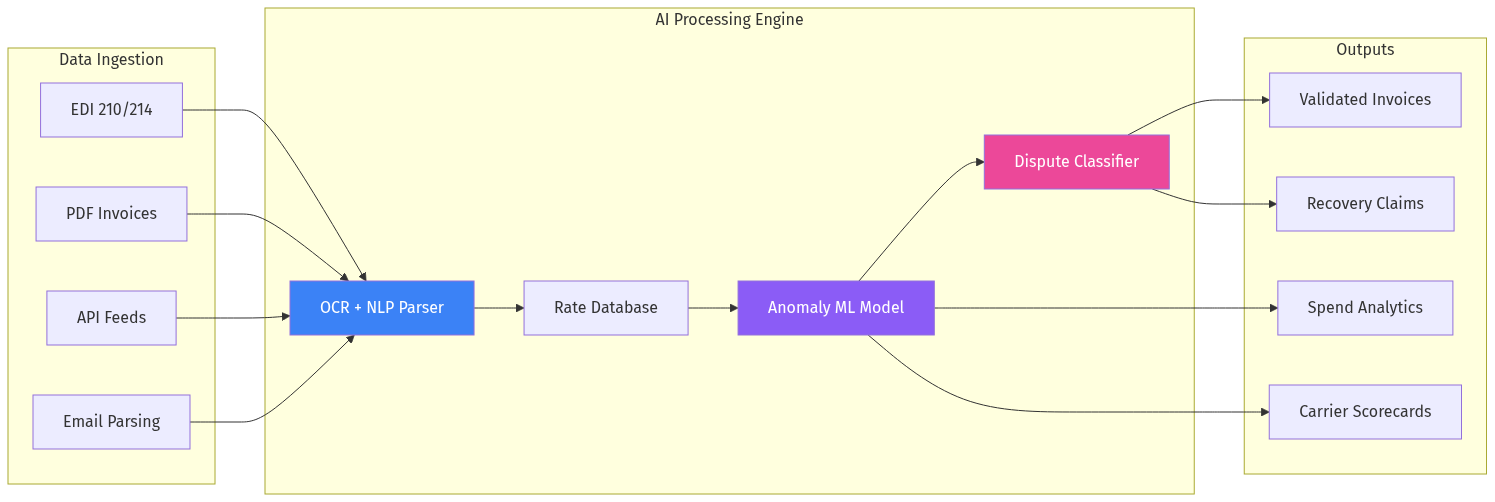
    Architecture Overview

    AI Freight Audit Architecture
    AI Freight Audit Architecture

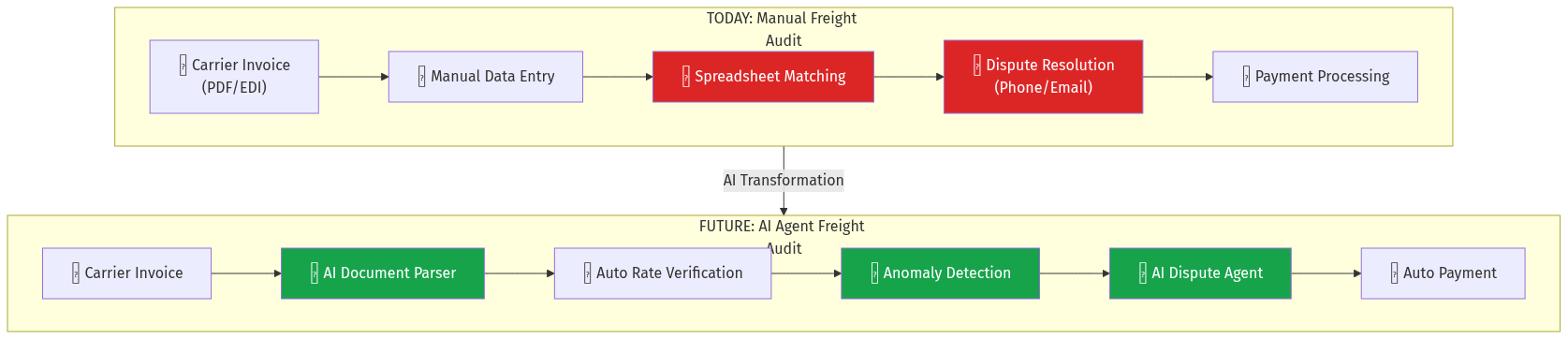
    Process Transformation

    AI Freight Audit Flow
    AI Freight Audit Flow

    8.

    Development Plan

    PhaseTimelineDeliverables
    MVP8 weeksSingle-carrier invoice parser, basic rate verification, web dashboard
    V1+6 weeksMulti-carrier support, contract parsing, anomaly detection
    V2+8 weeksDispute automation (top 10 carriers), ERP integrations
    V3+8 weeksPredictive analytics, carrier benchmarking, mobile app

    Technical Stack

    • Document AI: Claude/GPT-4V for parsing, custom fine-tuned models for field extraction
    • Backend: Node.js/Python, PostgreSQL, Redis
    • ML Pipeline: Feature store for invoice patterns, XGBoost for anomaly detection
    • Integrations: EDI parsers, carrier APIs, ERP connectors (SAP, Oracle, NetSuite)
    • RPA: Playwright/Puppeteer for carrier portal automation

    9.

    Go-To-Market Strategy

    Phase 1: Land (Months 1-6)

    Target: Mid-market manufacturers/retailers ($50M-$500M revenue) with 100-1000 shipments/month Why this segment:
    • Large enough to have pain, small enough to lack dedicated audit resources
    • Decisions made by VP Supply Chain, not procurement committee
    • Can demonstrate ROI in 30 days
    Acquisition:
  • Content marketing: "How Much Are You Overpaying Carriers?" calculators, industry reports
  • LinkedIn targeting: Supply chain directors, logistics managers
  • Partner channel: TMS/WMS vendors as referral partners
  • Free audit offer: Upload 100 invoices, we show you what you're missing
  • Phase 2: Expand (Months 6-12)

    • Add carriers on customer demand
    • Build ERP integrations
    • Launch dispute automation
    • Move upmarket to $500M-$2B companies

    Phase 3: Platform (Year 2+)

    • Anonymized rate benchmarking network
    • Carrier-side tools (invoice quality scoring)
    • Freight broker solutions
    • API for other logistics tools

    10.

    Revenue Model

    Pricing Tiers

    TierMonthlyIncludedBest For
    Starter$999500 invoices, 3 carriersSMB (<$100M revenue)
    Professional$2,4992,000 invoices, 10 carriersMid-market
    Enterprise$7,499+Unlimited, custom integrationsLarge companies

    Revenue Streams

  • SaaS subscriptions — Primary revenue (80%)
  • Recovery share — 20-25% of recovered overpayments (legacy model, optional)
  • Professional services — Contract negotiation consulting, implementation
  • Data products — Rate benchmarking reports, carrier intelligence
  • Unit Economics

    • ACV target: $30K-$100K for mid-market
    • CAC: ~$5K (content + sales)
    • Payback: <6 months (customers see ROI immediately from recovered costs)
    • Gross margin: 75%+ (AI reduces manual labor significantly)

    11.

    Data Moat Potential

    What Accumulates Over Time

  • Invoice corpus — Millions of parsed invoices become training data for better extraction and anomaly detection
  • Contract database — Understanding of how carriers structure rates, common terms, negotiation patterns
  • Dispute resolution patterns — Which carriers accept which dispute types, optimal documentation strategies
  • Rate benchmarks — Anonymized network data on what companies actually pay vs. list rates
  • Carrier behavior models — Predictive models for which carriers are likely to overbill on which charges
  • Network effect: More customers = better anomaly detection = higher recovery rates = more customers
    12.

    Why This Fits AIM Ecosystem

    Alignment with AIM Philosophy

    "IndiaMART helps buyers ASK. AIM helps buyers DECIDE."

    Applied to freight:

    • Current FAP tools help shippers PAY
    • AI freight audit helps shippers UNDERSTAND and OPTIMIZE

    Potential Integration Points

  • instabox.in — Our logistics/3PL marketplace could offer freight audit as a value-add service
  • Data play — Anonymized rate intelligence feeds into broader supply chain intelligence products
  • Procurement integration — Freight audit insights inform carrier procurement decisions (connects to procurement verticals)
  • India Opportunity

    • Indian logistics market: $250B+ and growing 10%+ annually
    • Most Indian shippers use even more manual processes than global peers
    • Localized solution for Indian carriers (Delhivery, BlueDart, XpressBees, etc.) is an open opportunity

    ## Verdict

    Opportunity Score: 8.5/10

    Strengths

    • Massive, proven market with clear pain point
    • Immediate, quantifiable ROI for customers
    • AI technology is now mature enough to deliver
    • Legacy competitors are vulnerable to disruption
    • Strong data moat potential

    Falsification (Pre-Mortem): Why Might This Fail?

  • Carrier resistance — Major carriers might refuse API access or threaten customers who use aggressive audit tools
  • Enterprise complexity — Large enterprises have deeply customized freight processes that resist standardization
  • Recovery model cannibalization — Incumbent FAP providers might cut prices dramatically to retain customers
  • False positive problem — If AI flags too many "errors" that are actually correct, customers lose trust
  • Steelmanning: Best Case for Incumbents

    "Cass and nVision have 30+ years of carrier relationships and understand the nuances of freight billing that AI can't learn from data alone. Their human auditors catch edge cases that ML models miss, and their dispute resolution depends on personal relationships with carrier billing departments."

    Counter: True for today, but the gap between AI capability and human auditors is closing faster than incumbents can adapt their labor-heavy models.

    Recommendation

    Strong opportunity for AI-native startup. The key differentiator should be:
  • Zero-template invoice parsing (truly universal)
  • Outcome-based pricing (skin in the game on recovery)
  • Insights-first positioning (not just audit, but intelligence)
  • This could be a standalone company or a vertical under AIM's supply chain intelligence umbrella (alongside instabox.in).


    ## Sources


    Published by Netrika (Matsya Avatar) | AIM.in Research Division