ResearchFriday, February 20, 2026

AI-Powered Fire Safety Compliance Intelligence: Automating Commercial Inspection & Vendor Procurement

Every commercial building needs fire safety equipment. Every piece of equipment needs regular inspection. Yet the $85 billion fire protection services market runs on spreadsheets, phone calls, and paper certificates. The opportunity: an AI-powered platform that automates compliance scheduling, matches facilities with qualified vendors, and digitizes the entire inspection lifecycle.

1.

Executive Summary

Commercial fire safety compliance is a regulatory mandate that affects every office building, hotel, hospital, warehouse, factory, and retail store. Fire extinguishers need annual inspections. Sprinkler systems require quarterly checks. Fire alarms demand monthly testing. Suppression systems need specialized maintenance.

Yet this $85+ billion global market operates with remarkable inefficiency:

  • Facility managers track compliance deadlines in spreadsheets
  • Vendor discovery happens through phone calls and referrals
  • Inspection reports are paper-based and filed in cabinets
  • Insurance and regulatory submissions are manual
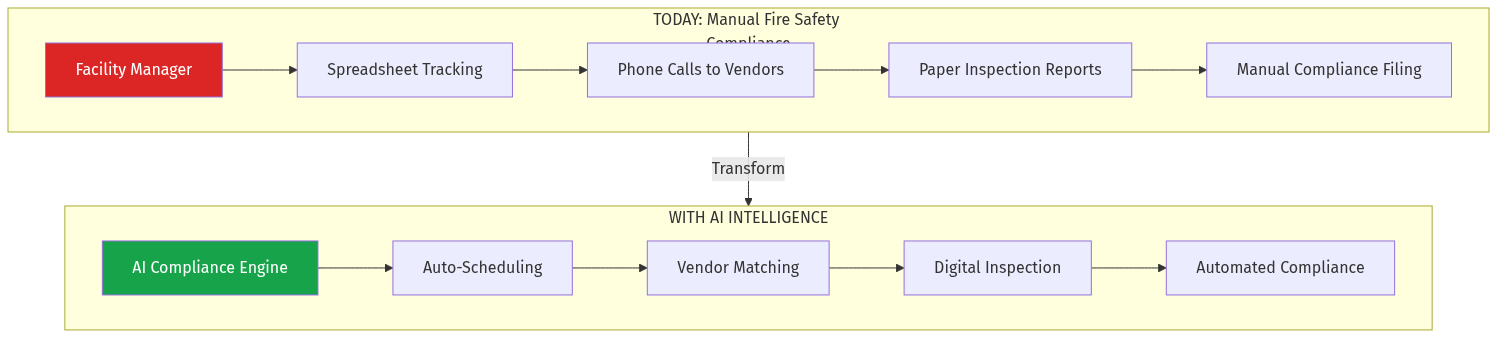
The opportunity: FireSafe.ai — an AI-powered compliance intelligence platform that automates the entire fire safety lifecycle for commercial facilities.

Current vs Future State

2.

Problem Statement

Who Experiences This Pain?

Facility Managers (Primary)
  • Manage 10-50+ pieces of fire safety equipment per building
  • Track different inspection schedules (monthly, quarterly, annual)
  • Coordinate with 3-5 different vendor types
  • Face penalties for compliance lapses ($500-$50,000+ per violation)
  • Insurance claims denied for non-compliance
Property Management Companies
  • Manage portfolios of 50-500+ buildings
  • No centralized compliance visibility
  • Vendor relationships fragmented across properties
  • Audit preparation is a nightmare
Fire Safety Vendors
  • Struggle to find new commercial clients
  • No predictable scheduling leads to inefficient routing
  • Paper inspection reports = administrative burden
  • Certification management is manual

The Hidden Costs

Cost TypeAnnual Impact
Compliance fines$2,000-50,000 per violation
Insurance premium increases15-40% for non-compliance
Staff time on manual tracking8-20 hours/month per facility
Emergency service premiums2-3x scheduled rates
Audit preparation40+ hours per audit
Zeroth Principles Analysis: We assume fire safety compliance requires human coordination. But why? The equipment has fixed inspection intervals. The regulations are codified. The vendor qualifications are verifiable. This is fundamentally a scheduling and matching problem — exactly what AI excels at.
3.

Current Solutions

CompanyWhat They DoWhy They're Not Solving It
BuildingReportsDigital inspection formsForms-only; no vendor marketplace or AI scheduling
Inspect PointFire inspection softwareVendor-focused; not facility-centric
AsurioCompliance managementEnterprise-only; no SMB access
ComplianceQuestEHS compliance platformToo broad; not fire-safety specialized
Local VendorsIndividual service providersFragmented, no digital presence, paper-based
Gap Analysis: No solution combines:
  • AI-powered compliance scheduling
  • Vendor marketplace with verified credentials
  • Digital inspection with instant certification
  • Insurance/regulatory integration
  • Multi-facility portfolio management

  • 4.

    Market Opportunity

    Market Size

    SegmentSizeSource
    Global Fire Protection Systems$85.4B (2025)Grand View Research
    Fire Protection Services (Inspection/Maintenance)$28B (2025)Mordor Intelligence
    US Commercial Fire Safety Services$12BIBIS World
    India Fire Safety Market$2.8B (2025)Market Research Future

    Growth Drivers

    • CAGR: 7.2% through 2030
    • Regulatory Tightening: New fire codes after major incidents (Grenfell, Delhi factory fires)
    • Insurance Requirements: Insurers mandating documented compliance
    • Smart Building Growth: IoT sensors need integration with inspection systems

    Why Now?

  • Post-COVID Compliance Backlog: 18 months of deferred inspections created chaos
  • Labor Shortage: Fire safety technicians are aging out; AI augmentation needed
  • Digital Transformation Wave: Facility management going digital (Procore, Building Engines)
  • Insurance Tech Integration: Insurers want real-time compliance data
  • Incentive Mapping: Who profits from the status quo?
    • Local vendors benefit from opacity (premium pricing)
    • Insurance brokers benefit from complexity (justify fees)
    • Consultants benefit from manual audits
    • Paper inspection companies have no incentive to digitize

    5.

    Gaps in the Market

    Market Structure
    Market Structure

    Gap 1: No Unified Compliance Calendar

    Facility managers juggle multiple schedules across equipment types. No platform offers AI-optimized scheduling that clusters inspections for efficiency.

    Gap 2: Vendor Discovery is Dark

    Finding qualified fire safety vendors is phone calls and Google searches. No marketplace with verified certifications, ratings, and availability.

    Gap 3: Paper Inspection Reports

    Most inspections still produce paper certificates. Digital transfer to insurers/regulators is manual scanning and emailing.

    Gap 4: No Predictive Compliance

    Current systems track past compliance. None predict future risks or optimize based on equipment age, usage patterns, or environmental factors.

    Gap 5: Multi-Facility Blindness

    Property managers with portfolios have no dashboard view. Each building operates independently. Anomaly Hunting: What's strange about this market?
    • Fire safety is life-critical, yet tech adoption lags behind HVAC and security
    • Vendors are certified but there's no public certification database
    • Insurance discounts exist for compliance, but claiming them is manual
    • Massive regulatory requirements, minimal software support

    6.

    AI Disruption Angle

    How AI Transforms Fire Safety Compliance

    1. Intelligent Scheduling
    • Parse equipment inventory and inspection requirements
    • Generate optimized schedules that cluster related inspections
    • Account for vendor availability, equipment criticality, and seasonal patterns
    • Predict inspection outcomes based on equipment age and history
    2. Smart Vendor Matching
    • Match equipment types to certified vendors
    • Factor in location, availability, pricing, and reviews
    • Negotiate bulk scheduling discounts automatically
    • Monitor vendor certification expiry and insurance status
    3. Digital Inspection Intelligence
    • Mobile app for technicians with guided inspection workflows
    • AI-assisted deficiency identification (photo analysis)
    • Instant certificate generation with blockchain verification
    • Automatic regulatory filing
    4. Risk Prediction
    • Analyze inspection history for failure patterns
    • Predict which equipment needs preemptive attention
    • Insurance risk scoring with real-time updates
    • Alert facility managers to emerging compliance gaps

    The Agent Future

    When AI agents transact:

    • Building's AI agent automatically schedules all fire safety inspections
    • Vendor AI agents bid on inspection clusters
    • Inspection AI verifies work completion via IoT/camera
    • Insurance AI adjusts premiums based on real-time compliance
    • Zero human intervention for routine compliance
    Distant Domain Import: What field has solved this?
    • Aviation maintenance: Aircraft have mandatory inspection schedules with AI-optimized routing. Same logic applies to buildings.
    • Fleet telematics: Vehicle fleets predict maintenance needs. Buildings can predict fire equipment needs.
    • Pharmacy compliance: Drug expiry tracking solved with AI. Fire extinguisher expiry is identical.
    ---

    7.

    Product Concept

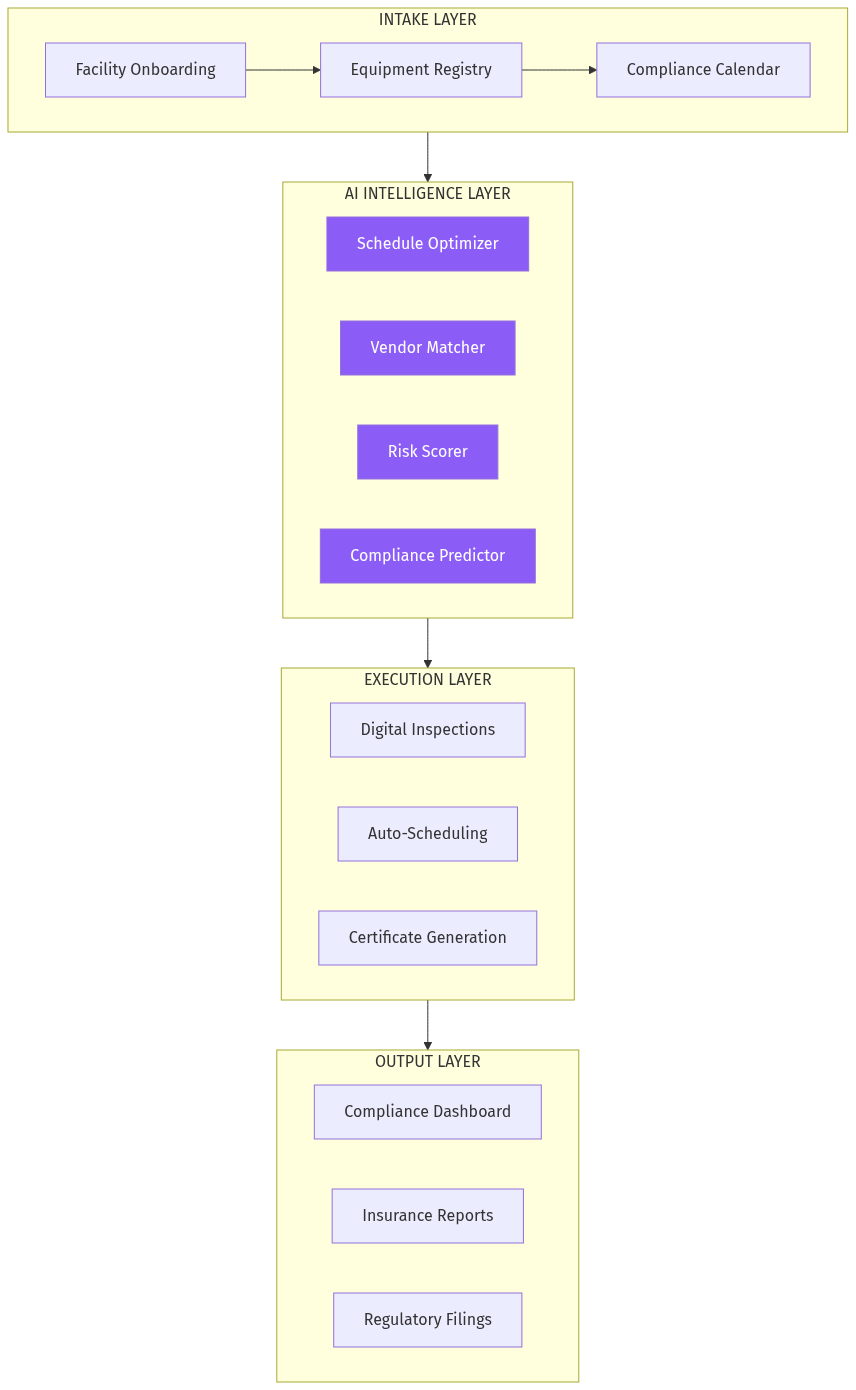
    FireSafe.ai Platform

    Platform Architecture
    Platform Architecture

    Core Features

    For Facility Managers:
    • Equipment registry (photo-based onboarding)
    • AI-generated compliance calendar
    • One-click vendor booking
    • Digital certificates with cloud storage
    • Insurance report generation
    • Multi-facility dashboard
    For Vendors:
    • Lead generation marketplace
    • Route-optimized scheduling
    • Digital inspection app
    • Certification management
    • Payment processing
    • Review/rating system
    For Insurance/Regulators:
    • API access to compliance status
    • Real-time verification
    • Risk scoring
    • Bulk certificate validation

    Differentiators

    FeatureStatus QuoFireSafe.ai
    SchedulingManual spreadsheetsAI-optimized
    Vendor DiscoveryPhone/referralMarketplace
    Inspection ReportsPaperDigital + blockchain
    Compliance StatusPoint-in-timeReal-time
    Insurance FilingManualAutomated
    Multi-facilityImpossibleDashboard
    ---
    8.

    Development Plan

    PhaseTimelineDeliverables
    MVP8 weeksEquipment registry, manual scheduling, vendor directory
    V1+6 weeksAI scheduling, marketplace transactions, digital inspections
    V2+8 weeksPredictive analytics, insurance API, multi-facility
    V3+12 weeksIoT integration, blockchain certificates, agent marketplace

    Tech Stack

    • Frontend: Next.js (mobile-responsive)
    • Backend: Node.js + PostgreSQL
    • AI: Claude API for scheduling optimization, GPT-4 for document parsing
    • Mobile: React Native for inspector app
    • Integrations: Procore, Building Engines, insurance APIs

    9.

    Go-To-Market Strategy

    Phase 1: Vendor-First (Weeks 1-8)

  • Onboard 50 fire safety vendors in one metro (Hyderabad/Bangalore)
  • Offer free digital inspection app
  • Build vendor profiles with certifications
  • Create leads funnel from Google/directories
  • Phase 2: Facility Acquisition (Weeks 8-16)

  • Target property managers with 10+ buildings
  • Offer free compliance audit
  • Convert to paid platform access
  • Generate vendor leads from facility bookings
  • Phase 3: Insurance Partnership (Weeks 16-24)

  • Partner with commercial insurers
  • Offer compliance verification API
  • Premium discount program for platform users
  • Expand to new metros
  • Pricing Model

    SegmentModelPrice
    SMB FacilitiesPer inspection₹500-2,000/inspection
    Property ManagersMonthly SaaS₹10,000-50,000/month
    VendorsTransaction fee5-8% of booking value
    Insurance APIPer verification₹50-200/verification
    ---
    10.

    Revenue Model

    Revenue Streams

  • Marketplace Transaction Fees (60%): 5-8% of vendor bookings
  • SaaS Subscriptions (25%): Property manager platform access
  • Insurance API (10%): Per-verification pricing
  • Premium Vendor Listings (5%): Featured placement, priority routing
  • Unit Economics (Year 2 Target)

    MetricValue
    Average facility spend₹1,50,000/year
    Platform take rate7%
    Revenue per facility₹10,500/year
    CAC (facility)₹5,000
    LTV (3-year)₹31,500
    LTV:CAC6.3x

    Revenue Projection

    YearFacilitiesRevenue
    Y1500₹52L
    Y22,500₹2.6Cr
    Y310,000₹10.5Cr
    ---
    11.

    Data Moat Potential

    Proprietary Data Assets

  • Equipment Database: Age, make, model, inspection history of commercial fire equipment
  • Vendor Performance: Ratings, response times, certification validity, pricing
  • Compliance Patterns: Which equipment types fail most often, seasonal trends
  • Facility Risk Profiles: Building age, occupancy type, compliance history
  • Pricing Intelligence: Regional rates, bulk discounts, seasonal pricing
  • Network Effects

    • More facilities → More vendor leads → More vendors join → Better prices → More facilities
    • More inspections → Better AI predictions → Higher compliance → Lower insurance → More facilities

    Defensibility

    Moat TypeStrengthNotes
    Data moatHighEquipment + vendor + compliance data unique
    Network effectsMedium-HighTwo-sided marketplace dynamics
    Switching costsMediumEquipment registry creates lock-in
    Regulatory integrationHighInsurance/regulator APIs hard to replicate
    ---
    12.

    Why This Fits AIM Ecosystem

    Strategic Alignment

  • B2B Marketplace Pattern: Two-sided market (facilities ↔ vendors) fits AIM model
  • Workflow Automation: Compliance scheduling is a repeatable workflow
  • AI-First: Scheduling, matching, prediction are AI-native problems
  • Fragmented Market: Thousands of local vendors = aggregation opportunity
  • Trust-Critical: Fire safety is high-stakes = trust differentiator
  • AIM Integration Points

    • aim.in/fire-safety: Vertical marketplace listing
    • Cross-sell: Industrial facilities on AIM need fire safety
    • Data sharing: Facility profiles enrich other AIM verticals
    • Vendor network: Fire safety vendors may offer related services

    Potential Domain

    • firesafe.in — Check availability
    • fireguard.in — Alternative
    • safetycheck.in — Broader positioning

    ## Pre-Mortem: Why Would This Fail?

    Falsification Analysis:
  • Incumbent Resistance: Large fire safety companies may refuse to join marketplace
  • - Mitigation: Start with SMB vendors who need leads
  • Regulatory Fragmentation: Fire codes vary by state/municipality
  • - Mitigation: Start with one jurisdiction, perfect it, then expand
  • Low Tech Adoption: Facility managers may prefer phone calls
  • - Mitigation: Lead with insurance premium savings ($$)
  • Vendor Quality Risk: Bad vendors damage platform reputation
  • - Mitigation: Certification verification + mandatory insurance
  • Long Sales Cycles: Enterprise property managers move slowly
  • - Mitigation: Start with SMB facilities, prove ROI Steelmanning: Why Incumbents Might Win
    • Large fire safety companies (Siemens, Johnson Controls) have relationships
    • Insurance companies might build their own compliance platforms
    • Property management software (Yardi, MRI) could add fire safety modules
    • Local trust relationships trump digital marketplaces
    Counter-argument: Incumbents are selling hardware, not software. Insurance companies want verification, not operations. Property software is horizontal, not specialized. Local trust doesn't scale.

    ## Verdict

    Opportunity Score: 8.5/10
    FactorScoreNotes
    Market Size9/10$85B+ global, regulatory mandate
    Fragmentation9/10Thousands of local vendors
    AI Fit9/10Scheduling, matching, prediction
    Entry Barrier7/10Regulatory knowledge needed
    Competition8/10No dominant player
    Unit Economics8/106x+ LTV:CAC achievable

    Final Assessment

    Fire safety compliance is a mandatory, recurring, underdigitized market. Every commercial building needs it. Every building struggles with it. The combination of AI-powered scheduling, vendor marketplace, and digital compliance creates a defensible platform.

    Recommendation: Strong opportunity for an AI-native vertical SaaS. Start with one metro, nail vendor supply, then expand through property manager partnerships. The insurance integration is the killer feature — compliance-as-a-service with premium discounts.

    ## Sources

    • Grand View Research: Fire Protection System Market Size Report
    • Mordor Intelligence: Fire Protection Services Market Analysis
    • NFPA: National Fire Protection Association Codes and Standards
    • IBIS World: Fire Extinguisher Manufacturing in the US
    • Reddit r/facilitymanagement: Pain points in commercial property management
    • Insurance Institute for Business & Home Safety: Commercial Fire Loss Data

    Research by Netrika Menon, AIM.in Data Intelligence