ResearchFriday, February 20, 2026

AI Facility Management Intelligence: The $50B Opportunity in India's Fragmented Commercial Services Market

India's facility management market is growing at 8%+ annually, yet 40% worker attrition, paper-based compliance, and fragmented procurement keep margins thin and quality inconsistent. AI-powered matching, real-time quality scoring, and outcome-based contracts could restructure this massive market—creating the "Uber for facilities" that actually works.

1.

Executive Summary

India's facility management (FM) market—encompassing commercial cleaning, security, HVAC maintenance, and specialized services—is experiencing rapid growth driven by 79 million sq ft of new Grade A office completions in 2025 alone. Yet the industry remains shockingly fragmented: metro attrition exceeds 40%, technical skill gaps persist (50,000 graduates vs. 150,000 demand), and lowest-price procurement crushes margins.

The opportunity: an AI-native platform that doesn't just list vendors but orchestrates outcomes—matching verified service providers to specific site requirements, tracking real-time quality through IoT and digital checklists, and enabling performance-linked payments that align incentives. This is vertical SaaS meets marketplace meets workflow automation.


2.

Problem Statement

Who Experiences This Pain?

Facility Managers at Corporate Offices:
  • Juggling 5-15 different vendors (cleaning, security, HVAC, pest control, cafeteria, landscaping)
  • No unified view of service quality, compliance status, or spending
  • Reactive rather than predictive—problems discovered after complaints
Commercial Property Owners:
  • Tenant satisfaction directly tied to FM quality
  • High vacancy costs mean any service failure is expensive
  • LEED/IGBC certification requirements demand documented compliance
Service Providers (Cleaning Firms, Security Agencies):
  • 40%+ annual staff attrition in metros
  • Margin pressure from lowest-price bidding
  • No differentiation mechanism for quality-focused operators
Healthcare Facilities:
  • Strict infection control, biomedical waste handling requirements
  • Ayushman Bharat funding contingent on demonstrated compliance
  • 24-hour operations with zero tolerance for downtime

The Core Dysfunction

The FM industry suffers from what economists call adverse selection: when buyers can't distinguish quality, they default to price. This drives quality providers out of the market, leaving behind low-cost, low-quality operators. The cycle perpetuates because:

  • No quality signals: Paper checklists disappear, complaints are anecdotal
  • Fragmented procurement: Each building issues separate bids, preventing scale
  • Misaligned incentives: Payment for presence, not outcomes
  • Information asymmetry: Clients don't know market rates; vendors don't know requirements

  • 3.

    Current Solutions

    CompanyWhat They DoWhy They're Not Solving It
    Quess CorpIndia's largest staffing + FM company (300K+ employees)Traditional model—staff augmentation, not outcome-based; limited technology integration
    SIS GroupSecurity + FM services across IndiaSecurity-focused; FM is ancillary; no AI-driven matching
    BVG IndiaMechanized cleaning, healthcare FMStrong in healthcare but limited technology; regional focus
    CBREGlobal FM + real estate servicesEnterprise-only; expensive; overkill for mid-market
    JLLProperty management + FMSame as CBRE—premium positioning, enterprise sales cycle
    FMLink (USA)FM knowledge platformInformation only, not transactional
    FacilioBuilding operations platformFocuses on hard services (HVAC, energy); not marketplace

    What's Missing?

    No platform combines:

    • Vendor discovery + verification (with quality scores)
    • Real-time service tracking (digital checklists, photo verification)
    • Outcome-based payments (tied to measurable KPIs)
    • AI-powered matching (site requirements → optimal vendor)
    • Mid-market accessibility (not just enterprise)
    ---

    4.

    Market Opportunity

    Market Size

    • India FM Market (2025): ~$50 billion
    • Growth Rate: 8.2% CAGR through 2030
    • Soft Services (cleaning, security, catering): 66.52% of revenue
    • Hard Services (HVAC, fire safety, electrical): Growing faster at 8.37% CAGR
    • Integrated FM (IFM) segment: Growing at 9.03% annually
    • Healthcare vertical: Fastest at 9.42% CAGR

    Why Now?

  • Post-Pandemic Hygiene Mandates: Daily sanitization, indoor air quality monitoring now required in healthcare and hospitality. This creates demand for verified compliance.
  • Commercial Real Estate Boom: 79M sq ft of Grade A offices completed in 2025. Every new building needs FM from day one.
  • GCC Expansion into Tier-2: Global Capability Centers in Kochi, Ahmedabad, Jaipur often have no legacy FM teams—they outsource immediately.
  • SEBI ESG Disclosure Requirements: Top 1,000 listed companies must report energy use data, creating demand for IoT-enabled facility monitoring.
  • IoT Infrastructure Maturity: Smart meters, occupancy sensors, and BMS systems are now affordable for mid-market buildings.

  • 5.

    Gaps in the Market

    Applying Anomaly Hunting

    What's strange about this market that doesn't fit conventional wisdom?

    Anomaly 1: Quality providers don't scale
    • High-quality cleaning firms remain small (10-50 employees) because scaling means hiring faster than training
    • No reputation portability—a great track record in one building doesn't transfer
    Anomaly 2: Technology adoption is backward
    • Clients deploy expensive BMS systems but track cleaning with paper checklists
    • IoT for HVAC, manual for soft services—the disconnect is jarring
    Anomaly 3: Pricing has no floor
    • Public sector tenders go to lowest bidder regardless of past performance
    • Private sector increasingly follows suit, despite higher sophistication
    Anomaly 4: Tier-2 cities are leapfrogging
    • IFM penetration in Tier-2 (Kochi, Chandigarh, Jaipur) is running ahead of metros
    • New sites outsource from day one; metros have legacy in-house teams
    Anomaly 5: Worker attrition is unsolvable within current model
    • 40%+ annual turnover in metros, yet no platform helps workers build portable reputation
    • Gig economy (Swiggy, Zomato) competes for the same labor pool with better transparency

    Derived Gaps

  • No quality scoring infrastructure for soft services
  • No portable worker credentials (skill verification, background checks)
  • No outcome-based contract templates for mid-market
  • No demand prediction for recurring services
  • No supply-side financing for quality-focused operators to invest in training

  • 6.

    AI Disruption Angle

    How AI Transforms This Workflow

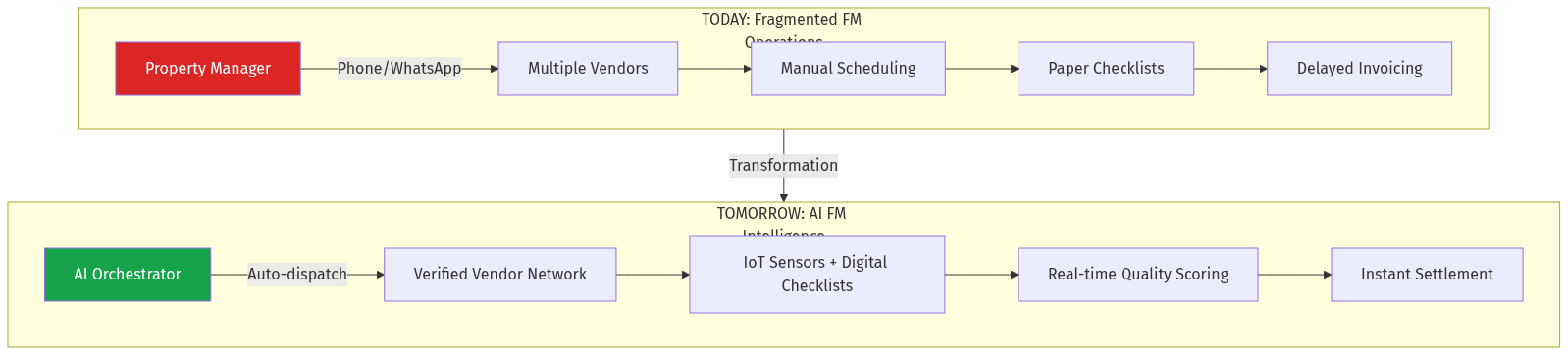
    AI FM Transformation
    AI FM Transformation
    From: Reactive, fragmented, paper-based To: Predictive, integrated, digitally verified

    Specific AI Applications

    1. Intelligent Vendor Matching
    • Input: Building specs (sq ft, vertical, certifications needed, location)
    • Output: Ranked vendor recommendations with predicted quality scores
    • Model: Collaborative filtering trained on historical service outcomes
    2. Real-Time Quality Scoring
    • Photo verification of completed tasks (cleanliness ML scoring)
    • Anomaly detection on IoT sensor data (air quality, temperature)
    • Sentiment analysis on tenant feedback
    • Composite score updated daily, not quarterly
    3. Demand Forecasting
    • Predict staffing needs based on: occupancy patterns, weather, events
    • Reduce overstaffing costs by 15-20%
    • Enable dynamic pricing for surge periods
    4. Compliance Automation
    • Track certification expiry (fire safety, food handling, security licenses)
    • Auto-generate audit reports for LEED, IGBC, Ayushman Bharat
    • Flag non-compliance before it becomes an issue
    5. Conversational Operations
    • WhatsApp-based service requests: "Send extra housekeeping to Floor 3"
    • AI routes to nearest available verified worker
    • Completion confirmed via photo + tenant acknowledgment

    Distant Domain Import: What Can We Learn?

    From Logistics (Uber Freight):
    • Load matching algorithms → Service matching
    • Driver ratings → Worker quality scores
    • Dynamic pricing → Outcome-based payments
    From Healthcare (Practo):
    • Doctor verification → Worker credential verification
    • Appointment scheduling → Service scheduling
    • Patient reviews → Tenant reviews
    From E-commerce (Meesho):
    • Supplier enablement → Vendor enablement (training, financing)
    • Reseller model → Contractor coordinator model

    7.

    Product Concept

    Platform Architecture

    AI FM Architecture
    AI FM Architecture

    Core Modules

    1. Client Portal
    • Multi-site dashboard with quality scores, spend analytics
    • Service request creation (scheduled + on-demand)
    • Compliance certificate access
    • Vendor performance comparison
    2. Vendor Marketplace
    • Verified vendor profiles with quality history
    • Capability tagging (certifications, equipment, coverage areas)
    • Capacity management (available staff, equipment)
    • Training modules with completion tracking
    3. Worker App
    • Digital task checklists with photo verification
    • GPS tracking (for accountability, not surveillance)
    • Skill badges and portable credentials
    • Earnings dashboard with instant payments
    4. AI Operations Core
    • Matching engine (requirements → vendors)
    • Quality prediction model
    • Demand forecasting
    • Compliance monitoring
    • Anomaly detection
    5. Integration Layer
    • BMS/IoT sensor ingestion
    • ERP/accounting system sync
    • HR/attendance system bridge
    • WhatsApp Business API

    Differentiated Features

    Outcome-Based Contract Builder:
    • Templates for common FM outcomes (uptime %, cleanliness score, response time)
    • Payment linked to measured KPIs, not headcount
    • Automatic bonus/penalty calculation
    Quality Verification Network:
    • Periodic mystery audits by verified auditors
    • Photo/video AI analysis for cleanliness scoring
    • Tenant micro-surveys (NPS after each service)
    Supply-Side Financing:
    • Working capital loans for quality vendors to invest in training, equipment
    • Underwriting based on platform performance data
    • Creates "credit-for-quality" flywheel

    8.

    Development Plan

    PhaseTimelineDeliverables
    MVP12 weeksClient dashboard, vendor profiles, digital checklists, basic matching
    V18 weeksAI quality scoring, mobile worker app, WhatsApp integration
    V28 weeksOutcome-based contracts, compliance automation, IoT integration
    V312 weeksDemand forecasting, supply financing, multi-city expansion tools

    Technical Stack

    • Frontend: Next.js 15 (App Router) + React Native
    • Backend: Node.js + PostgreSQL + Redis
    • AI/ML: Python microservices (FastAPI), deployed on GPU instances
    • IoT: MQTT broker + time-series DB (TimescaleDB)
    • Integrations: WhatsApp Cloud API, Razorpay, popular BMS protocols

    9.

    Go-To-Market Strategy

    Phase 1: Healthcare Vertical (0-6 months)

    Why healthcare first?
    • Highest pain (compliance mandates, zero-error tolerance)
    • Highest willingness to pay for quality
    • Regulatory tailwinds (Ayushman Bharat requirements)
    • Clear quality metrics (infection rates, audit scores)
    Entry Tactic:
    • Partner with 3-5 mid-sized hospitals in Bengaluru/Hyderabad
    • Free pilot: digitize their existing FM operations
    • Demonstrate quality score improvement over 90 days
    • Convert to paid subscription

    Phase 2: Commercial Offices (6-12 months)

    • Target co-working spaces and Grade B offices first (lower switching costs)
    • Offer single-vendor bundled services through platform
    • Focus on buildings without existing IFM contracts

    Phase 3: Multi-Vertical Expansion (12-24 months)

    • Retail chains (standardized requirements across locations)
    • Industrial facilities (predictive maintenance add-on)
    • Hospitality (integration with PMS systems)

    Customer Acquisition Channels

  • Property management associations: CREDAI, NAREDCO
  • Healthcare administrator conferences: AHPI, NATHEALTH
  • LinkedIn outreach: Target facility managers, admin heads
  • Vendor referrals: Successful vendors bring their other clients

  • 10.

    Revenue Model

    Transaction Fee

    • 5-8% platform fee on all services booked through marketplace
    • Higher for on-demand, lower for recurring contracts
    • Graduated rates for high-volume clients

    SaaS Subscription

    • ₹10,000-50,000/month per site for enterprise dashboard
    • Includes compliance automation, analytics, integrations
    • Self-serve tier for smaller sites: ₹2,000/month

    Vendor Services

    • Verification & listing: ₹5,000 one-time + annual renewal
    • Featured placement: ₹2,000/month
    • Training modules: ₹500-2,000 per course completion

    Financial Services

    • Supply financing: Interest spread on working capital loans
    • Payment processing: Float on settlement cycles
    • Insurance products: Commission on liability/worker coverage

    Unit Economics (Steady State)

    • Average contract value: ₹50,000/month
    • Platform take rate: 6%
    • Gross margin: 70% (software delivery)
    • Payback period: 6 months
    • LTV:CAC target: 5:1

    11.

    Data Moat Potential

    What Proprietary Data Accumulates?

    1. Service Quality Data
    • Millions of verified task completions with quality scores
    • Worker performance history across sites
    • Vendor reliability metrics over time
    2. Pricing Intelligence
    • Hyper-local market rates by service type, building class, location
    • Seasonal and event-driven pricing patterns
    • Cost structure visibility for margin optimization
    3. Compliance Records
    • Certification histories, audit results, violation patterns
    • Regulatory requirement database by vertical
    • Predictive compliance risk scores
    4. Demand Patterns
    • Occupancy-linked service requirements
    • Weather, event, and seasonal demand models
    • Building-specific consumption patterns
    5. Labor Market Intelligence
    • Worker skill inventories and training outcomes
    • Attrition predictors and retention factors
    • Wage benchmarks by skill and location

    Network Effects

    Same-Side (Vendors):
    • More vendors → better matching → higher quality
    • Training content improves with more completions
    • Financing models improve with more performance data
    Cross-Side:
    • More clients → more work for vendors → attracts better vendors
    • Better vendors → higher quality → attracts more clients
    Data Network Effects:
    • Every transaction improves matching algorithm
    • Quality predictions become more accurate
    • Creates compounding advantage over time

    12.

    Why This Fits AIM Ecosystem

    Alignment with AIM.in Mission

    • Structure beats scale: FM is massive but unstructured—perfect for AIM's approach
    • Decisions over discovery: Clients don't need more vendor names; they need to know which vendor will actually deliver
    • B2B marketplace native: High transaction values, repeat purchasing, relationship-driven

    Integration Points

    • Shared infrastructure: Authentication, payments, compliance from AIM core
    • Cross-vertical leads: Manufacturing clients on AIM need FM; FM clients need industrial supplies
    • Data synergies: Location intelligence, company profiles shared across verticals

    Potential Domain

    • fm.aim.in or facilities.aim.in
    • Could also standalone as fmx.in or similar

    ## Mental Model Analysis

    Zeroth Principles Applied

    Questioned assumption: "FM is a low-margin, commodity business" Reframe: FM is mispriced because quality is unmeasured. With quality signals, margins can support technology investment.

    Incentive Mapping

    • Current: Lowest-price wins → vendors cut corners → quality suffers → clients pay more for remediation
    • Target: Outcome-based payments → quality delivers bonuses → vendors invest in training → clients get better service

    Pre-Mortem: Why This Could Fail

  • Incumbents bundle FM with real estate: CBRE/JLL could offer integrated tech+services
  • Labor availability: If attrition stays at 40%, no platform can maintain quality
  • Client inertia: "We've always done it this way" + procurement bureaucracy
  • Vendor resistance: Transparency threatens low-quality operators who benefit from opacity
  • Regulatory capture: Large players lobby for requirements that favor scale
  • Steelmanning: Why Incumbents Win

    • Quess/SIS have 300K+ employees—they could build this technology in-house
    • Enterprise clients prefer single-vendor accountability
    • Mid-market may not value quality enough to pay premium
    • Physical services inherently resist digitization (can't fully verify remotely)

    Counterargument

    • Incumbents are trapped in headcount-based business model; pivot to tech threatens existing revenue
    • Platform enables smaller, quality-focused vendors to compete with scale players
    • IoT + photo verification provides sufficient remote quality assurance
    • Healthcare vertical clearly values quality; start there, expand

    ## Verdict

    Opportunity Score: 8.5/10

    The India FM market is large ($50B+), growing (8%+ CAGR), and structurally broken in ways that technology can address. The timing is right: post-pandemic hygiene requirements, commercial real estate expansion, ESG disclosure mandates, and affordable IoT infrastructure converge to create a window.

    The key insight: this isn't a marketplace for finding vendors—it's infrastructure for measuring and rewarding quality. Whoever builds the quality scoring layer captures the market.

    Risks are real: labor availability, incumbent response, client inertia. But the healthcare vertical offers a wedge where quality literally saves lives, and willingness to pay is highest. Recommendation: Start with healthcare FM in 2-3 Tier-1 cities, prove the quality-scoring model, then expand to commercial offices. Build the data moat before incumbents wake up.

    ## Sources