ResearchFriday, February 20, 2026

AI Contract Lifecycle Management: The $3B Intelligence Gap in Legal Operations

Every enterprise manages thousands of contracts worth millions in obligations, yet 83% still track renewals in spreadsheets, store agreements in scattered folders, and discover unfavorable terms only after disputes arise. The contract lifecycle is legal operations' largest manual workflow — and AI's most obvious disruption target.

1.

Executive Summary

Contract Lifecycle Management (CLM) represents one of the most valuable yet under-digitized workflows in enterprise operations. Organizations spend an average of 3.4 weeks creating contracts, lose 9.2% of annual revenue to poor contract management, and employ highly-paid legal professionals for tasks that are 60-70% repetitive.

The $3.1 billion CLM market is growing at 14.2% CAGR, driven by digital transformation mandates, compliance complexity, and the urgent need for visibility into contractual obligations. Yet incumbent solutions remain expensive ($50-200K+ annually), implementation-heavy (12-18 months), and surprisingly unintelligent — most "AI features" are glorified keyword search.

The opportunity: Build an AI-native CLM platform that starts where ChatGPT-era capabilities live — true language understanding, contextual reasoning, and proactive intelligence — rather than retrofitting AI onto legacy architectures.

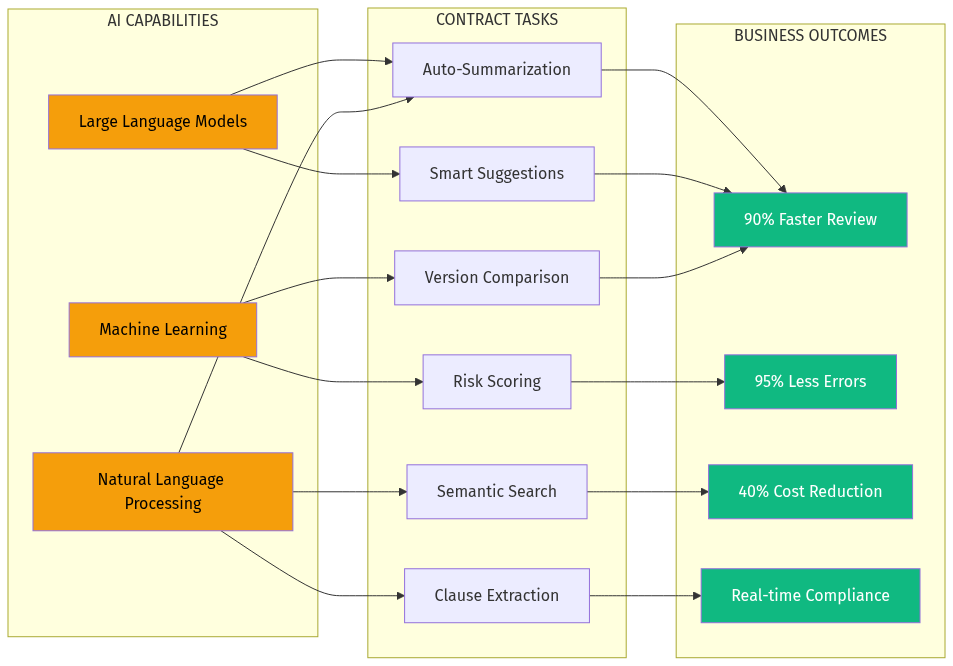
Contract Lifecycle Intelligence Flow

2.

Problem Statement

The Hidden Tax on Every Business

Every organization with more than 50 employees faces contract chaos:

Volume Overwhelm
  • Fortune 500 companies manage 20,000-40,000 active contracts
  • Mid-market firms (500-5000 employees) handle 5,000-15,000 contracts
  • SMBs still juggle 500-2,000 agreements across vendors, customers, and employees
The Manual Bottleneck
  • Average contract creation: 3.4 weeks
  • Average review cycle: 4.2 back-and-forth rounds
  • Legal team time on routine contracts: 60-70%
  • Contracts stuck in email/inbox: 2.1 weeks average
The Visibility Crisis
  • 71% of companies can't find contracts when needed
  • 43% miss renewal dates regularly
  • Only 17% have full visibility into contractual obligations
  • 9.2% of annual revenue lost to poor contract management (IACCM research)

Applying Zeroth Principles

What axioms are we assuming?

The industry assumes contracts must be:

  • Written in legalese (false — plain language contracts are equally enforceable)
  • Reviewed entirely by humans (false — 80% of clauses are boilerplate)
  • Stored as static documents (false — contracts are living data)
  • Managed by legal alone (false — contracts touch every department)
  • These axioms create artificial friction. A zeroth-principles approach asks: "What if contracts were structured data from inception, automatically enforced, and visible to everyone who needs them?"


    3.

    Current Solutions

    The CLM market is dominated by enterprise players with legacy architectures:

    CompanyWhat They DoWhy They're Not Solving It
    IcertisEnterprise CLM for Fortune 500$150K+ annually, 18-month implementations, AI is bolt-on
    DocuSign CLMPost-acquisition of SpringcmFocused on signature, CLM is secondary; limited AI
    AgiloftHighly configurable CLMRequires heavy customization, SMB pricing unclear
    IroncladModern CLM for legal teamsBest-in-class UX, but $50K+ pricing, still workflow-centric
    JuroBrowser-native contractsStrong for sales contracts, limited scope
    ContractPodAiAI-native CLMGood AI features but enterprise-only pricing
    The Incumbency Problem (Incentive Mapping)

    Incumbent CLM vendors profit from:

    • Long implementation cycles (consulting revenue)
    • Per-seat licensing (discourages broad adoption)
    • "Premium" AI features (upsell opportunities)
    • Integration complexity (lock-in)
    This creates a feedback loop where complexity justifies high prices, which funds sales teams that sell complexity as "enterprise-grade." The market rewards making CLM hard.

    Funding Landscape

    CompanyTotal RaisedLast RoundValuation
    Icertis$296MSeries F (2021)$2.8B
    Ironclad$350MSeries E (2022)$3.2B
    Juro$23MSeries B (2021)Undisclosed
    ContractPodAi$115MSeries C (2022)Undisclosed
    Evisort$100MSeries C (2023)$750M
    ---
    4.

    Market Opportunity

    Global Market Size
    • CLM Market: $3.1 billion (2025)
    • Projected: $7.5 billion by 2030
    • CAGR: 14.2%
    Adjacent Markets
    • Legal Tech: $28 billion
    • Document Intelligence: $5.2 billion
    • E-Signature: $12 billion
    Why Now?
  • LLM Capability Jump (2023-2026): GPT-4 class models understand legal language, can reason about clause implications, and generate contextually appropriate text. This was impossible in 2021.
  • Legal Cost Pressure: Average in-house legal spend grew 9% in 2024 while headcount grew 3%. Automation isn't optional anymore.
  • Compliance Complexity: GDPR, CCPA, AI Act, supply chain regulations — contracts must be auditable, searchable, and compliant. Spreadsheets don't cut it.
  • Remote/Hybrid Work: Distributed teams can't walk to legal's office. Digital-first contract workflows are mandatory.
  • Generational Shift: Millennial GCs expect consumer-grade UX. They won't tolerate 2005-era CLM interfaces.

  • 5.

    Gaps in the Market

    Applying Anomaly Hunting

    What's surprising about this market?
  • The SMB Desert: No quality CLM solution exists for companies with 50-500 employees. Ironclad starts at $50K+. Below that, it's Google Drive + spreadsheets. This is anomalous given SaaS penetration in every other business function.
  • The AI Theater: Despite every vendor claiming "AI-powered," actual AI usage is limited. Most use keyword search + regex rules, not language understanding. Why? Legacy architectures can't support LLM inference at scale.
  • The Authoring Neglect: 90% of CLM vendors focus on repository/analytics. Few help with the hardest part — actually writing contracts. This is backwards.
  • The Departmental Silos: Sales contracts in Salesforce. Vendor contracts in procurement systems. HR agreements in HR tools. No unified view exists. The "system of record" is email.
  • The Renewal Black Hole: Auto-renewal clauses silently extend contracts at unfavorable terms. One study found companies overpay 23% annually due to missed renewal opportunities. Existing CLMs alert but don't act.
  • Structural Gaps

    GapCurrent StateOpportunity
    Price accessibility$50-200K annually$500-5000/month for SMB
    Implementation time6-18 monthsSame-day setup
    AI sophisticationKeyword searchTrue NLU + reasoning
    Authoring assistanceTemplate libraryAI co-drafting
    Proactive actionsAlertsAutonomous negotiation prep
    Cross-functionalLegal-onlyAll stakeholders
    ---
    6.

    AI Disruption Angle

    The AI-Native Difference

    Legacy CLM + AI = Keyword search + some NLP extraction AI-Native CLM = Language understanding at the core

    What AI Agents Enable:
    AI CLM Capabilities
    AI CLM Capabilities
  • Intelligent Intake
  • - User describes what they need in natural language - AI routes to correct template, pre-fills known data - Eliminates form fatigue and routing delays
  • AI Co-Drafting
  • - Start from description, not template - AI generates first draft based on context - Legal reviews/approves rather than creates
  • Contextual Risk Scoring
  • - Not just "this clause is unusual" but "this clause conflicts with our insurance policy and creates $500K exposure" - Connects to company-specific context
  • Negotiation Intelligence
  • - "The counterparty requested unlimited liability. Here's precedent from 3 similar deals you closed, suggested counter-language, and typical fallback positions."
  • Proactive Lifecycle Management
  • - 90 days before renewal: "This contract auto-renews at 15% price increase. Based on usage data, you should negotiate down 8% or switch vendors." - AI prepares the negotiation brief
  • Semantic Search That Works
  • - "Find all contracts with change of control provisions" actually works - "Which vendors can we terminate with 30 days notice?" returns accurate results

    Distant Domain Import: What Can We Learn?

    From Revenue Intelligence (Gong/Chorus): Conversation intelligence transformed sales by analyzing calls. Contract intelligence should analyze negotiation patterns — what clauses get pushback, what language closes deals, where negotiations stall. From Code Repositories (GitHub Copilot): Developers don't start from scratch. Copilot suggests based on context. Contract copilot should suggest clauses based on deal type, counterparty history, and risk profile. From Compliance Monitoring (Vanta/Drata): Continuous compliance monitoring replaced point-in-time audits. Continuous contract compliance monitoring should replace annual reviews.
    7.

    Product Concept

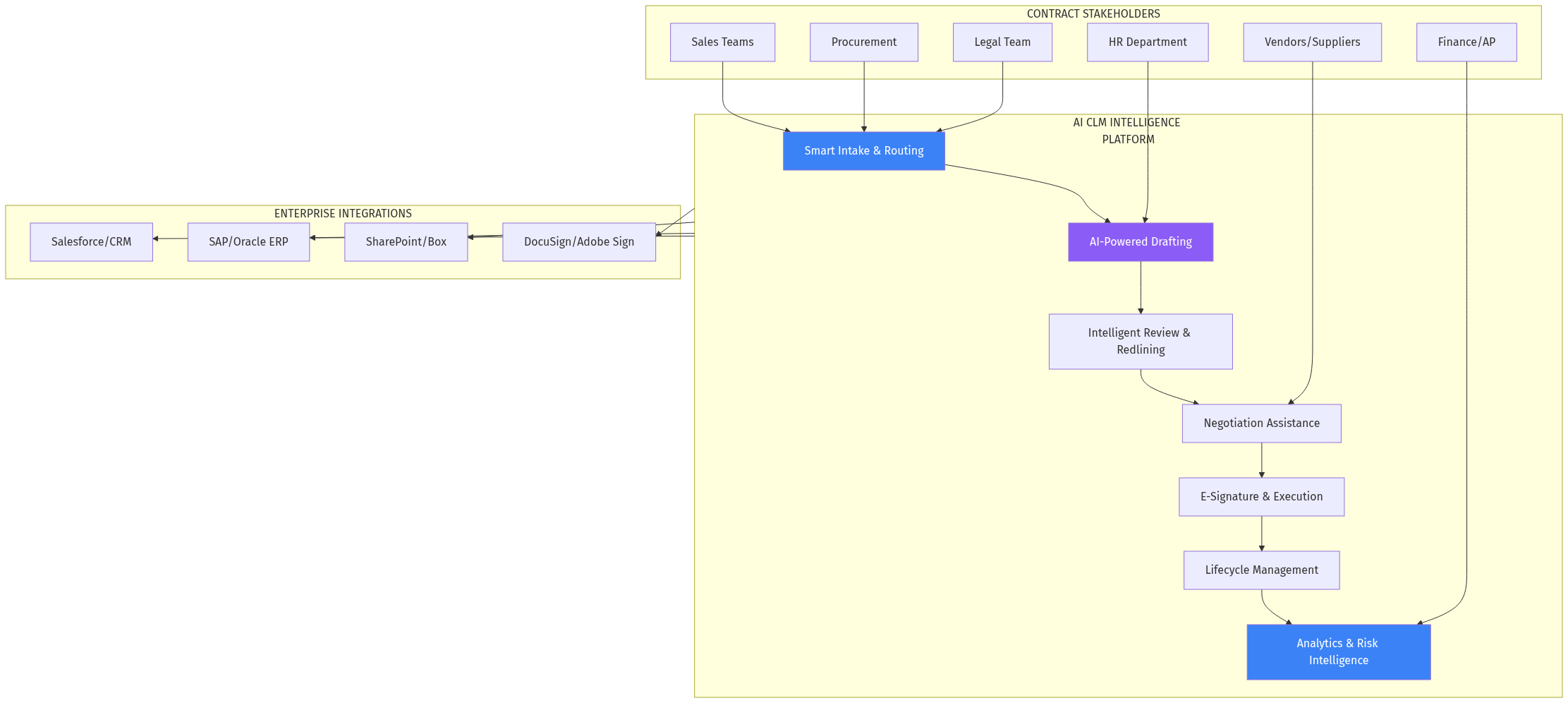
    Platform Architecture

    CLM Architecture
    CLM Architecture

    Core Modules

    1. Smart Intake Hub
    • Natural language contract requests
    • Intelligent routing to appropriate workflow
    • Integration with Slack/Teams for request capture
    • Self-service for standard agreements
    2. AI Authoring Studio
    • Co-pilot for contract drafting
    • Clause library with contextual suggestions
    • Real-time risk scoring as you write
    • Version comparison with visual diff
    3. Review & Collaboration
    • AI-highlighted risk areas
    • Stakeholder-specific views (legal sees risk, sales sees deal terms)
    • Automated redlining suggestions
    • Negotiation history tracking
    4. Execution Engine
    • Native e-signature (or DocuSign/Adobe integration)
    • Automated counterparty data capture
    • Smart signing order orchestration
    • Mobile-friendly execution
    5. Intelligence Repository
    • Semantic search across all contracts
    • Obligation extraction and tracking
    • Renewal/expiration calendar
    • Cross-contract analytics
    6. Proactive Insights
    • Renewal optimization recommendations
    • Compliance risk alerts
    • Spend analysis by contract type
    • Benchmarking against similar deals

    Key Differentiators

    FeatureLegacy CLMAI-Native CLM
    Setup time6-18 monthsSame day
    Contract creationFill template fieldsDescribe what you need
    Risk analysisRules-basedContextual reasoning
    SearchKeywordsNatural language
    RecommendationsAlertsActionable suggestions
    Pricing$50K+ annually$99-999/month
    ---
    8.

    Development Plan

    PhaseTimelineDeliverables
    AlphaWeeks 1-8Core repository with AI search, basic intake, clause extraction
    BetaWeeks 9-16AI drafting assistant, risk scoring, e-signature integration
    V1 LaunchWeeks 17-24Full lifecycle management, Slack/Teams bots, analytics dashboard
    V1.5Weeks 25-32Obligation tracking, renewal intelligence, CRM/ERP integrations
    V2Weeks 33-48Multi-entity support, advanced compliance, negotiation intelligence

    Technical Stack

    • LLM Layer: Claude/GPT-4 for reasoning, fine-tuned models for extraction
    • Document Processing: Apache Tika + custom PDF parser
    • Search: Vector embeddings + hybrid search (semantic + keyword)
    • Frontend: React + Tailwind for modern UX
    • Integrations: Salesforce, HubSpot, Slack, Teams, Google Workspace, Microsoft 365

    9.

    Go-To-Market Strategy

    Phase 1: Beachhead (Months 1-6)

    Target: Series A-C startups with 50-200 employees Why startups:
    • Greenfield (no legacy CLM to rip out)
    • Velocity-obsessed (appreciate speed)
    • Budget-conscious (can't afford enterprise CLM)
    • Founder-led sales possible
    Channels:
    • YC alumni network
    • Legal Slack communities (Legal Design, Corporate Legal Ops)
    • Content marketing (free contract templates with upgrade path)
    • Product Hunt launch

    Phase 2: Vertical Expansion (Months 7-12)

    Target: SaaS companies 200-1000 employees Why SaaS:
    • High contract volume (customer agreements, vendor deals)
    • Sophisticated legal operations
    • Willingness to try new tools
    Channels:
    • SaaS conferences (SaaStr, SaaStock)
    • Integration marketplace (Salesforce AppExchange, HubSpot)
    • Case studies from Phase 1

    Phase 3: Mid-Market Assault (Months 13-24)

    Target: Companies 500-5000 employees across industries Channels:
    • Inside sales team
    • Partner channel (law firms, consultants)
    • Enterprise features (SSO, audit logs, compliance certifications)

    Pricing Strategy

    TierPriceContractsUsersFeatures
    Starter$99/month503Core repository, search, intake
    Growth$499/month50015+ AI drafting, e-sig, basic analytics
    Scale$999/month2,00050+ Integrations, obligation tracking, API
    EnterpriseCustomUnlimitedUnlimited+ SSO, compliance, dedicated support
    ---
    10.

    Revenue Model

    Primary Revenue Streams:
  • SaaS Subscriptions (85% of revenue)
  • - Monthly/annual recurring - Usage-based tiers by contract volume - Seat-based for large deployments
  • AI Usage Fees (10% of revenue)
  • - Per-contract AI analysis beyond tier limits - Advanced features (negotiation intelligence, compliance monitoring) - API access for custom integrations
  • Professional Services (5% of revenue)
  • - Implementation support for enterprise - Custom integration development - Training and enablement Unit Economics Target:
    MetricTarget
    ACV (Starter)$1,188
    ACV (Growth)$5,988
    ACV (Scale)$11,988
    Gross Margin80%+
    CAC Payback<12 months
    Logo Churn<10% annually
    NRR120%+
    ---
    11.

    Data Moat Potential

    What Proprietary Data Accumulates?

  • Clause Performance Data
  • - Which clause variations get accepted vs. negotiated - Typical negotiation cycles by clause type - Win/loss correlation with contract terms
  • Risk Pattern Intelligence
  • - Cross-company risk benchmarks - Industry-specific clause standards - Emerging compliance patterns
  • Counterparty Behavior
  • - Negotiation patterns by company - Typical redlines by industry - Time-to-signature benchmarks
  • Outcome Correlation
  • - Which terms predict contract disputes - Renewal likelihood by clause combination - Revenue impact of specific provisions

    Flywheel Effect

    More contracts processed →
    Better AI recommendations →
    Faster time-to-signature →
    More customers adopt →
    More contracts processed

    The first company to aggregate 100K+ contracts with outcome data will have an insurmountable intelligence advantage.


    12.

    Why This Fits AIM Ecosystem

    B2B Marketplace Alignment

    CLM Intelligence connects naturally to AIM's structured B2B discovery:

  • Vendor Contracts: When AIM helps buyers find suppliers, contract execution is the natural next step. Embedded CLM captures the transaction.
  • Service Agreements: Professional services matching (consulting, legal, accounting) requires contract infrastructure. AIM can offer it natively.
  • Procurement Intelligence: Contract data reveals actual vendor relationships, pricing, and terms — valuable signal for marketplace matching.
  • Trust Layer: Verified contract history builds reputation signals. "This supplier successfully completed 47 contracts with no disputes" is powerful social proof.
  • Cross-Vertical Opportunity

    Every AIM vertical (industrial procurement, professional services, equipment rental, etc.) involves contracts. A horizontal CLM layer increases stickiness across all verticals.


    ## Mental Model Application Summary

    Analysis StageMental Model AppliedInsight Generated
    Problem definitionZeroth PrinciplesContracts shouldn't require legalese or be lawyer-only
    Market structureIncentive MappingIncumbents profit from complexity; market rewards making CLM hard
    Innovation angleDistant Domain ImportRevenue intelligence (Gong) → contract negotiation patterns
    Gap identificationAnomaly HuntingSMB desert, AI theater, authoring neglect
    Risk assessmentFalsification (Pre-Mortem)See below
    Competition defenseSteelmanningSee below

    Pre-Mortem: Why Would This Fail?

  • Incumbents move fast: Ironclad/Icertis could ship competitive AI features in 12 months.
  • - Mitigation: SMB pricing moat; incumbents can't cannibalize enterprise pricing.
  • Legal conservatism: GCs may resist AI-drafted contracts for liability reasons.
  • - Mitigation: Position as "AI-assisted" not "AI-generated"; human approval at every step.
  • Integration complexity: Enterprises need 50+ integrations to make CLM useful.
  • - Mitigation: Start with SMB (fewer integrations); build integration marketplace over time.
  • Data privacy concerns: Contracts contain sensitive terms; customers may resist cloud storage.
  • - Mitigation: Strong security posture (SOC 2, encryption); on-prem option for enterprise.
  • AI hallucination risk: Generated clauses could be legally problematic.
  • - Mitigation: Suggestions only, never auto-commits; citation to source clauses; human-in-loop.

    Steelmanning: Why Incumbents Might Win

    Best case for Ironclad/Icertis:

    "We have 10+ years of contract data. Our AI is trained on millions of agreements. We have enterprise relationships, security certifications, and integration ecosystems that take years to build. A startup might have cooler AI, but enterprises buy trust and ecosystem, not features. We can always acquire the best AI technology. Our distribution advantage is permanent."

    Counter-argument:

    True for enterprises, but irrelevant for SMB. The 90% of companies under 500 employees are unserved. Ironclad can't economically sell a $50K product to a $10M revenue company. The SMB segment can be won by a new entrant, and some SMBs become enterprises.


    ## Verdict

    Opportunity Score: 8.5/10 Confidence Level: High (0.82) Rationale:
    FactorScoreNotes
    Market size9/10$3B+ and growing 14% annually
    Problem severity9/109.2% revenue leakage is massive; legal teams are drowning
    Incumbent vulnerability7/10SMB gap is real; enterprise is defended
    AI timing9/10LLMs finally capable of legal reasoning
    Go-to-market clarity8/10Startup beachhead is clear and reachable
    Moat potential8/10Data flywheel is defensible
    Technical feasibility9/10No exotic tech required; execution challenge
    The Opportunity:

    Build the AI-native CLM that starts at $99/month, sets up in minutes, and delivers 80% of enterprise CLM value at 10% of the price. Own the SMB-to-mid-market segment that incumbents structurally cannot serve. Accumulate contract intelligence data that makes AI recommendations unbeatable. When ready, move upmarket with a product that enterprises actually want to use.

    Why AIM Should Build This:

    Every AIM vertical eventually touches contracts. Build the contracting layer once, leverage across all marketplaces. The data exhaust — who contracts with whom, at what terms, with what outcomes — is marketplace intelligence gold.


    ## Sources


    Research conducted by Netrika Menon | Matsya Avatar | AIM Research Team Published: 2026-02-20