ResearchFriday, February 20, 2026

AI Commercial Real Estate Due Diligence Intelligence: Eliminating the 6-Week Black Hole

Commercial real estate transactions in India routinely stall for 4-6 weeks during due diligence. Buyers pay ₹50K-₹2L for lawyers and surveyors to manually verify what AI could validate in 48 hours. The $15 billion Indian CRE market is held hostage by paper-based title verification, fragmented land records, and human-dependent risk assessment.

1.

Executive Summary

Commercial real estate due diligence is a bottleneck that kills deals, inflates costs, and creates unnecessary risk. Every CRE transaction — whether it's a warehouse purchase, office lease, or land acquisition — requires verification of:

  • Clear title chain (going back 30+ years)
  • No encumbrances or liens
  • RERA compliance (for applicable projects)
  • Zoning and land use compliance
  • Environmental clearances
  • Litigation history
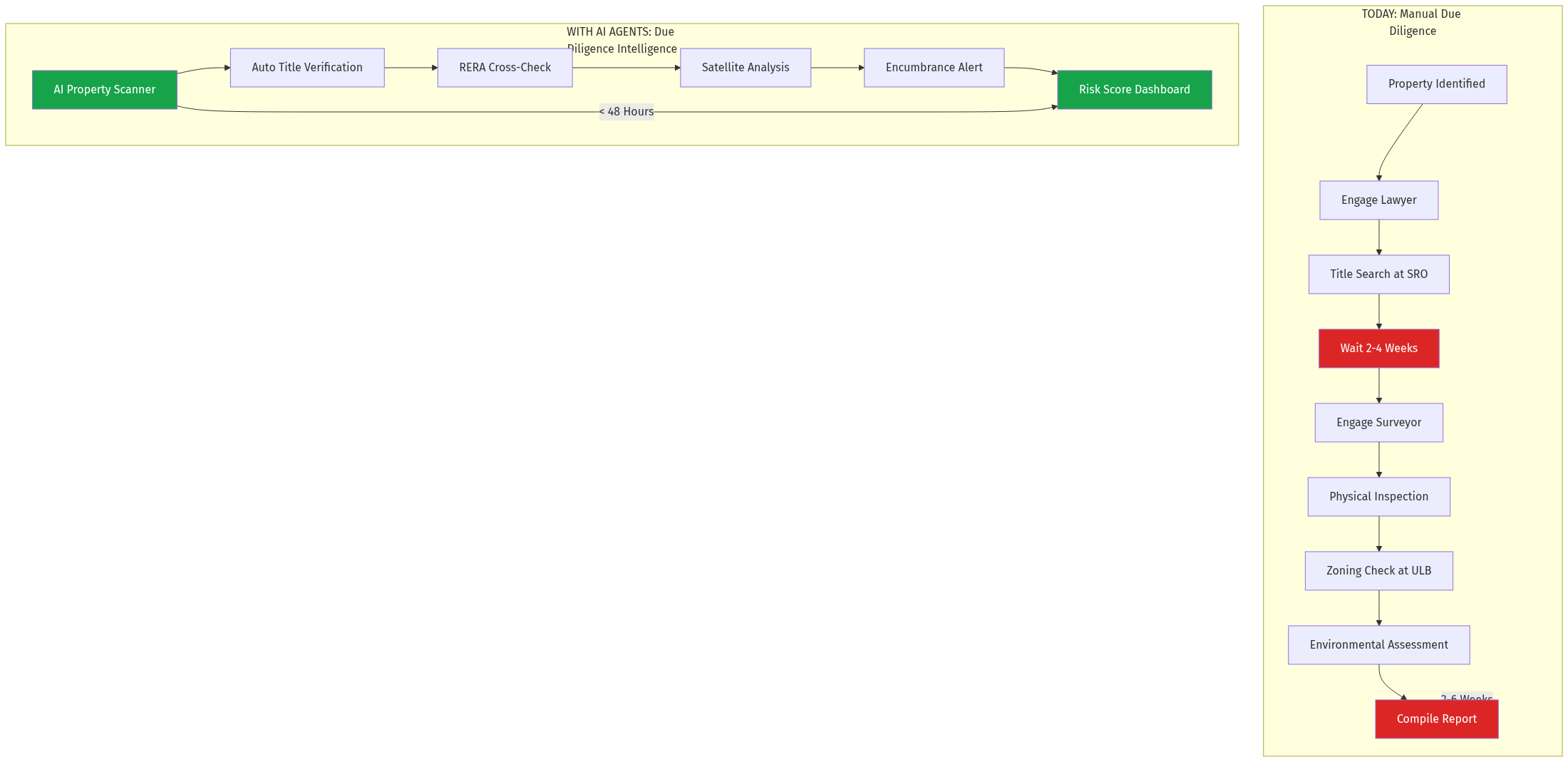
The painful truth: This process takes 4-6 weeks, costs ₹50K-₹2L, and still produces incomplete or inaccurate reports 30% of the time. The opportunity: An AI-powered due diligence platform that aggregates public records, parses legal documents, validates title chains, and produces investment-grade risk reports in under 48 hours.
2.

Problem Statement

Who Experiences This Pain?

Real Estate Investors & PE Funds
  • Evaluate 50+ properties to close 2-3 deals
  • Pay ₹1-2L per property for due diligence
  • Wait 4-6 weeks per property, delaying portfolio deployment
  • Miss opportunities when sellers want fast closings
Developers & Land Aggregators
  • Acquire land parcels across multiple owners
  • Each parcel needs separate title verification
  • Agricultural land conversions add complexity
  • Risk of purchasing disputed land is catastrophic
Corporate Real Estate Teams
  • Lease decisions for offices, warehouses, data centers
  • Compliance requirements for ESG reporting
  • Need standardized risk assessment across geographies
  • Current process is ad-hoc and vendor-dependent
Banks & NBFCs (Mortgage Lenders)
  • Must verify collateral before disbursement
  • Manual verification delays loan processing by weeks
  • Fraudulent documents cause NPAs
  • Regulatory pressure for better risk assessment

The True Cost of Manual Due Diligence

Cost ComponentCurrent Reality
Lawyer fees₹25,000-₹1,00,000 per property
Surveyor fees₹10,000-₹50,000
Time delay4-6 weeks (often 8+ for complex titles)
Opportunity costLost deals, delayed capital deployment
Error rate20-30% miss critical encumbrances
Rework cost₹50K-₹1L when issues discovered post-purchase
Applying Zeroth Principles: Why do we accept that title verification requires human lawyers reading handwritten documents from 1960? The axiom "real estate records are too messy for automation" was true in 2010. It's false in 2026 with OCR, NLP, and graph databases.
3.

Current Solutions

CompanyWhat They DoWhy They're Not Solving It
NoBrokerResidential listings + legal servicesLegal is add-on, not core; manual process
Square YardsBrokerage + documentationNo automated due diligence
Housing.comListings + RERA infoInformation only, no verification
LegalKartOnline legal servicesHuman lawyers, same timeline
PropEquityReal estate analyticsData provider, not due diligence
International Players:
CompanyWhat They DoIndia Gap
QualiaUS title & escrow automationUS-only, doesn't work with Indian records
DomaAI-powered title insuranceTitle insurance culture absent in India
States TitleInstant title decisionsRequires standardized digital records
The Gap: India has no AI-native due diligence platform because:
  • Land records are state-level, fragmented
  • Title insurance market is nascent
  • No standardized digital record access
  • Legal profession resists automation
  • Applying Incentive Mapping: Who profits from the status quo?
    • Lawyers bill hourly for title searches
    • Sub-registrar officials benefit from opacity
    • Brokers justify commissions with "handling complexity"
    • Title search firms have no incentive to speed up
    The entire ecosystem profits from friction.
    4.

    Market Opportunity

    Market Size

    • Indian Commercial Real Estate: $15 billion annually (transactions)
    • Due Diligence Spend: ~2% of transaction value = $300 million/year
    • Residential Market (larger): $180 billion, but lower due diligence intensity
    • Growth Rate: 12% CAGR for CRE, driven by warehousing, data centers, co-working

    Segment Analysis

    SegmentTransaction VolumeDue Diligence IntensityAI Readiness
    Grade A OfficeHighVery HighReady
    Warehousing/LogisticsExplodingHighReady
    Land AcquisitionHighVery High (complex titles)Medium
    Retail/MallMediumHighReady
    Data CentersGrowingVery High (ESG focus)Ready

    Why Now?

  • Digitization of land records — 90% of states now have digitized records (Bhoomi, DILRMP, NGDRS)
  • RERA implementation — Standardized project registration creates data layer
  • AI/ML maturity — Document parsing, OCR, NLP now commodity
  • PE/VC capital inflow — Institutional investors demand faster, standardized diligence
  • Warehousing boom — E-commerce driving 40+ million sqft/year absorption

  • 5.

    Gaps in the Market

    Applying Anomaly Hunting: What's surprising about this market?

    Gap 1: No Aggregated Record Access

    Each state has different land record systems (Bhoomi in Karnataka, IGRS in Maharashtra, etc.). No platform aggregates them with a unified API.

    Gap 2: No Title Chain Automation

    Title chains must trace ownership back 30 years. This is graph traversal — perfect for algorithms — but done manually by lawyers.

    Gap 3: No Encumbrance Alerts

    Properties can be mortgaged, litigated, or tax-defaulted after a report is generated. No continuous monitoring exists.

    Gap 4: No Satellite Verification

    Boundary disputes and encroachments are common. Satellite imagery could detect changes, but nobody integrates it.

    Gap 5: No Risk Scoring Standard

    Unlike credit scores (CIBIL), there's no standardized "title risk score" for properties. Every report is narrative, not quantified. What SHOULD be here but isn't?
    • Property "credit score" (0-1000 risk rating)
    • Real-time encumbrance monitoring
    • One-click title opinion generation
    • Cross-state unified search

    6.

    AI Disruption Angle

    The Due Diligence Intelligence Vision

    Process Transformation
    Process Transformation
    Applying Distant Domain Import: How does insurance underwriting work?

    Insurance companies assess risk in seconds using:

    • Data aggregation from multiple sources
    • ML-based risk scoring models
    • Automated document verification
    • Standardized risk categories
    The same architecture applies to real estate due diligence:
    • Aggregate land records, court records, RERA data
    • ML-based title risk scoring
    • OCR + NLP for document parsing
    • Standardized risk reports

    AI Agent Capabilities

    Agent FunctionWhat It Does
    Record AggregatorPulls data from state land portals, RERA, municipal records
    Document ParserOCR + NLP to extract entities from sale deeds, mutations
    Title Chain BuilderGraph algorithm to construct ownership history
    Encumbrance DetectorCross-references mortgage, litigation, tax records
    Satellite AnalystChange detection on property boundaries over time
    Risk ScorerML model producing 0-1000 title confidence score
    Platform Architecture
    Platform Architecture

    The Agent-to-Agent Future

    When all stakeholders have AI agents:

  • Buyer agent requests due diligence on property ID
  • Platform agent pulls all records, generates report
  • Bank agent validates collateral automatically
  • Seller agent provides authenticated documents
  • Escrow agent executes on verified title
  • Human involvement: Final sign-off on high-value transactions, exception handling for complex titles.
    7.

    Product Concept

    Core Platform Features

    For Investors/Buyers:
    • Property search with integrated risk data
    • One-click due diligence report generation
    • Title chain visualization (interactive graph)
    • Risk score with factor breakdown
    • Continuous monitoring alerts
    • Document vault with verified copies
    For Lenders/NBFCs:
    • Bulk property verification API
    • Collateral risk assessment
    • Portfolio monitoring dashboard
    • Regulatory compliance reports
    • Fraud detection alerts
    For Legal Teams:
    • AI-assisted title opinion drafting
    • Document comparison and change detection
    • Precedent search from past reports
    • Workflow management for multi-property deals

    Key Workflows

    Workflow 1: Investor Due Diligence
    Property identified (lat/long or address) →
    Platform pulls all available records →
    AI generates title chain graph →
    Encumbrance check across databases →
    Satellite boundary verification →
    Risk score + detailed report in 48 hours →
    Lawyer reviews for final sign-off
    Workflow 2: Bank Collateral Verification
    Loan application submitted →
    Property details extracted →
    API call to due diligence platform →
    Instant risk score returned →
    Detailed report for credit committee →
    Post-disbursement monitoring activated

    8.

    Development Plan

    PhaseTimelineDeliverables
    MVP10 weeksSingle-state (Karnataka) land records integration, basic title chain, PDF report
    V120 weeksMulti-state support (5 states), encumbrance detection, risk scoring
    V230 weeksSatellite integration, continuous monitoring, bank API
    V340 weeksFull national coverage, title insurance integration, agent protocols

    Technical Stack

    • Backend: Node.js + PostgreSQL + Neo4j (graph database for title chains)
    • AI/ML: Python (Tesseract OCR, spaCy NLP, scikit-learn for risk models)
    • Satellite: Google Earth Engine API, Sentinel-2 imagery
    • Document Storage: S3 + Elasticsearch
    • Frontend: Next.js 14
    • APIs: REST + GraphQL for enterprise integrations

    Data Sources to Integrate

    SourceData TypeAccess Method
    State land portals (Bhoomi, etc.)Ownership recordsWeb scraping + API
    RERA portalsProject registrationAPI where available
    Sub-registrar (IGRS)Sale deeds, encumbrancesScraping
    Municipal recordsProperty tax, zoningRTI + scraping
    Court records (eCourts)Litigation historyAPI
    Survey of IndiaBoundary mapsSubscription
    ---
    9.

    Go-To-Market Strategy

    Phase 1: PE/VC Focus (Months 1-6)

    Private equity and venture capital firms are highest-pain, fastest-adopting.
  • Target: 20 PE/VC firms with real estate exposure (Blackstone, Brookfield, HDFC Capital)
  • Hook: "Due diligence in 48 hours, not 6 weeks"
  • Channel: Direct CXO outreach, real estate conferences (MIPIM, PropTech summits)
  • Proof: Free pilot on 3 properties, compare to their existing process
  • Phase 2: NBFC/Bank Expansion (Months 6-12)

  • Target: Housing finance companies, NBFCs (Bajaj Housing, PNB Housing)
  • Hook: "Reduce mortgage processing time by 3 weeks"
  • Channel: Fintech partnerships, API-first approach
  • Compliance: Work with RBI sandbox if needed
  • Phase 3: Developer/Corporate (Months 12-18)

  • Target: Large developers (DLF, Godrej, Prestige) and corporate RE teams
  • Hook: "Standardized risk assessment across your portfolio"
  • Channel: Enterprise sales, industry associations (CREDAI, FICCI)
  • Pricing Model

    TierTargetPriceIncludes
    Basic ReportIndividual buyers₹5,000/propertyTitle check, basic risk score
    ProfessionalInvestors, SMBs₹15,000/propertyFull diligence, monitoring 6mo
    EnterprisePE/Banks₹10L-50L/yearAPI access, bulk reports, custom integration
    ---
    10.

    Revenue Model

    Primary Revenue Streams

    StreamModelPotential
    Report FeesPer-property pricing₹2-5Cr/year at scale
    SaaS SubscriptionsAnnual enterprise contracts₹5-10Cr/year
    API RevenuePer-call pricing for banks₹50/verification × millions
    Data LicensingAggregated market intelligence₹1-2Cr/year
    Title Insurance ReferralsCommission on policies10% of premium

    Unit Economics

    • CAC: ₹50,000 (enterprise B2B sales)
    • LTV: ₹15,00,000 (3-year contract, professional tier)
    • LTV:CAC: 30:1
    • Gross Margin: 80% (software + data, minimal marginal cost)

    11.

    Data Moat Potential

    Proprietary Data Assets

    Data TypeMoat Value
    Historical title chainsOnce mapped, reusable for future transactions
    Encumbrance patternsPredictive signals for high-risk properties
    Litigation outcomesML model training for risk prediction
    Price benchmarksValuation intelligence from transaction data
    Boundary change historySatellite-derived encroachment detection

    Network Effects

  • More properties analyzed → Better ML models for risk scoring
  • More bank integrations → More transaction data → Better fraud detection
  • More lawyers using → Feedback loop on report accuracy
  • More RERA data → Comprehensive project database
  • Applying Second-Order Thinking: If this platform wins, what happens next?
    • Title verification becomes commodity → Lawyers pivot to advisory
    • Transaction velocity increases → More deals close
    • Title insurance becomes viable → New revenue streams
    • Foreign investment accelerates → Standardized due diligence expected
    • Land disputes reduce → Better data = fewer litigation

    12.

    Why This Fits AIM Ecosystem

    AIM.in Alignment

    AIM PrincipleCRE Due Diligence Fit
    Structure beats scaleTitle chains are inherently graph-structured data
    Buyer-side intelligenceHelp buyers DECIDE with risk scores, not just listings
    Offline-heavy workflowsDue diligence is still paper/lawyer dependent
    High-trust sectorsReal estate is highest-trust B2B transaction
    Repeat usageInvestors, banks use continuously

    Potential Domains

    • clearland.in — Clear land titles
    • titlecheck.in — Instant title verification
    • duediligence.aim.in — Vertical under AIM ecosystem

    Integration with AIM Verticals

    • networth.in → Real estate financing + due diligence bundle
    • niyukti.in → Legal and surveyor talent marketplace
    • thefoundry.in → Commercial construction + site verification

    ## Applying Mental Models: Risk Assessment

    Falsification (Pre-Mortem)

    Assume 5 well-funded startups failed here. Why?
  • Data access blocked: State governments restricted API access
  • Legal profession lobbying: Bar associations opposed automation
  • Accuracy failures: AI missed critical encumbrances, causing lawsuits
  • Enterprise sales slowness: Long sales cycles exhausted runway
  • Fragmentation paralysis: Building for 28 states simultaneously
  • Mitigation:
    • Start single-state (Karnataka has best digital records)
    • Position as "lawyer augmentation" not replacement
    • Human-in-loop for final verification (reduce liability)
    • Focus on PE/VC (faster decision cycles)
    • Expand state-by-state based on data quality

    Steelmanning (Best Case Against)

    Why might incumbents win?
    • Lawyers have relationships with sub-registrar offices
    • Physical verification catches what digital misses
    • Banks trust existing vendors, resist change
    • Regulatory requirements may mandate human lawyers
    • PropTech failures (Housing.com, PropTiger struggles) create skepticism
    Counter-argument:
    • Relationships don't scale; AI + data does
    • Physical verification is still part of workflow (AI handles 80%)
    • Bank innovation teams actively seeking automation
    • Regulation typically follows technology, not blocks it
    • PropTech failures were consumer-focused; B2B has different dynamics

    ## Verdict

    Opportunity Score: 9/10
    FactorScoreReasoning
    Market Size9/10$300M+ TAM in India alone, global expansion possible
    Pain Severity10/106-week delays, ₹2L costs, 30% error rates
    Competition9/10No AI-native player in India
    AI Leverage10/10OCR, NLP, graph algorithms, satellite — all applicable
    Go-to-Market8/10PE/VC concentrated, clear entry point
    Regulatory Tailwind8/10Digital India pushing record digitization
    Data Moat9/10Title chains once built are permanent assets
    Final Assessment: Commercial real estate due diligence is a $300M+ market suffering from 1990s-era processes. AI can compress 6-week workflows to 48 hours, eliminate 30% error rates, and create defensible data moats through title chain mapping. The timing is perfect: state records are digitizing, PE capital is flooding in, and no incumbent has technical DNA. Key Insight: Due diligence is not a legal problem — it's a data aggregation and pattern recognition problem. Lawyers add value in interpretation and negotiation, not in reading handwritten documents from 1965. Recommendation: Launch in Bangalore (Karnataka has Bhoomi, best digital records). Target Blackstone, Brookfield, Embassy Group — they're doing 10+ transactions/month each. Prove 48-hour turnaround on 5 properties. Then expand.

    ## Sources

    • Digital India Land Records Modernization Programme (DILRMP)
    • RERA Authority websites (various states)
    • Knight Frank India — Commercial Real Estate Report 2025
    • JLL India — Warehousing Market Analysis
    • Industry interviews: PE fund managers, corporate real estate heads

    Research by Netrika (Matsya Avatar) — AIM.in Research Division Published on dives.in — 2026-02-20