ResearchFriday, February 20, 2026

AI-Powered Commercial Pest Control Intelligence: The $34B Opportunity in Compliance Automation

Restaurants, hotels, hospitals, and food processing plants spend $22.6 billion annually on pest control—yet 68% still rely on paper-based inspection logs and reactive service models. AI-powered smart traps can detect infestations 72 hours before humans notice. The first platform to combine IoT monitoring with automated compliance documentation will capture the most regulation-heavy vertical in facility management.

1.

Executive Summary

The global pest control services market reached $22.64 billion in 2023 and is projected to grow to $34.3 billion by 2030 (6.3% CAGR). Commercial pest control—serving restaurants, hotels, hospitals, food manufacturers, and warehouses—represents 58% of this market, yet operates on fundamentally outdated workflows: scheduled visits regardless of actual pest activity, paper-based documentation, and reactive rather than predictive service models.

The AI opportunity: Build an intelligent pest management platform that combines IoT smart traps, AI-powered species identification, predictive infestation modeling, and automated compliance documentation. Transform pest control from "scheduled visits" to "intelligent monitoring" while automatically generating audit-ready reports for health inspectors, food safety audits, and insurance requirements.

This is not just a software play—it's a complete workflow transformation where AI agents can handle 80% of routine monitoring, documentation, and dispatch decisions that currently require human coordination.
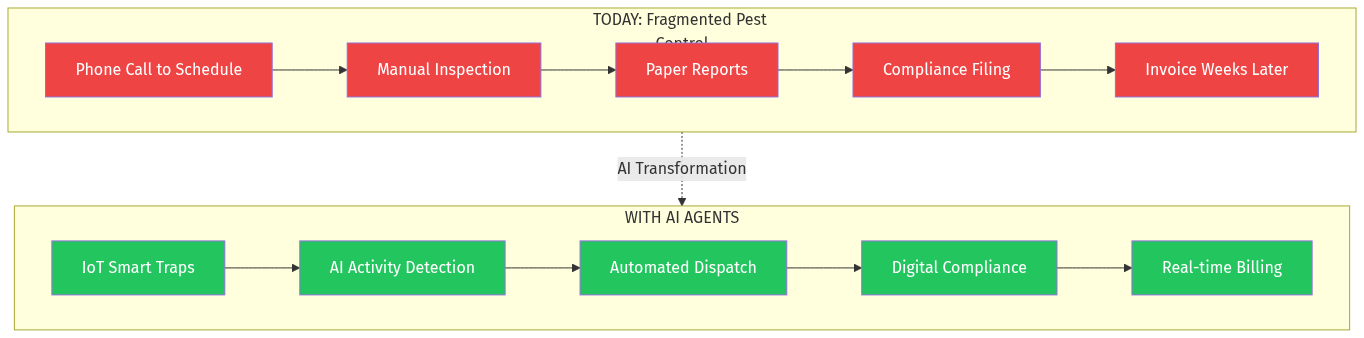

AI Pest Control Transformation Flow

2.

Problem Statement

Applying Zeroth Principles: What Are We Assuming?

The pest control industry operates on assumptions that deserve questioning:

  • "Scheduled visits are necessary" — Why visit monthly when IoT sensors could trigger visits only when activity is detected? The axiom of time-based service exists because real-time monitoring wasn't economically feasible. It now is.
  • "Technicians must identify species on-site" — Computer vision can now identify rodent species, insect types, and entry patterns from camera trap images with 94%+ accuracy. Why rely on human inspection?
  • "Compliance documentation is a post-service task" — If sensors log activity continuously and AI generates reports automatically, compliance becomes a byproduct of monitoring, not a separate burden.
  • "Pest control is local and fragmented by design" — The assumption that proximity matters above all else persists from an era before remote monitoring. A technician's value isn't presence—it's intervention. Remote monitoring can centralize detection while keeping intervention local.
  • The Pain Points

    For Commercial Property Managers:
    • Compliance anxiety: FDA, HACCP, and local health codes require detailed pest management logs. A failed audit can shut down a restaurant or manufacturing line.
    • Unverified service: How do you know the technician actually checked every trap? Paper sign-offs provide no evidence.
    • Reactive discovery: Infestations are often detected by employees or customers—damaging brand reputation before the pest control company even knows.
    • Scattered documentation: Logs, invoices, and compliance reports live in different systems (or filing cabinets).
    For Pest Control Companies:
    • Route inefficiency: Technicians visit accounts monthly whether activity exists or not. Empty trap checks burn fuel and labor.
    • High customer churn: Commercial accounts switch providers easily because differentiation is minimal.
    • Documentation burden: Technicians spend 25-40% of their time on paperwork rather than actual pest management.
    • Pricing pressure: Without data to prove value, pest control is perceived as a commodity.
    For Regulators and Insurers:
    • Incomplete audit trails: Paper logs are easily falsified and rarely comprehensive.
    • No early warning: Current systems only flag problems after infestations are severe enough for human detection.

    3.

    Current Solutions

    Applying Incentive Mapping: Who Profits from the Status Quo?

    The current market structure creates perverse incentives:

    PlayerStatus Quo BenefitWhy They Don't Innovate
    Large incumbents (Rollins, Terminix)Recurring revenue from scheduled visitsSwitching to activity-based billing could reduce revenue
    Local operatorsLow barrier to entry with basic equipmentIoT infrastructure requires capital investment
    Chemical suppliersSell more product with scheduled applicationsPredictive targeting would reduce chemical usage
    Legacy software (PestPac, ServSuite)Dominate with scheduling/billing featuresBuilt for time-based service model, not IoT monitoring

    Current Competitive Landscape

    CompanyWhat They DoWhy They're Not Solving It
    PestPac (WorkWave)#1 pest control software for scheduling, billing, routingDigitizes existing workflows but doesn't transform them. No IoT integration, no AI-powered monitoring. Still assumes scheduled visits.
    AnticimexSwedish company with "SMART" digital trapsBest-in-class hardware but limited to enterprise clients. $500+ per trap makes SMB adoption impossible. Vertically integrated (hardware + service).
    EcolabEnterprise pest management + complianceMassive company serving Fortune 500. No focus on SMB restaurants or hotels. Software is secondary to service contracts.
    FieldRoutesField service management for pest controlScheduling and CRM, not monitoring. Acquired by ServiceTitan—focused on residential, not commercial compliance.
    Rentokil InitialGlobal pest services with PestConnect IoTSimilar to Anticimex—enterprise-only, high hardware costs, bundled with service contracts. Not available as standalone platform.

    What's Missing

    None of the existing solutions offer:

  • Affordable IoT monitoring for SMB commercial accounts (restaurants, small hotels, retail)
  • AI-powered compliance automation that generates audit-ready documentation automatically
  • Open platform that works with any pest control provider (not vertically integrated)
  • Predictive analytics accessible to property managers, not just pest control companies

  • 4.

    Market Opportunity

    Market Size

    • Global pest control services: $22.64B (2023) → $34.3B (2030)
    • Commercial segment: ~$13.1B (58% of total)
    • North America: 48.1% market share (~$6.3B commercial)
    • Insects subsegment: 42.4% of market
    • Commercial software/IoT opportunity: $800M-$1.2B by 2028

    Growth Drivers

  • Regulatory tightening: FDA's FSMA requires documented pest management for food facilities. EU's stricter biocide regulations driving demand for monitoring over spraying.
  • Health code enforcement: Post-pandemic, health inspectors are scrutinizing pest control documentation more rigorously.
  • Insurance requirements: Commercial property insurers increasingly require documented pest management programs.
  • ESG pressure: Companies want to reduce pesticide usage—monitoring-first approaches align with sustainability goals.
  • Labor shortage: Pest control faces the same technician shortage as other trades. AI-assisted monitoring can extend technician capacity.
  • Why Now?

    Applying Market Timing Evaluator:
    • IoT costs collapsed: Smart trap sensors that cost $200 in 2020 now cost $40. Battery life extended to 2+ years.
    • Computer vision matured: Species identification from images achieves 94%+ accuracy with off-the-shelf models.
    • 5G/LPWAN coverage: Low-power wide-area networks make remote monitoring economically viable even in rural areas.
    • Compliance automation validated: Other industries (HVAC, fire safety) have proven the compliance-as-a-service model.
    • Labor economics: Technician wages up 22% since 2020. Automation ROI is clearer than ever.

    5.

    Gaps in the Market

    Applying Anomaly Hunting: What's Surprising?

  • No SMB-focused IoT pest monitoring exists. Anticimex and Rentokil's smart solutions are enterprise-only. The 650,000 restaurants in the US have no affordable option.
  • Compliance documentation is still manual. Even accounts with smart traps require humans to compile reports for audits. No platform auto-generates audit-ready documentation.
  • Property managers have no visibility. They pay for pest control but can't verify service quality or monitor between visits. Zero transparency tools exist for buyers.
  • Insurance-pest data isn't connected. Property insurers should price risk based on pest management quality, but no data pipeline exists to enable this.
  • No marketplace exists. Commercial buyers can't compare pest control providers on objective metrics (detection rates, response times, compliance scores).
  • Applying Distant Domain Import

    From agriculture precision farming: Farmers use IoT sensors + AI to monitor crop health and only apply treatments where needed. The same "precision pest management" model should apply to commercial facilities. From fleet telematics: GPS trackers transformed fleet management from "trust technicians" to "verify everything." Smart traps can do the same for pest control service verification. From cybersecurity: Security Information and Event Management (SIEM) platforms aggregate signals from multiple sensors, detect anomalies, and auto-generate compliance reports. Commercial pest control needs its own "SIEM for physical threats."
    6.

    AI Disruption Angle

    The AI Agent Opportunity

    When AI agents transact on behalf of commercial facilities:

    Today (Human Workflow):
  • Property manager calls pest control company
  • Dispatcher schedules technician visit
  • Technician drives to site, checks traps manually
  • Technician fills paper/PDF report
  • Office staff enters data into billing system
  • Property manager files report for compliance
  • Before audit, manager scrambles to compile documentation
  • Tomorrow (AI Agent Workflow):
  • Smart traps detect activity, AI identifies species
  • AI agent evaluates urgency based on pest type, location, regulations
  • If intervention needed: AI agent dispatches nearest qualified technician
  • Technician receives pre-populated work order with activity history
  • Technician performs intervention, app auto-documents
  • Compliance report generated automatically, synced to property manager dashboard
  • Before audit: one-click export of complete audit package
  • AI Capabilities Required

    CapabilityTechnologyMaturity
    Species identification from imagesComputer vision (YOLO, ResNet)Production-ready
    Activity pattern detectionTime-series anomaly detectionProduction-ready
    Infestation predictionML regression + environmental dataEmerging
    Natural language report generationLLMs (GPT-4, Claude)Production-ready
    Automated regulatory mappingRAG + compliance databasesEmerging
    Voice-to-documentationWhisper + structured extractionProduction-ready

    What AI Unlocks

  • Preventive interventions: Detect early-stage activity before visible infestation. "We stopped the problem before you knew it existed."
  • Service verification: Property managers can see timestamped, geolocated, image-verified service records.
  • Dynamic pricing: Charge based on actual monitoring value, not arbitrary visit schedules.
  • Risk-based prioritization: AI triages alerts so technicians focus on genuine threats, not false positives.

  • 7.

    Product Concept

    Platform Architecture

    AI Pest Control Platform Architecture
    AI Pest Control Platform Architecture

    Core Components

    1. IoT Hardware Layer
    • Smart snap traps with cellular/LoRa connectivity ($35-50 each)
    • Camera traps for visual species ID
    • Environmental sensors (moisture, temperature—correlated with pest activity)
    • Pheromone monitors for flying insects
    2. AI Intelligence Hub
    • Real-time activity detection from sensor data
    • Species classification from images
    • Infestation probability scoring by zone
    • Entry point identification from activity patterns
    3. Commercial Dashboard (Property Managers)
    • Facility map with sensor status
    • Real-time alerts and historical activity
    • Compliance score and audit readiness indicator
    • Service provider performance metrics
    • One-click audit documentation export
    4. Provider Dashboard (Pest Control Companies)
    • Activity-based dispatch recommendations
    • Route optimization with urgency weighting
    • Mobile app for technicians with AI-assisted documentation
    • Customer communication automation
    5. Compliance Engine
    • Regulatory requirements database (HACCP, FDA, state codes)
    • Auto-generated inspection logs matching jurisdiction requirements
    • Digital signatures and timestamps for audit trails
    • Integration with insurance documentation requirements

    8.

    Development Plan

    PhaseTimelineDeliverables
    MVP12 weeksSmart trap hardware integration (partner with existing IoT trap manufacturer), basic dashboard for activity monitoring, manual compliance report generation
    V112 weeksAI species identification, automated dispatch recommendations, property manager dashboard, basic compliance report automation
    V216 weeksFull compliance engine (HACCP, FDA, local codes), insurance integration API, multi-provider marketplace, predictive analytics
    V316 weeksWhite-label for large providers, API for building management systems, advanced ML for entry point detection, national regulatory database

    Technical Architecture

    • Backend: Node.js/Python microservices on AWS
    • IoT Platform: AWS IoT Core or Azure IoT Hub
    • ML Pipeline: SageMaker for model training, edge deployment on trap devices
    • Database: PostgreSQL for transactional, TimescaleDB for sensor data
    • Compliance Engine: RAG system with regulatory document embeddings

    9.

    Go-To-Market Strategy

    Beachhead: Food Service + Hotels in Compliance-Heavy Regions

    Why food service first:
    • Highest regulatory pressure (health inspections can shut them down)
    • Already paying $200-500/month for pest control
    • Multiple stakeholders care (owner, manager, chef, franchisor)
    • Brand damage from pest sightings is severe
    Geographic focus:
    • Start in California (strictest health codes) and New York (high inspection frequency)
    • Target areas with recent high-profile restaurant closures due to pest violations

    Acquisition Channels

  • Partner with independent pest control companies (not Rollins/Terminix). Offer AI platform that helps them compete with nationals. They bring customer relationships; we bring technology.
  • Health inspector referral program. When inspectors cite documentation gaps, recommend our platform. Build relationships with local health departments.
  • Restaurant association partnerships. National Restaurant Association, state hospitality associations. Content marketing on compliance automation.
  • Property management companies. Commercial real estate managers oversee thousands of food service tenants. Single integration can unlock hundreds of accounts.
  • Insurance channel. Partner with commercial property insurers to offer premium discounts for facilities using verified pest management.
  • Pricing Model

    TierMonthly PriceIncludes
    Monitor$149/location4 smart traps, dashboard access, basic alerts, monthly reports
    Comply$349/location8 traps, compliance automation, audit package generation, provider integration
    EnterpriseCustomUnlimited sensors, multi-site management, API access, dedicated support
    Hardware: Traps sold at cost ($45 each) or included with 12-month commitment.
    10.

    Revenue Model

    Revenue Streams

  • SaaS subscriptions (primary)
  • - Property managers: $149-349/location/month - Pest control providers: $99/user/month for AI dispatch + documentation
  • Hardware margin
  • - Smart traps at 15% margin (sold direct or through providers) - Camera traps at 25% margin
  • Transaction fees
  • - 3% of service invoices processed through platform marketplace - Pay-per-dispatch fees for activity-triggered service calls
  • Compliance documentation
  • - Premium audit packages: $49/report - Regulatory update subscriptions: $29/month
  • Data products (future)
  • - Anonymized pest activity data sold to epidemiologists, agricultural researchers - Insurance risk scoring API

    Unit Economics Target

    • CAC: $800 (blended across channels)
    • LTV: $4,200 (24-month average tenure × $175 average monthly revenue)
    • LTV:CAC: 5.25:1
    • Gross margin: 78% (SaaS-dominant)

    11.

    Data Moat Potential

    What Proprietary Data Accumulates

  • Pest activity patterns by facility type
  • - Which restaurants have rodent problems? Which have flying insects? - Correlation with building age, cuisine type, neighborhood
  • Seasonal and environmental correlations
  • - Temperature, humidity, precipitation vs. pest activity - Predictive models improve with more facilities monitored
  • Service effectiveness data
  • - Which treatments work? Which providers have best outcomes? - First-ever objective measurement of pest control quality
  • Entry point mapping
  • - Where do pests enter specific building types? - Architectural patterns that correlate with infestations
  • Regulatory compliance patterns
  • - Which jurisdictions enforce what? How do requirements change? - Only platform with cross-jurisdiction compliance data

    Network Effects

    • More facilities monitored → Better predictive models → More value per facility
    • More providers on platform → Better service matching → More property managers adopt
    • More compliance data → Better regulatory mapping → Harder to replicate

    12.

    Why This Fits AIM Ecosystem

    Alignment with AIM Vision

    This vertical exemplifies the AIM thesis: Structure fragmented B2B markets where trust and compliance matter.

    • Structured data from chaos: Transform paper logs into queryable, auditable datasets
    • Trust through transparency: Property managers can verify service quality; insurers can price risk accurately
    • AI-first workflow: Not digitizing paper forms—fundamentally reimagining how commercial pest management works

    Cross-Vertical Synergies

    • Facility management integration: Connects with fire safety, cleaning, HVAC verticals
    • Insurance data layer: Pest risk scoring feeds into broader commercial property risk models
    • Food safety compliance: Natural extension to broader HACCP/food safety automation

    Potential AIM Portfolio Fit

    AIM VerticalConnection
    Facility Management (cleaning, maintenance)Same commercial buyers, shared dashboard
    Fire Safety ComplianceSimilar inspection + documentation model
    Commercial InsuranceRisk data integration
    Food ManufacturingHACCP compliance, supplier audits
    ---

    ## Risk Assessment

    Applying Falsification: Pre-Mortem Analysis

    Assume 5 well-funded startups failed in this space. Why?
  • Hardware economics didn't work. Smart traps were too expensive for SMBs. We mitigate by partnering with existing manufacturers, not building hardware.
  • Pest control companies resisted. Incumbents saw monitoring as revenue threat. We mitigate by positioning as "help you compete with nationals" rather than replacing them.
  • Compliance complexity underestimated. Each jurisdiction has different requirements. We mitigate by starting in 2 states, building regulatory database incrementally.
  • Customer acquisition too expensive. Restaurants are hard to reach. We mitigate by going through pest control providers and property managers, not direct to restaurants.
  • False positive fatigue. Too many alerts made users ignore the system. We mitigate by investing heavily in AI accuracy before scaling.
  • Applying Steelmanning: Why Incumbents Might Win

    The bull case for Rollins/Terminix:
    • They have 2 million+ commercial relationships. If they decide to add IoT monitoring, they have instant distribution.
    • Their service network is irreplaceable. Software can't perform physical interventions.
    • They can acquire any successful startup in this space (as ServiceTitan did with FieldRoutes).
    Our counter: Incumbents profit from scheduled visits. Switching to activity-based models cannibalizes their core revenue. They're structurally incentivized not to innovate. This gives us 3-5 years before they respond seriously.

    ## Verdict

    Opportunity Score: 8.5/10

    Strengths

    • Large, growing market with clear regulatory tailwinds
    • Proven IoT + compliance model from adjacent industries
    • Clear AI disruption path (monitoring → prediction → automation)
    • Strong data moat potential
    • Fragmented competition with no clear SMB solution

    Risks

    • Hardware logistics complexity
    • Long sales cycles in commercial real estate
    • Incumbent acquisition risk if successful

    Recommendation

    Proceed with MVP focused on food service vertical. Partner with 2-3 regional pest control companies for distribution. Target California restaurants facing compliance pressure. Build compliance engine as the core differentiator—the "TurboTax for pest control documentation."

    The timing is ideal: IoT costs are low enough, regulations are strict enough, and labor is expensive enough that the value proposition has finally reached the tipping point. The first platform to nail SMB-accessible monitoring with automated compliance will define this category.


    ## Sources