AI Calibration Services Intelligence: Transforming Industrial Metrology Compliance
Every measurement in manufacturing, healthcare, and aerospace depends on calibrated instruments. Yet the $5.7B calibration services industry runs on spreadsheets, phone calls, and paper certificates. AI agents can transform this fragmented, compliance-critical market into an intelligent orchestration layer—matching instruments to accredited labs, predicting calibration drift, and eliminating audit scrambles.
1.
Executive Summary
Calibration services ensure that measurement instruments—from digital multimeters to pressure gauges to medical devices—remain accurate within specified tolerances. This is not optional: regulatory frameworks like ISO 17025, FDA 21 CFR Part 11, AS9100 (aerospace), and IATF 16949 (automotive) mandate traceable calibration for quality compliance.
The market is projected to grow from $5.7 billion (2023) to $8.1 billion by 2030 at a 5.3% CAGR. Yet the industry operates like it's 1995: equipment tracked in spreadsheets, providers found through Yellow Pages or word-of-mouth, and paper certificates filed in cabinets only to be frantically searched during audits.
The opportunity: An AI-powered calibration intelligence platform that:
Maintains a digital twin of all calibrated assets
Predicts calibration drift using usage patterns and environmental data
Matches instruments to the optimal accredited provider (capability + proximity + turnaround)
Issues blockchain-verified digital certificates
Generates instant audit-ready compliance reports
This is not another CMMS bolted onto calibration tracking. This is metrology intelligence—understanding which instruments matter most, when they'll drift out of tolerance, and how to maintain compliance at minimum cost and downtime.
2.
Problem Statement
Who Experiences This Pain?
Quality Managers at Manufacturing Plants
Track 500-5000 instruments across a facility
Manage calibration schedules using Excel spreadsheets
Scramble to find certificates before ISO audits
Face production shutdowns when critical gauges expire
Hospital Biomedical Engineers
Responsible for patient-safety-critical devices
Must maintain FDA/Joint Commission compliance
Coordinate with multiple service providers
Deal with life-or-death consequences of measurement error
Aerospace & Defense Quality Teams
AS9100 requires 100% traceability
Single failed audit can lose contracts worth millions
Must track calibration chains back to NIST standards
Manage classified and export-controlled instruments
The Daily Reality
A typical quality manager's week:
Monday: Discover 12 instruments past due for calibration
Tuesday: Call three vendors for quotes; two don't call back
Wednesday: Ship instruments; realize one needs special packaging
Thursday: Production halts—critical torque wrench expired
Friday: Spend 4 hours finding certificates for surprise audit
Zeroth Principles Analysis: The fundamental axiom everyone accepts: "Calibration is a necessary evil—an administrative burden to be minimized, not optimized."
But what if calibration data is actually a strategic asset? Usage patterns reveal equipment health. Calibration history predicts failure. Cross-facility comparison identifies best practices. The axiom is wrong.
Growing pharma sector with FDA/WHO GMP compliance needs
5.
Gaps in the Market
Gap 1: No Unified Asset Registry
Instruments scattered across departments, tracked in different spreadsheets (or not at all). No single source of truth for "what do we have and when is it due?"
Gap 2: Provider Discovery is Broken
Finding a lab that can calibrate a specific instrument (Mitutoyo digital micrometer, 0-25mm, class 1) with NABL accreditation, within 50km, with 5-day turnaround? Currently requires 10+ phone calls.
Gap 3: Paper Certificates Still Dominate
PDF at best. Usually paper certificates that must be physically retrieved for audits. No structured data extraction; no searchability.
Gap 4: No Predictive Intelligence
Calibration intervals are fixed (annual, semi-annual) regardless of actual usage. A gauge used 1000x/day drifts faster than one used 10x/day—but both get the same schedule.
Gap 5: Audit Preparation is Chaos
Quality managers spend 20+ hours before each audit collecting certificates, creating traceability matrices, and preparing responses.
Anomaly Hunting:
What's strange: In an industry obsessed with measurement uncertainty (±0.001mm), calibration scheduling still uses ±6 month intervals with zero data. The precision ends at the last calibration.
6.
AI Disruption Angle
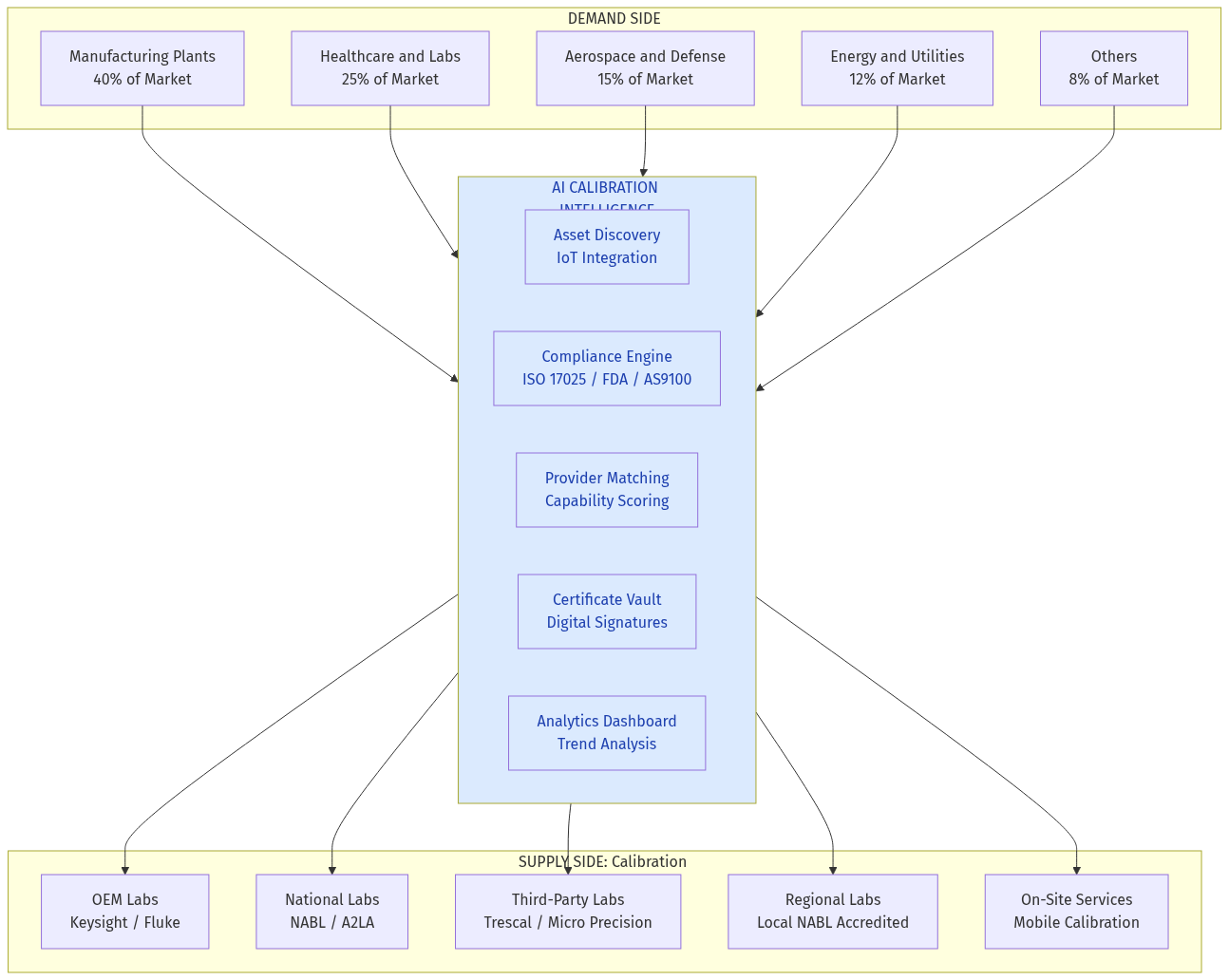
Calibration Intelligence Workflow
How AI Agents Transform the Workflow
1. Asset Discovery Agent
Connects to CMMS, ERP, and procurement systems
Extracts instrument master data automatically
Uses computer vision to read asset tags and nameplates
Builds unified equipment registry with calibration requirements
2. Predictive Scheduling Agent
Ingests usage data from smart instruments (cycle counts, operating hours)
Flags anomalies: unexpected drift, failed parameters, missing data
Stores structured data in searchable, auditable format
5. Compliance Dashboard Agent
Real-time view of calibration status across all facilities
Generates audit reports in required formats (ISO 17025, FDA, AS9100)
Predicts audit risk based on upcoming expirations and historical findings
Suggests corrective actions before auditors arrive
Distant Domain Import: Predictive Maintenance
The predictive calibration model borrows from industrial PdM (Predictive Maintenance). Just as vibration analysis predicts bearing failure, usage + drift analysis can predict calibration excursions. This is metrology's "condition-based maintenance."
7.
Product Concept
Core Platform: CalibrationOS
For Quality Managers:
Single dashboard for all instruments across facilities
Natural language search: "Show all pressure gauges due next month in Plant 2"
WhatsApp/SMS alerts for upcoming and overdue calibrations
One-click audit report generation
For Calibration Labs:
Digital job cards with instrument specs and requirements
Online certificate submission with structured data capture
Automated accreditation verification
Payment processing and invoicing
For Procurement:
Competitive bidding for calibration jobs
Spend analytics by instrument type, department, provider
- Mitigation: Offer value (digital job cards, faster payment) before demanding transparency
Quality Manager Inertia: "Excel has worked for 20 years"
- Mitigation: Show 10x value (instant audit reports); start with crisis (failed audit recovery)
Low Urgency: Calibration is "important but not urgent" until audit time
- Mitigation: Create urgency through predictive alerts ("3 instruments at risk of drift")
Steelmanning the Incumbent:
Trescal (€600M revenue, 5000 employees) could build this platform themselves. Their counterargument: "Why would we commoditize our own service? Our moat is relationships, not technology. Platform players come and go; lab infrastructure endures."
The response: Trescal has conflict of interest—they can't be neutral marketplace AND service provider. Customer trust favors independent platform.
Perfect for ML (drift prediction), LLM (certificate extraction)
Go-to-Market Clarity
8/10
Pharma cluster strategy is executable
Data Moat
9/10
Calibration history = unique, defensible asset
Competitive Risk
7/10
OEMs could retaliate; enterprise software vendors could add modules
Final Assessment
Calibration services is a "hidden" B2B category—boring, compliance-driven, invisible until something goes wrong. That's exactly why it's attractive: no flashy startups chasing it, incumbents are lazy, and customers are suffering quietly.
The playbook:
Start with a single industry cluster (pharma in Hyderabad)
Digitize paper certificates for free → earn trust
Upsell predictive scheduling → prove ROI
Expand marketplace → become the "Uber for calibration"
Build drift prediction models → create data moat
This fits AIM's thesis perfectly: structure a fragmented industry, add AI intelligence layer, and let the data compound.
Recommendation: Proceed with MVP development targeting pharma manufacturing.