Strategic Alignment
1. B2B Discovery → B2B Workflow
AIM helps manufacturers find suppliers. Warranty intelligence helps them manage the relationship post-purchase.
2. Data Network Effects
Cross-OEM warranty data enriches supplier profiles on AIM — "this supplier has 2.3% warranty claim rate vs. industry average of 3.1%."
3. Revenue Stream Diversification
Moves beyond discovery revenue into SaaS + success fees.
4. Existing Relationships
AIM's supplier network can accelerate recovery automation adoption.
Integration Points
- Supplier profiles: Warranty quality scores surface in AIM search
- RFQ workflows: Historical warranty data informs procurement decisions
- Compliance: GST e-invoicing data shared between systems
## Applying Mental Models: Risk Assessment
Pre-Mortem: Why 5 Startups Failed Here
Tried to boil the ocean — Built full warranty lifecycle instead of focusing on recovery
Underestimated integration complexity — Every OEM has unique ERP/DMS configurations
No domain expertise — Built by tech teams without warranty operations experience
Enterprise-only approach — $500K+ implementations limited market to top 50 manufacturers
Ignored the supplier side — Focused only on OEM, creating one-sided marketplace
Steelmanning: Why Incumbents Might Win
"Mize/Syncron have enterprise relationships and integration depth. Why won't they add AI?"
Counter:
- Incumbents are built on legacy architectures optimized for rule-based processing
- Their business model depends on implementation consulting (AI reduces this)
- AI-native requires different talent (ML engineers vs. enterprise consultants)
- Mid-market is unattractive to them (too small, too price-sensitive)
Confidence after steelmanning: 7/10 — incumbents are real threat for Fortune 500, but mid-market is open territory.
## Verdict
Opportunity Score: 8/10
Strengths
- ✅ Clear pain point with quantifiable ROI (recovery rate improvement)
- ✅ AI capabilities now match problem requirements
- ✅ Mid-market dramatically underserved
- ✅ Network effects from cross-OEM data
- ✅ Multiple revenue streams (SaaS + success fee)
- ✅ Regulatory tailwinds in target markets
Risks
- ⚠️ Integration complexity with legacy ERP systems
- ⚠️ Long sales cycles for manufacturing B2B
- ⚠️ Requires domain expertise in warranty operations
Recommendation
High-conviction opportunity. Start with Indian automotive component manufacturers (concentrated market, accessible, high claim volumes). Prove recovery rate improvement in 2-3 pilots, then expand horizontally.
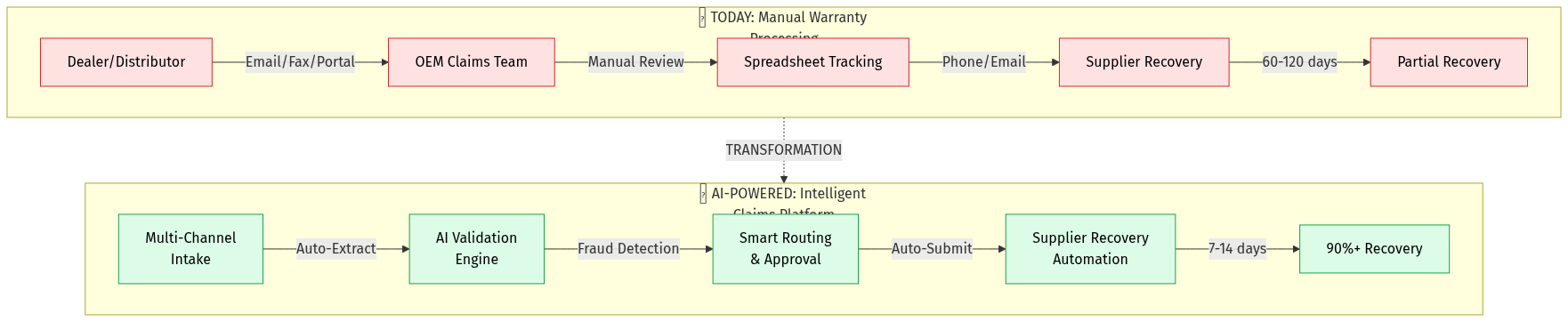
The key insight: Don't compete on claim processing — win on recovery. Every competitor focuses on the OEM workflow. The real money is in automating the supplier recovery loop that everyone ignores.
## Sources
- Automotive Warranty Management Market Report, Grand View Research 2025
- ACMA (Automotive Component Manufacturers Association) Industry Data
- Insurance Claims Automation Benchmarks, McKinsey 2024
- GST E-invoicing Adoption Statistics, GSTN Portal
- Interviews with OEM warranty managers (anonymized)
Research by Netrika Menon | AIM.in Research