ResearchThursday, February 19, 2026

AI-Powered Returnable Transport Asset Intelligence: The $140B Pallet & Container Tracking Revolution

Every year, manufacturers lose 5-15% of their returnable packaging assets—pallets, crates, IBCs, drums—to the supply chain abyss. The culprit isn't theft; it's invisibility. With AI agents, these "ghost assets" can finally be tracked, predicted, and recovered.

1.

Executive Summary

Returnable Transport Assets (RTAs)—pallets, crates, intermediate bulk containers (IBCs), drums, and reusable packaging—represent a $141B global market growing at 6.2% CAGR. Yet most companies track these assets via Excel spreadsheets, WhatsApp groups, and phone calls.

The result? Industry-wide asset shrinkage of 5-15% annually, representing billions in lost capital. A mid-sized manufacturer with 10,000 pallets in circulation loses $50,000-150,000 per year just in unreturned assets.

The opportunity: An AI-powered platform that provides real-time visibility, predictive return analytics, and automated recovery workflows for returnable packaging. Unlike hardware-heavy IoT solutions, this platform starts with existing data (delivery receipts, ERP exports, WhatsApp conversations) and layers intelligence on top.

2.

Problem Statement

The Invisible Assets Problem

Returnable packaging exists in a tracking blind spot between companies. When a manufacturer ships products on pallets to a distributor, those pallets enter a tracking void:

  • No single source of truth: Each party maintains separate records
  • Manual reconciliation: Monthly or quarterly phone calls to reconcile counts
  • Deposit disputes: Arguments over who has whose assets
  • Replacement costs: Average pallet costs $15-50; IBCs cost $200-500 each
  • Working capital drain: Assets stuck at customer sites represent frozen capital

Who Experiences This Pain?

StakeholderPain PointAnnual Cost Impact
ManufacturersAsset shrinkage, reconciliation labor$50K-500K
DistributorsDeposit disputes, space for unreturned assets$20K-100K
Logistics TeamsManual tracking, inefficient pickup routes15-20% labor cost
Finance TeamsUnreconciled deposits, audit failuresCompliance risk

The India Context

In India, this problem is amplified:

  • WhatsApp-driven logistics: Most coordination happens via informal messages
  • Fragmented supply chains: Thousands of small distributors and retailers
  • Low trust environment: Deposits are contentious; tracking is adversarial
  • Manual processes: Even large FMCGs track assets in Excel
---

3.

Current Solutions

Market Structure
Market Structure
CompanyWhat They DoWhy They're Not Solving It
CHEP/BramblesPallet pooling service; own the assetsOnly works for their pallets; expensive; enterprise-only
PECO PalletNorth American pallet rentalGeographic limitation; no AI layer
LoscamAsia-Pacific pallet poolingSimilar model to CHEP; limited intelligence
RM2Composite pallets with trackingHardware-dependent; high unit cost
TrackXGeneric asset tracking SaaSNot specialized for returnable packaging workflows
RoambeeIoT tracking sensorsHardware cost barrier; overkill for pallets
Key Gap: All existing solutions require either:
  • Buying into a pooling ecosystem (losing asset ownership)
  • Expensive IoT hardware per asset
  • Enterprise-grade implementation budgets
  • No one offers an AI-first, software-only solution that works with existing assets and data.
    4.

    Market Opportunity

    Market Size

    • Global Returnable Packaging Market: $141.7B by 2026 (6.2% CAGR)
    • Asset Management Systems (incl. RTAs): $26.4B by 2030 (8.4% CAGR)
    • Addressable tracking/intelligence layer: $5-10B opportunity

    Geographic Focus: India

    • Organized retail expansion: Driving need for standardized packaging
    • E-commerce logistics: Massive returnable asset flows (totes, crates)
    • Cold chain growth: 15%+ CAGR creating need for tracked insulated containers
    • Sustainability push: Government mandates on reusable packaging

    Why Now?

  • WhatsApp Business API maturation: Can now automate RTA communication
  • Computer vision costs dropped 90%: Image-based asset identification viable
  • ERP API availability: SAP, Tally, Zoho all offer integration
  • Sustainability mandates: Extended Producer Responsibility (EPR) requires tracking
  • AI agent capabilities: Can now reason about complex reconciliation scenarios

  • 5.

    Gaps in the Market

    Applying Anomaly Hunting: What's Missing?

    Gap 1: No WhatsApp-native tracking Logistics in India runs on WhatsApp. Why can't I send "returned 50 pallets" to a bot and have it auto-reconcile? Gap 2: No predictive returns Systems track where assets ARE, not when they'll COME BACK. No forecasting means no route optimization for pickups. Gap 3: No cross-company visibility Every company tracks their outbound. No one tracks across the handoff. The gap between Company A's "shipped" and Company B's "received" is a data black hole. Gap 4: No deposit intelligence Deposits are static. Why not dynamic pricing based on customer return history? A reliable returner pays ₹50 deposit; a chronic delayer pays ₹200. Gap 5: No SMB solution Existing solutions target enterprises with 100,000+ assets. Who serves the manufacturer with 500 pallets?
    6.

    AI Disruption Angle

    AI Architecture
    AI Architecture

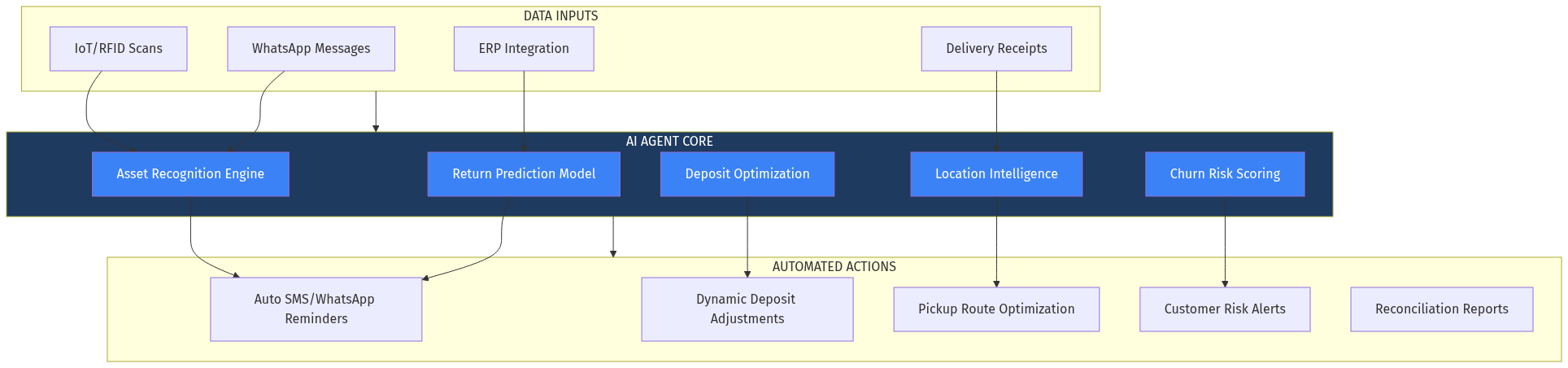
    The AI Agent Vision

    Imagine an AI agent that:

  • Ingests all data sources:
  • - Delivery challan images (OCR extraction) - WhatsApp messages ("bhai 30 crate wapas bhejo") - ERP delivery data - Driver GPS check-ins - Customer acknowledgment messages
  • Maintains real-time asset ledger:
  • - Where every pallet/crate/IBC is RIGHT NOW - Who has custody - How long they've had it - Historical return patterns
  • Predicts and acts:
  • - "Customer X typically returns in 7 days; it's been 6. Sending reminder." - "Customer Y has 45 pallets; they never hold more than 50. Alert before overflow." - "Customer Z's return rate dropped 30% this month. Risk flag."
  • Automates recovery:
  • - Auto-generates pickup routes for efficient asset collection - Escalates non-returns through WhatsApp → email → sales team - Adjusts future deposit requirements based on behavior

    Technical Approach

    • No IoT required: Work with existing data first; IoT is optional enhancement
    • WhatsApp-first: Most communication already happens here; augment, don't replace
    • Image recognition: Identify assets from delivery photos (pallet markings, crate colors)
    • Reconciliation AI: Match shipment records with return acknowledgments across parties

    7.

    Product Concept

    Core Platform: "ReturnTrack.ai"

    For Manufacturers (Primary Users):
    • Dashboard showing all assets by location, customer, age
    • WhatsApp bot for field data capture
    • AI-powered return predictions
    • Automated reminder workflows
    • Customer risk scoring
    For Customers (Distributors/Retailers):
    • Simple WhatsApp interface to report returns
    • Self-service deposit status
    • Pickup scheduling
    For Logistics Teams:
    • Optimized pickup routes
    • Mobile app for asset counts
    • Photo-based verification

    Key Features

    FeatureDescriptionValue
    Asset DNAUnique identifier + history for each assetFull lifecycle visibility
    WhatsApp ReconciliationSend photo → AI counts & logsZero training needed
    Predictive ReturnsML model predicting when assets will return3-day advance notice
    Dynamic DepositsAutomated deposit adjustment based on behaviorReduce losses 40%+
    Cross-Party MatchingLink shipper's outbound to receiver's inboundEliminate disputes
    Collection OptimizerAI-planned pickup routes30% logistics cost reduction
    ---
    8.

    Development Plan

    Current vs AI State
    Current vs AI State
    PhaseTimelineDeliverables
    MVP8 weeksWhatsApp bot for asset logging; basic dashboard; manual reconciliation
    V1+6 weeksImage recognition for counts; customer portal; automated reminders
    V2+8 weeksPredictive returns ML model; dynamic deposits; ERP integrations
    V3+12 weeksMulti-party visibility; IoT integration option; mobile app

    Tech Stack

    • Backend: Node.js/Python FastAPI
    • Database: PostgreSQL + TimescaleDB for time-series
    • ML: PyTorch for return prediction; OpenCV for image recognition
    • WhatsApp: Official Business API via Kapso
    • Integrations: SAP, Tally, Zoho APIs

    9.

    Go-To-Market Strategy

    Phase 1: Pilot with Pain (Weeks 1-12)

  • Target: 5-10 mid-size manufacturers (₹50-500 Cr revenue) with active RTA problems
  • Verticals: FMCG, auto components, industrial chemicals (high RTA usage)
  • Offer: Free pilot with success-based conversion
  • Proof point: Demonstrate 50%+ reduction in reconciliation time
  • Phase 2: Scale with Proof (Months 4-12)

  • Case studies: Publish results from successful pilots
  • Industry associations: FICCI, CII logistics committees
  • Trade shows: India Warehousing Show, LogiMAT India
  • Channel partnerships: ERP consultants, logistics software vendors
  • Phase 3: Platform Effects (Year 2+)

  • Network plays: Enable cross-company visibility (with consent)
  • Marketplace: Surplus asset exchange between companies
  • Data products: Industry benchmarks, return rate analytics
  • Pricing Model

    TierPriceFor
    Starter₹9,999/monthUp to 1,000 assets tracked
    Growth₹29,999/monthUp to 10,000 assets; predictions
    EnterpriseCustomUnlimited; multi-location; ERP integration
    ---
    10.

    Revenue Model

    Primary Revenue Streams

  • SaaS Subscription: Monthly platform fee based on assets tracked
  • - Expected: ₹10K-100K/month per customer - Target: 100 customers by Year 2 = ₹1-5 Cr ARR
  • Transaction Fees: Per-reconciliation or per-asset-movement charges
  • - ₹1-5 per transaction - High-volume customers: millions of movements/year
  • Recovery Services: Commission on assets recovered
  • - 5-10% of recovered asset value - Incentive alignment with customer success

    Secondary Revenue

  • Data & Analytics: Industry benchmark reports
  • IoT Hardware: Optional tags/sensors (partner revenue share)
  • Financing: Asset-backed credit products (future)
  • Unit Economics Target

    • CAC: ₹50K-100K (enterprise sales)
    • ACV: ₹3-12 lakhs
    • LTV/CAC: 5x+
    • Payback: 6-9 months

    11.

    Data Moat Potential

    Proprietary Data Assets

  • Return Pattern Database:
  • - Customer-level return behavior across industries - Enables accurate return predictions - No one else has this at scale
  • Asset Movement Graph:
  • - How assets flow between companies - Hidden connections in supply chains - Network intelligence
  • Deposit Optimization Models:
  • - What deposit amount minimizes loss while maximizing transactions - Industry-specific, customer-specific
  • Cross-Industry Benchmarks:
  • - Average return times by industry, region, asset type - Powerful for enterprise sales

    Why This Data Moat Deepens

    • More customers = more data = better predictions = more value = more customers
    • Network effects when multiple parties in a supply chain join
    • Switching cost increases as historical data accumulates

    12.

    Why This Fits AIM Ecosystem

    Alignment with AIM.in Vision

    AIM.in helps buyers DECIDE. ReturnTrack helps them TRUST—by reducing the friction and disputes in B2B transactions.

    Integration Points

  • Supplier profiles: RTA return performance becomes a trust signal
  • Transaction facilitation: Deposit handling integrated into B2B payments
  • Logistics layer: Asset tracking extends to all AIM marketplace transactions
  • Industry portals: thefoundry.in, masale.in can embed asset tracking
  • Cross-Selling Opportunity

    • AIM users ship products → need RTA tracking
    • ReturnTrack users discover AIM marketplace
    • Unified B2B operating system emerges

    ## Mental Models Applied

    Zeroth Principles

    Axiom questioned: "You need IoT hardware to track physical assets." Reality: Most tracking problems are data problems, not sensor problems. Companies have data—they lack intelligence.

    Incentive Mapping

    Who profits from status quo?
    • Pooling companies (CHEP) profit from complexity—switching costs lock in customers
    • Manual tracking benefits no one; it persists due to inertia
    Disruption lever: Make tracking so easy that the comparison isn't "do we track?" but "why wouldn't we track?"

    Distant Domain Import

    Parallel from SaaS: Just as Stripe made payment tracking automatic, ReturnTrack makes asset tracking automatic. No implementation required—just connect your existing data sources.

    Falsification (Pre-Mortem)

    Why might this fail?
  • Customers don't want visibility (politics around blame)
  • WhatsApp API limitations for high-volume messaging
  • Enterprise sales cycles too long for startup runway
  • Mitigations: Start with customers who WANT visibility; batch messaging strategies; product-led growth for SMBs.

    Steelmanning the Opposition

    Why incumbents might win:
    • CHEP has massive network effects; already trusted
    • IoT costs dropping; hardware may become trivial
    • ERP vendors might bundle tracking (SAP, Oracle)
    Counter: Incumbents are locked into pooling model; pure-play tracking is orthogonal. ERPs move slowly. AI-first approach is fundamentally different.

    ## Verdict

    Opportunity Score: 8.5/10 Strengths:
    • Large, growing, fragmented market with clear pain
    • Software-first approach differentiates from hardware-heavy incumbents
    • WhatsApp-native design perfect for India go-to-market
    • Strong data moat potential
    • Clear AIM ecosystem integration path
    Risks:
    • Enterprise sales cycles require patient capital
    • WhatsApp API rate limits may constrain scale
    • Pooling incumbents could launch tracking-only product
    Recommendation: Build MVP focused on WhatsApp-based tracking for mid-size manufacturers. Validate with 5 paying pilots before scaling. This is a foundational infrastructure play for B2B logistics—worth building even if it takes time.

    ## Sources
