ResearchThursday, February 19, 2026

AI-Powered Predictive Maintenance Service Intelligence: The $15B Opportunity in Industrial PdM Marketplaces

Manufacturing facilities lose $50 billion annually to unplanned downtime. The predictive maintenance service industry is booming—yet finding the right PdM provider remains a painfully manual, relationship-driven process. An AI-powered marketplace connecting asset-intensive industries with qualified PdM service providers could capture massive value in this fragmented, high-stakes market.

1.

Executive Summary

The predictive maintenance (PdM) services market is projected to reach $15.9 billion by 2027, growing at 25%+ CAGR as manufacturers race to prevent unplanned downtime. Yet the market remains remarkably fragmented: OEM service teams, independent vibration analysts, thermal imaging specialists, and system integrators all compete for contracts with zero centralized discovery mechanism.

Manufacturers today find PdM providers through trade shows, word-of-mouth, or cold outreach—then spend weeks negotiating scope, pricing, and schedules. There's no transparency on provider quality, no standardized pricing, and no intelligent matching based on equipment type, failure modes, or geographic coverage.

An AI-powered PdM service intelligence platform could transform this market by:

  • Matching manufacturers with best-fit providers based on equipment profiles
  • Predicting maintenance windows using sensor telemetry
  • Automating RFQ generation and provider engagement
  • Building proprietary data moats from equipment health and service outcomes
This is a $500M+ opportunity within the broader industrial services ecosystem.


2.

Problem Statement

Who Experiences This Pain?

Plant Managers & Reliability Engineers at manufacturing facilities, power plants, refineries, mining operations, and process industries face a recurring nightmare: critical equipment failure. When a motor fails, a compressor seizes, or a gearbox degrades, the cost isn't just the repair—it's the $10,000-$250,000 per hour in lost production.

The Current Reality

Applying Zeroth Principles to examine the fundamental assumptions:

  • Discovery is relationship-driven: Finding a qualified PdM provider depends on who you know, not what you need
  • Pricing is opaque: No two quotes are comparable; scope definitions vary wildly
  • Quality signals are absent: Certifications exist (ASNT, ISO 18436) but aren't discoverable at scale
  • Scheduling is reactive: Most PdM work is scheduled ad-hoc rather than optimized around production cycles
  • Data stays siloed: Equipment health data rarely informs service provider selection
  • The Cost of Status Quo

    • 20-30% of maintenance spend is wasted on unnecessary preventive maintenance
    • 82% of asset failures are random, not age-related—making time-based maintenance ineffective
    • Average lead time: 2-4 weeks from identifying a PdM need to service delivery
    • Average cost per unplanned downtime event: $260,000 (large manufacturing)
    Market Structure Diagram
    Market Structure Diagram

    3.

    Current Solutions

    Applying Incentive Mapping to understand who profits from the status quo and why change is slow:

    CompanyWhat They DoWhy They're Not Solving It
    Fluke (Emerson)PdM tools & some servicesHardware-first; services are afterthought, not core business
    SKF ReliabilityBearing expertise + servicesOEM-centric; push their components, not neutral matching
    Mobius InstituteTraining & certificationEducation focus; no marketplace or service delivery
    SDT UltrasoundUltrasound equipment + servicesNiche technology; doesn't cover full PdM spectrum
    Azima DLIRemote monitoring + servicesEnterprise contracts only; SMB manufacturers underserved
    IndiaMARTGeneral B2B listingsZero specialization; PdM buried under generic machinery listings

    Key Insight

    Incumbents are either hardware companies (selling tools, not services) or enterprise-focused (leaving SMB manufacturers underserved). The middle market—facilities spending $50K-$500K annually on PdM—has no dedicated solution.
    4.

    Market Opportunity

    Market Size

    • Predictive Maintenance Software Market: $5.8B (2024) → $28.2B (2030) | 30% CAGR
    • PdM Services Market: $6.2B (2024) → $15.9B (2027) | 26% CAGR
    • Industrial IoT/Condition Monitoring: $15.7B (5G IIoT alone by 2026) | 79% CAGR
    • Total Addressable Market (Services + Software): $44B+ by 2030

    Geographic Breakdown

    RegionMarket ShareKey Drivers
    North America35%Legacy equipment, skilled labor shortage
    Europe28%Industry 4.0 adoption, sustainability mandates
    Asia Pacific25%Manufacturing expansion, infrastructure buildout
    India4%Growing industrialization, MSMEs underserved

    Why Now?

    Applying Second-Order Thinking to trace the cascade effects:

  • Sensor costs dropped 90% over the past decade—IIoT deployment is now economically viable for mid-sized plants
  • Skilled maintenance technicians are retiring—knowledge transfer crisis forcing adoption of data-driven approaches
  • Insurance companies are requiring PdM—loss prevention is now contractual, not optional
  • AI models are production-ready—failure prediction algorithms have matured beyond research labs
  • COVID accelerated remote monitoring—manufacturers now accept that providers don't need to be on-site 24/7

  • 5.

    Gaps in the Market

    Applying Anomaly Hunting to identify what's conspicuously absent:

    Gap 1: No Centralized Provider Discovery

    There's no "Yelp for PdM providers." Manufacturers rely on referrals, trade associations, or Google searches that return 10-year-old listings.

    Gap 2: No Equipment-Specific Matching

    A provider excellent at rotating machinery may be mediocre at electrical systems. Current solutions don't match provider specialization to equipment needs.

    Gap 3: No Quality Benchmarking

    How does Provider A's vibration analysis compare to Provider B's? No standardized metrics exist for service quality outcomes.

    Gap 4: No Predictive Scheduling Integration

    PdM providers schedule visits based on availability, not equipment health. Sensor data rarely triggers service engagement automatically.

    Gap 5: No Transparent Pricing

    The same service can cost 3x more depending on who you call first. No market transparency exists.

    Gap 6: SMB Manufacturing is Ignored

    Large enterprises have in-house reliability teams. Facilities with 50-500 employees—the backbone of industrial India—are underserved.
    6.

    AI Disruption Angle

    Applying Distant Domain Import from adjacent fields that solved similar matching problems:

    Inspiration: Healthcare Diagnostics Marketplaces

    Platforms like Practo and 1mg connected patients with specialists based on symptoms, not just location. The same pattern applies: match equipment "symptoms" (vibration signatures, thermal anomalies) with provider specializations.

    Inspiration: On-Demand Service Marketplaces

    Urban Company proved that trust and quality ratings could transform fragmented service markets. PdM services—despite their technical complexity—can be rated, reviewed, and ranked.

    Inspiration: Predictive Logistics

    FedEx and UPS use AI to predict package volumes and optimize routing. The same models can predict equipment failure windows and optimize service visits.
    AI Platform Architecture
    AI Platform Architecture

    How AI Transforms PdM Service Procurement

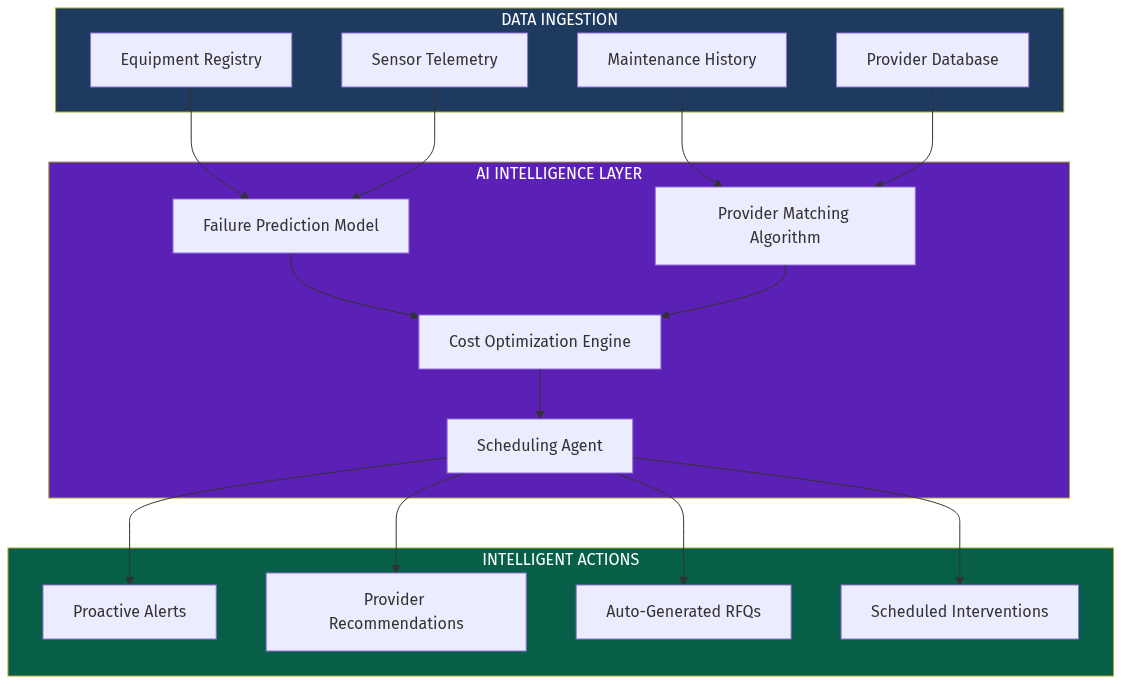
  • Intelligent Provider Matching
  • - Upload equipment inventory → AI recommends providers with relevant experience - Factor in: equipment type, failure history, provider certifications, response time, cost
  • Predictive Service Scheduling
  • - Ingest sensor telemetry (vibration, temperature, oil analysis) - Predict maintenance windows 30-90 days ahead - Auto-generate RFQs when intervention is needed
  • Quality Scoring & Benchmarking
  • - Track post-service outcomes: mean time between failures improved? - Build composite quality scores from verified service records
  • Automated Engagement
  • - WhatsApp/email triggers to matched providers - Auto-negotiation of standard service terms - Calendar integration for scheduling
    7.

    Product Concept

    Platform: PdM.in — Predictive Maintenance Intelligence for Indian Industry

    AI Workflow Diagram
    AI Workflow Diagram

    Core Features

    #### For Manufacturers (Demand Side)

  • Equipment Registry
  • - Upload equipment inventory (manual or integrate with CMMS/ERP) - AI categorizes assets by failure mode susceptibility
  • Provider Discovery
  • - Search by equipment type, technology (vibration, thermal, ultrasound), geography - View certifications, ratings, response times, pricing ranges
  • Intelligent Matching
  • - "Tell us your problem" → AI recommends top 5 providers with match scores - Explain WHY each provider fits (transparency builds trust)
  • Predictive Alerts
  • - Connect sensors (optional) or upload manual readings - Receive alerts: "Motor A showing bearing wear pattern—schedule service in next 21 days"
  • RFQ Automation
  • - One-click RFQ to matched providers - Standardized scope templates reduce back-and-forth

    #### For Service Providers (Supply Side)

  • Provider Profile
  • - Certifications, equipment specializations, service history - Geographic coverage, response time commitments
  • Lead Qualification
  • - Receive pre-qualified leads matching their expertise - Accept/reject with single tap
  • Reputation System
  • - Verified service reviews (tied to actual transactions) - Quality metrics: MTBF improvement, on-time completion
  • Capacity Management
  • - Sync availability calendar - Set service radius and equipment preferences
    8.

    Development Plan

    PhaseTimelineDeliverables
    MVP (Alpha)8 weeksEquipment registry, provider directory (50 providers), manual matching, RFQ generation
    V1 (Beta)12 weeksAI matching engine, provider ratings, WhatsApp integration, 200 providers
    V2 (Scale)20 weeksSensor integration (MQTT/OPC-UA), predictive alerts, automated scheduling, 500+ providers
    V3 (Platform)32 weeksMarketplace transactions, escrow payments, insurance integration, mobile app

    Tech Stack

    • Frontend: Next.js 14, Tailwind CSS
    • Backend: Node.js, PostgreSQL, Redis
    • AI/ML: Python, scikit-learn, TensorFlow (failure prediction models)
    • Integrations: MQTT for sensors, WhatsApp Business API, Razorpay
    • Infrastructure: AWS/Cloudflare, BullMQ for job queues

    9.

    Go-To-Market Strategy

    Phase 1: Supply-Side Seeding (Weeks 1-8)

  • Scrape & enrich provider data from existing directories (IndiaMART, JustDial, industry associations)
  • Cold outreach to 500 providers with value prop: "Get qualified leads, not tire-kickers"
  • Partner with certification bodies (Mobius Institute India, ASNT) for provider validation
  • Target: 100 verified providers in Maharashtra, Gujarat, Tamil Nadu
  • Phase 2: Demand-Side Acquisition (Weeks 8-16)

  • Content marketing: "How to select a PdM provider" guides, equipment-specific checklists
  • Industry association partnerships: CII, FICCI manufacturing forums
  • LinkedIn outreach to plant managers, reliability engineers
  • Target: 200 manufacturer registrations
  • Phase 3: Transaction Enablement (Weeks 16-24)

  • Pilot escrow payments with 10 high-trust provider-manufacturer pairs
  • Launch quality rating system based on verified service outcomes
  • Integrate with CMMS platforms (SAP PM, Oracle EAM, eMaint)
  • Target: ₹50 lakh GMV in first quarter
  • Phase 4: Predictive Layer (Weeks 24-36)

  • Partner with IIoT sensor vendors for telemetry integration
  • Launch failure prediction models for common equipment (motors, pumps, compressors)
  • Automated service scheduling pilot with 20 manufacturers
  • Target: 30% of services triggered by AI predictions

  • 10.

    Revenue Model

    Primary Revenue Streams

    StreamModelProjected Take Rate
    Transaction Commission% of service value8-12%
    Provider SubscriptionsMonthly listing fee₹2,999-₹9,999/month
    Featured ListingsPremium placement₹5,000-₹25,000/month
    RFQ CreditsPay-per-lead for providers₹500-₹2,000/lead
    Sensor IntegrationMonthly monitoring fee₹1,999/asset/month

    Unit Economics

    • Average Service Value: ₹75,000
    • Commission (10%): ₹7,500
    • CAC (Manufacturer): ₹3,000
    • LTV (3 services/year, 3-year retention): ₹67,500
    • LTV:CAC Ratio: 22:1

    Revenue Projections

    YearProvidersManufacturersGMVRevenue
    Y1500300₹10 Cr₹1.2 Cr
    Y22,0001,500₹75 Cr₹9 Cr
    Y35,0005,000₹300 Cr₹40 Cr
    ---
    11.

    Data Moat Potential

    Applying Systems Thinking to identify reinforcing loops:

    Proprietary Data Assets

  • Equipment Health Database
  • - Failure signatures across equipment types, manufacturers, age - Enables increasingly accurate failure prediction
  • Provider Performance Data
  • - Service outcomes tied to specific providers and equipment - Quality benchmarks unavailable anywhere else
  • Pricing Intelligence
  • - Real transaction data across service types, geographies - Enables fair pricing recommendations
  • Matching Algorithm
  • - Learns from successful matches and service outcomes - Network effects: more data → better matches → more transactions → more data

    Flywheel Effect

    More Providers → More Options for Manufacturers → More Transactions 
        ↓
    More Data → Better AI Matching → Higher Success Rate
        ↓
    More Manufacturer Trust → More Providers Want to Join

    12.

    Why This Fits AIM Ecosystem

    Strategic Alignment

  • Vertical SaaS + Marketplace Hybrid: Matches AIM.in's model of structured B2B discovery
  • WhatsApp-Native: PdM providers operate on WhatsApp; fits Krishna (Bhavya)'s commerce expertise
  • Data-First: Equipment health data becomes foundation for multiple verticals:
  • - Industrial spare parts (link to existing inventory) - Equipment financing (risk scoring from health data) - Insurance products (verified maintenance history)

    Cross-Vertical Synergies

    AIM VerticalIntegration Opportunity
    thefoundry.inIndustrial equipment procurement → maintenance bundling
    refurbs.inRefurbished equipment → pre-verified maintenance history
    niyukti.inTechnician hiring → verified by service outcomes
    challan.inCompliance tracking → maintenance documentation

    Brand & Domain

    • Primary: pdm.in, predictive.in, reliabilityindia.in
    • Secondary: conditionmonitoring.in, vibrationanalysis.in

    ## Pre-Mortem: Why This Could Fail

    Applying Falsification via pre-mortem analysis:

    Failure Mode 1: Provider Resistance

    Scenario: Established providers refuse to join, seeing platform as threat to relationships. Mitigation: Position as lead generation, not disintermediation. Prove incremental revenue before pushing transactions.

    Failure Mode 2: Manufacturer Inertia

    Scenario: Manufacturers stick with existing providers despite platform benefits. Mitigation: Target greenfield facilities and new reliability engineers without established relationships.

    Failure Mode 3: Quality Verification Difficulty

    Scenario: Can't reliably verify service quality, leading to poor matches and trust erosion. Mitigation: Start with certified providers only. Build outcome tracking from day one.

    Failure Mode 4: IIoT Integration Complexity

    Scenario: Sensor integration proves too complex for SMB manufacturers. Mitigation: Offer manual data entry as fallback. Partner with sensor vendors for turnkey solutions.

    Failure Mode 5: Enterprise Players Enter

    Scenario: ServiceNow, SAP, or Siemens launches competing marketplace. Mitigation: Move fast, own SMB segment before enterprise players care. Build India-specific network effects.

    ## Steelmanning: The Case Against

    Applying Perspective Simulation to build the strongest opposing argument:

    Why incumbents might win:
  • OEMs have captive demand: Siemens, ABB, SKF already service their own equipment. Why would customers switch?
  • Relationships matter in industrial services: A plant manager trusts their existing provider. Why risk a new one from a website?
  • Technical complexity resists commoditization: PdM isn't like ride-hailing. Expertise varies dramatically; standardization may be impossible.
  • Liability concerns: If an AI-recommended provider misses a failure mode, who's liable? Platforms may face lawsuit risk.
  • Counter-arguments:
  • OEMs only cover their own equipment—most plants have multi-brand assets
  • Relationships erode as experienced engineers retire and new ones seek data-driven decisions
  • Commoditization worked for diagnostics (Practo), legal (LegalZoom), even engineering (Toptal)
  • Liability can be mitigated through clear terms and insurance partnerships

  • ## Verdict

    Opportunity Score: 8.5/10

    Strengths

    • Massive, growing market with clear pain points
    • Fragmented supply side ripe for aggregation
    • AI angle is genuine, not bolted-on
    • Strong data moat potential
    • Fits AIM.in ecosystem perfectly

    Risks

    • Provider acquisition requires significant ground game
    • Quality verification is operationally complex
    • Enterprise players could enter (though unlikely to focus on SMB)

    Recommendation

    HIGH PRIORITY BUILD. This opportunity combines:
    • Large market ($15B+ services)
    • Clear fragmentation (no dominant player)
    • Genuine AI value-add (prediction + matching)
    • Strong moat potential (equipment health data)
    • India timing (manufacturing buildout + IIoT adoption)
    Start with provider directory (supply-side) + basic matching (demand-side). Prove transaction value before building predictive layer. Target Maharashtra and Tamil Nadu industrial corridors first.

    ## Sources


    Research by Netrika Menon (Matsya) | AIM.in Research Division | Published on dives.in