ResearchThursday, February 19, 2026

AI-Powered Industrial Scrap Intelligence: The $450B Metal Recycling Market Waiting for Disruption

The global scrap metal industry moves 600+ million metric tons annually through a network of informal dealers, phone negotiations, and opaque pricing. While steel mills use 97% recycled content and scrap represents the lowest-cost feedstock, the procurement process remains stuck in the 1990s. AI agents can transform this chaos into a structured, transparent marketplace.

1.

Executive Summary

Industrial scrap recycling is a $450 billion global market characterized by extreme fragmentation, price opacity, and informal workflows. Manufacturing plants generate tons of metal scrap daily but rely on local dealers discovered through word-of-mouth. Pricing varies wildly—the same grade of copper can have a 15-25% price spread within the same city.

The opportunity: An AI-powered scrap intelligence platform that provides visual grading, real-time price indices, automated matching, and compliance tracking. This isn't about building another listing site—it's about creating the infrastructure that makes scrap trading as structured as commodity trading while preserving the human relationships that make the industry work.

Key Insight: Steel doesn't lose physical properties during recycling. Energy saved by recycling steel reduces industry energy consumption by 75%—enough to power 18 million homes annually. The economics are compelling, but the transaction layer is broken.
2.

Problem Statement

Who Feels the Pain?

Manufacturing Plants (Scrap Generators)
  • Generate 2-15% of material as scrap during production
  • Don't know if they're getting fair prices
  • Rely on the same 2-3 dealers for years, never testing the market
  • Compliance documentation (EPR, hazardous waste) is manual and error-prone
Scrap Dealers (Aggregators)
  • Cash-flow intensive business with no formal credit
  • Price discovery happens through WhatsApp groups and phone calls
  • Quality disputes are common—no standardized grading
  • Logistics are self-arranged, creating inefficiency
Recyclers & Steel Mills (End Buyers)
  • Need consistent quality and quantity
  • Pay premium for reliability, not necessarily the best price
  • Face compliance risks from improper documentation
  • No visibility into upstream supply chain

The Information Asymmetry Problem

Applying Zeroth Principles: Why does scrap pricing remain opaque when commodity markets have had transparent pricing for decades? The axiom we rarely question: "Scrap is inherently variable, so standardized pricing is impossible."

This is false. Steel recyclers have been operating for 150 years with well-understood metallurgical grades. The opacity isn't technological—it's structural. Dealers profit from information asymmetry. Generators don't have alternatives. The status quo persists because no one has built the data infrastructure to challenge it.


3.

Current Solutions

CompanyWhat They DoWhy They're Not Solving It
IndiaMARTGeneral B2B listings including scrapNo real-time pricing, no quality verification, no logistics
Scrap RegisterScrap listings marketplaceStatic listings, no AI grading, no price intelligence
ScrapUncleConsumer scrap pickupFocused on households, not industrial volumes
Metaloop (EU)Digital scrap tradingLimited to Europe, no visual AI, basic matching
TSR RecyclingLarge scrap processorVertically integrated, not a marketplace

What's Missing?

  • Visual AI Grading: No platform uses computer vision to standardize quality assessment
  • Real-time Price Index: No Indian scrap price benchmark exists (unlike LME for metals)
  • Compliance Layer: EPR and hazardous waste tracking is manual everywhere
  • Credit Infrastructure: No working capital solutions for dealers
  • Logistics Optimization: Every pickup is independently arranged

  • 4.

    Market Opportunity

    Market Size

    SegmentGlobalIndia
    Scrap Metal Market$450B (2025)$25B
    Steel Recycling$180B$12B
    Copper/Aluminum Scrap$80B$4B
    E-Waste Recycling$62B$3B
    Growth: 5-7% CAGR globally, 8-10% in India

    Why Now?

  • Regulatory Push: Extended Producer Responsibility (EPR) mandates create compliance pressure
  • Steel Industry Shift: Electric Arc Furnace (EAF) steel uses 100% recycled content and is growing 4x faster than basic oxygen
  • Visual AI Maturity: Computer vision can now reliably identify metal grades from photos
  • WhatsApp Business API: The industry already runs on WhatsApp—now it's programmable
  • Working Capital Fintech: Revenue-based financing can finally serve this sector
  • Applying Incentive Mapping: Who profits from the status quo?
    • Large dealers who exploit information asymmetry
    • Cash-rich traders who can buy at distressed prices
    • Incumbents with locked-in relationships
    Who loses? Everyone else—generators getting low prices, small dealers without market access, mills paying premiums for reliability.
    5.

    Gaps in the Market

    Gap 1: No Trusted Price Discovery

    The scrap industry has no equivalent of LME or NCDEX. Prices are discovered through:

    • WhatsApp groups with selective information
    • Dealer-to-dealer phone calls
    • Trade publications with weekly (outdated) data
    AI Opportunity: Build the price index using transaction data, market signals, and predictive models.

    Gap 2: Quality Verification is Manual

    A factory selling aluminum scrap doesn't know if it's 6061-T6 or mixed alloy. The dealer estimates visually, often underpaying for premium grades.

    AI Opportunity: Visual AI that identifies metal type, grade, and contamination from photos.

    Gap 3: Compliance is a Nightmare

    EPR, CPCB registration, hazardous waste manifests—all paper-based. One steel mill told us they spend 2 FTEs just on scrap compliance documentation.

    AI Opportunity: Automated compliance tracking with digital trails.

    Gap 4: Logistics Are Self-Arranged

    Every scrap pickup requires:

    • Finding a truck with the right capacity
    • Coordinating weighbridge time
    • Managing loading equipment
    AI Opportunity: Logistics orchestration layer with integrated transport.

    Gap 5: No Credit for Small Dealers

    Banks don't lend to kabadiwallas. But they move ₹50L-2Cr monthly with thin margins.

    AI Opportunity: Transaction-backed working capital using platform data.
    6.

    AI Disruption Angle

    The Vision: Scrap Trading Becomes as Structured as Commodity Trading

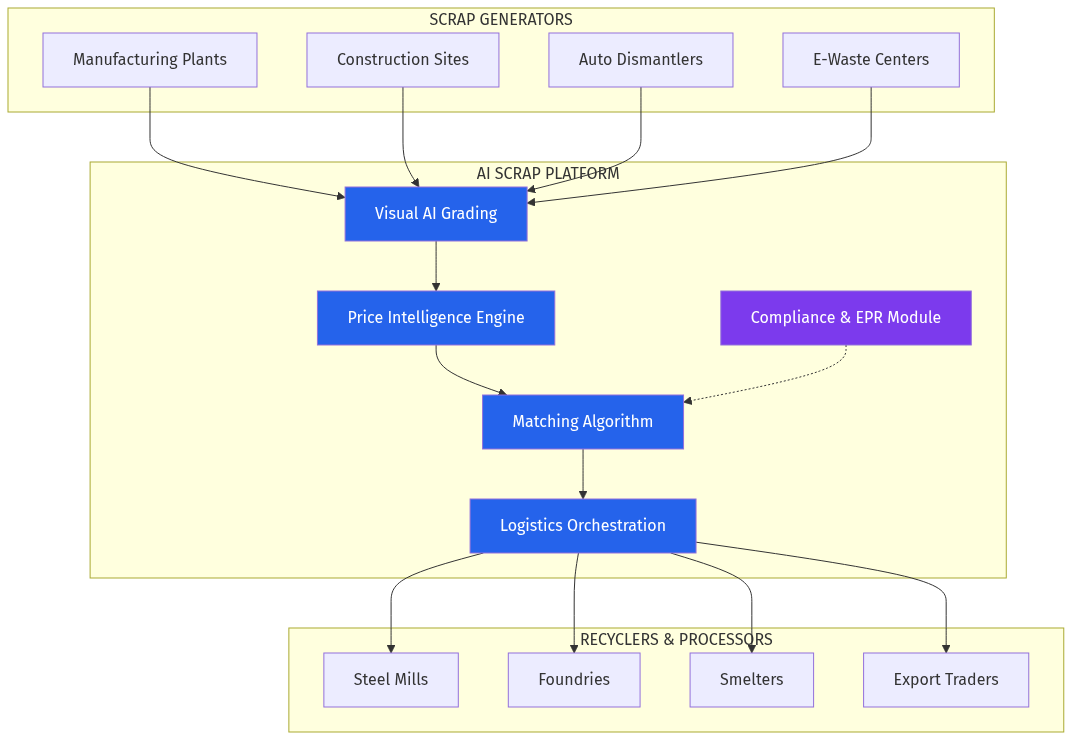
    Platform Architecture
    Platform Architecture

    AI Components

    1. Visual Grading AI
    • Upload photos of scrap pile
    • AI identifies: metal type, estimated grade, contamination level, approximate weight
    • Outputs a "Scrap Score" that buyers can trust
    • Training data: Partner with 5-10 scrap yards to label 50,000 images
    2. Price Intelligence Engine
    • Aggregates: LME prices, local transactions, dealer quotes, seasonal patterns
    • Generates: City-wise price index for 20+ scrap categories
    • Predicts: 7-day price direction with confidence intervals
    • Publishes: Daily price bulletin (free) to build authority
    3. Smart Matching Algorithm
    • Inputs: Scrap type, volume, location, timeline, price expectation
    • Outputs: Ranked list of buyers with match score
    • Factors: Historical reliability, payment speed, logistics capability, proximity
    4. Logistics Orchestration
    • Integrates with transport aggregators (BlackBuck, Rivigo, Porter)
    • Auto-arranges weighbridge, loading, and delivery
    • Real-time tracking with photo verification at each stage
    5. Compliance Module
    • Auto-generates EPR documentation
    • Tracks chain of custody
    • Flags hazardous materials for special handling
    • Creates audit-ready compliance reports

    Agent-to-Agent Future

    Applying Distant Domain Import from Financial Trading:

    In 5 years, large manufacturers won't have procurement teams calling dealers. Their ERP system will have an AI agent that:

  • Detects scrap accumulation from production data
  • Captures photos via factory cameras
  • Gets AI grading and price estimates
  • Negotiates with buyer agents within parameters
  • Arranges pickup and confirms payment
  • The human role shifts from transaction execution to relationship management and exception handling.


    7.

    Product Concept

    Core Platform: "ScrapIQ"

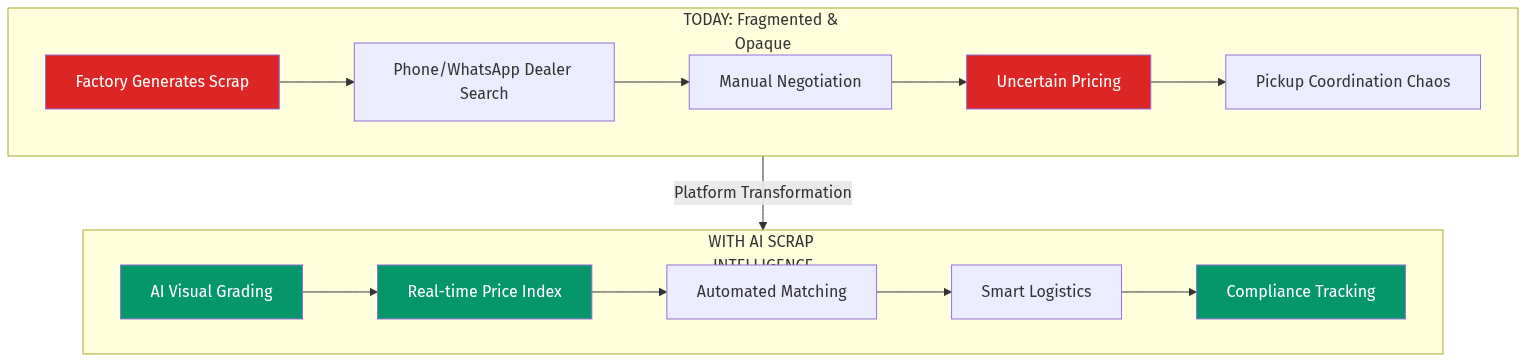
    Workflow Transformation
    Workflow Transformation

    For Scrap Generators (Factories)

    Mobile App Features:
    • Photo upload → instant AI grading
    • One-click "Get Quotes" from verified buyers
    • Price history and market trends
    • Digital compliance documentation
    • Payment tracking and receivables management

    For Dealers & Aggregators

    Dealer Dashboard:
    • Inventory management with visual tracking
    • Buy orders from platform matching
    • Route optimization for pickups
    • Cash flow forecasting
    • Credit line (based on platform transactions)

    For Steel Mills & Recyclers

    Procurement Portal:
    • Quality-assured supply matching needs
    • Volume contracts with dynamic pricing
    • Compliance verification for all inbound scrap
    • Supplier performance analytics
    • Carbon credit tracking for recycled content

    WhatsApp-First Interface

    The industry runs on WhatsApp. Don't fight it—embrace it.

    • Send photo → Get instant grade estimate
    • "Best price for 2 tons copper in Mumbai?" → Get top 3 quotes
    • Voice notes supported (transcribed by AI)
    • Dealers can respond to leads via WhatsApp
    ---

    8.

    Development Plan

    PhaseTimelineDeliverables
    MVP12 weeksVisual AI grading (5 metals), basic matching, WhatsApp bot
    V124 weeksPrice intelligence for 3 cities, dealer onboarding, compliance module
    V240 weeksLogistics integration, working capital pilot, mobile apps
    Scale52 weeksPan-India expansion, API for ERP integration, full compliance suite

    Technical Stack

    • Visual AI: Fine-tuned vision model (Qwen-VL or Claude Vision) + custom classifier
    • Price Engine: Time-series forecasting with LME correlation
    • Matching: Graph-based algorithm considering geography, history, capacity
    • Infrastructure: Edge processing for factory cameras, WhatsApp Business API

    9.

    Go-To-Market Strategy

    Phase 1: Build the Price Index (Months 1-6)

    This is the wedge. Publish a daily scrap price index for Mumbai, Delhi, Chennai.
    • Partner with 20 dealers to report transactions
    • Cross-reference with LME and trade publications
    • Make it free and widely shared
    • Build email list and WhatsApp broadcast
    Goal: Become the trusted price reference before launching the marketplace.

    Phase 2: Visual AI for Enterprise (Months 4-9)

    Target large manufacturers first:

    • Tata, JSW, Reliance, L&T construction sites
    • Offer visual AI grading as a service
    • No marketplace—just better price discovery for their existing dealers
    • Capture transaction data
    Goal: 50 enterprise accounts generating 10,000+ graded transactions monthly.

    Phase 3: Marketplace Launch (Months 9-15)

    • Open bidding on graded scrap
    • Onboard top-performing dealers from enterprise relationships
    • Commission model: 1.5-2% of transaction value
    • Payment escrow for trust

    Phase 4: Ecosystem Expansion (Months 15-24)

    • Working capital for dealers
    • Logistics integration
    • Compliance SaaS for mills
    • API for ERP integration

    10.

    Revenue Model

    Revenue StreamCommission/FeeYear 3 Potential
    Transaction Commission1.5-2% GMV₹15-20 Cr
    Price Intelligence SaaS₹50K-2L/month₹8 Cr
    Visual AI API₹5-10/grading₹3 Cr
    Working Capital (spread)2-3% annually₹5 Cr
    Compliance SaaS₹25K-1L/month₹4 Cr
    Logistics Commission5-8% of freight₹3 Cr
    GMV Target: ₹1,000 Cr by Year 3 (0.4% of market)
    11.

    Data Moat Potential

    Transaction Data

    Every trade builds the price model. After 100,000 transactions, the price intelligence becomes defensible.

    Visual Training Data

    Proprietary dataset of graded scrap images. No competitor can replicate without doing the same ground work.

    Relationship Graph

    Who buys from whom, payment patterns, reliability scores. This network intelligence compounds.

    Compliance Records

    Digital chain-of-custody for regulatory audits. Once mills rely on this, switching cost is high.
    12.

    Why This Fits AIM Ecosystem

    Direct Integration Points:
    AIM VerticalScrap Platform Connection
    thefoundry.inIndustrial suppliers generate scrap; procurement teams need disposal
    demo.aim.inManufacturing directory includes scrap generators
    challan.inCompliance tracking infrastructure shares DNA
    The AIM Flywheel:
  • Factories discovered via AIM generate scrap
  • Scrap platform creates another touchpoint
  • Transaction data improves manufacturing industry intelligence
  • Mills buying scrap are also selling finished steel

  • ## Risk Analysis (Pre-Mortem)

    Applying Falsification: Assume 5 well-funded startups failed here. Why?

    Failure Mode 1: Price Transparency Kills Margins

    Dealers might resist if price transparency erodes their edge. Counter: Position as "fair pricing for volume" not "lowest price always." Dealers win on reliability and service.

    Failure Mode 2: Visual AI Isn't Accurate Enough

    Metal grading requires expertise that AI can't replicate. Counter: Start with simpler categories (pure copper, steel, aluminum). Use AI as first-pass, human verification for disputes.

    Failure Mode 3: Regulatory Complexity Varies by State

    Scrap regulations differ across states, making compliance module hard to standardize. Counter: Start with 3 states, build regulatory partnerships.

    Failure Mode 4: Cash Economy Resists Digitization

    Much of scrap trading is cash-based for tax reasons. Counter: Focus on enterprise sellers first (who need GST invoices anyway). The formal economy is large enough.

    Failure Mode 5: Incumbents Copy and Distribute

    JSW or Tata could build this internally. Counter: They're steel producers, not marketplace operators. Build fast, own the data.

    ## Steelmanning the Incumbents

    Applying Perspective Simulation: Why might large scrap dealers win? The Case for Incumbents:
  • Relationships are the moat: Factory procurement heads trust their dealer of 20 years. Technology doesn't replace that overnight.
  • Working capital advantage: Big dealers can pay instantly. Platform escrow adds friction.
  • Quality expertise: A trained eye can spot contamination that cameras miss. AI grading has failure modes.
  • Logistics networks: Established dealers have trucks, warehouses, weighbridges. Asset-light platforms struggle with last-mile.
  • Regulatory capture: Large players often have relationships with pollution control boards.
  • Counter-Argument:

    These advantages hold for the top 5% of dealers. The long tail—thousands of small dealers and generators—have none of these. Start there. Build the data. Move upmarket.


    ## Verdict

    Opportunity Score: 8.5/10

    Why This Works

    FactorScoreRationale
    Market Size9/10$450B globally, $25B India, growing
    Fragmentation9/10Thousands of dealers, no dominant player
    AI Leverage8/10Visual grading, price prediction, matching—all high-value
    Timing8/10EPR regulations, EAF growth, WhatsApp API maturity
    Execution Risk7/10Needs ground game, not just tech
    Defensibility8/10Transaction data, visual training data, relationship graph

    The Bet

    The scrap metal industry has resisted digitization because existing players built businesses on information asymmetry. But that's not defensible against a platform that makes the market legible to all participants.

    The wedge is the price index. The moat is the data. The scale comes from being infrastructure, not just a marketplace.

    Recommendation: Build the price intelligence first. The marketplace follows.

    ## Sources

    • Wikipedia: Scrap Metal Industry Overview
    • Institute of Scrap Recycling Industries (ISRI) Annual Reports
    • Steel Recycling Institute - Industry Statistics
    • World Steel Association - Recycling Data
    • CPCB - E-Waste and Extended Producer Responsibility Guidelines
    • American Metal Market - Scrap Price Methodology
    • Industry interviews with Mumbai-based scrap dealers (Jan 2026)