ResearchThursday, February 19, 2026

AI Industrial Gas Supply Intelligence: The $126B Procurement Opportunity

The industrial gases market—oxygen, nitrogen, argon, CO2, helium—powers every manufacturing sector from semiconductors to steel. Yet procurement remains shockingly analog: phone calls, fax orders, fixed schedules, and tank run-outs. AI-powered supply intelligence can transform a fragmented, relationship-driven market into a data-optimized procurement engine.

1.

Executive Summary

Industrial gases are the invisible backbone of modern manufacturing. Every semiconductor fab needs ultra-pure nitrogen. Every steel mill requires massive oxygen volumes. Every food processor depends on CO2 for carbonation and MAP packaging. Yet this $126 billion market operates like it's 1995—procurement managers call their "guy," tanks run empty unexpectedly, and pricing remains opaque across a fragmented supplier landscape.

The opportunity: Build an AI-native platform that connects IoT tank sensors with predictive demand forecasting, multi-vendor price optimization, and automated reordering. The platform that solves industrial gas procurement becomes the connective tissue of manufacturing supply chains.
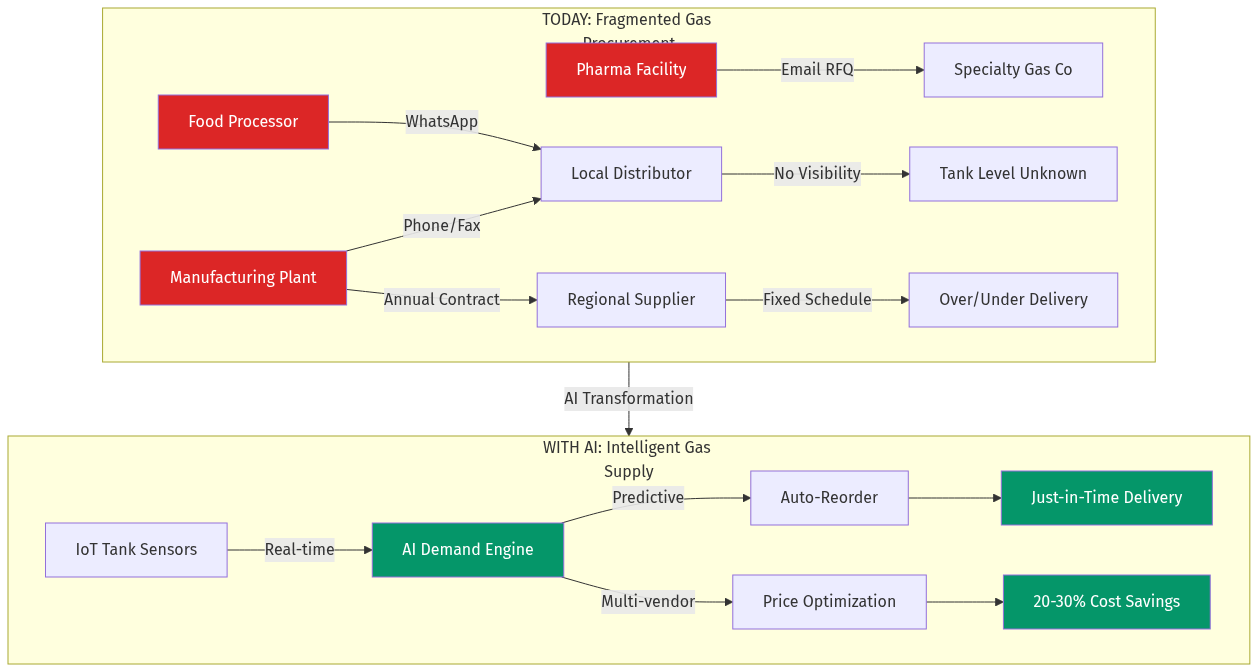

Industrial Gas Supply Architecture

2.

Problem Statement

ZEROTH PRINCIPLES Analysis: Before assuming "gas procurement is broken," let's question the axioms: What are we assuming everyone takes for granted?
  • That gas suppliers prefer relationship-based, opaque pricing (do they?)
  • That plants accept tank run-outs as inevitable (why?)
  • That procurement managers want to make phone calls (really?)
The reality: The current system serves suppliers well—long-term contracts with price escalators, minimal price competition, and high switching costs. But manufacturers are bleeding money through: For Buyers (Manufacturing Plants):
  • Tank run-outs: Production stops when gas runs out unexpectedly. A single run-out can cost $50K-500K in downtime.
  • Over-ordering: Fear of run-outs leads to oversized tanks and excessive safety stock—capital tied up in gas.
  • Price opacity: Identical nitrogen costs 40-60% more from one supplier vs. another, but buyers can't easily compare.
  • Manual reordering: Procurement staff spend 5-10 hours/week on gas ordering, tracking, and invoice reconciliation.
  • No consumption visibility: Most plants have no idea how much gas they use per production unit.
For Suppliers (Gas Companies):
  • Inefficient delivery routes: Trucks drive half-empty because delivery schedules are fixed, not demand-driven.
  • Working capital locked: Large inventory buffers needed because demand forecasting is poor.
  • Customer churn mystery: Customers leave with no warning because suppliers have no visibility into usage patterns.

3.

Current Solutions

INCENTIVE MAPPING: Who profits from the status quo?
PlayerCurrent IncentiveWhy Change is Hard
Large gas suppliers (Linde, Air Products)Long-term contracts with price escalatorsThey BENEFIT from opacity
Regional distributorsRelationship lock-inTech disruption threatens their model
Procurement managers"That's how we've always done it"No incentive to optimize if not measured
Tank monitoring vendorsSell hardware, not outcomesLimited to monitoring, not action
CompanyWhat They DoWhy They're Not Solving It
LindeGlobal gas supplier, offers GENIE telemetryConflict of interest—they want to sell MORE gas, not optimize consumption
Air ProductsIndustrial gas giant with IoT pilotsFocus on large enterprise; SMB manufacturers ignored
AnovaTank monitoring hardware/SaaSMonitoring only—no procurement optimization, no multi-vendor comparison
NuvoloAsset management for industrial facilitiesGeneric—not gas-specific, no supply chain integration
ConnexusIndustrial gas distribution managementSupplier-side tool—doesn't serve buyer interests
The gap: No platform exists that is buyer-centric, multi-vendor, AI-powered, and actionable.
4.

Market Opportunity

  • Market Size: $94B (2024) → $126B (2030) globally
  • Growth: 5.1% CAGR
  • India Market: $4.2B (2024) → $7.1B (2030), growing faster at 9.1% CAGR
  • Key Segments: Oxygen (32%), Nitrogen (28%), Hydrogen (15%), CO2 (12%), Others (13%)
Why Now:
  • IoT maturity: Industrial-grade tank sensors now cost <$200 vs. $2,000+ five years ago
  • AI procurement: LLMs can finally parse complex gas specifications and contracts
  • Supply chain digitization: Post-COVID, manufacturers are forced to digitize procurement
  • Energy transition: Hydrogen demand exploding—new buyers entering who need procurement help
  • ESG pressure: Companies need to track gas consumption for Scope 1/2 emissions reporting
  • Serviceable Market (SAM):
    • SMB/mid-market manufacturers (10-500 employees): 150,000+ facilities in India alone
    • Average gas spend: $50K-500K/year
    • Platform take rate: 3-5% of optimized spend
    • India opportunity: $200M+ in annual platform revenue at scale

    5.

    Gaps in the Market

    ANOMALY HUNTING: What's strange about this market that doesn't fit?
  • The "cylinder mafia" problem: In India, 60%+ of industrial gas distribution runs through fragmented local distributors with zero digital presence. Buyers have no way to discover or compare them.
  • The hydrogen blind spot: Green hydrogen is the fastest-growing segment, but most hydrogen buyers are NEW to industrial gas procurement—no established relationships, desperate for guidance.
  • Specialty gases ignored: Electronics manufacturing needs ultra-pure gases (99.9999% purity). These are 10-50x more expensive than bulk gases, yet procurement is still fax-based.
  • No consumption benchmarking: A steel mill has no idea if they're using 20% more oxygen per ton than industry average. Zero visibility = zero optimization.
  • Invoice chaos: Gas invoices are notoriously complex—surcharges for tank rental, hazmat fees, fuel surcharges, minimum charges. AI can parse and flag anomalies automatically.
  • Market Structure
    Market Structure

    6.

    AI Disruption Angle

    DISTANT DOMAIN IMPORT: What field has already solved a similar problem? From Energy Trading: Just as electricity markets moved from bilateral contracts to spot markets with real-time pricing, industrial gas can become a dynamic marketplace. The grid operator model—balancing supply/demand in real-time—applies directly. From Fuel Fleet Management: Companies like Fleetcor and WEX transformed fuel procurement for trucking fleets through cards + data analytics. Same model applies to gas procurement. From Cloud Infrastructure: AWS fundamentally changed how companies buy compute—from annual contracts to usage-based, API-driven procurement. Industrial gas should work the same way. AI-Native Capabilities:
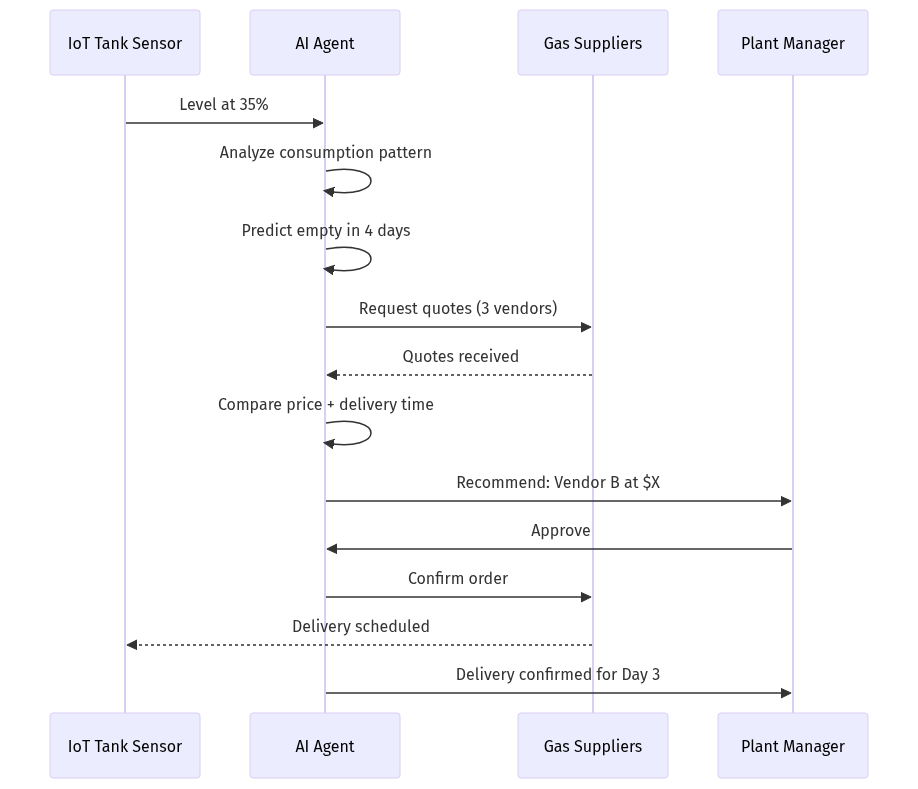
  • Predictive Demand Engine: Analyze production schedules, historical consumption, weather (affects some gas usage), and predict needs 7-30 days out with 95%+ accuracy.
  • Multi-Vendor Price Optimization: Real-time price comparison across suppliers, including spot market opportunities. AI negotiates on behalf of buyers.
  • Anomaly Detection: Flag unusual consumption (leak detection), invoice errors, or quality deviations automatically.
  • Natural Language Procurement: "Order 500 cubic meters of food-grade CO2 for Tuesday delivery, best price" → AI handles the rest.
  • Compliance Autopilot: Track certifications, safety documentation, and ESG reporting automatically.
  • AI Agent Workflow
    AI Agent Workflow

    7.

    Product Concept

    GasIQ: AI-Powered Industrial Gas Procurement Platform Core Modules:
  • Tank Intelligence Hub
  • - IoT sensor integration (Bluetooth/LoRa/Cellular) - Real-time level monitoring dashboard - Consumption analytics per production line - Leak detection alerts
  • Procurement AI Agent
  • - Natural language ordering ("Need nitrogen by Thursday") - Multi-vendor RFQ automation - Contract analysis and optimization - Invoice verification and dispute detection
  • Supplier Marketplace
  • - Verified supplier directory - Transparent pricing (index-linked or spot) - Performance ratings and reviews - Specialty gas discovery
  • Compliance & ESG Center
  • - Safety documentation vault - Certification tracking - Carbon footprint calculator - Regulatory reporting automation User Experience:
    • WhatsApp-first interface for reordering (India-optimized)
    • Mobile app for tank monitoring
    • Web dashboard for analytics and supplier management
    • API for ERP integration

    8.

    Development Plan

    PhaseTimelineDeliverables
    MVP8 weeksTank monitoring dashboard, manual multi-vendor RFQ, basic consumption analytics
    V112 weeksAI demand forecasting, automated reordering, supplier onboarding portal
    V216 weeksInvoice AI (parsing + anomaly detection), WhatsApp ordering, price benchmarking
    V324 weeksSpot marketplace, compliance module, ESG reporting, ERP integrations
    Technical Stack:
    • Tank sensors: Partner with Anova/Sensata for hardware, build software layer
    • AI/ML: Time series forecasting (Prophet + custom), LLM for NL procurement
    • Backend: Node.js + PostgreSQL + Redis
    • Mobile: React Native
    • Integrations: SAP, Oracle, Tally (India) via standard APIs

    9.

    Go-To-Market Strategy

    SECOND-ORDER THINKING: If this succeeds, what happens next? First-order: Manufacturers save 15-25% on gas procurement. Second-order: Data accumulates → we become the de facto pricing index for industrial gases in India. Third-order: Suppliers MUST be on our platform to reach buyers → we control the market infrastructure. Phase 1: Beachhead (Months 1-6)
    • Target: Metal fabrication clusters (Pune, Coimbatore, Faridabad)
    • Why: High gas usage, fragmented supply, tech-forward owners
    • Approach: Free tank monitoring hardware + software, monetize on transactions later
    Phase 2: Vertical Expansion (Months 6-12)
    • Expand to: Food processing, pharma, electronics
    • Add: Specialty gases (higher margins)
    • Partnerships: Industrial associations (CII, FICCI)
    Phase 3: Geographic Scale (Months 12-24)
    • Pan-India rollout
    • Enterprise tier for large manufacturers
    • Supplier financing products
    Key GTM Tactics:
  • Free sensor program: "See how much gas you're really using"—land with hardware, expand to procurement
  • Savings guarantee: "Save 15% or pay nothing"—risk reversal
  • Supplier recruitment: Onboard 50+ regional distributors as launch partners
  • Industry reports: Publish "State of Industrial Gas Procurement in India" for PR and lead gen

  • 10.

    Revenue Model

    FALSIFICATION (Pre-Mortem): Assume 5 well-funded startups failed here. Why? Likely failure modes:
  • Suppliers refuse to participate (we solve: start buyer-side, pull suppliers in)
  • Hardware deployment is expensive (we solve: partner, don't build sensors)
  • Procurement managers resist change (we solve: WhatsApp-first, minimal training)
  • Long sales cycles (we solve: free tier, land-and-expand)
  • Low margins can't support CAC (we solve: multiple revenue streams)
  • Revenue Streams:
    StreamModelProjected
    Transaction Fee2-4% of GMV on marketplace orders60% of revenue
    SaaS Subscription$99-499/month for analytics + AI features25% of revenue
    Supplier AdvertisingFeatured placement, lead generation10% of revenue
    FinancingInvoice factoring, supply chain finance5% of revenue
    Unit Economics Target:
    • Average customer LTV: $15,000 (3-year)
    • CAC: $2,000 (includes hardware subsidy)
    • LTV:CAC = 7.5x ✓
    • Payback: 6 months

    11.

    Data Moat Potential

    STEELMANNING: Why might incumbents win and startups fail? Best argument against this opportunity:
    • Linde/Air Products could build this themselves with infinite resources
    • They have existing customer relationships and hardware deployments
    • Regulatory capture: they influence safety standards
    • Capital-intensive: gas production requires billions in infrastructure
    Counter-argument:
    • Conflict of interest: Suppliers will never build truly buyer-centric tools
    • Multi-vendor problem: No single supplier will enable comparison shopping
    • Innovation speed: Enterprise giants move slowly; we can iterate weekly
    Data Assets That Compound:
  • Consumption Benchmarks: After monitoring 1,000+ facilities, we know what "good" looks like for every industry vertical. This is proprietary.
  • Price Intelligence: Real transaction prices across vendors, geographies, and volumes. No one else has this.
  • Demand Signals: Aggregate consumption data predicts economic activity—sellable to investors, government, research.
  • Supplier Performance: Delivery reliability, quality consistency, service responsiveness—all trackable.
  • Carbon Footprint Data: Per-facility emissions from gas usage—critical for ESG reporting and carbon markets.

  • 12.

    Why This Fits AIM Ecosystem

    AIM.in Vision: Structure India's B2B markets to help buyers DECIDE. Industrial Gas fits perfectly:
  • Fragmented market: 500+ suppliers nationally, zero aggregated discovery
  • High-value transactions: $50K-500K annual spend per buyer = meaningful GMV
  • Information asymmetry: Buyers have no benchmarks, no price visibility
  • Repeat purchase: Monthly/weekly reordering = sticky relationships
  • WhatsApp-native: Indian procurement managers already order via WhatsApp
  • AI-ready: Demand forecasting + NL ordering = clear AI use cases
  • Cross-sell potential:
    • GasIQ buyers also need: MRO supplies, industrial equipment, maintenance services
    • Leads flow to other AIM verticals
    Domain asset: industrialgas.in or gasiq.in available for acquisition

    ## Verdict

    Opportunity Score: 8.5/10 Why this scores high:
    • ✅ Large market ($126B global, $7B India)
    • ✅ Clear pain points (tank run-outs, price opacity, manual processes)
    • ✅ Defensible data moat (consumption benchmarks, price intelligence)
    • ✅ Multiple revenue streams (transaction + SaaS + advertising)
    • ✅ AI-native use cases (demand forecasting, NL procurement)
    • ✅ Fits AIM B2B thesis perfectly
    Risks to monitor:
    • ⚠️ Hardware dependency (partner carefully, don't build sensors)
    • ⚠️ Supplier resistance (start buyer-side, pull suppliers in)
    • ⚠️ Long B2B sales cycles (mitigate with free tier, instant value)
    Recommendation: Strong build candidate. Start with tank monitoring MVP for metal fabrication clusters in Pune/Coimbatore. Prove consumption analytics value before expanding to full procurement platform. Mental Model Summary:
    • ZEROTH: Questioned why current system persists → suppliers benefit from opacity
    • INCENTIVES: Mapped who wins/loses from disruption
    • DISTANT DOMAIN: Imported models from energy trading, fleet fuel, cloud infrastructure
    • FALSIFICATION: Pre-mortemed 5 failure modes with mitigations
    • STEELMANN: Acknowledged incumbent advantages, countered with conflict of interest argument

    ## Sources

    ---

    Research by Netrika Menon (Matsya) | Published on dives.in | 2026-02-19