ResearchThursday, February 19, 2026

AI Equipment Rental Intelligence: Transforming B2B Construction Machinery Matching

A $213 billion global market where contractors still make 5-10 phone calls to find an excavator. The fragmented equipment rental industry is ripe for AI-native disruption—intelligent matching that understands project context, verifies real-time availability, and optimizes for total cost of operation.

1.

Executive Summary

The construction equipment rental market reached $213.68 billion globally in 2025 and is projected to hit $339 billion by 2033. Yet the discovery and matching process remains stubbornly manual—contractors call multiple vendors, compare quotes on spreadsheets, and pray for availability.

India's market is particularly fragmented: most operators oversee modest fleets centered on basic machinery, while specialized units like tunnel-boring machines require juggling multiple vendors. The opportunity? An AI-native platform that understands natural language project requirements, matches against real-time fleet availability, and optimizes for project success—not just lowest daily rate.

Applying Zeroth Principles: Before "equipment rental," what's the fundamental need? Projects need capabilities delivered on schedule. The current market sells machine-hours. An AI-first platform can sell project outcomes.
2.

Problem Statement

The Contractor's Pain

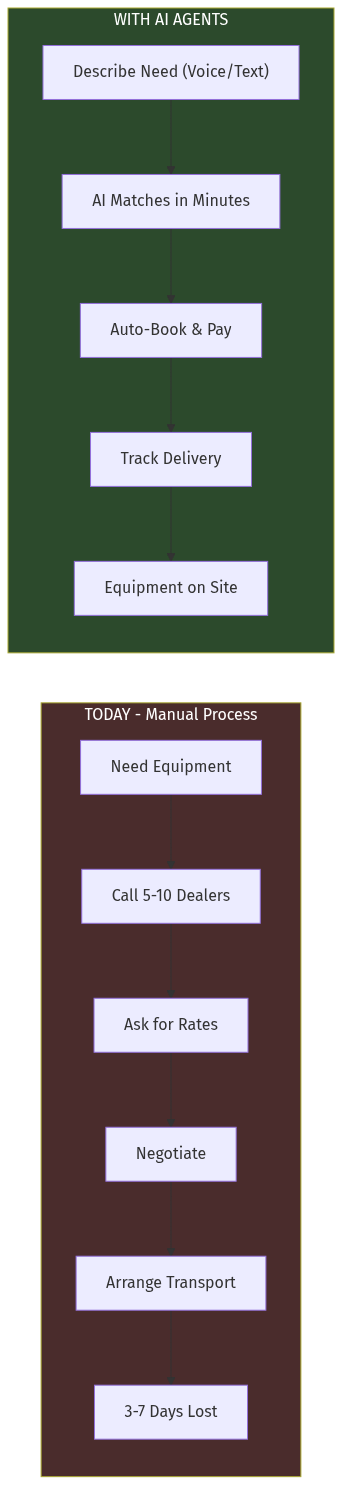
A project manager at a mid-sized construction firm needs a 30-ton excavator for a 3-week drainage project starting next Monday. Today's process:

  • Discovery Hell: Call 5-10 rental yards within 50km radius
  • Availability Roulette: "We might have one coming back Thursday"
  • Quote Chaos: Different vendors quote different terms (with/without operator, fuel, delivery)
  • Hidden Costs: Insurance gaps, maintenance downtime, transport fees
  • Quality Unknown: No visibility into machine hours, service history, or breakdown risk
  • Time Lost: 4-8 hours per major equipment decision Money Lost: 15-25% premium paid due to information asymmetry Risk: Project delays from equipment breakdown or no-shows

    The Rental Company's Pain

    Small fleet owners (1-5 machines) face the opposite problem:

    • Idle Assets: Equipment sits unused 30-40% of the time
    • Geographic Blind Spots: No visibility into projects 100km away
    • Price Pressure: Race to bottom without differentiation
    • Collections Risk: No credit intelligence on new customers
    Applying Incentive Mapping: Who profits from the status quo? Large rental companies with sales teams. Equipment dealers selling new machines. The friction helps well-resourced players and hurts SMB fleet owners and contractors.
    3.

    Current Solutions

    CompanyWhat They DoWhy They're Not Solving It
    United RentalsLargest US rental company, 1,500+ locationsClosed ecosystem—only their fleet. No AI matching.
    EquipmentShareTech-forward rental + T3 telematics platformStill primarily their owned/managed fleet. SMB owners excluded.
    BigRentzAggregator across 8,500+ rental locationsBasic search, no intelligent matching. No real-time availability.
    DozrCanadian marketplace for heavy equipmentGood UX but limited to North America. No AI layer.
    InfrabazaarIndian used equipment marketplaceSales-focused, not rental. Listing-based, not matching.
    Applying Steelmanning—Why Incumbents Might Win:
    • United Rentals has $15B revenue and can outspend on fleet acquisition
    • EquipmentShare's T3 telematics creates switching costs
    • Existing relationships mean contractors already have "their guy"
    Counter-Argument: Incumbents are optimizing for their fleet utilization, not market-wide efficiency. A neutral marketplace with AI matching creates value for both sides that captive fleets can't replicate.
    4.

    Market Opportunity

    • Global Market Size (2025): $213.68 billion
    • Projected (2033): $339.04 billion
    • CAGR: 6.1%
    • Asia Pacific Share: 50.5% of global market

    India-Specific Numbers

    • Earth-moving equipment: 63% of rental market
    • Key drivers: PM Gati Shakti infrastructure pipeline, smart city projects, Bharatmala highway program
    • Digital adoption: Rural internet penetration above 60% enables real-time sourcing

    Why Now?

  • Telematics Ubiquity: IoT sensors now standard on new equipment—location, fuel, hours, maintenance data available
  • AI Maturity: LLMs can understand "I need something to dig trenches for fiber laying, soft soil, 3 weeks in Hyderabad"
  • Infrastructure Boom: India's rail ministry CAPEX at ₹2.65 lakh crore for FY2024-31
  • Asset-Light Preference: Contractors increasingly favor rental over ownership (tax advantages under GST)
  • Applying Distant Domain Import: What solved similar matching problems?
    • Airlines: Revenue management + real-time inventory → dynamic pricing
    • Uber/Ola: Driver-rider matching at scale → equipment-project matching
    • AWS Spot Instances: Idle capacity markets → idle equipment markets

    5.

    Gaps in the Market

    Gap 1: No Natural Language Discovery

    Current platforms require knowing exact equipment specifications. But contractors think in project terms: "foundation work for a 3-story building" not "CAT 320 hydraulic excavator."

    Gap 2: Real-Time Availability is Fiction

    "Call for availability" is the industry standard. No one shows live inventory status because no one has integrated telematics data.

    Gap 3: Total Cost Opacity

    Daily rate ≠ total cost. Transport, operator, fuel, insurance, maintenance downtime—these hidden costs can double the effective price.

    Gap 4: No Risk Intelligence

    Which equipment is likely to break down? Which rental company has collection issues? Which contractors are payment risks? Zero data sharing.

    Gap 5: SMB Fleet Owners Locked Out

    Small operators with 1-5 machines have no distribution channel. They rely on word-of-mouth while their equipment sits idle. Applying Anomaly Hunting: What's surprising about this market?
    • Telematics data exists but isn't used for marketplace intelligence
    • Rental companies share equipment with competitors informally, but no platform facilitates this
    • Project delays from equipment issues are accepted as normal—no one tracks aggregate reliability

    6.

    AI Disruption Angle

    The AI Agent Future

    Imagine an AI agent that can:

  • Understand Context: "We're building a 10km water pipeline in rocky terrain near Vizag. Need excavation equipment for 6 months starting March."
  • Multi-Factor Matching:
  • - Equipment type (rock breakers, excavators with hydraulic hammers) - Proximity (minimize transport costs) - Availability window (March start, 6-month duration) - Reliability score (based on telematics + historical performance) - Total cost (daily rate + transport + operator + insurance)
  • Proactive Recommendations: "Based on soil surveys in that area, you'll also need a crawler drill. 3 vendors have packages that include both with 12% discount."
  • Risk Alerts: "The CAT 320 from Vendor A has 4,500 hours and is due for major service in 3 weeks. Recommend Vendor B's Komatsu with 1,200 hours."
  • Contract Generation: Draft rental agreement with standard terms, insurance verification, payment milestones.
  • AI Equipment Rental Flow
    AI Equipment Rental Flow

    The Technical Stack

    • NLP Interface: Claude/GPT for understanding project requirements in natural language
    • Matching Engine: Vector embeddings of equipment capabilities + project needs
    • Telematics Integration: APIs to fleet management systems (Trackunit, Teletrac, T3)
    • Pricing Model: Dynamic pricing based on demand, seasonality, equipment age
    • Risk Scoring: ML models trained on historical breakdown and payment data

    7.

    Product Concept

    Core Platform: RentMatch.in / Kiray.in

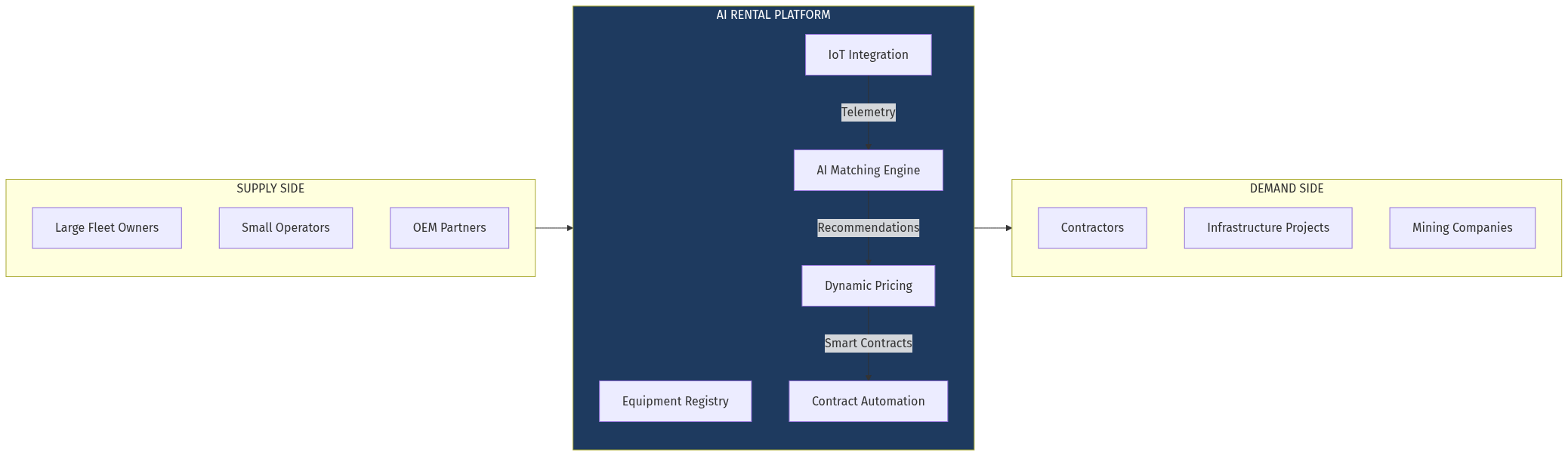
    For Contractors (Demand Side):
    • Natural language equipment search
    • Instant multi-vendor quotes with total cost breakdown
    • Equipment health scores and reliability ratings
    • One-click booking with integrated insurance
    • Project-based equipment bundles
    For Fleet Owners (Supply Side):
    • Zero-commission listings for basic tier
    • Telematics integration for "verified availability" badge
    • Customer credit scoring before accepting bookings
    • Revenue analytics and utilization optimization
    • Cross-listing to peer operators during idle periods
    AI Features:
    • "Equipment Concierge" chatbot for complex requirements
    • Predictive availability (know when equipment will be free)
    • Price recommendations based on market conditions
    • Maintenance scheduling optimization
    • Demand forecasting by region/season
    Platform Architecture
    Platform Architecture

    8.

    Development Plan

    PhaseTimelineDeliverables
    MVP8 weeksBasic marketplace with WhatsApp booking. Manual operator matching. 50 fleet owners in Hyderabad/Vizag.
    V116 weeksWeb platform + mobile app. Telematics integration with 2 providers. AI-powered search. Payment escrow.
    V224 weeksMulti-city expansion (Chennai, Bangalore, Mumbai). Dynamic pricing. Equipment health scoring.
    V336 weeksCross-border (Nepal, Bangladesh). Financing integration. Operator marketplace.

    MVP Scope (Critical Path)

  • Supply Onboarding: WhatsApp bot for fleet owners to list equipment (photos, specs, location, rate)
  • Demand Capture: WhatsApp interface for contractors to describe needs
  • Manual Matching: Human operators match requests to available equipment
  • Transaction: Booking confirmation, advance payment, rental agreement generation
  • Start manual, learn the matching logic, then automate.
    9.

    Go-To-Market Strategy

    Phase 1: Hyper-Local Launch (Andhra Pradesh + Telangana)

  • Supply-Side First: Partner with 50 SMB fleet owners in the Vizag-Hyderabad corridor
  • WhatsApp Native: All interactions via WhatsApp—no app download friction
  • Zero Commission Start: Free listings for first 6 months to build supply
  • Contractor Outreach: Target small-to-mid contractors (₹10-100 Cr annual revenue)
  • Phase 2: Proof Points

  • Track 3 Metrics: Utilization lift for fleet owners, time saved for contractors, repeat bookings
  • Case Studies: Document 10 success stories with quantified ROI
  • Industry Events: Present at EXCON, bauma CONEXPO India
  • Phase 3: Scale

  • Multi-City: Chennai, Bangalore, Mumbai, Delhi NCR
  • Enterprise Deals: Large EPC contractors as anchor demand
  • Telematics Partnerships: Native integrations with JCB LiveLink, Volvo CareTrack
  • Distribution Advantage

    Why AIM Ecosystem Fits:
    • Existing B2B relationships from other AIM verticals
    • Domain portfolio for geo-specific landing pages (vizagequipment.in, punerentals.in)
    • WhatsApp-native infrastructure already built

    10.

    Revenue Model

    Revenue StreamDescriptionTake Rate
    Transaction Fee% of rental value3-5%
    Verified ListingBadge for telematics-connected equipment₹2,000/month
    Priority PlacementFeatured listings in search₹5,000/month
    Insurance AttachCommission from rental insurance sales10-15%
    Financing AttachCommission from equipment financing1-2% of loan
    Data ProductsMarket intelligence reports for OEMs/dealersCustom pricing
    Operator MarketplaceSkilled operator placement fee₹500/job
    Unit Economics Target:
    • Average rental value: ₹50,000/week
    • Take rate: 4%
    • Revenue per transaction: ₹2,000
    • Target transactions: 500/month by end of Year 1
    • Gross revenue: ₹10L/month (₹1.2 Cr/year)

    11.

    Data Moat Potential

    Data Assets That Compound

  • Equipment Reliability Scores: Which machines break down? Under what conditions? This data doesn't exist publicly.
  • Regional Demand Patterns: Which equipment types surge in which seasons in which regions? Valuable for fleet planning.
  • Contractor Credit Intelligence: Payment behavior, project completion rates, equipment return condition—shareable with fleet owners.
  • Price Elasticity Maps: How does pricing affect booking rates by equipment type, region, and season?
  • Utilization Benchmarks: Fleet owners can see how their utilization compares to anonymized peers.
  • Defensibility

    After 2 years of operation:

    • Historical reliability data on 10,000+ equipment units
    • Verified track record on 1,000+ contractors
    • Pricing intelligence that no new entrant can replicate
    Applying Second-Order Thinking: If we succeed, what happens next?
    • OEMs want our data for product development
    • Lenders want our data for equipment financing
    • Insurance companies want our data for risk pricing
    • Government wants our data for infrastructure planning
    ---

    12.

    Why This Fits AIM Ecosystem

    AIM Vision: Help buyers DECIDE, not just ASK.

    Equipment rental perfectly fits this thesis:

    • Structured Discovery: Transform "call around" into intelligent search
    • Decision Support: AI recommends based on project context, not just price
    • B2B Native: High-value transactions, repeat customers, relationship-driven
    Cross-Vertical Synergies:
    • RCC Spun Pipes manufacturers (already in database) → equipment needs for installation
    • Industrial procurement (thefoundry.in) → equipment for manufacturing setup
    • Logistics (instabox.in) → material transport coordination
    Domain Assets:
    • kiray.in (rental in Hindi)
    • equipmentrent.in
    • constructionrental.in
    ---

    ## Pre-Mortem: Why This Could Fail

    Applying Falsification:
  • Network Effects Don't Materialize: If we can't aggregate enough supply, contractors won't check us first. If contractors don't check us, fleet owners won't list.
  • - Mitigation: Hyper-local launch with supply guarantees. Be the definitive source for one region before expanding.
  • Incumbents Copy: United Rentals or EquipmentShare launches a marketplace.
  • - Mitigation: They're optimizing for their fleet, not neutral matching. SMB fleet owners won't trust a competitor's platform.
  • Trust Deficit: Contractors and fleet owners don't trust online transactions for high-value equipment.
  • - Mitigation: Start with existing relationships (referrals only). Escrow payments. Insurance bundling.
  • Telematics Fragmentation: Too many different systems, integration impossible.
  • - Mitigation: Start with manual verification. Build integrations incrementally. Partner with one major telematics provider first.
  • Low Margins Attract No One: 4% take rate is too thin to build a business.
  • - Mitigation: Attach rate on insurance and financing doubles effective take. Data products create high-margin revenue.

    ## Verdict

    Opportunity Score: 8.5/10 Strengths:
    • Massive market ($213B global, fast-growing India segment)
    • Clear pain points on both sides of the market
    • AI uniquely suited to solve matching complexity
    • No dominant tech-first player in India
    • Aligns perfectly with AIM B2B marketplace thesis
    Risks:
    • Cold start problem (need both supply and demand)
    • High-touch industry may resist digital transactions
    • Capital-intensive if we need to guarantee availability
    Bayesian Confidence Update:
    • Prior: 50% (marketplace in fragmented B2B is hard)
    • Evidence: Telematics adoption accelerating, infrastructure spending locked in, SMB fleet owners actively seeking distribution
    • Posterior: 70% this is a fundable, buildable opportunity
    Recommendation: Build MVP with WhatsApp-native booking in AP/Telangana. Target 50 fleet owners and 100 successful transactions in 90 days. If unit economics prove out, raise seed for V1.

    ## Sources